On the morning of September 19, 2023, Azerbaijani troops launched an offensive against the remnants of Karabakh, where Armenians were still living. Over the next couple of weeks, almost all of them left for Armenia along the long serpentine road known as the Lachin Corridor. And like almost everything in the Karabakh conflict, this event received two names. “Ethnic cleansing”, according to the Armenian side, and “voluntary resettlement”, according to the Azerbaijani side. The sight of a hundred thousand people leaving their homes forever shocked many. But for the external audience, the shock was short-lived. Azerbaijan managed so quickly to convince everyone that what was happening was normal and natural that the topic disappeared from the agenda. It was also in Russia’s interest to sweep everything under the rug so that no one would ask an uncomfortable question. The only thing left now is to make sense of what happened and not allow propaganda myths to take root.
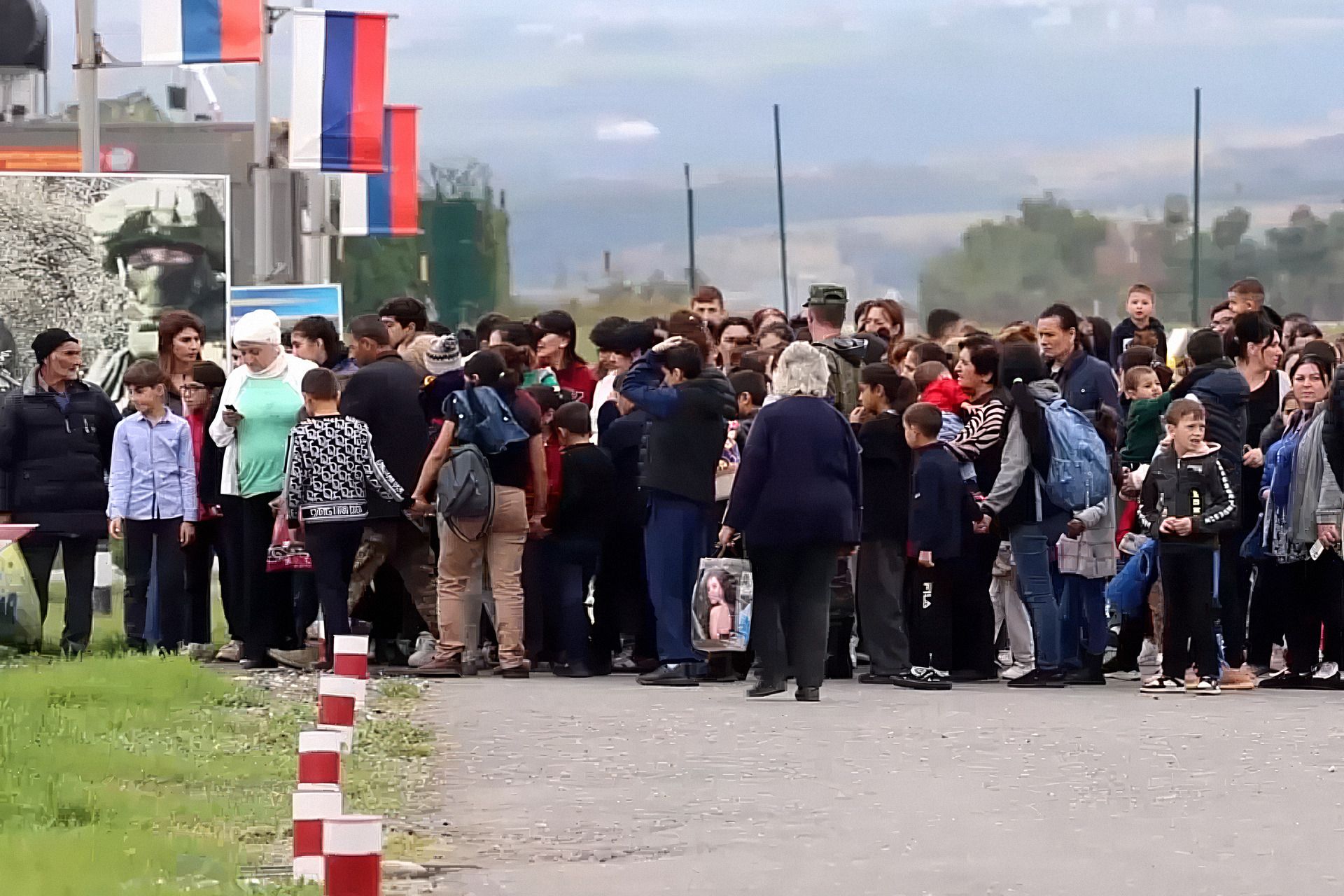
Ethnic Armenians of Nagorno-Karabakh, evacuated from their homes due to attacks by the Azerbaijani armed forces, seek refuge with Russian peacekeepers, September 21, 2023. Photo: Wikipedia / Mil.ru / CC BY 4.0
Talking about the Armenian-Azerbaijani conflict with someone unprepared is very difficult. Probably as difficult as talking about the Israeli-Palestinian one, which, fortunately, I do not deal with. People who are not directly tied to either side build their convictions on frankly weak foundations and fleeting sympathies. At the same time, few are ready to wave it off and say they do not care at all. People want to sympathize with someone, but do not want to dive very deeply into the events and details.
This makes internet discussions on the subject something like two neural networks talking to each other. The sides throw long-known arguments back and forth. Sometimes they are based simply on fear (“there could have been a real genocide there”), sometimes on half-truths from the media and social networks (“they refused to agree to peaceful coexistence”), sometimes on an argument that has nothing to do with the conflict at all (“but they always supported us, that is already enough”).
Both in Armenia and in Azerbaijan, I was accused of working for the opposing side. In reality, I was simply listening to people on both sides and sympathizing with them as much as I could. And with the Azerbaijanis who were driven out of the towns and villages of Karabakh (and also from the districts around it and even from Armenia itself) in 1992-1994. And with the Armenians who left Azerbaijan en masse even earlier — starting in 1990. And with those who were forced to leave their homes just now — in 2023. And even if these people considered someone else’s home their own (that happened too — in the 1990s Armenians occupied Azerbaijani houses or dismantled them for building materials), with the passage of years that loses its significance. Even today’s forty-year-olds were still children during the First Karabakh War. Which means they are in no way responsible for where their parents brought them.
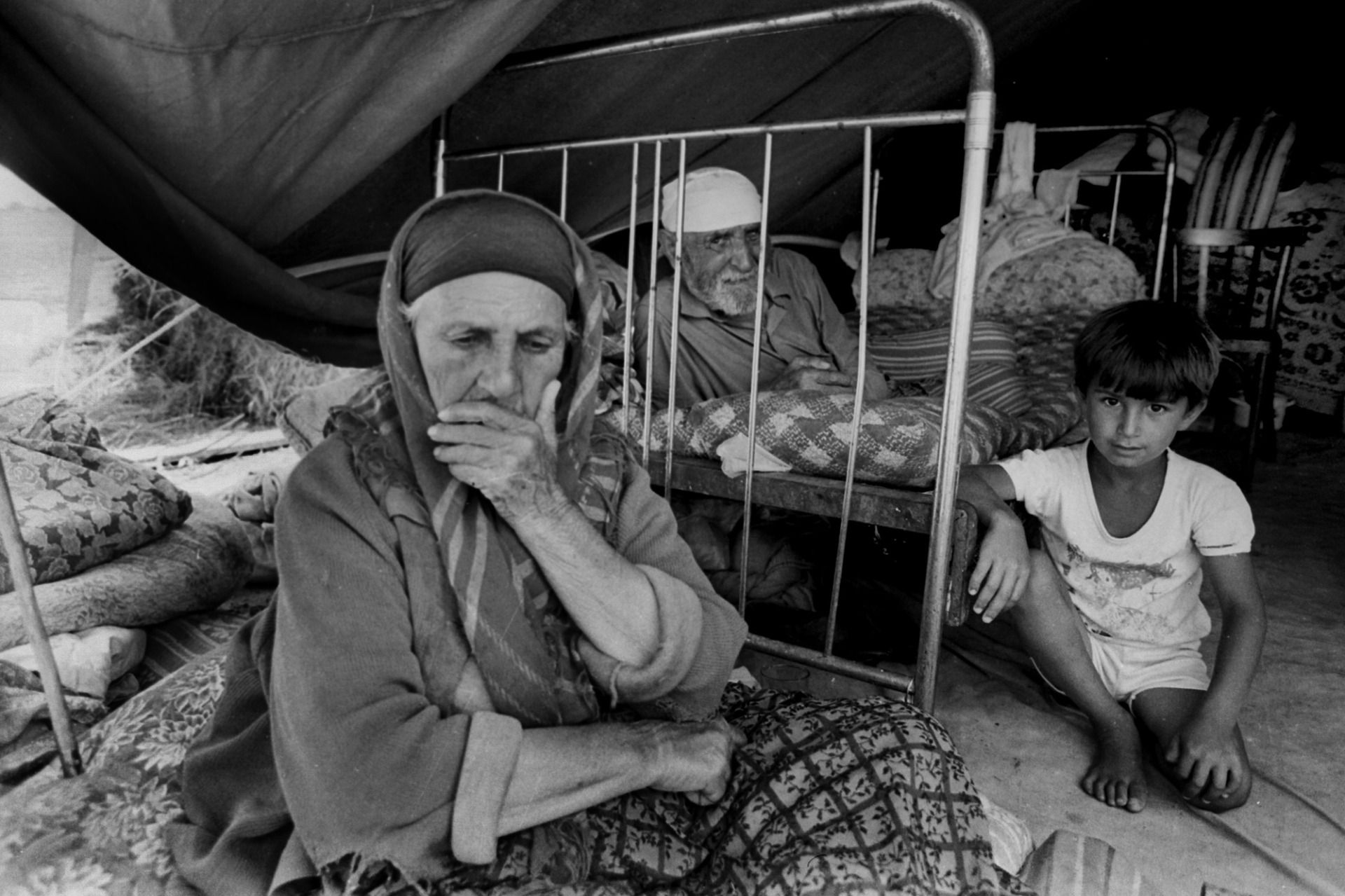
Azerbaijani refugees in Aghdam, 1993. Photo: Wikipedia / Ilgar Jafarov / CC BY-SA 4.0
That is why I want to offer myself as your guide through the labyrinth of statements, comments, and events from three years ago (a little more than that — but do not worry, we will not get to Noah). All of them brought tragedy closer, and it will continue to hurt for a long time. But on the other hand, important lessons must be drawn from it. For example, what priorities politicians set in critical situations and how propaganda can deceive you.
The Time of Empty Hopes
I suggest taking November 2020 as the starting point of our conversation. Then Armenia and the unrecognized Republic of Artsakh together lost the 44-day war to Azerbaijan. In Baku, of course, such a formulation would be condemned. From their point of view, they had only one enemy — the Armenian occupation forces. And indeed, Armenian conscripts officially served on Karabakh territory, and about half the budget consisted of an “interstate loan” from Yerevan. De facto, this was financing. It continued after that war too — in 2022 and even in 2023.
And yet it was precisely then, after 2020, that the difference between Yerevan and Stepanakert began to show more and more. It was a strange and therefore very interesting time. On the one hand, the Armenian and Artsakh authorities continued to meet regularly and hold meetings. On the other hand, everyone fully understood that there was no chance of preserving the republic in its former form. Even the peacekeepers, who were supposedly supposed to ensure the security of the Armenian population (because there was simply no Azerbaijani population in their area of control), were theoretically supposed to facilitate the soft integration of Karabakh Armenians into the Azerbaijani state.
What is this claim based on? Indeed, I cannot show you a single document where this is stated. But it was already clear from the mechanism for extending their mission that they would have to cater to Baku. It could be terminated at the request of one side if it notified the other six months in advance. No one expected this from the Armenian side, but from the Azerbaijani side — very much so.
When the Russian peacekeepers were just entering Karabakh, no one really understood what life would look like next. But they really did fit into the system built by the Armenians.
The authorities led by President Arayik Harutyunyan remained in place and maintained working contacts with the Russians. When I first noted this two days after the end of the war, the popular Azerbaijani blogger Sadat Guliyev did not want to accept such a reality. “The statement of the three presidents is a brief synopsis of a comprehensive document that will answer all pressing questions”, he wrote. “Until then, believing that Aliyev will allow Harutyunyan and Co. to stroll around Khankendi peacefully is, at the very least, unwise”. In reality, Harutyunyan remained in Karabakh until the beginning of October 2023, managing to see off the last bus with refugees. Then he was arrested and sentenced to life imprisonment. By then he was no longer the head of the unrecognized republic — 10 days before the fateful date, he had been replaced by Sergey Shahramanyan.
And what is especially surprising — the Russians did not insist on disbanding the Artsakh Defense Army at all. As before the war, it called up local young men for service. The question of how many residents of Armenia were there remains disputed to this day. Officially, Pashinyan claimed that units of the Armenian Armed Forces withdrew from there in October 2021. And then begins the phenomenon familiar to Russian viewers as “they-are-not-there”.
According to Baku, all of this was a violation of the trilateral statement, according to which “the peacekeeping contingent of the Russian Federation is deployed in parallel with the withdrawal of Armenian armed forces”. But here one can play with wording and say that the document says nothing about local, Karabakh units. And if an Armenian from Yerevan comes and enlists in the Artsakh Defense Army — that is his personal initiative.
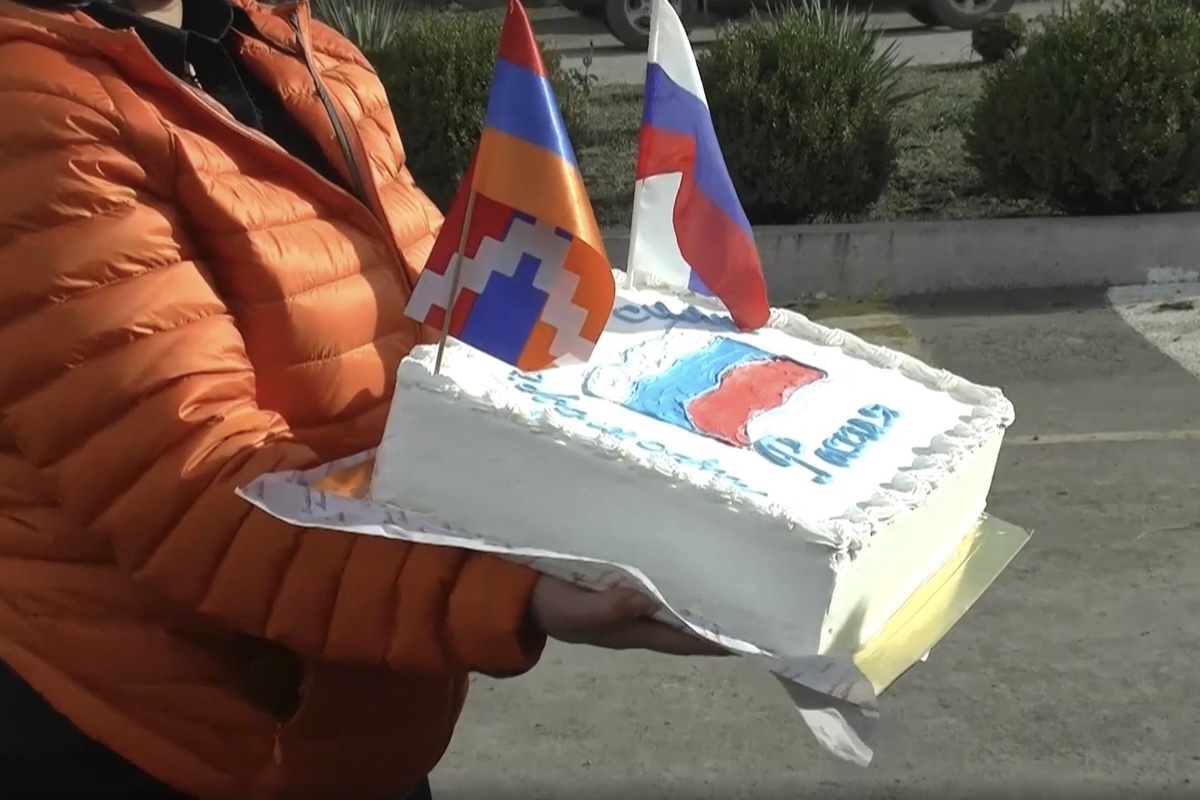
In Azerbaijani media, the peacekeepers were constantly criticized. For letting French politicians who support Armenians into Karabakh. For accepting a cake from Armenians with Russian and Artsakh flags stuck into it. Finally, for using the phrase “Republic of Nagorno-Karabakh“ in internal documents. By the way, such a term had never been used before: in Soviet times there was the Nagorno-Karabakh Autonomous Oblast (NKAO), and later the Armenians called the region the Nagorno-Karabakh Republic (NKR) or the Republic of Artsakh.
Sometimes I was invited into the argument too. For example, the publication Caliber.az asked: “Why are Russian peacekeepers unable to disarm the remnants of Armenian armed groups (the Azerbaijani publication’s wording — ‘Most Media’) in Karabakh?“ — and I answered what I thought. If Russian soldiers start going into every village house and searching for weapons (which were in almost every family), that will seriously damage their relations with the locals. And under conditions where pressure is coming at you from both sides, it is logical to try to preserve good relations with at least one. In the end, Azerbaijanis on social media called the peacekeepers “peace-fakers“.
By the way, we knew absolutely nothing about the rights and duties of the Russian peacekeepers. The statement of November 9 said they were “deployed” along the line of contact and the Lachin Corridor. But what they do after deployment is not specified.
The resolution of the Federation Council of the Russian Federation clarifies why they are being deployed — “in order to prevent the mass death of the civilian population of Nagorno-Karabakh and to prevent significant damage to civilian facilities“. But what casualties count as mass, and what damage counts as significant? And what exactly can be done to prevent this? The questions seem mocking and idiotic, but the lack of an explicit answer to them was largely what caused the tragedy of September 2023. One can, of course, assume that all this is in classified orders that we are not supposed to know about. But what was visible in their actions raised questions. Walking through schools and giving gifts to children, talking about the danger of unexploded shells and mines — that is not bad. But what strategy lies behind it?
Each side understood it in its own way. Armenians saw the Russians as those who would help preserve a statehood that no one recognized and the old order. Azerbaijanis saw them as those who would be the only authority in the region, both military and civilian. Of course, that was until full control over the Karabakh capital, Khankendi in Azerbaijani and Stepanakert in Armenian, was established by Baku.
As for what Russia wanted, that is not so easy to say. Moreover, in the Kremlin, in the Defense Ministry building on Frunzenskaya Embankment, and directly at the checkpoint, these tasks could look different. “No matter how much we sympathize with the Armenian side — well, you understand why; I think there is no need to explain — nevertheless, we will stop any attempts to violate the peace. From any side. Our people here must be neutral“, said a peacekeeper officer to my colleague Sasha Chernykh.
By “neutrality”, they apparently meant the traditional Russian “do not get involved in politics”. If there is already an Armenian administration on the territory and it even calmly allows “lessons of courage“ to be held in schools — why argue with it? And even more so, why try to replace it — after all, the paratroopers simply have no experience in civilian administration. The officers on the ground may not have had any long-term goal at all — serve their six months and go home. And the leadership was warmed by the thought that Russia had gained a new point of military presence in the Caucasus — after leaving the main territory of Azerbaijan (2012) and Georgia (2007). “Boots on the ground” are self-valuable for such people. Asking why they are needed simply makes no sense.
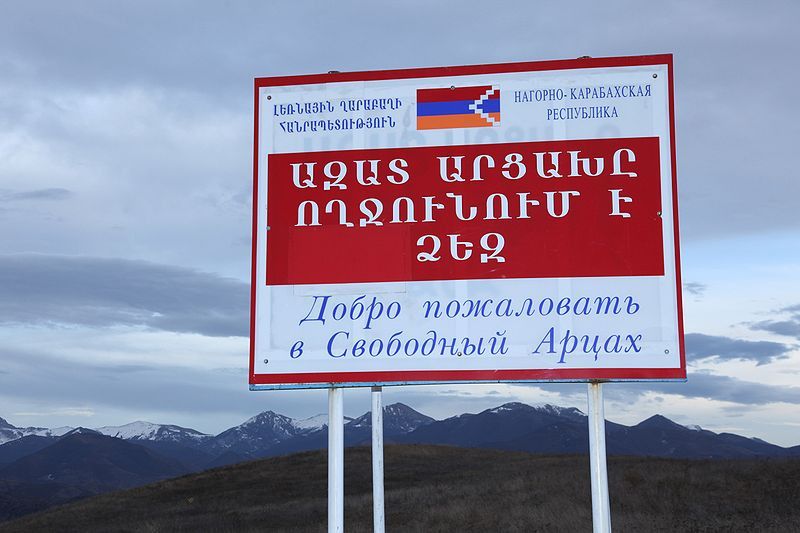
Sign at the entrance to NKR with the inscription “Welcome to Free Artsakh” in Armenian and Russian. Photo: Wikipedia
This state of affairs allowed the Armenians of Karabakh simply not to think about the future. No signals that such conditions would last only two years were sent to them from either Moscow or Yerevan. As a result, completely terrible things were happening (if one thinks about the consequences). Houses for residents of villages that came under Baku’s control in 2020-2022 (during fighting or by agreement) were being built not somewhere in Armenia, but right in Karabakh. Entire neighborhoods were growing — more than a thousand apartments and houses were planned to be built in two years. And some people even managed to receive them.
Of course, at the time those people were happy. But if you think about it — without this program, a couple thousand people might have had a chance to leave the region earlier and not experience a second shock. But they were even encouraged to stay. For example, for the residents of Lachin (in Armenian Berdzor), which was handed over to Azerbaijan in August 2022, the choice was this: receive a certificate for 10 million drams and move to Armenia, or 12 million and stay in the unrecognized republic. Which had four months left until the blockade and one year until complete disappearance.
And this was not even the first such story with settlers in Karabakh. Literally in the last days of Soviet power, when Karabakh was already smoldering, the town of Khojaly near Stepanakert grew at a Sobyanin-like pace. It was Azerbaijani — and new Azerbaijanis kept arriving there. Baku’s logic was to dilute the disloyal population with a loyal one. Already in the winter of 1991-1992, something terrible would happen to them. The city would first be blockaded — it could only be reached by helicopter. And then the Azerbaijanis would try to leave it — and would stumble upon an Armenian checkpoint. At least 485 people died then — including those who died of hypothermia in the forest. Azerbaijan calls this event the Khojaly genocide — and places it at the center of its Karabakh narrative.
A Non-Scary Regime
Small Karabakh, where even before 2020 everything was built on personal ties, became even smaller after the war. Unlike Yerevan, Baku, and especially Moscow, there the janitors, schoolteachers, ministers, and generals studied in the same schools — and then walked the same streets. Such a state does not much resemble what is called a “regime”. A regime needs significant social distance. The bosses in expensive jackets must move exclusively in convoys and live in closed settlements outside the city. Of course, this corner of the Caucasus did not do without showing off. But still, it was not possible to wall itself off from the people with a concrete wall there.
At the same time, the Azerbaijanis called the authorities of the unrecognized Artsakh precisely an “illegal separatist regime”, sometimes a “junta”, carefully correcting foreigners.
But when after 2020 the question of the “reintegration” of the Armenian population began to arise, the most difficult question was this: who among these 120-150 thousand people is still the population, and who is already the regime? Who should be threatened with prison for war crimes (committed either in 1992 or in 2020), and who should be promised a prosperous life in multinational Azerbaijan?
There were many fresh rumors and old myths around this topic. For example, Azerbaijani media persistently told the story that Izaura Balasanyan, a mother of many children from Stepanakert, tried to get to the Azerbaijani side — to Shusha. But the peacekeepers did not let her through. Even from their version it is clear that the woman did this out of desperation — the landlord raised the rent. Whether she really wanted to move to Shusha or simply shame someone in this way is unknown. But what matters is that this was one story. Other Armenians sincerely seeking reintegration were not found even by Azerbaijani journalists. But they explained this by saying that Karabakh Armenians live in fear and simply do not dare to challenge the “junta”.
By the way, until the very end of the Armenian presence in Karabakh, the Azerbaijani authorities continued to insist that thousands of Armenians lived throughout the country. The figure of 30,000 people had been circulating since the early 2000s in official documents and statements by officials. It was not even confirmed by the 2009 census — then a little more than 200 people identified themselves as Armenians. That sounds plausible, but most likely almost all of them are elderly women who married Azerbaijanis back in Soviet times. As one Armenian interlocutor aptly put it, they traded ethnic identity for preserving the family. All other such families either left Azerbaijan or fell apart.
I cannot say that Baku actively used the argument that “30,000 Armenians live here on equal terms, and you will live the same way”. But the logic was exactly that — Karabakh Armenians were supposed to become ordinary citizens. What that could look like, no one could imagine. People were simply afraid and pushed bad thoughts away — Russian peacekeepers gave them confidence. They made it clear that they were not going anywhere. Which meant the new status quo could theoretically last for decades. There were even rumors that one day Karabakh Armenians would receive Russian passports, like the residents of Abkhazia and South Ossetia.
Yerevan was even less suitable as a protector. The further negotiations with Azerbaijan developed after 2020, the more the Armenian government removed itself from responsibility for the future of Karabakh Armenians. But it did so not out of malicious intent, but out of desperation. Baku made it clear that any move regarding Karabakh’s status would be met with a real military response. The entire border between Armenia and Azerbaijan had remained undelimited since Soviet times (that is, not even defined on a map). And this made it possible to turn attacks into gaslighting — “there was actually no border violation”. Such clashes took place in 2021 and 2022 in the Syunik region. And it was after them that Pashinyan accused the CSTO of inaction. So the popular argument that “the CSTO was not supposed to defend Karabakh” (used by both Putin and Zakharova and Shoigu) is not relevant at all — not every military action between Armenia and Azerbaijan took place in Karabakh.
Putin discussed Pashinyan’s decision to recognize Azerbaijan’s territorial integrity with obvious sarcasm. From his point of view, this issue should have remained unresolved for many years — and for all those many years Russian troops would have stood in Karabakh. But Baku simply outmaneuvered Moscow by the Turkish expression sahada ve masada — “on the battlefield and at the table“.
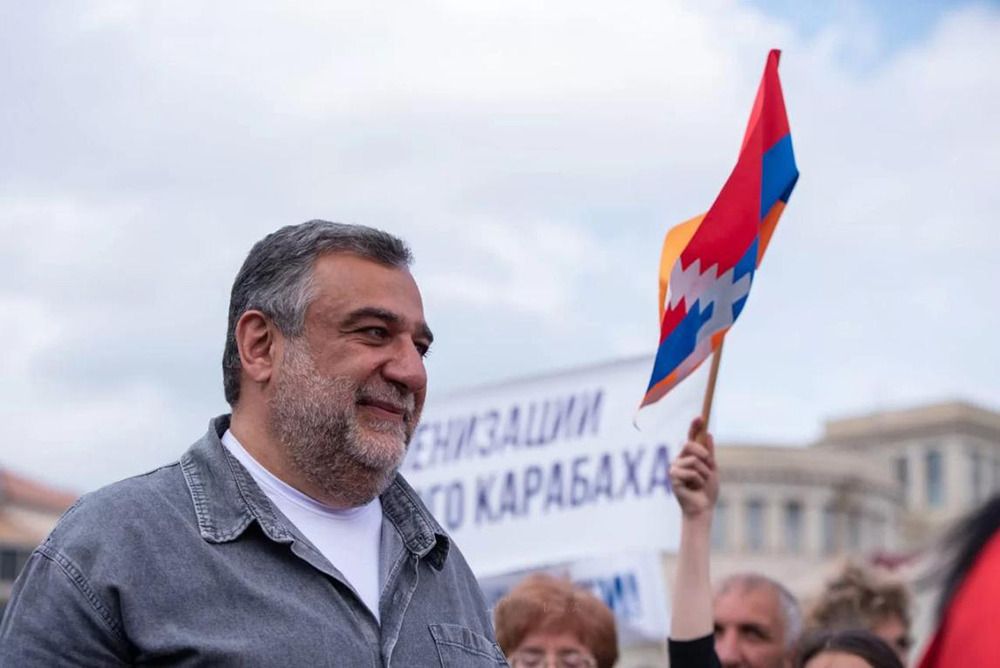
The push toward the most decisive actions came with Ruben Vardanyan’s move to Karabakh — the Russian billionaire who, for a very short time (from November 2022 to February 2023), was even the head of government of the unrecognized republic.
Ruben Vardanyan. Photo: David Ghahramanyan / pastinfo.am
Apparently, the Azerbaijanis really believed that he was an agent of Moscow, given the task of gaining political points in the unrecognized republic and then taking power in Armenia and returning it to Moscow’s orbit of influence. Even exotic options were voiced: make Armenia part of the Union State of Russia and Belarus or place Russian nuclear weapons on its territory (the first question is how, the second is why). This sounds like someone’s fears, but one thing can be said for sure. Vardanyan certainly would not have even discussed any kind of reintegration. He repeated again and again that “Artsakh will never be part of Azerbaijan” and gave people new hope. Extremely unwelcome for Baku.
Three years ago exactly (after the start of the Azerbaijani “special operation”) I even appeared with Ruben Vardanyan on the same broadcast. I was already connected when he was finishing his speech from Karabakh under shelling. Vardanyan criticized Pashinyan and insisted that all of Armenia must go to war again. And I, listening to this, thought: “God forbid. These will be completely senseless casualties, but now on the scale of all Armenia“.
“The Trap Has Snapped Shut”
The end of Armenian Karabakh began when so-called Azerbaijani environmentalists came out onto the road linking Stepanakert with Armenia. At first they simply tested the possibility by blocking the road for three hours. A delegation in work clothes and suits (at that time they really were employees of relevant agencies) approached the checkpoint near Shusha on December 3 and demanded to speak with the peacekeepers. The pretext was gold mining without government permission and in violation of environmental standards. The peacekeepers responded politely and invited the Azerbaijanis to negotiations at headquarters, after which the cars started moving again.
But when the Azerbaijanis, together with the peacekeepers, tried to inspect the mines on December 11, the Armenians did not let them in — in the Azerbaijani Foreign Ministry they were called “local activists”. What would have happened if Baku officials had been allowed in is hard to say. Even if environmental standards were being observed there, another question would inevitably arise — where the owners’ permit from the Azerbaijani authorities was. It did not exist, could not exist, and for more than two years after the war no one even hinted that it might be asked for.
The Azerbaijanis made it clear that they were serious. And the very next day, December 12, they backed up their words with action. People with posters about “ecocide” — that is, the destruction of the region’s nature — came out onto the road. To claim that this was someone’s private initiative is simply foolish. First, even to enter Shusha, Azerbaijani citizens need permission. Second, even if you have it — why would the soldiers at the checkpoint suddenly decide to let civilians into a place where no one had previously been allowed?
The region was blocked: only peacekeeper vehicles were allowed through, and later those of the International Committee of the Red Cross, which responded to the crisis. At first there was hope that all of this would last only a few days and that after another round of bargaining the road would be opened. But it never reopened in its previous form. It looked very strange. Although the peacekeepers were supposed to control the Lachin Corridor under the agreement, they became literally a laughingstock. TikTok filled with videos where one of the “activists” openly provoked the soldiers: “What, you gonna fight? One on one”. But they did not react at all.
Azerbaijanis get very angry when what happened in Karabakh from the end of 2022 is called a blockade. According to them, there was no hunger, and if anyone needed medical help, they were allowed to travel toward Yerevan with the Red Cross. Especially since Ruben Vardanyan already on the second day compared what was happening to the blockade of Leningrad. Of course, this was a major image blunder — the events were not even remotely similar.
Then came the traditional argument about the imperfection of the victim. As during any crisis, many were surprised to discover that while some would stand in line for buckwheat from humanitarian aid, others would dine in restaurants (though even for a wealthy person that would become much more expensive). My acquaintance Sadat Guliyev even made a selection in his channel called “The Hungry Separatist“. And although the title and approach always bothered me (which I told Sadat many times in person), it must be said that this was also part of the story. People celebrated weddings and anniversaries with Armenian-style lavishness. There was shashlik, pastries, and pizza on the tables. Of course, many shared this on social media. For which they often received criticism from their own people: “Why are you helping the Azerbaijanis?!”
Similar arguments were used in Israel when speaking about the Gaza Strip. How can one talk about the suffering of the local population if restaurants are open there? I will not go deeper into this topic (I said at the beginning that I do not deal with it), but this argument is completely useless. Yes, even the poorest residents of Stepanakert had enough pasta and grains to get their daily calorie intake. But all other food and goods were in severe shortage. And the peacekeepers gladly took advantage of this, cooperating with speculators. I heard about a bottle of sunflower oil for $20 and a pack of cigarettes at the same price.
The Azerbaijani action on the road continued until April. People simply took turns in an organized way, like on duty — and they had something to eat and somewhere to sleep (by then a couple of new hotels had already been built in Shusha). The “action” ended only when a real Azerbaijani checkpoint unexpectedly appeared on the border with Armenia. Literally a couple of trailers were brought in — and there, a real border was ready. “The trap has snapped shut”, said one Azerbaijani acquaintance of mine then — far from the most bloodthirsty. And propaganda rejoiced too — now everyone who had a weapon in their hands would end up in the hands of Baku’s security forces.
Forcing Integration
I already understood then that this was the end. There is even a note from one of the media outlets where they quote my grim forecast. But what surprised me especially was that no one was preparing for the exodus then. In Armenia, they did not frantically look for apartments for 100,000 refugees, although that is exactly what I would have started doing. Yerevan seemed not to be planning to receive these people, but at the same time it was not really acting as their advocate during “integration”.
Only after the exodus did Pashinyan blame the leadership of the unrecognized republic for this. “I will reveal a secret to you: we tried to lower the bar, together with our Karabakh colleagues. But what happened then? We lowered the bar — Nagorno-Karabakh raised it. And it raised it at your prompting”, he said, arguing with opposition members in parliament. Before that he had also said that the realistic goal for Armenian society was to secure acceptable conditions for Karabakh Armenians within Azerbaijan, rather than argue about status. But there was literally no one to convey these words to people calmly and kindly.
Talk about integration could only be successful if there were an effective “moderator”. And there was none. Russia did not want to take on that role, and Azerbaijan did not allow Armenia to do so (“we will not discuss our internal matters with Yerevan”).
The local authorities continuedto say that “Artsakh will never be part of Azerbaijan”. The Russian peacekeepers “did not get involved in politics”. And the Azerbaijanis speculated about how soon the Armenians would “integrate” — of course, except for those who had something to answer for under the criminal code.
At the same time, no one even tried to sketch a portrait of the Armenian suitable for integration. And from the fragmentary descriptions, the impression arose that such people did not exist at all. It is clear that at the very least, military personnel, police officers, intelligence officers, and even employees of civil administrations immediately fall under suspicion. After all, they actively contributed to the violation of Azerbaijan’s territorial integrity. Teachers and journalists can be charged under a milder article — propaganda of separatism. In the end, only doctors, utility workers, restaurant employees, and hairdressers remain outside suspicion. And even then — most likely each of them has someone in the family who fought, and they themselves supported the army during the war.
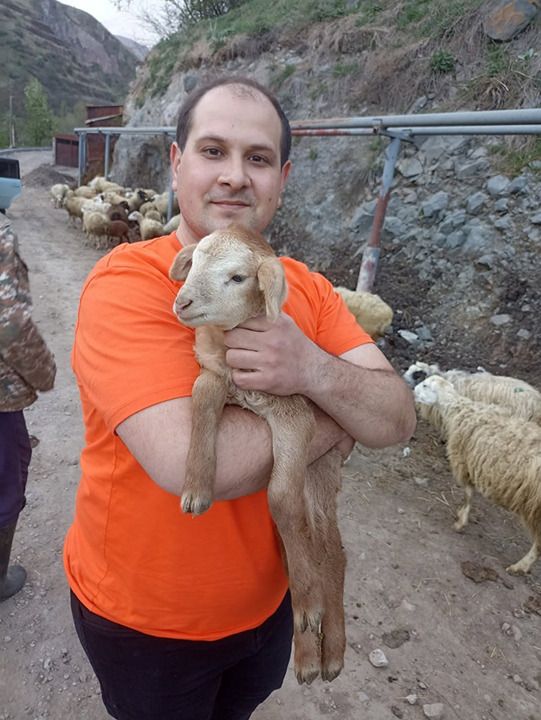
Kirill Krivosheev in the Armenian village of Khoznavar near the border with Nagorno-Karabakh, 2025
I am definitely not a fan of Alexander Lukashenko — I have been in a Belarusian police van, and local propagandists ranted about my articles on air. But even he, by offering opposition figures a chance to return to Belarus, created an opportunity to get an answer in advance to the question: will I personally be persecuted? For this, a special website was created.
For the Armenians of Karabakh, not even such an opportunity was created. Azerbaijan only mentioned amnesty, but without any specifics. “The parliament must be dissolved, the element calling himself president must surrender, all ministers, deputies and others must already leave their posts. Only in this case can concessions be made for them. Only in this case can one speak of any amnesty“, Aliyev said in May 2023. Not only is this an impossible condition — after it, the amnesty would still be ”any kind“.
Where the bar for a loyal citizen was, people had to search for it by touch. After the checkpoint was set up on the road to Armenia, Armenians began to be cautiously allowed through it — almost always only to leave. This happened in small batches, in coordination with the peacekeepers and the Red Cross. But television channels still broadcast a beautiful picture: it turns out that a situation in which Armenians show a passport to an Azerbaijani border guard is possible.
True, incidents did occur in such cases. One man, Vagif Khachatryan, was detained and accused by Azerbaijani border guards of killing residents of the village of Meshali and torturing prisoners in 1991. Three students were also detained who had once posted a video on social media showing them wiping their feet on the Azerbaijani flag in a locker room before a football game. “Since two years had passed since then, we thought they would no longer remember. But they not only remembered, they also gathered a huge amount of information about us over those two years”, one of them later said. In the end, the guys were first taken to Baku for trial, given 10 days of arrest, and only then brought back to the same checkpoint.
Both of these things instilled fear in all Karabakh Armenians. If Azerbaijanis were so determined to give 10 days to three twenty-year-old guys for a video with a flag, then what could threaten an official or a police officer? Amnesty for military personnel in Azerbaijan was explicitly announced only on September 22 — after the Azerbaijanis had taken control of Stepanakert (which had already de facto become Khankendi). But no one willing to rely on these promises was found. Because de jure, the article of the Azerbaijani criminal code applied to almost every local resident. And whether your particular case would fall under the amnesty would be decided by the local major. And then there would be no way to change that decision.
Before taking the remnants of Karabakh by force, the Azerbaijanis several times offered negotiations to the local leaders. And this was a new reality — when Yerevan stepped aside, Baku began to perceive this as an internal process, something like a dialogue between France and New Caledonia (by the way, Azerbaijan also took part in this conflict in order to harm Paris!).
The first “reintegration” meeting between officials of the unrecognized republic and representatives of Baku took place back in March 2023, at the peacekeepers’ base in Khojaly. But it was only about reintegration for the Azerbaijanis. The Armenians insisted that the meeting agenda was different — reopening the road, as well as uninterrupted gas and electricity supply (since the lines came from Armenia through Shusha, the Azerbaijanis had the ability to periodically shut them off, citing “accidents“). After that, the Azerbaijanis invited the Armenians to negotiations without intermediaries — in Baku. But they twice declined the invitation, demanding neutral territory. “There will be no third invitation. Either they will come themselves with bowed heads, or things will now develop differently“, Aliyev said. Before Aliyev carried out his threat, there were rumors that the meeting was still supposed to take place in Sofia, the capital of Bulgaria. But it never happened.
Of course, the Armenian leaders were simply afraid to go to Azerbaijani territory — to Baku or even the much closer Yevlakh (where they eventually went after the military takeover and capitulation). But they also had absolutely no idea what to talk about. Apparently, they believed that if they seriously discussed how to live under the Azerbaijanis, that would mean their political death. In any case, it came anyway. The few who managed to leave (including the last president Sergey Shahramanyan) became not even politicians, but second-tier “public figures”.
When the Armenian leaders finally reached Yevlakh on September 21, there was even less talk of reintegration. According to my source in Baku, they asked for only one thing — gasoline to refuel the cars and leave. It is amusing that the website where one could submit an application for Azerbaijani citizenship was launched only on September 28. By that day, more than 60% of the population had already left the region.
And the “reintegration” conditions were published only on October 2 — when the departure was almost complete. But even this document was written very dryly and without details: Regardless of ethnic, religious, or linguistic affiliation, the equality of rights and freedoms of everyone, including everyone’s security, is guaranteed. In accordance with the legislation of the Republic of Azerbaijan, municipalities are formed through elections.
The process of disarmament and demobilization is completed, and all weapons are confiscated from residents.
Property issues are regulated in accordance with the legislation of the Republic of Azerbaijan.
The use of the Armenian language is made possible.
All this gave no answer to the questions that worried everyone: what exactly will happen to me for what I did? What will happen to my loved ones? Will there later be a chance to leave for Armenia at any moment?
Almost everyone left — with the exception of a couple dozen people. Then there were 15, 14, 13 of them left, and now, according to my data, exactly one.
At the border, Azerbaijani journalists asked Armenians whether they were leaving voluntarily and whether force had been used against them. They all answered no. Elderly people even spoke Azerbaijani — they remember the language from Soviet times. Someone mentioned that the departure had been organized by the local authorities: the village head and district officer went around the houses and told people to pack up. In the end, Baku began using two theses: “the departure of Armenian residents from the territory of Azerbaijan is their voluntary and individual decision“. And if there was coercion, it was only from the ”separatist regime“.
The latter always seemed too implausible to me even for propaganda. Obeying against your will makes sense only to the authority that can do something to you. And we in Russia have some experience in that regard. But what is the point of fearing a “regime” whose capital already hosts the enemy army? And more than that — the “regime” had already signed a document on disarming the army, and then on its self-dissolution. In theory, anyone who wanted to stay could simply shut the door in the face of a representative of the dying unrecognized state. Or tell that to Azerbaijani soldiers and police officers, of whom there were plenty along the way. But people kept driving toward Armenia.
The portraits of those who managed to “resist pressure” and stay in Stepanakert-Khankendi also look extremely strange. There is a childhood invalid, an elderly man named Fred. A lecturer at the local university, the Ukrainian Sergey Ogoltsov. Or Meruzhan Stepanyan — a lonely man who reflects on the guilt of the Armenian intelligentsia for the conflict. Some of them lived in apartments, the less independent ones — in a shelter, practically a nursing home. Azerbaijan assigned them a small pension, but did not allow them to get SIM cards or use the internet.
This strange coexistence continued until Karen Avanesyan — a 58-year-old man who walked around the city and fed cats — was accused of preparing a terrorist attack. It is claimed that he wanted to attack police officers with an assault rifle and several grenades — on exactly the day Ilham Aliyev visited Khankendi. The story could have been loud and scandalous, but for some reason propaganda did not blow it up. Avanesyan was given 16 years in prison, and after that all the “integrated” Karabakh Armenians were put on a bus and taken to the border with Armenia. As eyewitnesses tell it, only one refused to cross it. This was Musheg Grigoryan — a strange man who first introduced himself to the Azerbaijanis as the “owner of the city“, and then testified in court against Ruben Vardanyan. He was afraid that such cooperation with the new authorities would not be forgiven.
Nothing Else Was Assumed
As stated on September 20, 2023, by Russian presidential spokesman Dmitry Peskov, “de jure we are now talking about the actions of the Republic of Azerbaijan on its own territory”. And therefore, everything is fine. He reacted sharply to the words about the peacekeepers’ inaction — “we do not accept such reproaches against us, especially after the official decision of the Armenian side to recognize Karabakh as part of Azerbaijan”.
And even in Europe the outrage was quite restrained. The European Parliament resolutions that Aliyev ranted about are, in essence, empty words. While the deputies were adopting them, truly influential peoplewere increasing purchases of Azerbaijani gas. It is very little, but in the context of abandoning Russian gas, any volumes matter.
Azerbaijan’s defense line against all accusations was elementary: “They did not want to accept the laws of our country and left, even though we offered them to stay. But we will not cry over them. Good riddance!“ I always saw it differently. People were deliberately not told the specific conditions so that they would make exactly that decision.
The argument that they were promised “the same rights as Azerbaijani citizens” is also insufficient. First, how would they know how Azerbaijani citizens live? Second, besides the law, there is also how it is applied in practice. And there was also the understanding that any encounter with an ordinary Azerbaijani could end with unwanted attention and bullying. And that did happen — with the same disabled Fred, who was repeatedly filmed in Khankendi.
There is a sad episode in the history of the Karabakh conflict. At one point, European diplomats suggested that the parties study the experienceof the Åland Islands. They belong to Finland, but Swedes live there. And before the 20th century there was also a separatist movement on the islands — the Swedes wanted to be part of Sweden. Under the League of Nations, the conflict was resolved — the Swedes were given broad autonomy. But after hearing all this, a Karabakh representative said: “Azerbaijan is not Finland; its actions and demands are very different from the Finnish ones”. Azerbaijani Foreign Minister Tofig Zulfugarov replied: “Well, Armenians are not like Swedes either”. This off-the-record dialogue began to be retold, and at some point the Armenian argument came to look like this: “We would not be opposed to becoming part of Finland. But you are offering Azerbaijan”.
And here the most important question arises. Is it acceptable when the conditions of “reintegration” push absolutely the entire population, except for a few lonely old men, to leave? For example, if after the two Chechen wars all Chechens decided to leave Russia, or after China’s actions in Xinjiang — all Muslims? Both scenarios were almost impossible because of the different scale of the populations. But even if we are talking about 100,000 people — is it really normal that almost all of them did not want to live with you? Would Azerbaijan have been obliged to win them over?
In Baku they confidently answer: no. According to local speakers, Armenians themselves should, on their own initiative, earn forgiveness for occupying territories (especially those where Azerbaijanis lived), rather than wait for someone to beg them to stay. As an emotional argument, they cite photos from 1992-1994. Back then, Azerbaijani civilians left their homes on foot, and sometimes were forced to cross mountains. True, this argument completely overlooks the overall humanization that took place over 30 years (during these years, the death penalty, street fights, and physical punishment of children ceased to be normal in mass consciousness).
The expulsion of Azerbaijanis in the 1990s and the occupation of their territories is a crime. But what happened to the Armenians three years ago is perceived similarly today because of greater sensitivity to any coercion and violence.
In the hope of precisely this global humanization, the Armenians tried to speak as loudly as possible about the blockade. And they were very angry when my colleague Elena Romanova wrote an article suggesting that the Karabakh authorities were “using the suffering of the people“ for political purposes. The idea of accepting humanitarian aid from Azerbaijan really seemed unacceptable to them, and in Baku this was called “self-blockade“. But the step looked unacceptable precisely because it was followed by uncertainty. If tomorrow seems frightening and the day after tomorrow monstrous, logic suggests holding on to today with all your might.
I thought a lot about how things could have been done differently. For example, what if Azerbaijani officials, starting in 2020, had come to the Armenians together with the peacekeepers and offered pensions and benefits? At first, cash could be used, and then bank cards issued. At first people would have turned up their noses at that too, but over time the ice might have melted — why is the neighbor getting money and I should not? Then, also under peacekeeper protection, stores could have been opened where both Armenian drams and Azerbaijani manats were accepted. In Yevlakh and other nearby Azerbaijani cities, points could have been organized where Armenian farmers could sell their produce — also with peacekeepers on duty nearby. Separately, the Azerbaijani ombudsman could have looked for people with serious illnesses — and offered them treatment in Azerbaijan. Georgia offers this to Abkhazians and Ossetians, and they take advantage of the opportunity.
Of course, all this would have had to be done over the heads of the authorities of unrecognized Artsakh. No politician wants to give up power voluntarily. And even less does anyone want to twist their own people’s arm and force them into what the people themselves would consider occupation (from the point of view of international law, this would be the restoration of territorial integrity — but try explaining that to Karabakh Armenians). Expecting Arayik Harutyunyan and other officials to go along with this was completely unreasonable. A moderator could have pushed them toward it by promising them something in return (first and foremost — personal security). But no one even tried to look for one. In my view, because that was never the task. Baku was entirely satisfied with a scenario in which it did not need to look for any additional solutions — pure triumph, pure victory, pure territories for restoration and development.
And whether it is good or bad that such a moderator was not found and the Armenians of Karabakh did not end up under Baku’s rule — you are better off answering that yourselves. In my mind, a scenario arose in which they, after first demonstrating loyalty, gradually began to change Azerbaijan from within — toward greater freedoms for themselves and everyone else. But that is better suited to a fantasy novel than to reality.
If you enjoyed this article, consider making a donation — one-time or, even better, monthly. Your support helps us motivate our authors and become better with every article.
Our organization is recognized by the Internal Revenue Service (IRS) as a 501(c)(3) tax-exempt, charitable organization, which means that all contributions made to us are tax-deductible to the fullest extent permitted by U.S. law. Individuals may generally deduct charitable contributions of up to 60% of their Adjusted Gross Income (AGI) for cash donations made to qualifying 501(c)(3) organizations. For donations of appreciated assets (such as stocks or other long-term capital assets), the deduction is typically limited to 30% of AGI, based on the fair market value of the asset. C-corporations may deduct charitable contributions of up to 10% of their taxable income for donations made to eligible charitable organizations.
By submitting a donation, you confirm that you have read and accept the following documents: Privacy Policy and User Agreement, and also give consent to the processing of your personal data.
If you would like to unsubscribe from a monthly donation, please email us at: [email protected]