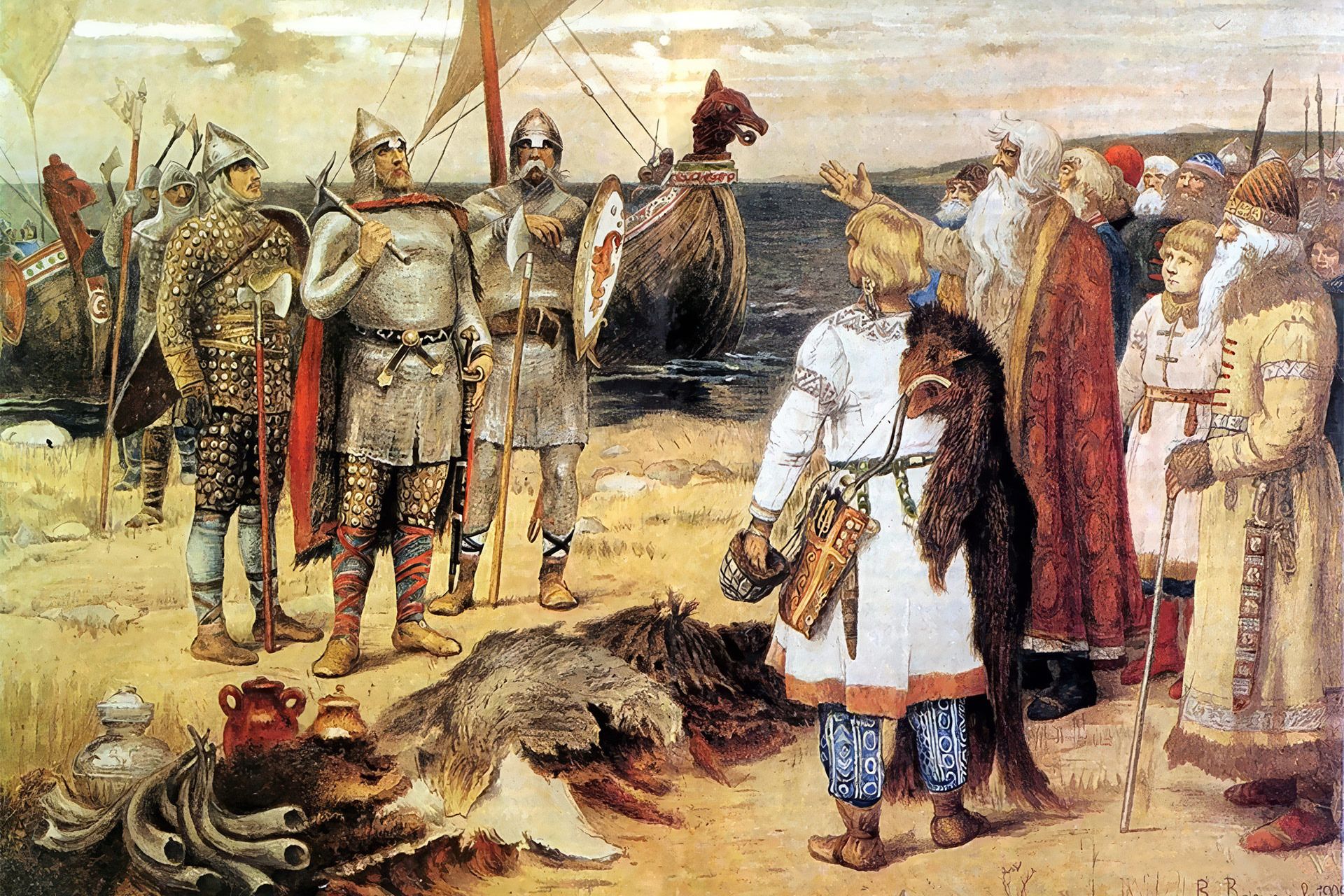
According to ancient chronicles, on September 21, 862, representatives of the tribes of the Slovenians, Krivichs, Chuds, and others (that is, not only Slavs, but also Finno-Ugric peoples), living in the northwestern part of modern Russia, invited three brothers to rule: Rurik, Sineus, and Truvor. The khans were told: “Our land is generous and rich, but there is no order in it. Come and rule us!” The date, of course, is approximate. But in the end it was accepted as the starting point for the foundation of Russian statehood, and over time Rurik’s name came to be revered as the founder of this state. And this continued until the 18th century.
Viktor Vasnetsov, “The Call of the Varangians (Rurik and His Brothers Arrive in Old Ladoga)”, 1909.
Although the story of the “calling of the Varangians” to the Russian throne is semi-legendary, it is quite possible that it is based on real events. Since the 11th century, details about the lives of princes who ruled over vast territories from Kiev to Beloozero and gradually expanded the lands under their control have been known from a wide variety of sources. Including quite reliable ones. However, the question of the origin of the Rurikids has for many years not given peace to Russian patriotic circles. Moreover, in recent years these attacks on the classic version of the calling of the Varangians have become especially sharp. So what is it that so irritates the “defenders of true history”?
From the mists of time: Vikings, Normans, and Varangians
There is no doubt that Scandinavian detachments were actively using river routes to travel from the Baltic to the Black and Caspian Seas no later than the 9th century. Dozens of ships crossed the route “from the Varangians to the Greeks” every year. Hundreds of Vikings entered the service of the Byzantine emperor (the so-called Varangians). The sagas preserve many references to various settlements founded by Vikings in the area of the eastern Baltic and Lake Ladoga. Thus, Old Ladoga, one of the early capitals of the ancient Russian state, they called Aldeigjuborg. So what is surprising if one of the khans decided to settle firmly on the banks of the Volkhov, the Dnieper, the Western Dvina, or the Velikaya?
Most historians have no doubt that the names Oleg, Olga, or Igor are of Scandinavian origin. It seems very likely that Rurik, too, may have come from Denmark.
At any rate, the names Rorik, Rorig, Ruri, or similar ones were very common a thousand years ago in Jutland, Norway, and Sweden. Moreover, lists of warriors who took part in negotiations with Byzantium on behalf of Ancient Rus have survived: Roald, Gunastr, Frasten, Igeld, Thurbern, Sven, and dozens of others with obvious Scandinavian origins.
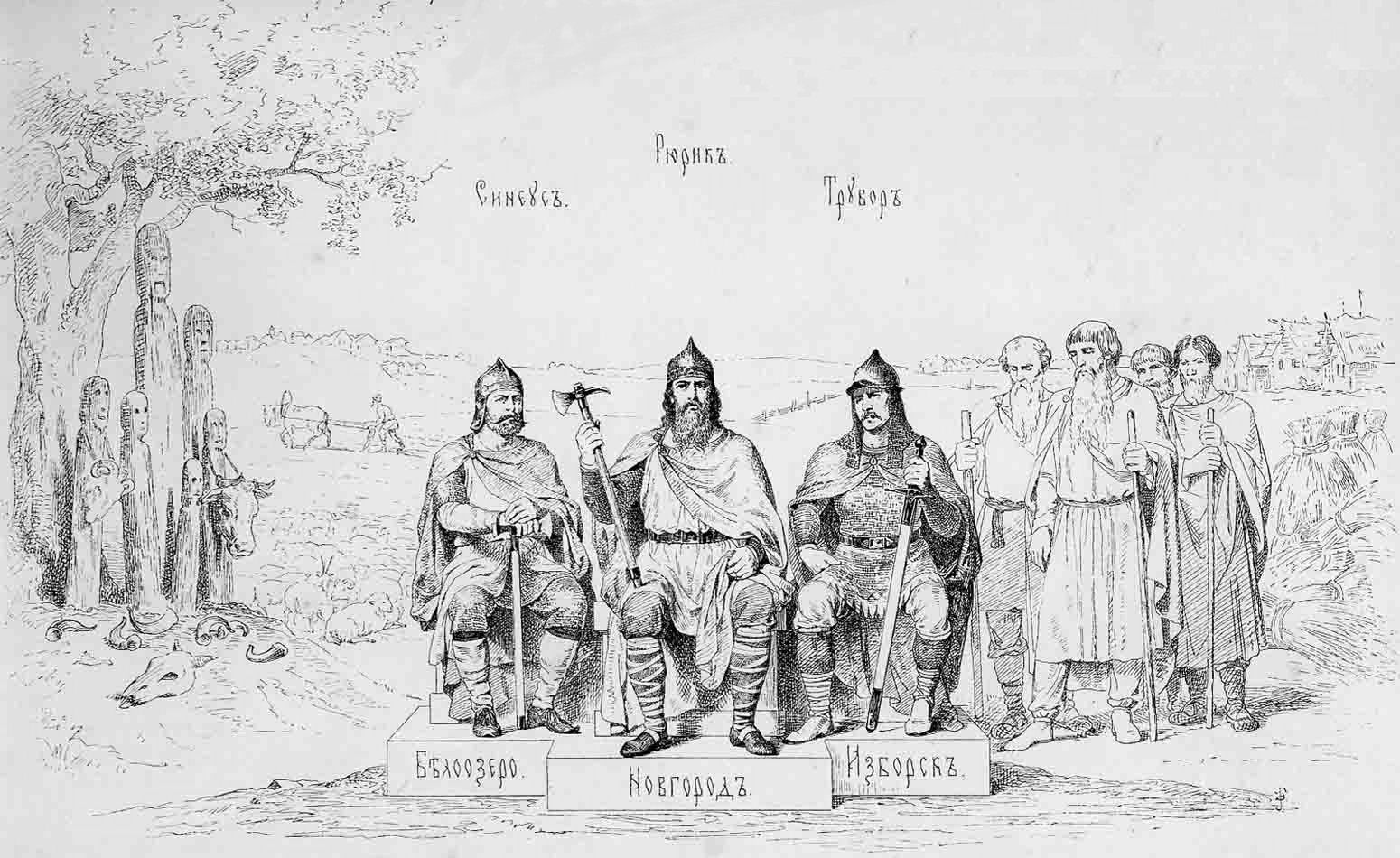
The calling of the Varangian princes — Rurik, Sineus, and Truvor. Drawing by Vasily Vereshchagin from the album “The History of the Russian State in Images of Its Sovereign Rulers” (1890–1891).
From the 10th century onward, Slavic names of princes and warriors gradually replaced the earlier “Varangian” ones. Iziaslavs, Yaroslavs, Mstislavs, and other “slavs” now dominate the pantheon of rulers. But no one is bothered if, under the rule of Sviatoslav Igorevich, one of the chief voivodes was a man named Sveneld.
Over time, the Rurikids became very numerous. Different branches of the dynasty’s founder disputed the right to be “first among equals” in countless internecine wars. But ties with Scandinavia did not disappear. For example, Yaroslav the Wise’s wife was the Swedish princess Ingegerd. In the romanticized version, it was from her name that the name Ingria came, which became fixed for the lands around the Neva. And even in later times the Rurikids remembered their kinship with the rulers of the western shores of the Baltic. At any rate, Andrei Yaroslavich, the younger brother of Alexander Nevsky, who refused to recognize Mongol rule, spent several years with distant relatives in Sweden. That is, among those whom his elder brother supposedly defeated in the Battle on the Neva. And no one forced Andrei to convert to Catholicism.
In this connection it is useful to recall: in modern France, no one is bothered by the fact that the name of the region Normandy comes from the name of the foreign Normans who settled there.
Yes, the French kings had to accept the transfer of the north of the country under Viking control. They had to take this measure in order to save the inland regions from new raids by sea robbers from the north. And in modern Great Britain no one denies that in 1066 the inhabitants of England were conquered by the troops of William I, Duke of Normandy, who arrived there. That is, the Anglo-Saxons found themselves subordinate to foreigners whose lineage traced back to people from Norway. This is part of European history, which does not need to be rewritten or interpreted in any special way. But things turned out differently in Eastern Europe.
Ivans from the Germans
The descendants of Alexander Yaroslavich settled in Moscow and gradually brought the surrounding principalities under their control. At the same time, they remembered their origins well. Even in the popular comedy Ivan Vasilyevich Changes Profession, the formidable tsar, when asked by the policemen about his surname, confidently replies: “We are Rurikids”. But less well known is that in the 16th century representatives of the Moscow aristocracy began to worry about their roots in a very peculiar way. It would seem they had finally decided to recognize themselves as Slavs? Nothing of the sort!
Ivan IV the Terrible repeatedly told guests from Western Europe that he considered himself German by blood. Moreover, by order of the tsar, a detailed genealogy was compiled stating that Rurik had not merely come from German lands, but was a descendant of Pruss (who founded the Prussian state), who in turn traced his origin to the Roman emperor Augustus. That is, the monarch sharply separated his ethnic origin from that of his subjects, the overwhelming majority of whom were unquestionably East Slavs.
Other representatives of the Moscow nobility were not much different from Ivan IV the Terrible. Some of them took pride in being descendants of people from the Golden Horde (Yusupovs, Sheremetevs, Apraksins). Others were ready to spend a considerable sum in order to prove, through a “proper genealogy”, any origin whatsoever, but not a Russian one. One known example is the noble family of Kozodavlevs, who were deeply upset by their own surname, which rather plainly revealed the family’s “foundational” roots. In the end, a family tree was produced in which the founder of the dynasty was traced back to... the German knight Koss von Dahlen.
Lomonosov takes aim at the foundations
The origin of the Rurikids from the Vikings did not particularly bother anyone until the 18th century. People from Scandinavia were considered the obvious creators of Russian statehood. The only question open to debate was where exactly the legendary khan had come from, arriving in the Old Ladoga area with his brothers and retinue in the distant year 862. However, everything began to change in the middle of the 18th century.
In 1745, Mikhail Lomonosov became an academician of the St. Petersburg Academy of Sciences. He was the first Russian recognized in the Russian Empire as a scholar of such rank. All the other academicians were Germans, Swiss, or Frenchmen. The self-taught man from Kholmogory (who mastered German perfectly) had a difficult relationship with his colleagues. The tall and sturdy Lomonosov often resorted to his fists in scientific “discussions”.
The denouement came in 1749. Academician Gerhard Miller prepared a solemn report, “The Origin of the Name and People of Russia”. It confirmed that statehood had been brought by the Varangians-Scandinavians of the Rus lineage. In other words, it закреплял in scholarly work what later came to be called the “Norman theory”. Lomonosov was sharply displeased by this. He succeeded in having Miller removed from his work and personally took up refuting “Normanism”.
However, if under Elizabeth Petrovna the first Russian academician acted quite decisively, then with the accession of Catherine II (the German princess of Anhalt-Zerbst) the Kholmogory “natural talent” became cautious. In the end he came up with the hypothesis that the Russians trace their origin to the warlike people mentioned by ancient authors, who called themselves the Roxolani. According to Lomonosov, writers such as Pliny and Ptolemy simply mistakenly replaced one of the letters “s” with “k”. That is, if the fearless warriors of antiquity are called not Roxolani but Rossolani, then everything falls into place. The etymology is suitable, the antiquity is prestigious, and the German princess on the Russian throne need not feel offended.
Of course, no authoritative historian could take Lomonosov’s hypothesis seriously. But as the number of Russian academicians in St. Petersburg grew, the positions of the anti-Normanists began to strengthen. Unexpected support also came from the ruling Romanov dynasty.
The more German blood flowed in the veins of the monarchs (whose mothers always belonged to the German aristocracy), the more confidently the voices of the “rooted” camp sounded, seeking to prove that in the 9th century the East Slavs (the Rus) themselves created a mighty state. Without any assistance from Scandinavians, Germans, or anyone else.
The “Millennium of Russia” monument, erected in 1862 in Novgorod. Photo: Wikipedia / Tsyganov Sergey / CC BY-SA 4.0
A radical turn occurred under Alexander III. The tsar wanted to feel as close as possible to the “Russian world”. Therefore, the son of the Hesse princess grew a beard and, wherever possible, replaced ordinary typefaces with Old Church Slavonic script. His successor, Nicholas II, followed the same path. The culmination was the war with Germany and the renaming of St. Petersburg to Petrograd.
From the Bolsheviks to Putinism
The Bolsheviks who came to power in 1917 only at first strictly adhered to the ideas of internationalism and cursed the nobility. It very quickly turned out that, apparently, the Russian people are the “elder brother” of all the other ethnic groups. At the same time, Soviet citizens learned that Prince Alexander Nevsky and Tsar Ivan IV the Terrible were not a feudal collaborator and not a cannibal tsar, but “progressive statesmen” who had done much good for the prosperity of the Russian lands.
On Joseph Stalin’s orders, school textbooks appeared in which it was scientifically proven that all significant innovations (from steam locomotives to airplanes) had been invented by Russian people. At the same time, Soviet citizens from their school desks had to learn that nothing good had ever existed and does not exist on the “decaying West”. In the past there were hostile German knight-dogs, cunning English plotters, and Napoleon, who dreamed of enslaving Moscow, and in the 20th century they were replaced by imperialist predators who, in their London and Washington, are hatching plans to destroy the “world’s first state of workers and peasants”.
Of course, Soviet scholars churned out dissertations and doctoral theses at full speed, refuting Normanism as a “foreign, hostile, and deeply false” theory. But even more astonishing metamorphoses among court post-Soviet historians began to occur in the 21st century.
With the establishment of Vladimir Putin’s authoritarian dictatorship, the star hour arrived for ideologues such as Vladimir Medinsky. He wrote a whole series of “scholarly works” proving that from ancient times the “Russian world” had brought only good and light to the outside world, while it was always met with evil and deceit. Medinsky’s associates went even further. Thick books appeared in which, on the basis of “facts and documents”, readers were told that the name Rurik was unquestionably “ours”. That is, as Russian as can be. Supposedly, the ancient Rus often gave their children that very name. These same “specialists” confidently stated that, for example, the toponym Vyborg comes from the name of the Slavic prince Vybor. And all in the same spirit.
All such pseudoscientific studies could be treated with irony. But it was precisely the ideas of the dominance of the “Russian world” that became the ideological basis for the Kremlin’s right to interfere in the affairs of neighboring countries. After all, one must at the very least defend the rights of the Russian-speaking population! And in general, the right of Russian culture to dominate all others. Especially since everything around had once “been ours”. And all sorts of Ukraines or Finlands were invented by the naive Vladimir Lenin out of kindness and humanity. And for the sake of a “return to just borders”, the use of force is no sin.
The terrible culmination came in 2022 with the bloody invasion of Ukraine by the Russian army. And now it is hard to believe that it all began with disputes over the origin of the legendary khan Rurik, the quite real prince Vladimir, and the even more real paranoid tsar Ivan IV the Terrible.
If you enjoyed this article, consider making a donation — one-time or, even better, monthly. Your support helps us motivate our authors and become better with every article.
Our organization is recognized by the Internal Revenue Service (IRS) as a 501(c)(3) tax-exempt, charitable organization, which means that all contributions made to us are tax-deductible to the fullest extent permitted by U.S. law. Individuals may generally deduct charitable contributions of up to 60% of their Adjusted Gross Income (AGI) for cash donations made to qualifying 501(c)(3) organizations. For donations of appreciated assets (such as stocks or other long-term capital assets), the deduction is typically limited to 30% of AGI, based on the fair market value of the asset. C-corporations may deduct charitable contributions of up to 10% of their taxable income for donations made to eligible charitable organizations.
By submitting a donation, you confirm that you have read and accept the following documents: Privacy Policy and User Agreement, and also give consent to the processing of your personal data.
If you would like to unsubscribe from a monthly donation, please email us at: [email protected]