The Cold War between the USSR and the USA was a unique conflict in human history. On both sides, it was waged not so much by the military as by intelligence agents, diplomats, weapons designers, and even journalists, athletes, and cultural figures. Therefore, it’s no surprise that the flight of a single aircraft could be comparable to the actions of a large military formation in a conventional war.
The Cold War between the USSR and the USA was a unique conflict in human history. On both sides, it was waged not so much by the military as by intelligence agents, diplomats, weapons designers, and even journalists, athletes, and cultural figures. Therefore, it’s no surprise that the flight of a single aircraft could be comparable to the actions of a large military formation in a conventional war.
That’s what happened on May 1, 1960. The reconnaissance mission of pilot Francis Powers turned into one of the biggest failures for the United States during the entire confrontation. They not only lost an aircraft considered invulnerable over enemy territory. Their agent was captured alive by the Soviets and then submissively stood trial before an enemy court. Meanwhile, the highest military-political leadership of the USA, trying to cover up the incident, only exposed themselves as liars and incompetents before the whole world.
At that moment, the two superpowers irreversibly missed an opportunity to ease international tensions. And just a couple of years later, humanity almost came to the brink of World War III.
Friendly fire
Sergey Safronov — today, only the most meticulous experts of Russian history recall the name of this senior lieutenant of the USSR Air Force. No streets in Russian cities bear his name, no monuments are erected, and no films are dedicated to him. Meanwhile, Safronov is a unique figure in his own way: throughout the entire Cold War, he was the only one killed during actions against a US intelligence officer who illegally penetrated Soviet territory. And not somewhere on the border, but far from any frontiers — near Sverdlovsk.
In 1960, the thirty-year-old Safronov was serving in the 764th Fighter Regiment, stationed precisely in the Middle Urals. Early on the morning of May 1, Sergey was unlucky to be one of the pilots sent by command on a hopeless chase. The pilots were tasked with intercepting the American spy plane Lockheed U-2 that violated the border — and at the controls sat none other than Powers himself.
At 8:53 Moscow time, the American was hit from the ground by fire from the S-75 “Dvina” complex of the 57th Anti-Aircraft Missile Brigade. But Safronov, along with a more experienced partner, Captain Boris Aivazyan, continued to pursue the intruder. Worse, the air defense did not believe the success had been achieved. Powers was damaged by the 2nd division of the 57th brigade, while other units kept firing for another half hour — encouraged by their superiors, already heavily pressured by Moscow.
At 9:23, the 4th division of the brigade fired three more S-75 missiles. The fateful order was personally given by the deputy commander of the Sverdlovsk Air Defense District, Major General Ivan Solodovnikov, who had hastily arrived to hunt the U-2. The unnecessary salvo proved fatal for Safronov. The more experienced Aivazyan dodged the fire aimed at him. Later he recalled:
“I didn’t realize that Powers was shot down, no one on the ground realized that debris was falling, and here we crawled out from those wreckage pieces. I was in front, […] Safronov behind, […] and we crawled like this on our stomachs. From that moment on, we were perceived as the enemy, as a target that changed altitude to 11,000 meters. […] I decided to land not as usual — normally you circle over the airfield and land — but straight in, as soon as the airfield appeared beneath me. That saved me — pure chance — intuitively I got out of the missile’s range, became unreachable by it in altitude.”
Francis Gary Powers
The cause of the tragedy was simple carelessness. In the rush, the pilots forgot to change the “friend-or-foe” system codes, and the soldiers of the 57th brigade did not realize they were shooting at their own pilots. But the high command ultimately ruled by the principle “winners are not judged.” After all, Soviet air defense, after several years of failures, finally caught the supposedly unshootable U-2.
Solodovnikov was quietly sent into honorable retirement, and Safronov, along with other participants in the chase after Powers, was posthumously awarded the Order of the Red Banner. Moreover, the very word “posthumously” was omitted in the award order for the deceased officer. Apparently, so as not to overshadow the glorious victory of the Soviet troops.
Into the enemy’s lair — riding the Dragon Lady
This story began with paranoia in high offices. Not Moscow’s, but Washington’s. In the mid-1950s, Dwight Eisenhower’s administration was haunted by the ghost of Pearl Harbor. The CIA learned about new Soviet weapons — strategic bombers M-4 capable of carrying nuclear warheads.
In the mind of the 34th US president and his team, news about this aircraft instantly turned into an image of enemy air hordes destroying everything alive in America. For such an effect, the Soviet side used a simple trick: M-4s were immediately assigned two-digit, then three-digit tail numbers. Thus, the actual number of bombers on their side was perceived as greatly exaggerated.
In July 1955, Eisenhower tried to solve the problem delicately. In Geneva, Switzerland, he personally proposed to Nikita Khrushchev the “Open Skies” plan. It was about mutual rights to freely conduct reconnaissance with unarmed aircraft. The Soviet leader refused — the idea seemed too sly. While the US had several bases for aerial reconnaissance against the USSR (West Germany, Italy, Norway, Turkey, Pakistan), Moscow at that time had no allies in the Western Hemisphere. The Cuban Revolution was still four years away, and hardly any country close to the US would have allowed Soviet Air Forces.
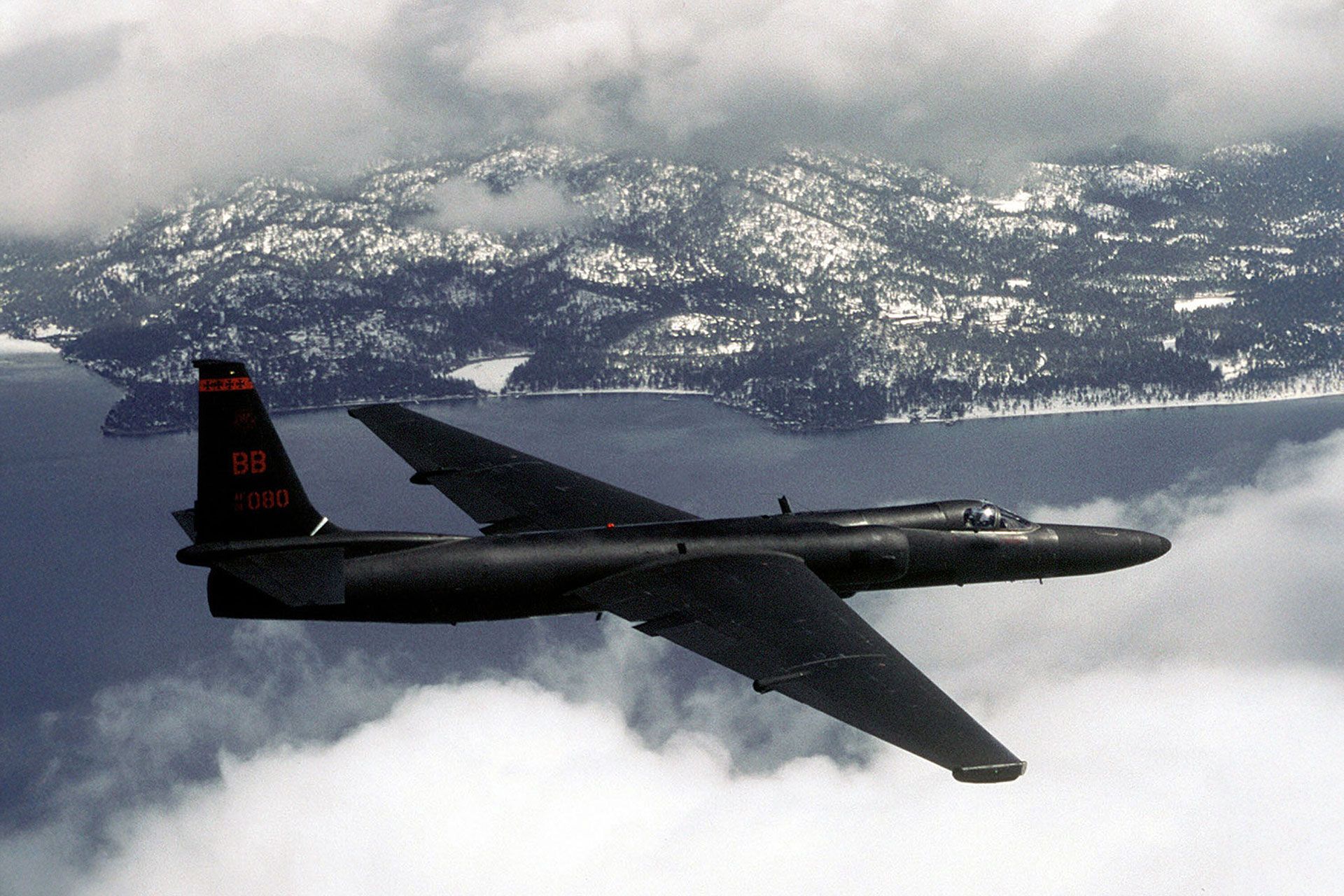
Then the CIA began secret reconnaissance flights. Officially, the program was called Project AQUATONE, but it became known in history as Operation Overflight. In late summer 1955, designer Clarence Johnson created a fundamentally new spy plane, the Lockheed U-2. The development was extremely intense, with Johnson and his team having to solve unprecedented tasks in a short time. It’s enough to say that during tests of the plane, nicknamed Dragon Lady for its difficulty to fly, three pilots died. But in the end, the US got what it wanted — a highly advanced single-seat aerial reconnaissance aircraft capable of flying above 20 kilometers, out of reach of contemporary Soviet aviation and air defenses.
In June 1956, U-2 pilots under the CIA’s aegis made their first flights over Soviet satellites in Eastern Europe. A month later, it was the turn of the western part of the Soviet Union itself, including the skies over Moscow and Leningrad. The results exceeded all expectations. From the photos taken by Perkin-Elmer cameras mounted on the planes, intelligence analysts could clearly distinguish not only equipment and buildings but even individual people. The Americans quickly realized that the three-digit numbers on the ominous M-4s were just a bluff: the potential enemy did not have dangerous bombers in the numbers needed for a massive raid.
They realized this — but did not stop. Now the CIA was drawn not by the European part of the USSR but by the vast expanses of its Asian part. In the 1950s, America had only a rough idea of Soviet military facilities in the Urals, Siberia, and Kazakhstan. Johnson’s design allowed them to fill in these gaps. Of course, the White House understood that with each flight they were poking a bear with a stick. Soviet radars detected every breach of their borders, and the Kremlin knew perfectly well who was doing this and why.
Back in 1956, Khrushchev threatened at a meeting with US Air Force Chief of Staff General Nathan Twining: “We understand everything and will soon turn your planes into flying coffins.” However, such threats caused less and less fear in the US, and Eisenhower, initially hesitant, repeatedly approved new flights of the “Dragon Ladies” deep into the rival superpower’s territory. It’s believed that by May 1, 1960, at least 24 such missions had taken place.
The “Grand Slam” that was too big
Meanwhile, Khrushchev was not bluffing. As early as 1953, Soviet designers from OKB-2 (“Fakel”) began work on a mobile anti-aircraft missile system with a special range zone. In 1957, their work culminated in success: the government adopted the S-75 “Dvina” system. For the mid-20th century, this development was exceptional weaponry. The “Dvina” could hit targets up to 29 kilometers away with guided missiles at altitudes up to 22 kilometers. In other words, its potential victims included the notorious U-2.
It remains unclear whether the Americans fully understood this: by 1960, the CIA hardly was unaware of the existence of the S-75. Most likely, the US had heard something about new installations on the potential enemy’s side but underestimated both their capabilities and the widespread deployment of “Dvina” systems across Soviet territory. By then, Americans penetrated Soviet airspace from the west less often. More often, they used the less protected southern flank of the Soviets in Central Asia, taking off from the Badaber base in friendly Pakistan.
On April 9, 1960, pilot Bob Ericson made another such flight. Early in the morning, he crossed the Afghan-Soviet border near the Pamirs and moved north. The intruder photographed the Baikonur cosmodrome near the Aral Sea settlement of Toretam, the Semipalatinsk nuclear test site, and other objects of interest to the authorities in Kazakhstan. Having completed the assigned tasks, Bob returned to Badaber without hindrance. Of course, enemy radars “saw” his U-2 from the start, but Soviet military could do nothing to stop Ericson. Moscow diplomats could only send a customary closed protest note to their American colleagues, who predictably dismissed all accusations.
Military attachés of foreign states at the exhibition of the downed plane’s wreckage in the Central Park of Culture and Leisure in May 1960
However, that spring, the Americans were not satisfied with the secrets of just one Kazakh SSR. On May 16, a meeting of the heads of the four victorious powers of World War II was scheduled in Paris. Eisenhower, before the new meeting with Khrushchev, wanted to have as much information as possible about the state of Soviet troops, military-industrial complex, and space industry. Therefore, at the end of April, the CIA scheduled a new, even more complex flight over Soviet territory codenamed Grand Slam — taken from the card game bridge. The “Slam” performer was to re-photograph Baikonur and not linger in the Kazakh steppes. The further route led north and northwest: Chelyabinsk — Sverdlovsk — Kirov — Arkhangelsk — Severodvinsk — Kandalaksha — and finally Murmansk. From there, the reconnaissance pilot was to fly to the nearest allied airfield in Bodø, Norway.
Command entrusted the “Grand Slam” to former US Air Force Captain Francis Gary Powers. The thirty-year-old Kentucky native was considered a veteran of Operation Overflight. In 1956, he left regular military aviation for CIA service; urged by his young wife, Powers was drawn to the adventurous and better-paid intelligence work. By May 1960, the pilot had violated Soviet borders at least five times, successfully completing all assigned tasks each time.
“We never tried to fly over the entire territory of the Soviet Union […], mainly due to technical support risks. But in this case [before May 1, 1960], it was decided that the ends justify the means. The planned route would allow us to penetrate deeper into Russia than ever before and fly over targets we had never photographed […]. The flight was to last nine hours and cover about 3,800 miles [over 6,100 kilometers].” - Francis Powers
Originally, the Americans scheduled Grand Slam for April 28. But due to logistical difficulties and bad weather, the date had to be shifted slightly. In the end, Powers flew on Sunday, May 1 — International Workers’ Day, one of the two main holidays in the USSR calendar at that time. The coincidence of the spy flight with a communist celebration was purely accidental, but later this detail could not help but irritate Soviet leadership.
The predator cornered in the mountains
Around 5:00 Moscow time, Powers lifted his “Dragon Lady” into the sky. Half an hour later, he safely crossed the Afghan-Soviet border and headed deep into Soviet territory.
It seemed everything was going according to the usual scenario. Border radars promptly detected the intruder again, but pilots in the not-so-modern MiG-15s were powerless to intercept or shoot down the brazen intruder in a more advanced machine — they physically could not reach the required altitude of 20 kilometers. So Powers continued flying his U-2 over Uzbek fields, Kazakh steppes, and the still full Aral Sea, unaware of the passions boiling on the other side of the USSR.
That morning in Moscow, under Nikita Khrushchev’s leadership, preparations were underway for the May Day parade on Red Square. A key attribute of the celebration was the march of Soviet soldiers and equipment. The de facto head of state was furious upon learning of yet another violation of his airspace. How was it, they were rattling weapons in the capital, yet again letting enemy spies slip through the borders — even on a sacred date for every Soviet citizen!
The enraged First Secretary of the CPSU immediately berated the high command. Marshals and generals, in turn, pressured their subordinates from various military districts. It was said that at that moment, the Soviet Air Defense commander Marshal Sergey Biryuzov angrily exclaimed: “If I were a missile, I’d shoot down the bastard myself.” Of course, the celebrated commander was not expected to become a kamikaze. The command decided to make two officers of a more modest rank — Air Force Captains Igor Mentyukov and Anatoly Sakovich — into sacrificial lambs.
On the morning of May 1, both pilots happened to be at the Sverdlovsk “Koltsovo” airbase. The partners were simply ferrying two Su-9 interceptors from repair in Novosibirsk to Baranovichi in Belarus, and the Ural airfield was one of the intermediate stops. The planes they led carried no missiles, and Mentyukov and Sakovich themselves were without the altitude-compensating suits necessary for combat missions in the air. Nevertheless, at eight o’clock Moscow time, the Soviet Air Defense aviation commander, Lieutenant General Yevgeny Savitsky, personally ordered the officers to intercept and ram the intruder.
At that time, the Su-9 was considered a cutting-edge aircraft — it had been adopted only three years earlier. This interceptor was one of the few Soviet planes capable of reaching the coveted 20 kilometers altitude, albeit under certain conditions. For Mentyukov and Sakovich, the assigned task automatically meant death. Without the proper gear, they would not have been able to eject safely if the ramming succeeded and the Su-9 fuselage was inevitably damaged.
Fortunately, both pilots survived, failing to catch the American — primarily due to incorrect target guidance from the ground. However, the military command in Sverdlovsk panicked even more: the intruder, closely monitored in the Kremlin, threatened to go further! Then the enemy was decided to be stopped by all available means: pilots from the local 764th aviation regiment were sent against him, and almost simultaneously, the 57th Air Defense Brigade opened fire with their brand-new “Dvina” systems.
The uncoordinated actions of pilots and anti-aircraft gunners led to the aforementioned tragedy. One of eight missiles fired from the ground struck senior lieutenant Sergey Safronov’s MiG-19. Moreover, as would later be revealed, firing it made no sense. Powers’ plane was downed by the Soviet gunners’ first shot — the clock showed 8:53 a.m. Moscow time.
Embarrassed Ike and triumphant Khrushchev
The missile exploded near the tail of the U-2. The entire rear part of the “Dragon Lady” almost instantly tore off, and the plane, now a heap of metal, plunged inexorably to the ground. Powers barely managed to eject and, in free fall, deployed his parachute. The American was (un)lucky to land near a populated area — the village of Kosulino, 28 kilometers southeast of Sverdlovsk. Local collective farmers who witnessed the crash quickly found him, initially mistaking the downed pilot for one of their own.
However, Powers, who did not speak Russian at all, had no chance to pose as a Soviet citizen. In broken German, through a Kosulino teacher who acted as translator, the pilot confirmed he was from the United States. The uninvited guest was taken by arriving police and KGB officers. During a search, they seized money, documents, a knife, a pistol with a silencer, and other evidence, including a pin with fast-acting poison — in case the agent decided to commit suicide upon failure. Francis chose life and initially found himself in a difficult situation.
Officially, participants in the Overflight program covered themselves with the legend of working for NASA. In case of being shot down or captured, they were to claim they were meteorologists who accidentally got lost while observing air currents. As Powers later admitted, he immediately dismissed the possibility that Soviet state security would believe this story — Sverdlovsk was simply too far from any state borders. And any counterintelligence agent would have understood at a glance from the American’s belongings and the wreckage (which fell near a village neighboring Kosulino) that this foreigner was no meteorologist.
In the Kremlin and at Lubyanka, there was no doubt from the start that they had caught a spy. Especially since Powers, after being transferred to Moscow, began cautiously giving confessions. There was great temptation to immediately expose the captured CIA agent on television cameras, but Khrushchev played a more cunning game. The Soviet leader waited until May 5, 1960, when the US State Department announced a probable U-2 crash — saying the “meteorologist” might have crashed while “collecting air samples near the Soviet-Turkish (sic!) border.”
Only on May 7 did Nikita Sergeyevich declare: there was no meteorologist in the Transcaucasus; the American spy was shot down in a completely different place, is now in captivity, and is already cooperating with competent authorities. It turned out that the White House — which until then had officially denied reconnaissance flights over the USSR and socialist bloc countries — lied not only to a potential enemy but to the whole world, including its own citizens. Now the Soviets had caught the liars red-handed.
On May 11, 1960, President Eisenhower reluctantly admitted the Overflight program and his direct involvement in it: as head of state, he had sanctioned every illegal flight deep into a foreign country. Five days later, the meeting of the former Allied powers’ leaders from World War II predictably failed — Khrushchev demonstratively sabotaged the summit.
“Eisenhower explained [the secret flights over the USSR] by saying that the Soviet Union is a closed country, and the US was forced, in caring for its own security, to conduct reconnaissance. He said that the US would continue to do so. […] A clearly unreasonable statement, to put it mildly. […] Now we spared no one, not even the president, because he himself put his ass on the line, and we kicked the Americans as much as we could and whenever possible…” - Nikita Khrushchev
In the Soviet Union, Ike’s reluctant admission was rightly seen as an important stroke in the achieved victory. Twenty-one serviceman involved in shooting down Powers were awarded orders and medals. The Kosulino collective farmers who found the American near their village also received official thanks. The wreckage of the damaged “Dragon Lady” was put on public display in Moscow’s Maxim Gorky Central Park of Culture and Leisure.
Life after the fall
Part of the Soviet triumph was the swift trial of Powers. On August 19, 1960, the Military Collegium of the Supreme Court found the American guilty under the article “On criminal liability for state crimes.”
The paragraph provided for punishment up to the death penalty, but the judges limited the sentence to just 10 years in prison. After all, the downed pilot cooperated with the investigation, admitted guilt, and even expressed remorse. In addition, dozens of foreign journalists were brought to the show trial, and Powers’ wife and father came from the US — a harsh verdict under such circumstances was unnecessary.
Powers spent less than two years in the notorious Vladimir central prison. On February 10, 1962, the pilot was exchanged for the convicted Soviet spy William Fisher (“Rudolf Abel”), who had spent nine years gathering secret information on US nuclear facilities for the Kremlin. Along with Powers, a compatriot, student Fred Prior, who had been held in an East German prison on fabricated espionage charges, was also exchanged. The swap took place on the Glienicke Bridge in divided Berlin, later beloved by creators of Cold War films.
In Russian-language sources, the myth persists that Powers was ostracized upon his return home — that in the US, their unfortunate spy was branded the last coward and traitor. In reality, the Senate committee that examined Francis’s case found no betrayal in his actions while in Soviet captivity. The pilot only reported facts the Russians already knew or could establish by working with the wreckage and seized documents.
“I am satisfied that Powers [in the USSR] behaved impeccably, in accordance with the highest traditions of service to his country. I congratulate him on his dignified conduct in captivity.” - Prescott Bush, US Senator from Connecticut, 1952–1963
Yes, Powers was barred from operational work after exposure. But he was gladly hired as a test pilot at Lockheed — the very company that produced U-2 planes. However, in 1970, Francis destroyed his new career by publishing memoirs detailing his personal intelligence experience and the May 1, 1960 incident. Under CIA pressure, he left defense work and thereafter piloted civilian helicopters. This job turned out to be his last — on August 1, 1977, he died piloting a helicopter in a crash.
The CIA’s nervous reaction to Powers’ memoirs is understandable. The U-2 incident near Sverdlovsk overshadowed Eisenhower’s otherwise successful presidency and became one of the most notorious failures of American intelligence during the entire Cold War. In spring 1960, the downed plane dragged down US-Soviet relations and triggered a new phase of confrontation. Its culmination in autumn 1962 was the Cuban Missile Crisis, when Khrushchev would repeat his opponents’ recent mistakes on a fundamentally different level — but that is a different story.
If you enjoyed this article, consider making a donation — one-time or, even better, monthly. Your support helps us motivate our authors and become better with every article.
Our organization is recognized by the Internal Revenue Service (IRS) as a 501(c)(3) tax-exempt, charitable organization, which means that all contributions made to us are tax-deductible to the fullest extent permitted by U.S. law. Individuals may generally deduct charitable contributions of up to 60% of their Adjusted Gross Income (AGI) for cash donations made to qualifying 501(c)(3) organizations. For donations of appreciated assets (such as stocks or other long-term capital assets), the deduction is typically limited to 30% of AGI, based on the fair market value of the asset. C-corporations may deduct charitable contributions of up to 10% of their taxable income for donations made to eligible charitable organizations.
By submitting a donation, you confirm that you have read and accept the following documents: Privacy Policy and User Agreement, and also give consent to the processing of your personal data.
If you would like to unsubscribe from a monthly donation, please email us at: [email protected]