Public interest in the lives of celebrities has always been high, and in the era of the open world, the internet, and social media it has surged even higher. No wonder the popularity of memoirs, interviews, and documentaries about famous people has grown so much — in short, any nonfiction. The personality of an individual has become more interesting than the context in which that person lived.
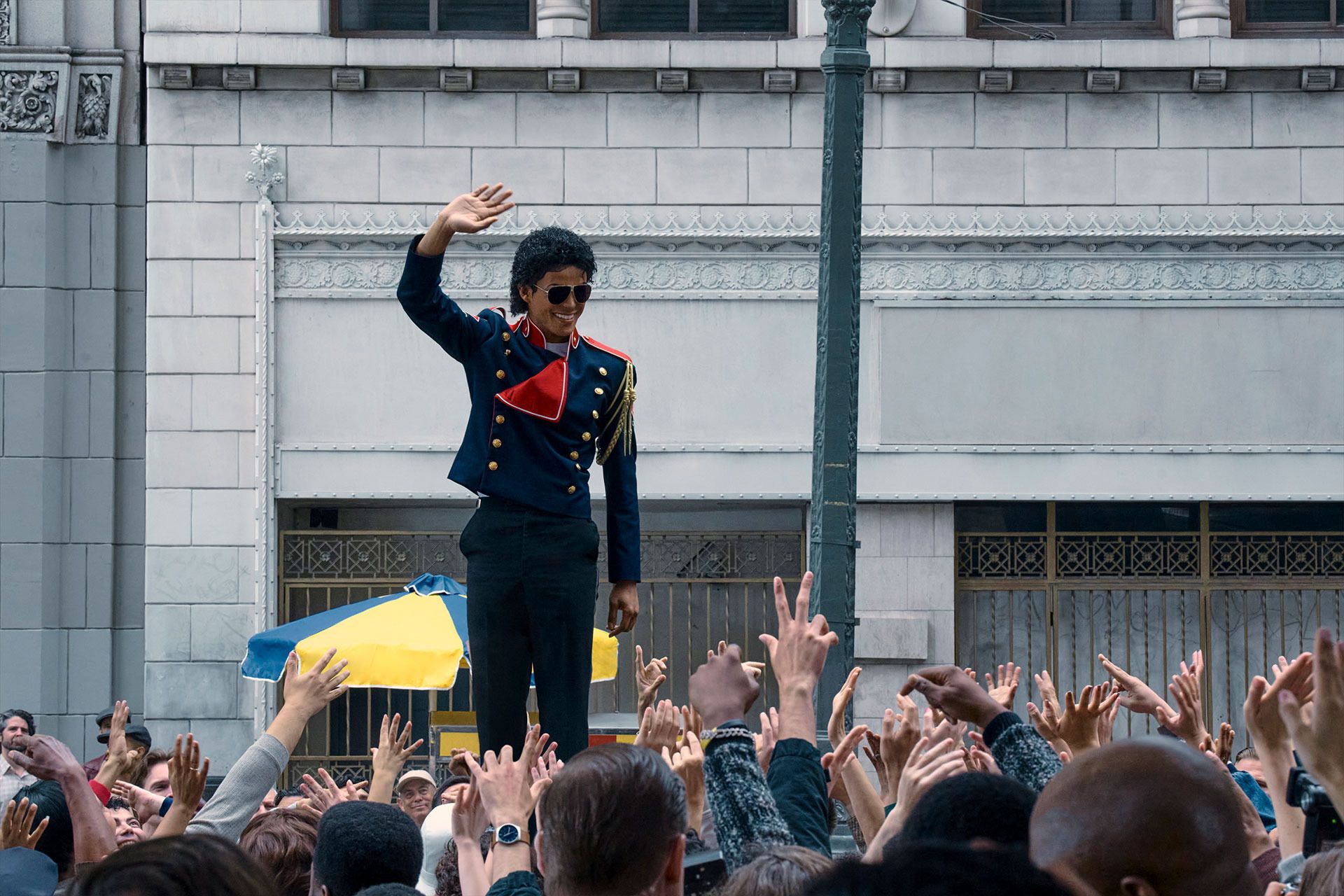
A still from Antoine Fuqua’s film “Michael” (2026
Roughly since the early 2000s, the number of biopics has begun to grow relentlessly. If in the 20th century culture mostly created fictional heroes, conveying meaning to the viewer through conventional characters, then the 21st century suddenly revealed a shortage of ideas. Real people required a more careful approach, but they already provided material for a screenplay. And if it is a “well-promoted” personality, the hero’s name itself becomes a brand that audiences are willing to buy into.
How can you not be interested in the life of an idol — Freddie Mercury, Bob Dylan, Elvis Presley? The commercial advantage is obvious, and if it is also multiplied by the global impoverishment of dramatic thinking, a biopic project is doomed in advance, if not to success, then certainly to interest.
Public interest in the lives of celebrities has always been high, and in the era of the open world, the internet, and social media it has surged even higher. No wonder the popularity of memoirs, interviews, and documentaries about famous people — in short, any nonfiction — has grown so much. The personality of an individual has become more interesting than the context in which that person lived.
If cinema once tried to tell history through events, now it increasingly tells the story of the person at the center of events. The era itself turned out to be less attractive than the person who lived in that era.
But, as they say, there is biopic and there is biopic. If earlier this was one genre with rare exceptions like Tarkovsky’s “Andrei Rublev”, Parajanov’s “Sayat-Nova”, or Forman’s “Amadeus”, now it has split into two subgenres. Biopics are now loosely divided into Hollywood-style and poetic ones.
Hollywood-style biopics (it should be noted here that this refers not only to films made directly in Hollywood — “Hollywood” here is merely a genre definition) are similar in structure. The concept is usually simple and direct, like a railroad tie. Take any film biography and you will see the same thing: a difficult childhood, the beginning of the journey, first recognition, success, crisis, decline, overcoming obstacles, triumph, or a tragic ending. And of course, a love story with a happy ending, as a rule.
The dramaturgy confidently moves through the hero’s main life milestones, describing the psychological motivation behind their actions depending on the screenwriter’s and director’s level of professionalism. Often, authors become absorbed in simply marching through the milestones, blurring cause-and-effect relationships and the logic of the actions, but audiences often forgive this or do not notice it at all.
Among recent biopics, a very characteristic example is Antoine Fuqua’s “Michael” about Michael Jackson. The film was slammed by critics, although everyone unanimously praised Jaafar Jackson’s magnificent performance; he is Michael’s nephew and sings and moves no worse than his uncle. But audiences were more compliant — by mid-June, “Michael” had grossed about 930 million dollars. No wonder: the whole world went to see an idol. Although for a film of this scale, a 7.5 rating on imdb.com is hardly a record.
Why did critics attack the film so fiercely? Very simply — they expected some kind of exploration of such a controversial figure as Michael Jackson. Everyone already knows about his rise and achievements. If the creators had tried to understand the life of a hero full of the darkest deeds, and the reasons for his early death, then the film could have had not only box office success but also professional recognition. However, the filmmakers immediately decided not to offend the feelings of believers in the infallibility of the “King of Pop”, never once mentioning the shadow side of his life.
Ideally, the story of Michael Jackson in all its variety seems made to become the basis of a poetic biopic — his life is too intricate, his personality too ambiguous. But it would not work for fans — they need milestones, not introspection.
Today, the main author of poetic biopics can probably be called Chilean director Pablo Larraín. Over the past 10 years, he has made four biographical films — “Jackie”, “Neruda”, “Spencer”, and “Maria”. “Jackie” tells of Jacqueline Kennedy’s first days after the murder of her husband, U.S. President John F. Kennedy. At first, the dramaturgy seems chaotic, reality is interwoven with dreams, memories, and fantasies, but you quickly understand that this chaos is the key to understanding the heroine’s state. She is confused, her thoughts are tangled, warm memories of a life of love with her husband are constantly displaced by the latest memories of the tragedy.
“Neruda” is a film about the Chilean poet Pablo Neruda, about his political battles with enemies, told from the perspective of a police detective who is tasked with finding Neruda after he goes on the run following news of an imminent arrest. At some point the film begins to resemble a dream in which either Neruda is dreaming up the policeman or vice versa; the action becomes nonlinear, and Neruda’s figure grows increasingly ambiguous.
“Spencer” is a story about several days in Princess Diana’s life, the days when she decided to leave the royal family because of Charles’s affair with Camilla (for the role of Diana, Kristen Stewart was nominated for an Oscar), about her wavering between duty and desire, about happy memories.
“Maria” is the story of Maria Callas, who lost her voice. How will an opera star of global stature endure this tragedy, will she come to terms with it, how many small tragedies against the backdrop of one big one still await her — and the viewer, together with Maria, wanders through the labyrinth of her soul, sometimes pitying the heroine, sometimes smirking, sometimes feeling unexpected irritation. Undoubtedly Angelina Jolie’s best role. All of Larraín’s biopics tell about a period in the hero’s/heroines life when fame has already arrived, unlike Hollywood biographical films, which trace the path to fame.
One of the brightest examples of a poetic biopic is Todd Haynes’s “I’m Not There”, in which five actors and one actress play the same Bob Dylan in six episodes, each presented in a different form. It sounds utterly insane, right? But in fact it is a fantastically conceived and executed story about a man about whom making a linear Hollywood film would be sacrilege, because Bob Dylan himself is so elusive and nonlinear. Dylan gave permission for the film, prepared for meetings with the director, but Haynes did not even think about meeting him — it seemed to him that communication with the living hero could only get in the way.
Usually poetic biopics do not win any Oscars, but true cinephiles and true fans of the heroes of these films value them. If you want to get to know your favorite artist, painter, or athlete better, don’t go on a march through milestones with the creators of Hollywood biopics. Look for fantasy and poetry.
If you enjoyed this article, consider making a donation — one-time or, even better, monthly. Your support helps us motivate our authors and become better with every article.
Our organization is recognized by the Internal Revenue Service (IRS) as a 501(c)(3) tax-exempt, charitable organization, which means that all contributions made to us are tax-deductible to the fullest extent permitted by U.S. law. Individuals may generally deduct charitable contributions of up to 60% of their Adjusted Gross Income (AGI) for cash donations made to qualifying 501(c)(3) organizations. For donations of appreciated assets (such as stocks or other long-term capital assets), the deduction is typically limited to 30% of AGI, based on the fair market value of the asset. C-corporations may deduct charitable contributions of up to 10% of their taxable income for donations made to eligible charitable organizations.
By submitting a donation, you confirm that you have read and accept the following documents: Privacy Policy and User Agreement, and also give consent to the processing of your personal data.
If you would like to unsubscribe from a monthly donation, please email us at: [email protected]