For the second week, Siberian farmers have been protesting against the destruction of animals on their farms. Despite public outrage, the slaughter continues and is now spreading to other regions. Slaughter teams arrive with the police, officials read out orders about a “dangerous disease” — but never say which one, and run away from farmers. Conspiracy theories are multiplying across the country.
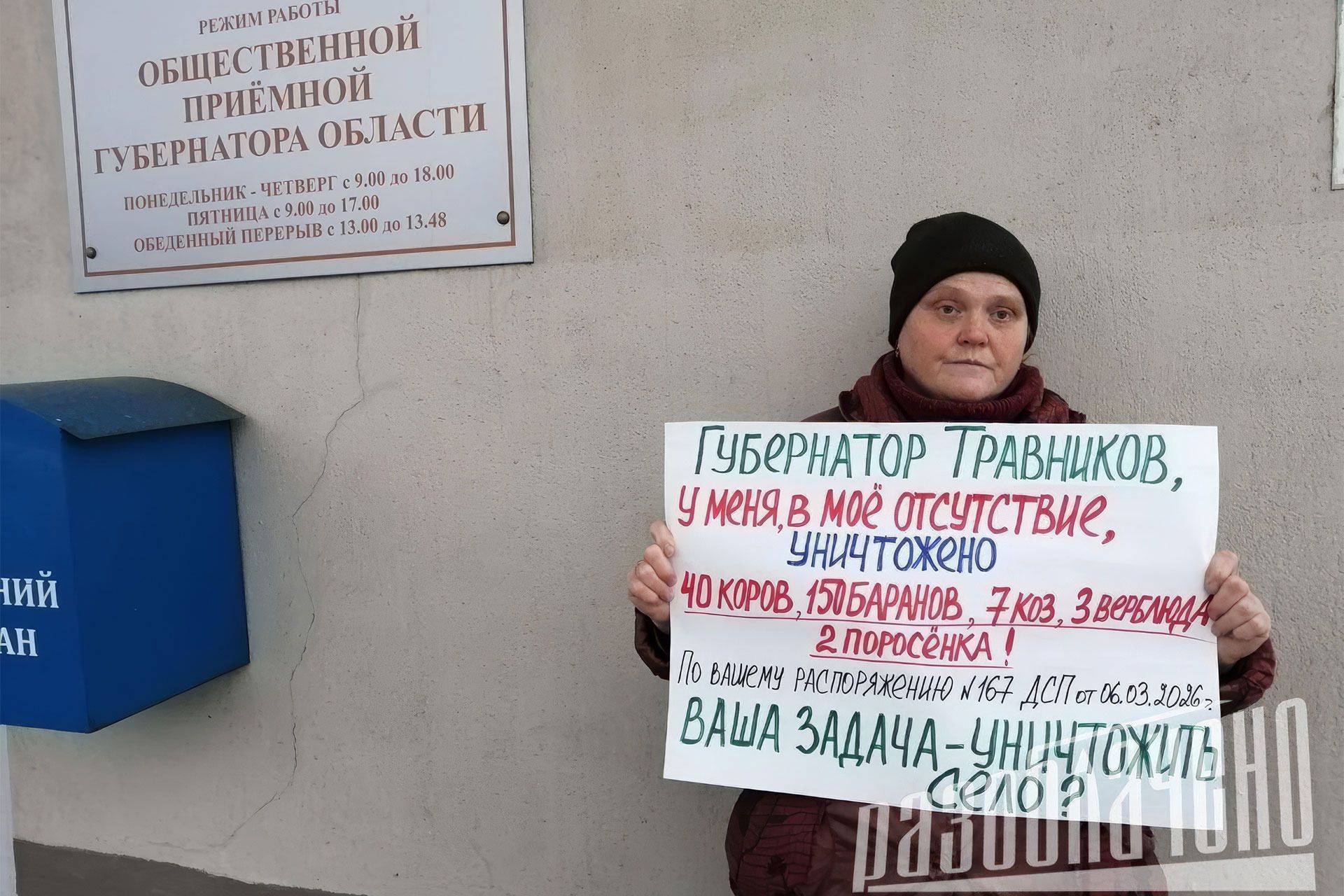
Farmer Svetlana Panina stands at the public reception office of the governor of Novosibirsk region with a homemade sign: “Governor Travnikov, in my absence 40 cows, 150 sheep, 7 goats, three camels, and two piglets were destroyed! By your order No. 167 from 03/06/2026. Is your goal to destroy the village?” Photo: “Agrarian Council” / Telegram
“On what grounds did you take away my farm? Why are you running away? I’ll keep coming to you, I have nothing else left to do,” — video of the Novosibirsk region’s Minister of Agriculture Andrey Shindelov silently and quickly walking away from farmer Svetlana Panina has spread widely online. In Svetlana’s absence, on March 12, a team of veterinarians came to her farm and put down everyone living there — 150 sheep, 40 cows, seven goats, three camels, and two piglets.
In total, tens of thousands of animals have already been destroyed in the Novosibirsk region. The procedure is standard: veterinary workers arrive accompanied by police and tractors, farmers are read an order to destroy the herd “due to an outbreak of a dangerous disease,” the animals are driven outside, put down, and then burned. The burnt remains are buried by tractors — right there, near the farms and settlements. Compensation is promised for the killed animals — 171 rubles per kilogram of live weight, but often the destruction happens without any weighing at all. After protests, there were reports that the payment would be 250 rubles, but so far no compensation has been given, and even this price is nowhere near enough: even a young bull or heifer, which still needs to be raised, costs two or three times more on the market.
At the same time, because of the authorities’ silence, the reason for the mass slaughter of livestock is still unclear, so new theories keep appearing. On closer inspection, none of them fully explains what’s happening.
Pasteurellosis
Officials mention pasteurellosis as the reason for the slaughter. According to them, due to heavy snowfall, wild animals came out of the forest and infected domestic livestock. Outbreaks of pasteurellosis were also reported in the Tomsk region and in Tatarstan.
Pasteurellosis is indeed a fairly dangerous bacterial disease. Above all, because it develops rapidly: the incubation period is up to three days, and the animal often dies as soon as the second day. However, like any bacterial infection, it is treated with antibiotics — you just need to start treatment quickly.
Moreover, with pasteurellosis, it is not necessary to slaughter livestock, even the sick ones; for the rest of the herd, quarantine is applied. According to current veterinary regulations from 2023, for cattle — 90 days, for poultry — 14 days.
And there’s another oddity. One of the first symptoms of the disease is animals refusing food and, in cows, stopping to chew cud, after which they start stumbling and soon lie down. But farmers in numerous videos emphasize: the animals are lively, standing, and eating actively.
Foot-and-mouth disease, rabies, anthrax
The inadequacy of the measures taken has sparked rumors that a more serious disease has actually broken out in Russia, but the authorities are hiding it to avoid losing Siberian meat exports to China and Kazakhstan.
For example, animal rights activist Yuri Koretsky suggests rabies, some sources mention foot-and-mouth disease (this version is actively discussed by officials themselves). And political analyst Dmitry Oreshkin reminds that near Novosibirsk is the famous “Vector” institute, which developed not only vaccines but also bacteriological weapons. In 1979, anthrax spores already leaked from there once before.
Another theory: the domestic vaccine — against pasteurellosis, foot-and-mouth disease, rabies, or anthrax — that the animals were vaccinated with turned out to be of poor quality or ineffective, and now officials are keeping silent about the true cause of the disease to cover it up.
But there are inconsistencies in these theories too. Firstly, the same liveliness and good appetite of the livestock. Secondly — and most importantly — the behavior of the veterinary teams themselves.
The thing is, rabies and foot-and-mouth disease, not to mention anthrax, are dangerous for humans as well. Accordingly, if there is a suspicion of infection among animals, slaughter is carried out in protective suits (and in case of anthrax, in the highest class of protection), with mandatory analysis of carcasses. And, of course, animal remains are not burned or buried next to villages or farms.
Meanwhile, in numerous videos from the slaughter sites, veterinary officials appear in symbolic white coats, slaughter teams are in regular overalls that only protect against blood and dirt. No respirators, no protective face shields — nothing. Police and tractor drivers are in regular clothing. There is no talk of quarantine for the population in the outbreak areas, which is declared in cases of rabies and anthrax, with military cordons along the border.
Competitors’ Schemes
Among the farmers themselves, the most popular theory is that a large meat and dairy producer is entering Siberia and “clearing out” farmer-competitors. Novosibirsk farmers point to a large livestock complex located near the affected districts, where quarantine has been declared but no livestock has been slaughtered. However, most often they say — and even pro-government propagandists have picked up this theory — that it’s about the company “Miratorg,” which is linked to Dmitry Medvedev (the company’s owners, the Linnik brothers, have the same last name as his wife Svetlana’s maiden name).
There are reasons for this too. First, both in Europe and in Russia, milk prices are sharply dropping. By removing farmers’ milk from the market, large producers can increase their profit margins.
Second, in Russia, it’s long been common practice that around large farms, it’s forbidden to keep domestic animals even for personal use. For example, in Belgorod region, for many years before the war, it was forbidden to keep pigs. Around poultry farms, keeping birds is usually banned within several kilometers. This is done both to prevent diseases from private farms and to eliminate competition. This reason is much more substantial: after all, to prevent epizootics, it would be enough to introduce stricter veterinary controls for nearby farms, as is done in Europe.
However, this theory doesn’t fit with the fact that slaughtering animals has started in other regions too: besides Tatarstan, it’s Penza region, Udmurtia, Chuvashia, Altai Krai. Veterinary checkpoints have appeared in Khakassia. Moreover, exports of live animals, meat, and dairy products from several Russian regions have already been banned by Kazakhstan and Belarus. This all seems too large-scale for just competitive warfare.
Right now, it’s hard to say what’s really happening. But here’s one thing that’s certain: the actions of officials, regardless of the real reason, have already done more harm than good.
If this is a real epizootic, the veterinarians’ silence will lead farmers not to believe (and they already don’t) in the need to slaughter livestock. And it’s safe to assume they will start (if they haven’t already) hiding their most valuable animals. Which means, if there’s a real danger of mass infection, the disease will spread — and hopefully people won’t suffer as a result.
If this is an attempt to remove competitors, then as a result, Russian meat and dairy products are being “removed” from export altogether. And the consequences of such secrecy will later make importing countries suspicious of Russian products in general.
And as for Russian citizens, who will soon face yet another increase in meat and dairy prices, they now know exactly whom to thank for it.
If you enjoyed this article, consider making a donation — one-time or, even better, monthly. Your support helps us motivate our authors and become better with every article.
Our organization is recognized by the Internal Revenue Service (IRS) as a 501(c)(3) tax-exempt, charitable organization, which means that all contributions made to us are tax-deductible to the fullest extent permitted by U.S. law. Individuals may generally deduct charitable contributions of up to 60% of their Adjusted Gross Income (AGI) for cash donations made to qualifying 501(c)(3) organizations. For donations of appreciated assets (such as stocks or other long-term capital assets), the deduction is typically limited to 30% of AGI, based on the fair market value of the asset. C-corporations may deduct charitable contributions of up to 10% of their taxable income for donations made to eligible charitable organizations.
By submitting a donation, you confirm that you have read and accept the following documents: Privacy Policy and User Agreement, and also give consent to the processing of your personal data.
If you would like to unsubscribe from a monthly donation, please email us at: [email protected]