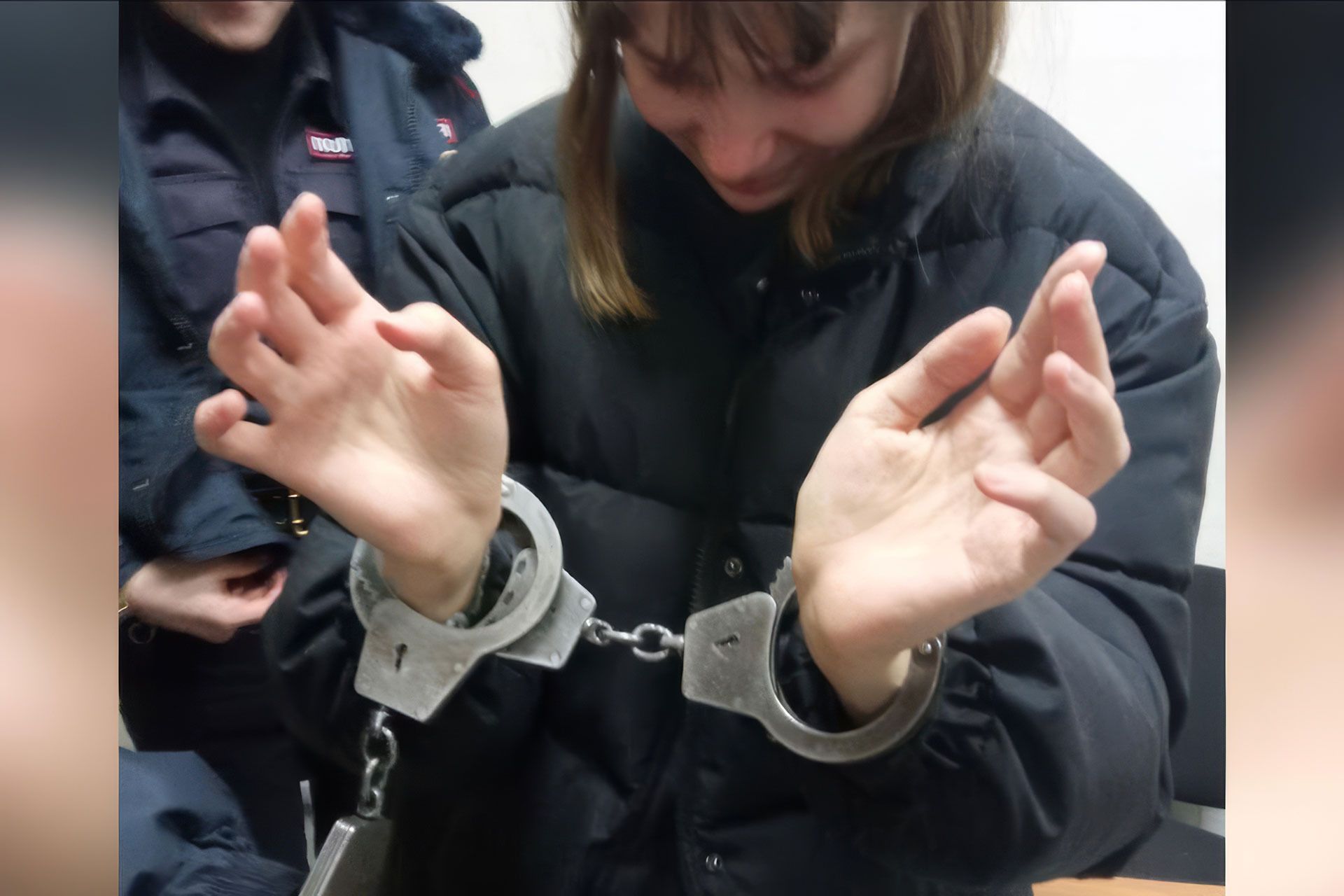
Teachers are being fired, students expelled from universities, schoolchildren interrogated by the FSB, and criminal cases are being opened against their parents. Since February 2022, all this has been happening thanks to informing within educational institutions. The scale of today’s persecutions cannot be compared to Stalin-era purges: millions suffered then, while now it’s hundreds and thousands. But the logic of today’s repressions in Russia increasingly resembles that of the 1930s and 1940s in the USSR.
Screenshot from video: “Romb”
This article was prepared in collaboration with the video project “Romb“
Russian law does not have a clear definition of informing. But any citizen has the right to contact the authorities, and the authorities are obliged to respond. Such reports are increasingly becoming grounds for administrative and criminal cases, says human rights activist Dmitry Anisimov from “OVD-Info” (the Russian Ministry of Justice considers this organization a foreign agent): “Informing acts as a catalyst that allows law enforcement to target people and cause them trouble.”
According to Anisimov, informers are motivated by different things: civic duty—“defending the homeland from enemies,”—financial gain, the desire to secure a position, or career advancement.
Informing is almost becoming a profession, where people monitor, collect screenshots, and “identify” undesirable statements.
According to the human rights activist, informing is especially active in Crimea: there “are entire groups that monitor social networks and pass on information about anti-war statements to law enforcement.” As a result, the region is one of the leaders in the number of administrative cases for “discrediting the army.”
By autumn 2025, over 1,500 such protocols had been drawn up in Crimea. In 2024, there were already at least 10,000 in Russia. Most often, cases under administrative article 20.3.3 are opened in Moscow, Crimea, St. Petersburg, and Krasnodar Krai.
Fear and Dismissals
According to Anisimov, about a third of persecution cases in education start with informing. Nearly two-thirds of teachers, by his estimates, are fired as a result. For a teacher, this is a catastrophe: being dismissed for “violating ethical rules” often closes the door to further employment. Sometimes a principal simply “warns” colleagues at other schools not to hire this person.
The state is increasingly working with youth and monitoring their loyalty through education. Any independent initiative by teachers provokes a hysterical reaction from the authorities. People are persecuted not just for conversations in class—but also for social media posts, even for swimsuit photos.
One example of persecution is the case of Natalia Taranyushenko. An elderly Russian language and literature teacher from the Moscow region showed her class a video about war crimes committed by Russian soldiers in Ukraine. The complaint was filed by the father of two schoolgirls, who himself once studied under Taranyushenko. As “Agentstvo” later learned, he was supported by another parent. A criminal case was opened against the teacher, but she was released under an obligation to appear. She managed to leave Russia—at the age of 65. Later, the court sentenced her in absentia to seven years in a penal colony.
Repression affects not only schools, but other educational institutions as well.
In 2022, English teacher Olga Lizunkova shared a critical view of the war and mobilization with students at a college in Nizhny Novgorod, urging them by any means to avoid participating in the “special operation.” The next day, Olga was suspended from teaching—after two female students reported her. She was charged with “discrediting the army.” She resigned, realizing the environment was no longer safe.
Olga Lizunkova. Screenshot from video: “Romb”
After her dismissal, Lizunkova was fined 30,000 rubles and there was an attempt to open a criminal case. She left Russia—first for Kyrgyzstan, then for Argentina.
Children under Repression
Pressure is felt not only by teachers, but by students as well. For administrators, punitive measures are convenient: it’s easier to expel someone than to deal with an activist.
One of the most high-profile cases of this kind is the story of Masha Moskalyova. In April 2022, when she was 11, the girl drew a Ukrainian family under fire and a Russian flag with the words “No to war” during class. Classmates showed the drawing to the teacher, the teacher to the principal, the principal to the authorities.
Police came to the school. The sixth-grader was interrogated several times. Her father, Alexei Moskalyov, was charged administratively for “discrediting the army”—the reason was a comment online. Then a criminal case was opened for a repeated offense. Their home was searched, Masha was temporarily separated from her father and placed in a shelter. Alexei was sentenced to one year and ten months in prison; he tried to escape but was detained in Belarus and returned to Russia.
After almost two years in prison, he was released and the family left for a neutral country. Now the Moskalyovs are waiting for visas to Germany.
Alexei and Masha Moskalyov. Screenshot from video: “Romb”
At the end of 2022, 19-year-old student of the Northern Federal University in Arkhangelsk, Olesya Krivtsova (included in the list of terrorists and extremists in Russia)was reported by fellow students from the history faculty. Four young people discussed in a chat who among the students could be framed for a criminal case and how to make it convincing. At first, they tried to “set up” another person by provoking them in private messages. But then they switched to Olesya. The reason was her posts and stories on Instagram (Meta is recognized as extremist in Russia), where she criticized the war and commented on the Crimean bridge explosion, as well as reposts and messages in a VKontakte chat where Olesya expressed her opinion about the “occupation” of the “so-called L/DNR.”
The students handed over screenshots to law enforcement. In court, they appeared as witnesses, not as complainants—a typical pattern of modern repression.
It later turned out that one of the informers, Viktor Baev, was also involved in another political case, again as a “random witness.”
Olesya Krivtsova at home three years ago. Screenshot from video: “Romb”
Olesya managed to escape from house arrest and now lives in Norway.
Informing Destroys Schools from Within
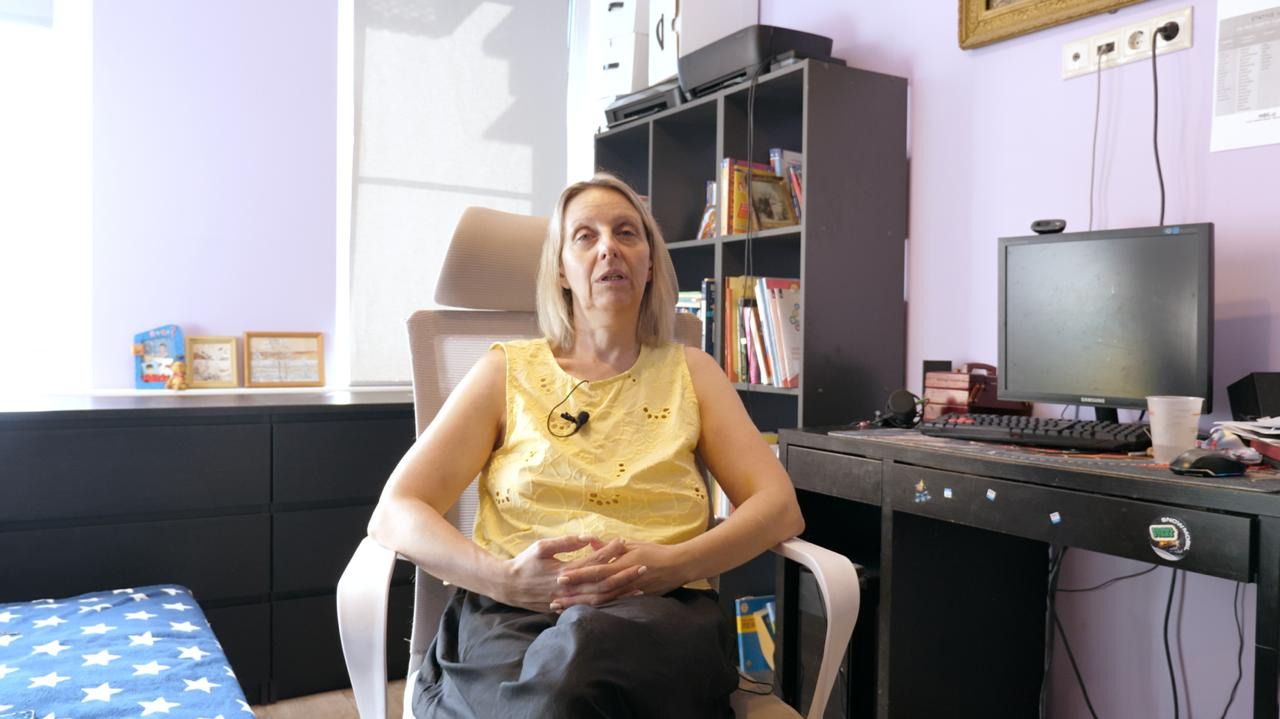
At a school on the outskirts of Moscow, fifty-year-old math teacher Tatyana Chervenko, at the request of parents, held extra math lessons instead of “Conversations About Important Things.” In her free time, she gave an interview to independent media about propaganda in schools and spoke out against the war.
This triggered a wave of reports against her. The first came in summer 2022, outside of school hours. The author was someone named “Anna Korobkova,” who accused the teacher of “pro-Kyiv views.”
At first, the principal defended Tatyana, but a second report—this time to the Commissioner for Children's Rights Maria Lvova-Belova—frightened the administration. The teacher received a series of reprimands: for “improper conduct” of lessons, for giving interviews to the media. In the end, Tatyana was forced to resign.
Tatyana Chervenko. Screenshot from video: “Romb”
Serial informer “Anna Korobkova” wrote at least 74 reports, and according to her own words—at least 1,357. She is called “Russia's top informer.” Social anthropologist Alexandra Arkhipova (the Russian Ministry of Justice considers her a foreign agent) found that behind this pseudonym is Ivan Abaturov from Yekaterinburg, a graduate of UrFU and a postgraduate student at the Department of Philosophy and Cultural Studies at RGPPU, formerly a teacher at one of the Ural colleges. According to Abaturov himself, he was taught to write reports by his grandfather, a former NKVD officer. “Most” reached out to Ivan for comment, but he refused to speak.
Tatyana Chervenko now works at another school and keeps her workplace secret.
Logic Like Stalin’s
A historian from the International “Memorial” (recognized as a foreign agent and liquidated in Russia) S., who asked to remain anonymous, emphasizes: comparing today’s persecutions to Stalinist terror is pointless in terms of scale. In the 1930s–40s, millions went through the repressive system. Today, according to the expert, it’s hundreds and thousands. But what matters is that the logic of modern persecution increasingly resembles that of the 1930s, making the comparison inevitable.
According to S., Stalinist terror was systemic. It simply could not rely on grassroots initiative—in other words, on informing—it was a state machine built on top-down directives, plans, campaigns, quotas, and reporting.
Today’s repression does not repeat Stalin’s on a mass scale, but the mechanisms of pressure are becoming more similar. The investigation no longer matters; what’s important is the fact of persecution itself; reports of torture are increasing.
The historian clarifies: the idea that Stalinist terror “relied” on informing is a common myth. “Informing itself is not that important. Terror is a systemic thing,” S. explains. Soviet agencies could use reports as sources of information, but could not give citizens the initiative—that would be too chaotic.
And although modern Russian authorities also do not depend on informing, they use it as a convenient tool:
to legitimize persecution as a “public demand”;
to increase fear “from below”;
to maintain the sense that the state “sees everything”;
to create grounds for cases that will be included in the statistics of “solved” crimes.
According to S., Soviet reports were often motivated by a desire to show loyalty or to take advantage of a situation—to take someone’s apartment, get a job, or remove a competitor.
Today’s motives are similar. Among them are the desire to demonstrate patriotism; personal hatred; career interests; the wish to “play it safe.” Citizens’ initiative is built into the system: the authorities not only respond to reports but also encourage them as a social practice.
The Complaint Becomes a Tool of Power
Anthropologist Ilya Utekhin (former professor at EUSPb) says that today the word “informing” is replaced by neutral terms like “appeal” or “signal,” but its essence has not changed. The authors of such letters believe they are doing something useful—defending the state and order.
In different eras, informing served different purposes: in Rome—to strengthen power; in revolutionary France—to fight “counterrevolution”; in the USSR—to prove loyalty to the state; in modern Russia—to maintain the myth that society is united in patriotic feeling. Today, informing becomes a form of civic engagement, only turned inside out.
When the state tightens repression, the number of reports always rises. Certain topics become sacralized in society, off-limits for criticism—today, above all, the “special operation,” the army, “spiritual values,” and “patriotic education.” The state demands vigilance and signals about the “disloyal.”
Utekhin emphasizes: in many cases, the authorities themselves instigate complaints—to create the illusion that “society demands punishment,” not the state. And if the state encourages informing, there will always be people ready to fill that niche.
And the authorities cannot ignore such people: failing to respond leads to new complaints—now about the authorities’ “criminal inaction.”
Every case of informing is a break in trust within the most important spaces of socialization: schools, universities, professional communities.
The logic of informing is passed down through generations. This is shown by the story of math teacher Tatyana Chervenko: her grandmother, the daughter of a priest, suffered from a friend’s report after the revolution—she lost her job, became withdrawn, and was afraid to speak openly all her life. Decades later, her granddaughter faces the same thing in modern Russia.
Photo from Tatyana Chervenko’s archive. Screenshot from video: “Romb”
The practice of informing is not an accident, but a long-term cultural pattern that returns when the state creates conditions for it. When the authorities sacralize a certain topic, any “offense” against it becomes a reason for a complaint. And people start writing reports sincerely, believing it is their civic duty.
American historian Sheila Fitzpatrick, who studied Soviet letters to newspapers, notes that people wrote poems, drew pictures—and at the same time, filed loyalist complaints against someone.
In times of active informing, counter-reports always appear. Utekhin gives an example from 1964. There, residents of a communal apartment preemptively write to the department store management about their neighbor being a “complainer.” They warn: if she files a report, it’s a lie. People start defending themselves with the same methods—in advance.
“Informing and the fear of it destroy horizontal ties. It’s a mine laid under Russia’s future,” says anthropologist Ilya Utekhin. And this mine works against the state as well: “Authorities who rely on informing stop seeing reality. They see only a reflection of their own fantasies.”
If the only connection with citizens is material benefits from above and reports from below, the state begins to exist in its own worldview. This makes the system increasingly inadequate and increases the risk of sharp and dangerous decisions.
“It’s like driving on an icy road and not feeling the grip: there’s a risk you’ll skid out someday,” the scholar concludes.
To resist the repressive machine, OVD-Info human rights activists launched the “By Own Will” project. This initiative provides free legal assistance to those who were fired or expelled for political views. Dmitry Anisimov emphasizes: “It’s important not to ignore such cases—that’s how resistance to political repression works. We must seek reinstatement and compensation, even if the person no longer wants to return.”
If you enjoyed this article, consider making a donation — one-time or, even better, monthly. Your support helps us motivate our authors and become better with every article.
Our organization is recognized by the Internal Revenue Service (IRS) as a 501(c)(3) tax-exempt, charitable organization, which means that all contributions made to us are tax-deductible to the fullest extent permitted by U.S. law. Individuals may generally deduct charitable contributions of up to 60% of their Adjusted Gross Income (AGI) for cash donations made to qualifying 501(c)(3) organizations. For donations of appreciated assets (such as stocks or other long-term capital assets), the deduction is typically limited to 30% of AGI, based on the fair market value of the asset. C-corporations may deduct charitable contributions of up to 10% of their taxable income for donations made to eligible charitable organizations.
By submitting a donation, you confirm that you have read and accept the following documents: Privacy Policy and User Agreement, and also give consent to the processing of your personal data.
If you would like to unsubscribe from a monthly donation, please email us at: [email protected]