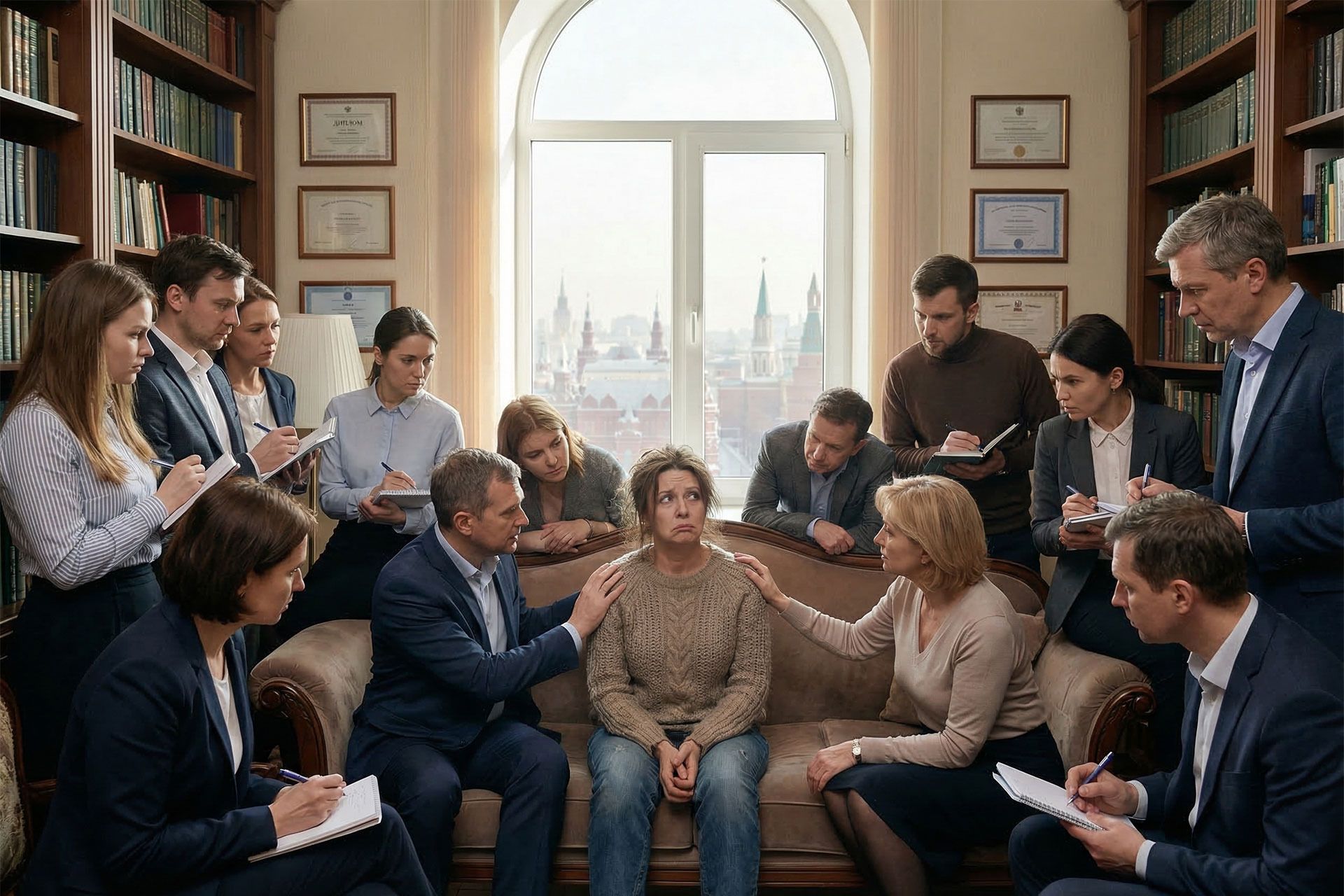
Former choreographers, accountants, and fitness trainers, after express psychology courses, record polished videos and take on children and adults as clients. Their clients either become disillusioned with psychology or end up with psychiatrists with worsened problems. The State Duma has been unable to pass a law regulating private psychologists for 12 years.
Illustration: Google Nano Banana Pro
Against the backdrop of growing anxiety and emotional burnout, the demand for psychological help in Russia continues to rise. According todata from VTsIOM, more than 40% of Russians surveyed in 2025 had consulted a psychologist at least once—twice as many as five years ago. The market is responding quickly: the online psychologist-matching service “Yasno” appeared back in 2017 and now has 4,700 specialists; its competitors are trying to keep up.
“Now people go to psychologists with great enthusiasm: rarely does anyone come to me without first seeing a psychologist,” says private psychotherapist Alexander Dokukin. “People have finally started to understand that such specialists are needed and their help is in demand.” However, according to him, there are only a handful of competent psychologists on the Russian market who can help people with serious problems—depression, psychosomatic disorders, panic attacks.
“Mostly, these are some underqualified or retrained people who, to put it mildly, don't know what they're doing. Every now and then I visit psychological websites—such appalling ignorance there! They don't know the basics of psychiatry,” says Dokukin. “They have no right to work with such conditions, but they take them on anyway! And people go to these amateurs, but the problem remains. Well-trained psychologists see the difficulties and refer people to psychiatrists or psychotherapists, but they are the minority. The rest take on anything.”
At any classical university, future psychologists are warned almost from day one: we are not making you psychotherapists; you (if you wish) will only be able to do psychological counseling in the future and work exclusively with healthy people who need help resolving family issues, finding a way out if relationships with colleagues aren't working, or dealing with a personal crisis.
A difficult divorce, trouble adapting after moving, or breaking up with a loved one—these are also cases for psychologists. But dozens of sessions, “working through childhood trauma,” “closing gestalts,” “healing the inner child” are not needed in such cases—if they're needed at all. Often, the client simply needs to “talk through the problem,” as psychologists call it: the solution is already there, it just needs to be formulated—which is what a competent specialist does, without giving advice.
Only the specialty “Clinical Psychology” grants the right to work in psychiatric hospitals, dispensaries, and rehabilitation centers. But not every university trains such specialists. There is a way: you can become a clinical psychologist by completing a course in the system of additional professional education. But it's not that easy. A psychologist will have to spend at least a year on average in training. If you don't have a basic psychology degree, you can still get a clinical psychologist certificate, but only after signing an information letter stating that in this case, you cannot count on a job as a medical psychologist in Ministry of Health institutions.
These strict restrictions are no accident: depressive and anxiety disorders, neuroses, and PTSD are clinical cases that often require not only therapy and correction but also the prescription of special medications. “Just talking” with such clients is like trying to put out a forest fire with a child's bucket.
But that's only the case in theory.
If, when applying for a job at a school or kindergarten, someone without a psychology degree won't even be considered, almost anyone can become a private-practice psychologist. The work of such psychologists in Russia is still not regulated by law.
“Becoming a 'psychologist' here is very easy: register as self-employed to avoid tax issues, place an ad on Avito or VK—and off you go. If you also write that you're a gestalt therapist, work with eating disorders, or do some kind of family constellations, in other words, add something fancy—clients will snap you up. I'm not exaggerating. I'll show you such profiles on VK now,” explains Anna, who currently works with children and teens. “You can't even imagine what our profession has turned into.”
Her indignation is understandable: Anna has five years of university, postgraduate studies, and university teaching behind her. Now, former choreographers, accountants, landscape designers, and fitness trainers, after commercial courses, record polished videos and take on children and adults. Their clients end up either disillusioned with psychologists altogether, considering them charlatans, or are forced to see psychotherapists and psychiatrists with worsened problems.
“I had a 16-year-old girl with teenage depression. She came asking for help to break up with her boyfriend. But I saw that it was depression, and that's not my area. It took a lot of effort to persuade her and her mother to see a doctor,” Anna recalls. “Her mother later called to thank me—it was moderate depression, the girl was prescribed mild antidepressants and pulled out of that state.”
Large online services are trying to save the situation, but there are questions about them too.
The “Yasno” service claims that only 9% of applicants make it onto their team, higher education diplomas in psychology or medicine are strictly checked, candidates must have at least three years of experience and provide recommendations from senior colleagues or a psychological association. There are many psychologists with degrees from state universities and even PhDs. However, among the psychotherapists, it's not hard to find “bachelors of social sciences” or retrained coaches.
Even more concerning is the breadth of specialists' claimed competencies. Many say they're ready to work with all sorts of issues—from divorce, breakups, job loss, financial changes, and unstable self-esteem to sleep problems, panic attacks, psychological trauma, and eating disorders. There are even “money issue psychologists.”
“I work with any client requests. The main thing is to decide and come to therapy,” writes one psychologist. Another immediately warns: “I invite clients to long-term therapy. I am least interested in short-term work and situational counseling.” But can a person, coming for the first time, really know whether one or two sessions will be enough or if a months-long process lies ahead? The specialists' and service's interest is obvious: long-term therapy means much more money.
“Only 2% of candidates become psychologists for the service, and only 20% of them successfully adapt and are featured on the platform,” future clients are assured on the zigmund.online platform, which has over 1,000 psychologists. Clients are offered a short test, after which an algorithm selects the most suitable methods. For me, it recommended symbol drama, EMDR (eye movement desensitization and reprocessing, EMDR), body-oriented and cognitive-behavioral therapy. Brief explanations like “symbol drama helps work with internal attitudes, images, and symbols that can increase anxiety or a sense of hopelessness” or “EMDR works with traumatic backgrounds that affect well-being and can maintain (?) depressive states“ are unlikely to clarify anything. But it all sounds impressive.
Alter also asks you to answer a few questions about yourself and your problems. I choose the most difficult: “I have a disorder diagnosed by a psychiatrist.” Unlike zigmund.online, the service immediately offers clinical psychologists. The results are puzzling. “My task is to create the most comfortable conditions so that the client can make their own choices,” says one of them. Another assures: “I help find and then change ineffective thinking strategies that hinder rather than help coping with difficulties.” It's doubtful all this would help someone with diagnosed depression.
Despite the claimed strict selection of specialists, all three major Russian services share vague wording, which is not always clear to clients “at the entrance,” and a willingness to work with any problems. Meanwhile, even an experienced family psychologist is by no means always able to handle literally every issue.
No one expects a surgeon to treat diabetes, or an endocrinologist to help a heart attack patient. In psychology, competencies may not be divided quite as strictly, but they are still separated—this is not only due to the specifics of education, but also to experience, which often plays a key role.
Meanwhile, in the State Duma, lawmakers have been trying for 12 years to pass a law regulating the work of private psychologists. The first version was introduced by deputy Lyudmila Shvetsova back in 2014, but parliament rejected the document. Ten years later, the bill was proposed by State Duma Deputy Speaker Anna Kuznetsova—it was also not supported. A year later, deputies from the Communist Party took up the matter, but the government gave it a negative review as well, reminds Kommersant.
In the recently revised version of the document, it is allowed that citizens with higher education in a non-core field and additional professional training with proof of qualification can provide psychological services. In other words, almost everything is still permitted, except perhaps for some “numerologist psychologists” or “astrologer psychologists.” Co-author of the amendments, deputy Nina Ostanina, told Kommersant that the new version of the bill takes into account almost all expert comments.
If you enjoyed this article, consider making a donation — one-time or, even better, monthly. Your support helps us motivate our authors and become better with every article.
Our organization is recognized by the Internal Revenue Service (IRS) as a 501(c)(3) tax-exempt, charitable organization, which means that all contributions made to us are tax-deductible to the fullest extent permitted by U.S. law. Individuals may generally deduct charitable contributions of up to 60% of their Adjusted Gross Income (AGI) for cash donations made to qualifying 501(c)(3) organizations. For donations of appreciated assets (such as stocks or other long-term capital assets), the deduction is typically limited to 30% of AGI, based on the fair market value of the asset. C-corporations may deduct charitable contributions of up to 10% of their taxable income for donations made to eligible charitable organizations.
By submitting a donation, you confirm that you have read and accept the following documents: Privacy Policy and User Agreement, and also give consent to the processing of your personal data.
If you would like to unsubscribe from a monthly donation, please email us at: [email protected]