On the Day of Remembrance for the Victims of Repression, we analyze the most dangerous stereotypes about Stalin’s crimes
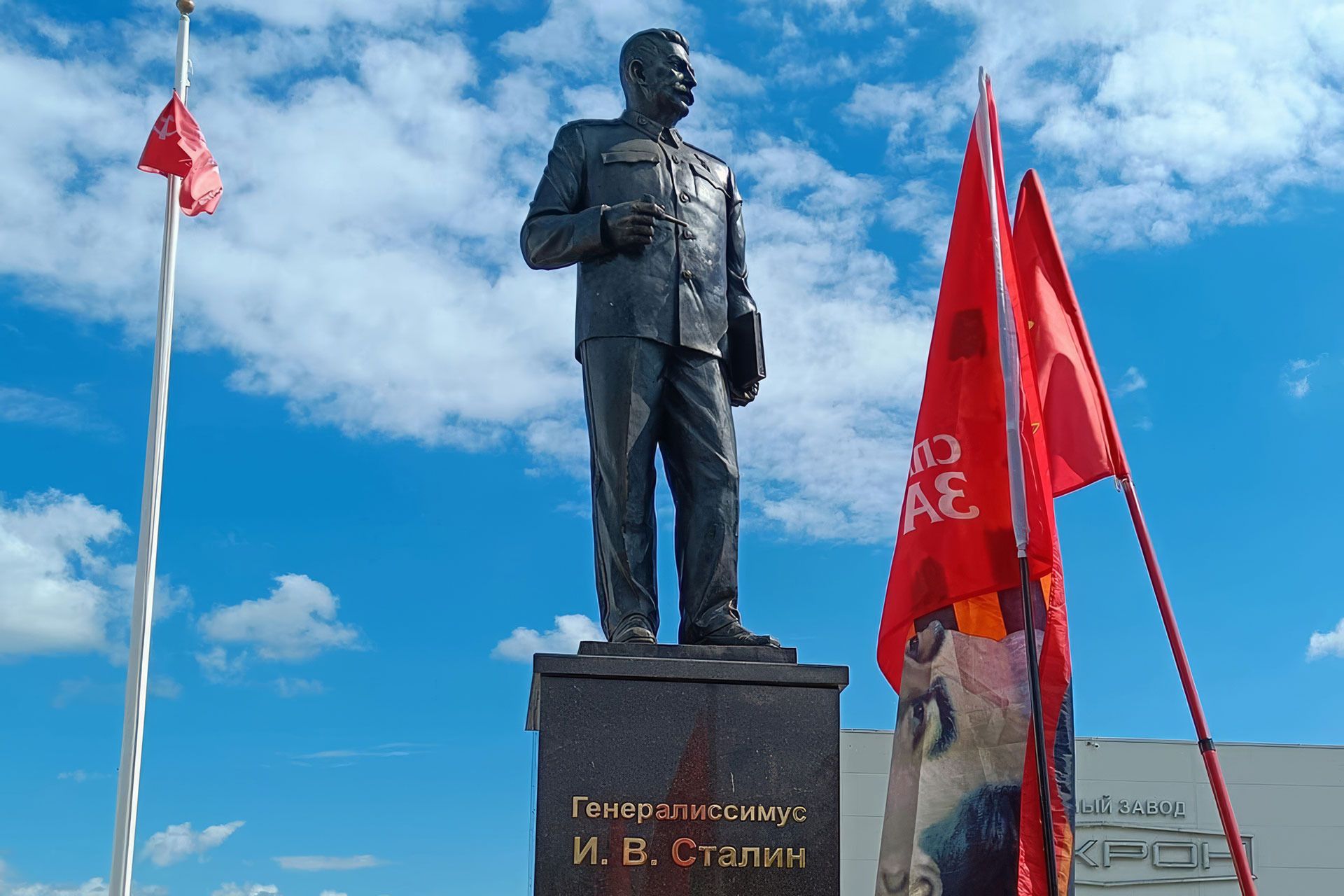
Monument to Stalin in Velikiye Luki (Pskov region), August 2023. Photo: mk.ru / Vladimir Kuryishev. As of summer 2025, there were no fewer than 120 such monuments in Russia (including annexed Crimea). On average, about 4-5 are erected annually in various regions of the Russian Federation
Once, still a schoolboy, I came across an article about Stalinism in the magazine “Around the World” “1937: The Agony of Realization” by political scientist Dmitry Oreshkin. I read it with interest back then, only disturbed by the author’s pessimism toward the end:
The country does not want to know its past. It has not gotten over it. It is ashamed and afraid. It is putting on a brave face and pretending with all its might that it doesn’t care. It believes it had to be that way. Because otherwise, why such sacrifices? Psychologists call this condition Stockholm syndrome: a hostage victim justifies the executioner.
Back then, in 2007, such statements were dismissed as, as people liked to say at the time, “demshiza” (democratic dissent). It seemed Stalinism, like nostalgia for the USSR in general, was historically doomed. That all this was the concern of a small number of unhappy and already older people, albeit sometimes quite prominent in the media. Alas, time has shown: Oreshkin was entirely right.
In recent years, the ghost of Stalin has materialized in Russian reality. It exists in the form of monuments, in the laudatory speeches of senior officials, in poll numbers, and in media events involving the Head of State. But precisely for this reason, it is important to remember the crimes of the “leader” himself — a sickness that our country cannot overcome.
Myth 1. Repressions happened, but their real scale was insignificant
One of the main problems in understanding Stalinist repressions is the fact that it is extremely difficult to bring all victims under a single denominator. Historians will hardly ever dare to state: Stalinism claimed so many millions and so many thousands of victims. Historian Arseny Roginsky on this matter noted:
It is difficult even to define the concept of “victim of the regime.” It can be understood narrowly: victims are those arrested by the political police and convicted on political charges by various judicial and quasi-judicial bodies. Or it can be understood broadly to include not only various types of deportees, those who died from man-made famine, and those killed in provoked conflicts, but also [soldiers who died in World War II] and [unborn] children, etc.
Indeed, dictatorships usually suppress specific groups of citizens they dislike: opposition activists, ethnic minorities, disloyal religious groups and sects. Stalinism, however, defied all rules. For political reasons, it could target a bohemian director from Moscow or a shepherd from a Caucasian village, a celebrated Red Army commander or a simple locksmith from a district center. Any of these four could be sent straight to a shooting range, perish in a polar camp, serve the entire sentence “until the bell,” or even have their case reviewed.
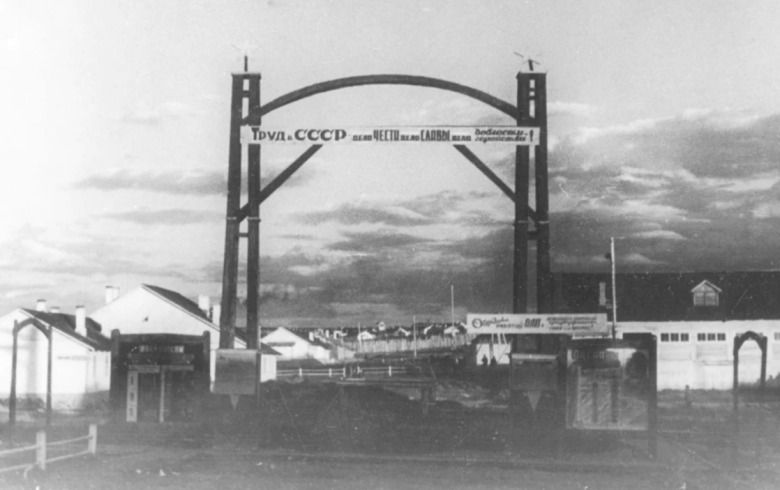
The motto “Labor in the USSR is a matter of honor, glory, valor, and heroism” above the gates of Vorkutlag, late 1930s. Photo: Wikipedia
It is relatively easy to count those executed. During perestroika, the last KGB chief Vladimir Kryuchkov acknowledged 786,098 citizens sentenced to the “highest measure” between 1930 and 1953 (i.e., during Stalin’s sole rule). It is important to emphasize: not just sentenced to death, but sentenced specifically on political charges. Even if Kryuchkov’s figure is complete, it is already a very large number. For comparison, in 1906-1911, military tribunals in Tsarist Russia sentenced 5,735 people to death for participating in the First Russian Revolution, and between 1825 and 1905, only 625 people were executed in the empire.
It is much harder to account for those who passed through (or, conversely, did not survive) various camps, prisons, “special settlements,” and places of exile. According to the most conservative estimates, this system processed over 20 million people between 1930 and 1953. Most of them were not formally political prisoners, but neither were they criminals in the usual sense.
Myth 2. Ordinary citizens faced no danger under Stalin; only elite members suffered
As American scholar Anne Applebaum, who worked in Soviet archives during perestroika, testified, most prisoners under Stalin were precisely those considered ordinary people.
Even in 1937-1938, at the height of the Great Terror, university graduates made up just over one percent of the total Gulag population. Meanwhile, over 80% of their comrades were illiterate or had only basic education.
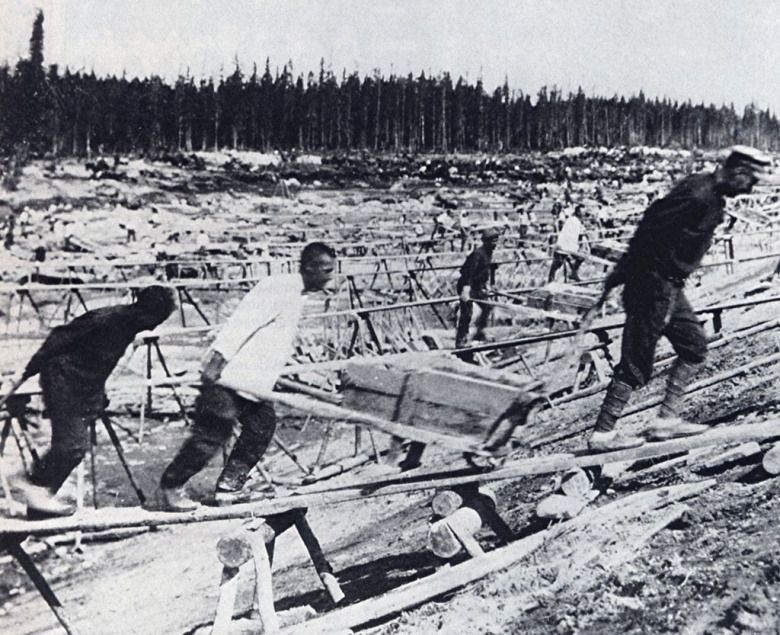
Prisoners building the ultimately economically useless White Sea Canal, 1932. Photo: Wikipedia
Law-abiding citizens continued to be imprisoned for nothing up until the dictator’s death. This reflected Stalinist legislation, where even minor offenses were treated as criminal acts, including being late for work. Additionally, during times of semi-famine, people tried to feed their families through petty thefts and under-the-table deals, but the regime was indifferent.
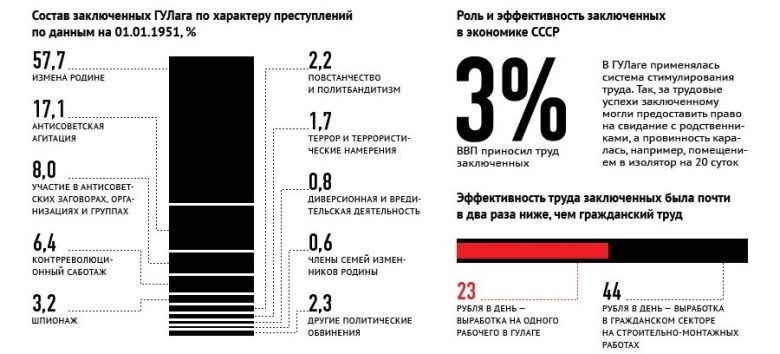
Gulag prisoner composition and their role in the Soviet economy by the 1950s. Contrary to another Stalinist myth, prisoners’ labor actually caused huge losses to the treasury — maintaining the vast camp system was too costly. Infographic: antisovetsky.livejournal.com
Applebaum cites the example of the Polyansky ITL camp in Krasnoyarsk Krai. After World War II, this remote place held “dangerous criminals” like a man who stole one galosh at a market (sentenced to 6 years), an accomplice in stealing ten loaves of bread (10 years), and a “speculator” who resold several packs of cigarettes (only 5 years).
In the inverted world of the Gulag, criminal “offenders” were often no more criminal than “political” prisoners — active opponents of the regime.
- Anne Applebaum
By the time of Stalin’s death, so many such people were in the camps that even at the highest levels it was recognized as absurd to keep “petty criminals” with real offenders. On March 28, 1953, the authorities enacted the so-called “Beria amnesty,” which freed about 1.2 million people convicted of minor non-political crimes. However, many had acquired criminal habits during their time in the Gulag, and among those released were embezzlers, abortionists, and troublemakers, as well as many hardened criminals who exploited loopholes in the amnesty.
Myth 3. Repressions are only about 1937. Before and after, the authorities were not especially brutal
This opinion is not without grounds. The year 1937 — or more precisely the period from August 1936 to November 1938 — was largely the climax of Stalinism. This period saw the peak of death sentences in the USSR on political charges; these 27 months are historiographically called the Great Terror. In the calendar year 1937 alone, courts and extrajudicial bodies executed more than 353,000 people — nearly half of all those executed under Stalin.
Of course, Soviet justice was not struck by a sudden murderous frenzy. Chekists, judges, and prosecutors followed Stalin’s will, who decided to demonstratively purge the ruling elite and replace it with loyalists. This was primarily realized through:
- the three Moscow Trials of prominent Bolsheviks, mainly Stalin’s intra-party opponents from the 1920s;
- repressions in the Red Army command;
- two waves of bloody “rotations” in the leadership of the People’s Commissariat for Internal Affairs, the main instrument of terror.
At the same time, the authorities conducted much larger campaigns. The largest was the so-called “kulak operation” ordered by NKVD directive No. 00447 of July 30, 1937. It meant a massive purge in all republics and regions of the USSR according to quotas from the center, which localities were expected to exceed. Contrary to the established name, the operation targeted not only kulaks but anyone fitting the vague category of “anti-Soviet element.” This included those practicing any religion, those connected abroad, former White Army members, members of small non-Bolshevik parties or internal opposition within the VKP(b), and anyone who had ever lived abroad.
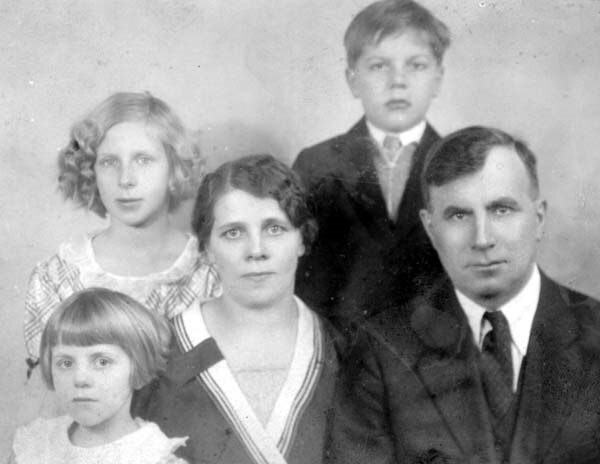
Communist from the USA Oscar Korgan with family. An ethnic Finn who for ideological reasons moved to the Soviet Union in the 1930s along with hundreds of compatriots, becoming one of thousands of victims of the Great Terror in Karelia. Photo: severreal.org
In short, in 1937, repressions affected top public figures and simultaneously reached ordinary households. And it was impossible to escape them anywhere in the Union. Armenian chekists fulfilled Moscow’s quotas just as zealously as, say, Karelians, and the NKVD in the so-called West Siberian region was as active as in Uzbekistan. But this does not mean repressions did not occur before or after the Great Terror.
Initially, we look at the late 1920s and early 1930s — there were cases against the old intelligentsia, technical and humanities (“Promparty,” “Shakhty,” “Slavists,” etc.). Then 1932-1934 — full collectivization, which in Kazakhstan, Ukraine, and some RSFSR regions turned almost into genocide. 1935 — the “Kirov stream,” a purge of Leningrad from “enemies of the working class” under the pretext of responding to the assassination of local chief Sergey Kirov. Repressions continued after the Great Terror: mass deportations of disloyal peoples, a second purge of Leningrad, purges in academia, “struggle against cosmopolitans,” and many other fabricated cases.
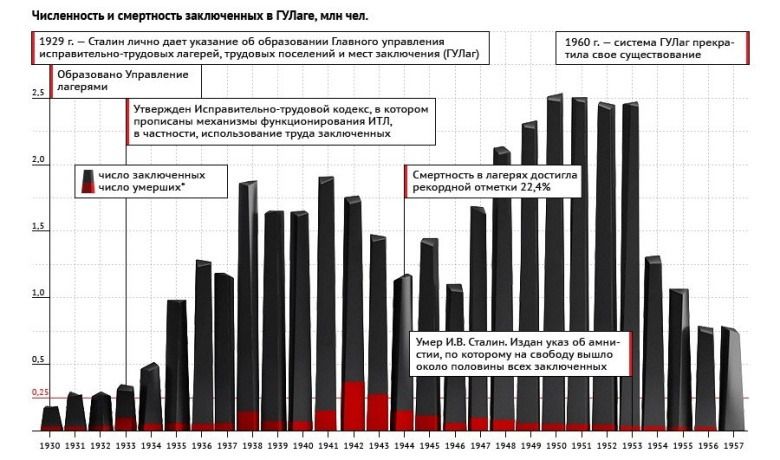
Yes, after the Great Terror, the number of death sentences never approached the 1937 level. However, it is incorrect to equate Stalinist repressions solely with executions. Repressions also entailed various forms of deprivation of liberty, and the number sentenced rose exponentially until March 5, 1953. At Stalin’s death, over 5.4 million citizens of the USSR were in camps, prisons, “special settlements,” and exile — about 3% of the entire population,many times more than in the late 1930s.
Dynamics of Gulag prisoner numbers by year. As can be seen, the “peak of Stalinism” came after the victory in World War II. Infographic: antisovetsky.livejournal.com
In other words, the Stalinist system constantly needed an internal enemy and mobilization of the security apparatus against it. Only the groups considered enemies changed. What happened specifically in 1937 was so grand in scale that educated Russian-speaking urban residents could not ignore it. Hence the infamous four digits are etched forever in collective memory.
Myth 4. Stalin did not know or knew very little about the nature and scale of repressions
Of all attempts to rationalize the 1930-1953 repressions, this is the most untenable. It is absurd to think that in a totalitarian state its all-powerful leader could be unaware of the actions of his own bureaucrats and security forces.
As early as January 1933, at a VKP(b) Central Committee plenum, Stalin put forward the thesis of the intensification of class struggle as Soviet society moved toward communism. This Marxist scholasticism bore a very concrete and grim meaning: constant purges were the guarantee of the established power’s survival. Stalin honestly kept this promise. The head of state was the instigator of every repressive campaign, as all served to preserve his unlimited power.
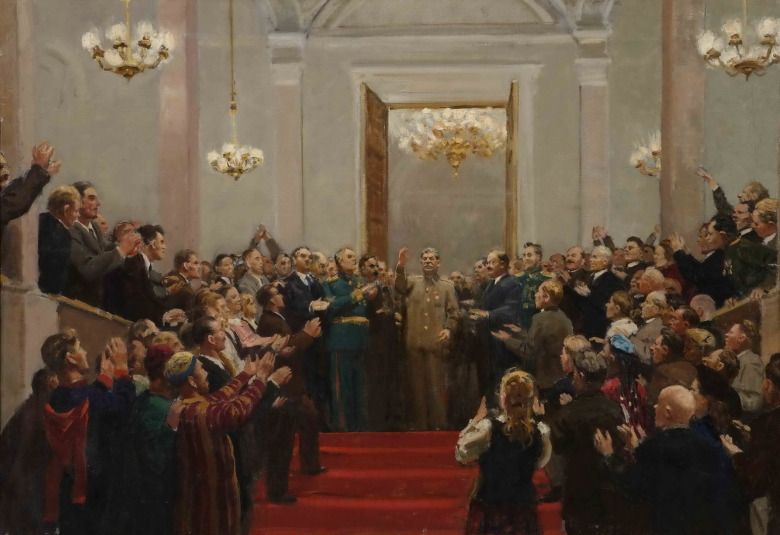
“Glory to the Great Stalin,” painting by Viktor Tsyplakov, 1950. Image: media.tumblr.com
Moreover, Stalin supervised them strategically, controlling all USSR regions. Countless notes and markings by the dictator survive on top of chekist reports with instructions on how, where, and with whom to work. Historian Oleg Khlevnyuk in “Stalin: The Life of a Leader” provides an exhaustive collection of such quotes just for September 1937, addressed to NKVD head Nikolai Yezhov: “Very important. Sweep through the Udmurt, Mari, Chuvash, Mordovian republics with a broom”; “Beat Unshlikht for not revealing Polish agents by regions“; ”Very good! Dig and clean out this Polish-spy filth from now on.“
Fictions about an “alternative Stalin” are not supported by any real facts, let alone basic logic. […] Party and state officials, who according to this theory [of a “Stalin who knew nothing”] organized terror, actually became its first victims.
- Oleg Khlevnyuk
Terror for Stalin was not just a practical tool to maintain power. According to numerous testimonies, the leader enjoyed playing with victims. He asked NKVD officers how particular detainees — commanders or party members — behaved, read their complaints and written confessions, written in desperate attempts to save their lives.
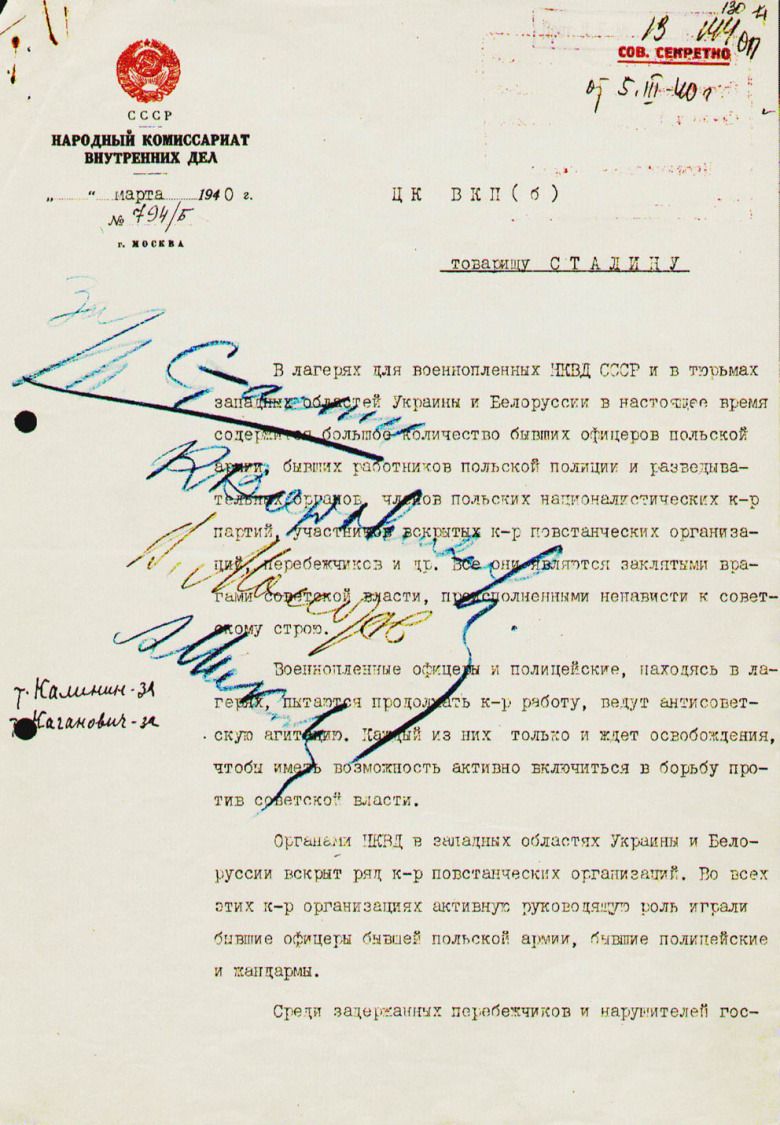
One of many pieces of evidence of Stalin’s direct involvement in repressions — the dictator’s signature on a proposal by Lavrentiy Beria to destroy over 20,000 Poles captured during the 1939 campaign. Image: Wikipedia / RGASPI F. 17 op. 166 file 621 sheet 130
Major of State Security Alexander Orlov, who fled to the USA in 1938, recalled a characteristic episode. On December 20, 1936 — the day of the chekists — Stalin informally met with a group of NKVD chiefs. One of them, Stalin’s security chief Karl Pauker, amused the patron by “performing” the life finale of recently executed Grigory Zinoviev. The chekist, acting as a party member, begged on his knees to “call Joseph Vissarionovich,” imitated a Jewish prayer, and did other antics. The main viewer laughed so hard he was out of breath and gestured for Pauker to stop.
Six months later, Pauker himself was executed in another NKVD purge. Perhaps someone later even reenacted Pauker’s last moments for Stalin.
Myth 5. Soviet citizens massively informed on each other — that’s why repressions happened
Of all Stalin-related myths, this one is arguably the most harmful. Slightly twisted, it becomes pure victim-blaming: Stalin and the NKVD were not the bad ones, ordinary people were. That uninformed citizens were snitching en masse. What else could the chekists do but act on the received tips?
Supporters of this theory often cite a popular quote from Sergey Dovlatov: “We endlessly criticize Comrade Stalin, and rightly so. But I want to ask — who wrote four million denunciations?” But first, this phrase is taken out of context, and second, the stated number should be understood as a literary device. No professional historian dares to estimate how many denunciations were written during Stalin’s years.
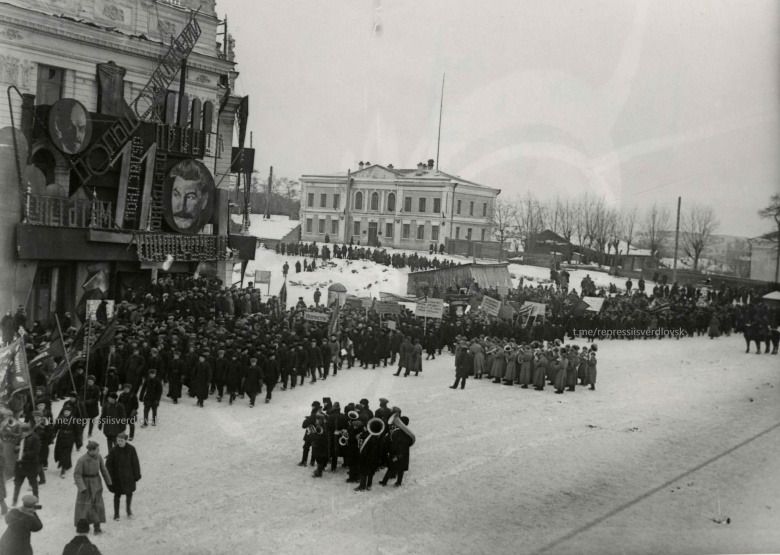
Demonstration during a regional party conference in Sverdlovsk, 1937. Photo: t.me / repressiisverdlovsk / CDOSSO Archive
Thirdly, separating informers from the regime is fundamentally wrong. The authorities, including Stalin personally, cultivated denunciations as civic virtue. Active informers like doctor Lidia Timashuk or biologist Trofim Lysenko often advanced their careers. But in reality, “tips” mostly served as an ideological fiction needed by Stalinism (to show the people and party were united). Their practical importance in arrests and fabricated cases — especially during the Great Terror — was limited.
“Operations” were massive and fast; people were arrested by lists from card files. Denunciations were rare and often concerned a person years before. I remember one case: someone joked at a meeting commemorating Kirov [in December 1934]. A sexot wrote to the NKVD, but the note lay there for years. Then in 1937, that joker was arrested for another reason — a supposed “Polish line” — and only then did the 1934 document surface. You read it and realize: the denunciation wasn’t the cause of arrest.
- Oleg Novosyolov, researcher of repressions in Sverdlovsk region
Another important point is that not all Stalin-era informers were like antagonists in “The Count of Monte Cristo,” who coldly used denunciations to settle scores and advance in career and love. In the USSR during mass repressions, denunciations were often extracted under torture — beaten and frightened detainees tried to save their lives this way.
Myth 6. The 1930s were a special time — so the laws were accordingly special
This attempt to reconcile with Stalinism is also unconvincing. From the perspective of written law, repressions in the USSR were a continuous legal collision.
For example, in January 1939, the regime legalized the aforementioned torture — retroactively and by a special act personally signed by Stalin. Meanwhile, anti-torture articles remained in Soviet law. This came in handy in 1939-1940 when the NKVD purged people from Yezhov’s team, the main executors of the Great Terror: they knew too much. Besides phantom counterrevolution, Trotskyism, and espionage for foreign intelligence, Beria’s new team accused Yezhov’s people of real abuse of power.
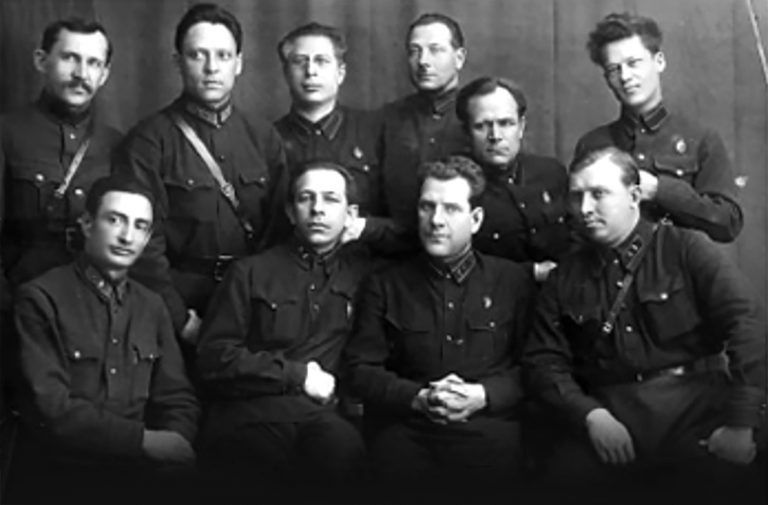
Group photo of NKVD staff in one of the Ural regions, 1930s. Photo: Wikipedia
Soviet laws formally promised citizens not only protection from torture. It is worth recalling that on December 5, 1936, the USSR adopted a constitution written in a liberal spirit. Its articles proclaimed freedom of speech and conscience, freedom of assembly and association, secrecy of correspondence, inviolability of person and home. That is, legally, there was no special period when the state officially restricted citizens’ rights — whether due to preparations for a great war or other reasons. Nevertheless, the Stalinist leadership began violating all these promises as soon as the new constitution was adopted.
Another important point: Stalinism consistently violated basic principles of any legal school. Responsibility before the law (or rather its appearance) in the USSR at that time was collective. This primarily applied to “ChSIR”, relatives of those convicted on political charges. In the late 1930s, such people faced 5 to 8 years imprisonment for the nonexistent crimes of their relatives. Near Kazakhstan’s Tselinograd (modern Astana), there was even a special camp for wives of traitors to the Motherland.
- Why did repressions extend to wives and children?
- What do you mean “why”? They had to be isolated. Otherwise, of course, they would spread complaints and decay to some extent.
- from an interview of Stalin’s associate Vyacheslav Molotov to his son-in-law Felix Chuev, 1970s.
Collective responsibility in Stalin’s USSR was borne not only by families but entire peoples. In the 21st century, we mostly remember the mass deportations of 1941-1945 under the pretext of military necessity: Kalmyks, Crimean Tatars, Volga Germans, and ethnic groups of the North Caucasus. However, in reality, the regime practiced this both before and after the war with Nazi Germany. Under various pretexts, tens of nationalities were forcibly resettled, from Ingrian Finns to Russian Koreans of the Far East.
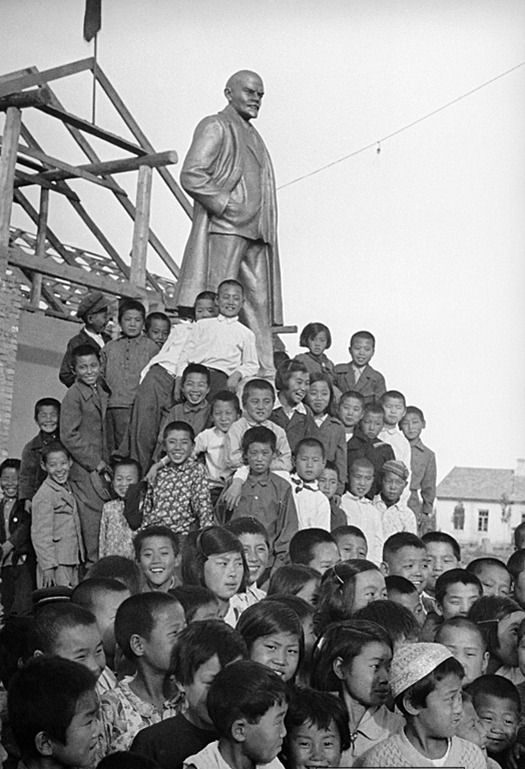
Deported Korean children in Uzbekistan, 1939. Photo: Wikipedia / MaxPenson
The NKVD deported disgraced ethnic groups in a deliberately inhumane manner. Everyone from newborns to the very old was given minimal time to gather. Deportations stretched over weeks with minimal food and medical care — people began dying already on the trains. Those who survived were usually settled in uninhabited areas of Siberia and Central Asia with harsh unfamiliar climates. According to British historian Michael Ellman, at least 3.5 million people were deported on ethnic grounds in Stalin’s USSR.
Finally, the state did not always lag behind former political prisoners. On February 21, 1948, the Supreme Soviet ordered the renewed persecution of “counterrevolutionaries” who had served their sentences — contrary to the basic legal principle that a person can only be punished once for any offense. Thus Stalinism throughout its history was a continuous mockery of jurisprudence.
Myth 7. Repressions helped the USSR win World War II
This misconception is based on the classic logical error of confusing “after” with “because of.” In rough terms, it’s like adjusting a math problem’s solution to fit a known result. But objectively, there is hardly any basis to say that in the 1930s the NKVD purged the “fifth column” (in the army and civilian population), which then helped defeat Hitler.
Such an argument would make sense if in June 1941 the German Wehrmacht had been decisively expelled from Soviet territory. In reality, as everyone knows, the opposite happened. It is also important that Soviet people in captivity and occupied territories collaborated with the enemy at roughly the same levels as in Nazi-occupied European countries. Moreover, while in France or the Netherlands collaborators were mostly local far-right party activists, in the USSR these were often members and candidates of the VKP(b) — supposedly reliable citizens who had passed all required checks.
Here it is appropriate to recall the most famous Soviet collaborator — Lieutenant General Andrey Vlasov. The purges in the Red Army did not reveal the future commander of the “Russian Liberation Army”: thanks to them, Vlasov advanced his career. In 1936, the young corps commander led only a regiment, and four years later he became a brigade commander (roughly a brigadier general). During the height of the Great Terror, Vlasov sat on district military tribunals and sentenced comrades to death.
Photo of Andrey Vlasov (bottom left) alongside other Soviet commanders distinguished in the Moscow battle of winter 1942
Vlasov’s career rise in the late 1930s was not exceptional. Many mid-level commanders achieved similar success in those years. This was facilitated by Stalin’s ruthless purge of the Red Army’s top command. According to historian Oleg Suvenir, from 1937 to 1941, over 65% of commanders ranked from brigade commander (captain 1st rank) and above were repressed in the army and navy. Vacant positions passed to younger commanders often lacking talent, experience, and education.
Another important point: an unwritten rule operated in all Stalinist purges. After arresting a leader — party bureaucrat, scientist, chekist, or military — those considered their protégés were inevitably targeted.
Imagine a Komsomol purge in a specific region. The “organs” arrest the first secretary, an enemy of the people, and look: who are the second and third secretaries? Who led the sectors? Surely protégés of the exposed “enemy,” so they must have absorbed his vices. They arrest them too — except maybe those who quickly sided with the persecution [of the former first secretary]. So everything kind of spreads in circles.
- Nikita Petrov, historian
So when we read about the fall of Mikhail Tukhachevsky, Vasily Blyukher, or Ieronim Uborevich, we should keep in mind an unpleasant fact. Behind the fall of a marshal or commander came a brutal purge of their real and imagined followers. The tragedy of one man turned into a catastrophe for dozens of subordinates.
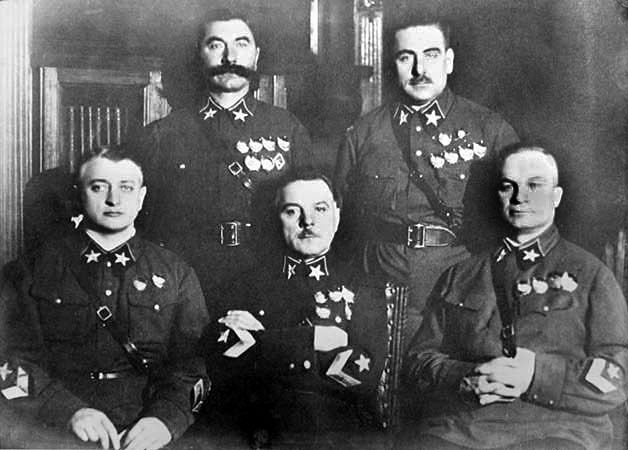
The first five marshals of the USSR in 1936: Mikhail Tukhachevsky, Kliment Voroshilov, Alexander Yegorov (seated), Semyon Budyonny, and Vasily Blyukher (standing). Three of them would not survive the coming purges, costing the lives of dozens connected to them
Everyone knows about the BM-13 “Katyusha” rocket mortar, a symbol of the Great Patriotic War in the post-Soviet space. But far fewer know the name of the inventor of RS-82 and RS-132 rockets fired by the BM-13 — Georgy Langemak. And even fewer recall his fate: he was executed in 1937 as a German spy. Langemak simply got caught up in the purge of the Reactive Research Institute in Moscow, considered the brainchild of the already executed Marshal Tukhachevsky.
If you enjoyed this article, consider making a donation — one-time or, even better, monthly. Your support helps us motivate our authors and become better with every article.
Our organization is recognized by the Internal Revenue Service (IRS) as a 501(c)(3) tax-exempt, charitable organization, which means that all contributions made to us are tax-deductible to the fullest extent permitted by U.S. law. Individuals may generally deduct charitable contributions of up to 60% of their Adjusted Gross Income (AGI) for cash donations made to qualifying 501(c)(3) organizations. For donations of appreciated assets (such as stocks or other long-term capital assets), the deduction is typically limited to 30% of AGI, based on the fair market value of the asset. C-corporations may deduct charitable contributions of up to 10% of their taxable income for donations made to eligible charitable organizations.
By submitting a donation, you confirm that you have read and accept the following documents: Privacy Policy and User Agreement, and also give consent to the processing of your personal data.
If you would like to unsubscribe from a monthly donation, please email us at: [email protected]