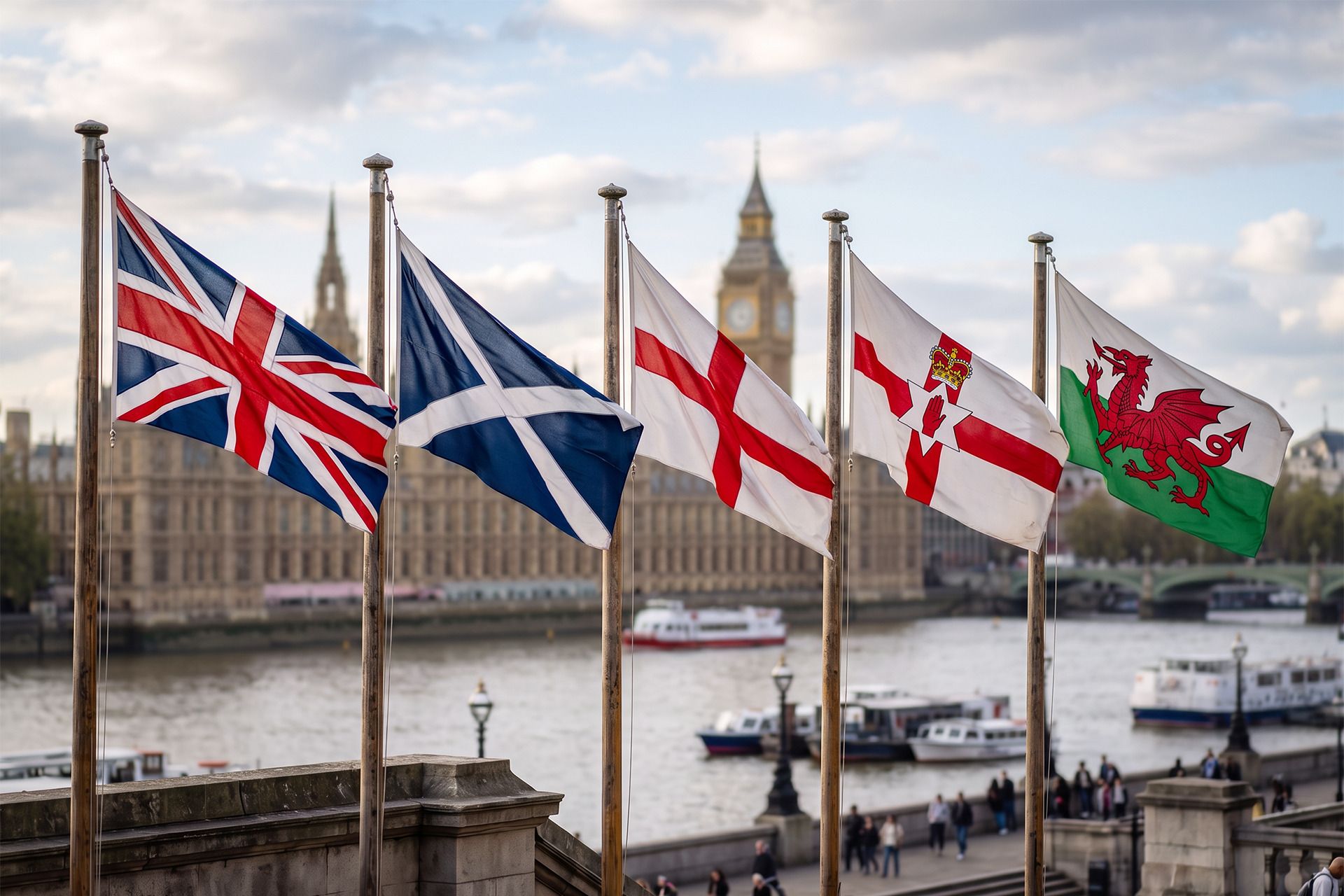
Scotland, Wales and Northern Ireland have spoken together for the first time in favor of the right to self-determination. What will happen to Britain now?
The news about the memorandum in support of the rights of the peoples of Scotland, Northern Ireland and Wales to self-determination, signed by the leaders of the ruling national parties, caused an enthusiastic reaction in Russia. Pro-government media were filled with headlines like: “Britain is falling apart”, “The breakup of Great Britain in 2026”, and so on. Not surprisingly: in the understanding of the Russian authorities and many Russians, the departure of any regions from any country is “disintegration”, “collapse”, and generally “horror, horror, horror”. In reality, there is no breakup of Britain yet, and none is expected in the near future. But there is still a serious topic for discussion.
Image: Google Nano Banana / MostMedia
The leaders of the ruling nationalist parties of Scotland, Wales and Northern Ireland, who gathered on September 14 in Cardiff — John Swinney, Rhun ap Iorwerth and Michelle O’Neill — said they would act within the constitutional laws of the United Kingdom. For Scotland and Wales, the path to a referendum depends on Westminster. In November 2022, the Supreme Court confirmed that the Scottish parliament has no right to call an independence referendum on its own.
Northern Ireland has a different legal regime: the possibility of a referendum on unification with the Republic of Ireland is explicitly provided for by the Belfast Agreement and British legislation
Supporters of Scottish independence, however, are not discouraged. Nicola Sturgeon, former First Minister of Scotland, said at the time: “Today’s decision closes only one of the paths to ensuring that Scotland’s voice on independence is heard. But in a democracy, silencing us is impossible and will not work”.
The new Prime Minister of the United Kingdom, Andy Burnham, initially said that for Scotland, as for Northern Ireland, a clear change in public opinion should matter when deciding on a referendum. However, he later clarified that the government’s position had not changed and that a new referendum on Scottish independence is not currently under consideration.
As for Northern Ireland, the referendum will be “considered by the Secretary of State for Northern Ireland when there is a clear consensus in the country [on this issue]“.
The meeting of the leaders of British separatists in the Welsh capital took place two days after U.S. President Donald Trump’s visit to Ireland. There he said that he would like to see a united Ireland and that “if it is going to happen someday anyway, then why not do it now”
Meanwhile, even if Northern Ireland were able to hold a referendum now on leaving the United Kingdom and joining the Republic of Ireland, supporters of this idea would have little chance of winning it. According to a poll from last year, only 36% of respondents in Northern Ireland supported such a decision. In Wales, in a survey conducted in August this year, only 32% expressed support for the region’s independence from Britain.
In Scotland, meanwhile, the idea of independence is currently supported by 47% of those surveyed. In the first referendum on Scottish independence in 2014, 45% voted for sovereignty. Since then, support for independence has fluctuated roughly in the range of 45–50%
Nevertheless, there is one important change: for the first time, the leaders of three national regions jointly declared their desire to leave the United Kingdom.
To understand how the situation could develop further, let us look at demographic statistics.
The total population of the United Kingdom of Great Britain and Northern Ireland, according to the preliminary estimate for mid-2025, is about 69.5 million people.
At the same time, Scotland’s population, according to the latest available data for 2024, is about 5.5 million people.
Wales’s population is about 3.2 million people.
Northern Ireland’s population is 1.9 million people.
If we imagine that all three of these regions do eventually leave Britain, England would be left with about 58.6 million people. That means it would still be one of the largest European states by population.
The remaining part of the United Kingdom would likely seek to preserve its status as a nuclear power and its membership in NATO. Although Scottish independence would create a serious problem: all four British strategic nuclear submarines are based at Faslane in Scotland, and nuclear warheads are stored nearby in Coulport. Therefore, the fate of Britain’s nuclear arsenal would inevitably become a subject of negotiations
On the other hand, if Northern Ireland joined the Republic of Ireland, it would increase the European Union’s territory on the British Isles. Scotland and Wales are also ready to move in the same direction. The parties governing these regions, in the event of leaving the United Kingdom, intend to join the EU, which Britain left in 2016.
It is worth recalling that the Scots began insisting on a second referendum on independence after Brexit, in which Britain voted to leave the European Union. This was because in Scotland itself, a majority of residents voted to remain in the EU.
Thus, Russia will gain no geopolitical benefit from the “collapse” of Britain. Quite the opposite.
The example of Scotland, Northern Ireland and Wales leaving the United Kingdom (if it does happen) would be a serious signal for the growth of separatist sentiment in Russia, whose population is diverse.
Today, it includes eight national republics in which Russians do not make up the majority of the population: Chechnya, Ingushetia, Tuva, Kalmykia, Dagestan, Tatarstan, Yakutia and Bashkortostan. And there is experience of the struggle for self-determination in some of these regions, including a very dramatic one.
So Russian propagandists would be better off not stirring up the topic of regional independence. Otherwise, as the saying goes: who dig a pit for another, will fall into it yourself.
If you enjoyed this article, consider making a donation — one-time or, even better, monthly. Your support helps us motivate our authors and become better with every article.
Our organization is recognized by the Internal Revenue Service (IRS) as a 501(c)(3) tax-exempt, charitable organization, which means that all contributions made to us are tax-deductible to the fullest extent permitted by U.S. law. Individuals may generally deduct charitable contributions of up to 60% of their Adjusted Gross Income (AGI) for cash donations made to qualifying 501(c)(3) organizations. For donations of appreciated assets (such as stocks or other long-term capital assets), the deduction is typically limited to 30% of AGI, based on the fair market value of the asset. C-corporations may deduct charitable contributions of up to 10% of their taxable income for donations made to eligible charitable organizations.
By submitting a donation, you confirm that you have read and accept the following documents: Privacy Policy and User Agreement, and also give consent to the processing of your personal data.
If you would like to unsubscribe from a monthly donation, please email us at: [email protected]