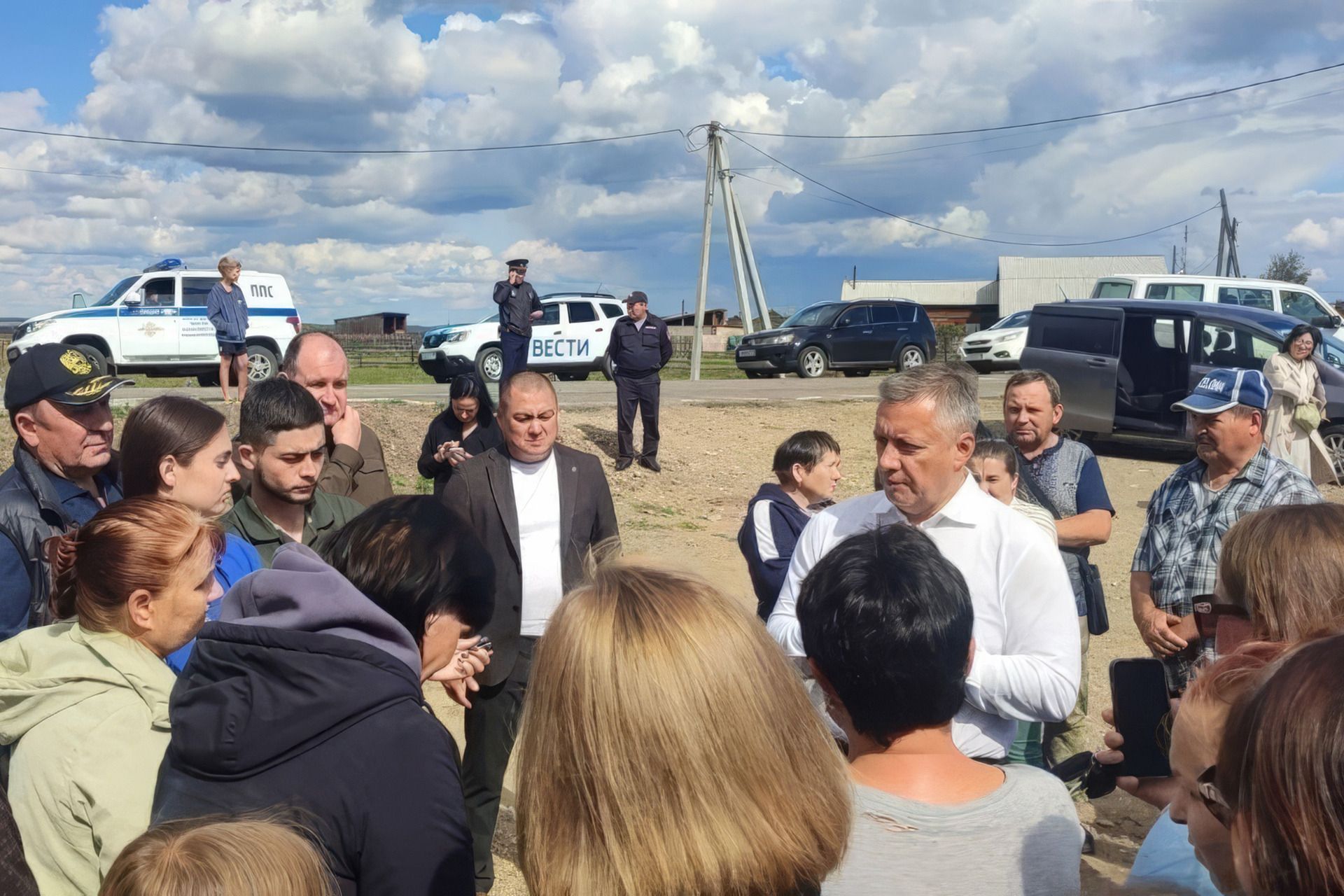
Siberian farmers had barely recovered from the mass slaughter of livestock in the spring when slaughter teams appeared again. This time — in Irkutsk Oblast and Zabaykalsky Krai. Now they are seizing not only cows, but also pigs.
Photo: SOTAvision / Telegram channel of the mayor of Irkutsk Municipal District Leonid Frolov
The first reports came in early September from Tyumen Oblast. A state of emergency was declared there in the Uporovsky, Ishimsky, Omutinsky, and Yurginsky districts. The cause was the mass death of pigs. Only the cause was not named — regional authorities said that “data on the detection of animal diseases is classified information”. However, almost all sources, from local residents to specialists, agree that this is African swine fever (ASF).
African swine fever (ASF) is a highly contagious viral disease affecting domestic and wild pigs, characterized by almost 100% mortality in animals. The disease is not dangerous to humans, as the virus is not transmitted from animals to people. But for pig farms it is a catastrophe: not only is there neither a cure nor a vaccine for the disease, but the virus itself is extremely resilient — in frozen meat, soil, or manure it can survive for months.
Accordingly, the only way to deal with the disease is to impose strict quarantine at the outbreak site, completely cull the livestock regardless of symptoms, ban meat sales within several kilometers of the outbreak, and disinfect the area. Pigs must be destroyed by a bloodless method. In practice, there is really only one such method — a lethal injection.
In general, ASF is not news to farmers, but the lack of information has bred distrust toward the authorities. Veterinarians began saying that the pigs had nodular dermatitis — which, unlike ASF, is treatable. Besides, this is a disease of cattle, and pigs do not get it. But in the end, the regional Main Directorate of the Ministry of Emergency Situations acknowledged ASF, and the only complaint left was the amount of compensation: owners of destroyed pigs were paid 90–95 rubles per kilogram, and for refusing to hand over the animal they were threatened with fines of 30,000–35,000 rubles.
However, soon the destruction of cattle began as well. The diagnosis was the same — nodular dermatitis.
Strange nodules
Just a couple of days after the news about the pig disease in Tyumen Oblast, authorities in Irkutsk Oblast also announced an outbreak of nodular dermatitis and began destroying cows. Independent veterinarians note, first, the inhumane method of killing — the animals are killed with a curare-like poison that causes a long agony from suffocation; second, violations by slaughter teams and the veterinarians accompanying them, who go from yard to yard without changing clothes after finding sick animals. Independent expert and epizootologist Svetlana Shchepetkina says that this is how the causative agent of the disease, which she identifies as foot-and-mouth disease, is spread.
By the way, the country’s largest bioplant producing foot-and-mouth disease vaccines — the Shchyolkovo Biocombinate — has been placed under quarantine. Supposedly for the same “nodular dermatitis”.
This only fuels suspicions that arose back during the spring outbreak of the unknown “dangerous disease” that it was precisely a poorly inactivated virus in the vaccine that caused the epidemic outbreak. At the time, many farmers whose animals were seized noted that they had recently vaccinated against foot-and-mouth disease and the animals had been lethargic for several days afterward.
“Quarantine was introduced for contagious nodular dermatitis. But the clinical picture, the speed of spread of the epizootic (incubation period 24–28 hours), and the actions of the state veterinary service to destroy the animals correspond to the requirements of Order No. 157 of the Ministry of Agriculture dated 24.03.2021 — that is, foot-and-mouth disease. At the same time, other measures provided for by the same order are not being carried out. This is not a fight against disease — it is an attempt to hide the disease by destroying animals”, believes Shchepetkina. In her opinion, the spread of the disease is facilitated by house-to-house inspections in the outbreak zone: the commission does not change clothes, which may have become contaminated with the pathogen.
Residents appealed to the prosecutor’s office, held pickets — all in vain. The only change was that after the arrival of officials, the site where the slaughtered livestock was burned was moved farther away from the villages, and compensation for the slaughtered livestock was raised: 308 rubles per kilogram of small livestock and 190 rubles per kilogram of live pig weight. This is still much less than even the cost price of the animals, not to mention the market price (in Irkutsk pork costs about 900 rubles per kg), but still 83 rubles more than the original amount.
Meanwhile, Buryatia has set up sanitary cordons on the border with Irkutsk Oblast. However, now the situation has flared up in Zabaykalsky Krai.
Can it be treated like this?
In the villages of Shishkino, Nizhny Stan, and Undino-Poselye in Zabaykalsky Krai, quarantine was introduced in connection with emphysematous carbuncle (emkar) — an infectious livestock disease that affects joints and muscles. However, here, unlike in other regions, animals are vaccinated and treated. A couple dozen cows died. The chief physician of the Baley Station for Combating Animal Diseases, Tatyana Ermachkova, said that laboratory tests confirmed emkar. In her opinion, the livestock owners themselves were to blame because they do not vaccinate their animals.
It looks like there really is an emkar outbreak in Zabaykalsky Krai. But what exactly the livestock in Irkutsk Oblast is sick with is unknown. There, the same story as in early spring is repeating itself, when neither the incubation period nor the course of the disease fit any of the explanations given by the authorities and veterinarians.
Perhaps in those regions it was easier for veterinarians to destroy the livestock than to answer for possible consequences? And in Zabaykalsky Krai, were there people willing to take responsibility? Or is it still all because there really is foot-and-mouth disease in Irkutsk Oblast? But why hide it?
The thing is that foot-and-mouth disease is treatable — in fact, as farmers assure, infected livestock that were not killed in time recover on the third to fifth day without any treatment at all. So why are the authorities so afraid to declare an outbreak of foot-and-mouth disease specifically? Because with foot-and-mouth disease, meat sales are banned over a much larger area around the outbreak — this disease is transmitted to humans, although people get a much milder form. Because then an investigation into the source of the disease may begin — and it is not certain that it will not lead to the unfortunate foot-and-mouth disease vaccine — possibly from that same Shchyolkovo Biocombinate, which is now closed under quarantine for “nodular dermatitis”.
During the spring outbreak of the unknown disease, there was suspicion that the authorities feared the closure of meat exports to China and Mongolia — the main buyers of Siberian meat. But China buys Russian pork and beef only from strictly certified enterprises in regions recognized as completely free of ASF and foot-and-mouth disease. As of 2026, Irkutsk Oblast is not included in the list of regions from which such supplies are allowed. Kazakhstan imposed temporary targeted bans on the import and transit of meat from a number of Siberian and border regions of Russia (the list included Altai Krai, Omsk, Novosibirsk, Chelyabinsk Oblasts, etc.) at the first outbreak of the “unknown” disease in those areas. But Irkutsk Oblast was already on Kazakhstan’s stop list before that.
Such treatment of one’s own farmers hurts the prevention of livestock epidemics. Siberia is generally quite troubled by outbreaks of various diseases in wild animals — which here often come into contact with domestic ones. By surrounding disease outbreaks with a veil of secrecy, while at the same time totally destroying livestock, the authorities themselves are provoking farmers to hide sick animals. Epizootics happen all over the world, and for any farmer this is a great grief and a serious loss. But usually the authorities try to combine stick and carrot so that farmers follow sanitary rules and do not hide diseases.
For example, in Serbia, every domestic animal must be registered with a veterinarian. The farmer pays a small monthly fee, under which the veterinarian he chooses regularly examines the animals and vaccinates them according to the vaccination schedule. Treatment is paid for, but hiding a disease is more expensive in the end: first, after slaughter the meat is обязательно checked in a veterinary laboratory; second, if the fact of concealing a contagious disease is established, a hefty fine can be imposed.
In Russia there is no punishment for lack of vaccination, and scheduled checkups are not very good either — but there is fear of punishment from higher-ups. Therefore, veterinary management in the district often sees total destruction as the best solution.
There are also many questions about vaccines. And not only for livestock. In September 2026, Russian media and social networks were flooded with mass complaints from pet owners about domestic vaccines produced by Vetbiohim: “Multifel” (for cats) and “Multikan” (for dogs): the animals developed fever, vomiting, bloody diarrhea — and it often ended in a painful death. The result? The manufacturer privately compensated the owners of the dead animals — and everything quieted down. However, the company recalled several batches of the drug, and Rosselkhoznadzor suspended circulation of “Multikan-8” and began an inspection.
Will the cause of the slaughter of livestock in Irkutsk Oblast ever be known, and are new outbreaks of the mysterious disease awaiting us? Unknown. But one thing is certain: where competent veterinary oversight is replaced by a veil of secrecy and the ends are hidden in water, the repetition of such dramas is only a matter of chance.
If you enjoyed this article, consider making a donation — one-time or, even better, monthly. Your support helps us motivate our authors and become better with every article.
Our organization is recognized by the Internal Revenue Service (IRS) as a 501(c)(3) tax-exempt, charitable organization, which means that all contributions made to us are tax-deductible to the fullest extent permitted by U.S. law. Individuals may generally deduct charitable contributions of up to 60% of their Adjusted Gross Income (AGI) for cash donations made to qualifying 501(c)(3) organizations. For donations of appreciated assets (such as stocks or other long-term capital assets), the deduction is typically limited to 30% of AGI, based on the fair market value of the asset. C-corporations may deduct charitable contributions of up to 10% of their taxable income for donations made to eligible charitable organizations.
By submitting a donation, you confirm that you have read and accept the following documents: Privacy Policy and User Agreement, and also give consent to the processing of your personal data.
If you would like to unsubscribe from a monthly donation, please email us at: [email protected]