Last week, the Supreme Court of the Russian Federation declared the non-existent “International Satanists Movement” extremist. It's surprising that a phenomenon of Western pop culture like satanism still causes moral panic among Russian authorities.
In the information age, people often learn about serious and “adult” matters at an age when critical thinking skills are not even developed yet. This gives unscrupulous politicians the opportunity to recruit young radicals and pimps of the new generation from an early age, while anthropologists have a good chance to study the effects of propaganda and manipulation on an unclouded child's consciousness.
I clearly remember first hearing about satanism in the late 2000s, just as I was starting school—and I remember how this word and its derivatives filled me with indescribable horror. Which is quite natural: Russian society at that time was engulfed in moral panic due to several high-profile incidents presented by the media and authorities with striking bias. It’s worth recalling the 2008 story of Yaroslavl teenagers who ritually killed four peers, the death and subsequent consumption of schoolgirl Karina Buduchyan in 2009, as well as the mythology surrounding the abandoned Khovrinskaya hospital (KHB), which once stirred Moscow.
Notably, any tangible “satanic trace” was seen only in the first case—and even then, considering the personal specifics of the criminals involved, including a person diagnosed with schizophrenia and a drug addict nicknamed “Hitler.” In the second case, the killers were goth and emo youths (also not entirely sane). And no evidence ever emerged that a satanic cell called Nimostor operated in the KHB, allegedly performing sacrifices in the basement of the unfinished building.
“There was no evidence, but accusations of satanic ritual abuse did not disappear... When people become emotionally involved in an issue, common sense and reason take a back seat. People believe what they want to believe and what they need to believe,” commented former FBI agent Ken Lanning. Not about the post-Soviet hysteria, of course, but its Western predecessor—the “satanic panic” that swept the USA in the 1980s. A very curious phenomenon in the American context, it must be noted.
The presidency of Ronald Reagan can be described as a kind of pushback against the progressive countercultural wave that swept the Western world in the 1960s, enchanting it with sexual and religious freedom, pacifism, psychonautics, ideas of equality, and opposition to capitalism.
Reagan and his supporters were not very fond of these things, which explains many social trends of that era. For example, the presidential administration’s ignoring of the AIDS epidemic (the “gay plague”), the Just Say No campaign that quickly evolved from an anti-drug message to “say no” to other 1968 values and became a tool for persecuting Black people, and the satanic panic itself. Which was less satanic and more anti-progressive.
A 1985 report from the popular ABC show 20/20 opens with photos of tortured animals that “were definitely used in some strange ritual, although there is no official explanation.” Soon, the host takes viewers to a shopping mall, focusing on bookstores, music stores, and a video rental shop. All are involved in promoting satanism and discrediting Christian values—because teenagers can buy Anton LaVey’s “Satanic Bible” Anton LaVey, rent tapes of “Rosemary’s Baby,” “The Omen,” or “The Exorcist,” and pick up a couple of records by Ozzy Osbourne or Iron Maiden.
You don’t need to be a media expert to see how manipulative and simply absurd it is to link thousands of cases of satanic abuse (as The New York Times wrote in 1994, none of the 12,000 such “ritual” accusations were confirmed) with listening to heavy metal. As agent Lanning rightly pointed out, emotions block further rational analysis—the uninitiated viewer, shocked by a slideshow of charred dog corpses mixed with Baphomet sigils, readily “buys” the claim that pop culture is responsible. Along with a simplified worldview that blames a specific destructive ideology—satanism—for a surge in violence. The question is why conservative and religious-right forces in the US needed to “sell” exactly this fiction.
And here I return to my childhood to recall when satanism stopped frightening me. It actually happened when Western pop culture was introduced into my upbringing—at age 11, I first heard the Swedish band Ghost, who combine a caricatured satanic image and lyrics about Beelzebub and Lucifer with quite melodious, almost pop-like sounds (recently their song Mary On A Cross went viral on TikTok and Instagram). Shortly after, I came across the animated series “South Park,” where Satan is portrayed as the clumsy lover of Saddam Hussein, and the “demonization” of satanism in my young mind ended there. Something funny or aesthetically appealing cannot scare you.
In fact, Ozzy, who also flirted with occult aesthetics for entertainment, was a similar “de-demonizer” for the 1980s generation. Like Madonna, whose “satanic” concerts the Christian community was urged to avoid by none other than Pope John Paul II, for the 1990s generation. This is a very important feature of modern pop culture—it does not so much promote any values as emphasize the fragility and triviality of established ones, playing with them as mere aesthetic attributes. Madonna illustrates this vividly in the video for the song Like a Prayer.
There is no religion, no Islam, Judaism, or Christianity, no Jesus Christ or Satan—there is only a set of images and myths connected to these concepts, from which homo neoliberalus can assemble a postmodern mosaic to define their own identity.
It no longer requires association with any major institutional movements or Abrahamic religions—in the era of individualism, one is not obliged to constrain oneself with these “outdated” canons and is free to construct new ones independently (from which New Age emerged). This breakdown of the social is the main achievement of the phenomenon Mark Fisher called “capitalist realism,” and Michel Houellebecq criticized with disdain in the novel “Atomised.”
The main problem with this situation is that you cannot build a traditionalist society from atomized elementary particles. Even Auguste Comte, despite his skeptical view of religion, noted that its most important function is to bring people to a state of complete unity—where society is far more cohesive in the face of external or internal threats than when fragmented into thousands of isolated cells. Individualism also does not promote the spread of family values and childbirth, which, from a conservative perspective, creates the perfect foundation for national degeneration and the “great replacement.”
If we set aside the hysteria around ritual murders and extravagant symbolism, it’s easy to see that modern satanism—Anton LaVey’s satanism—is nothing but a cult of radical individualism.
In the already mentioned “Satanic Bible,” under a grim pentagram cover, there is almost a free-form summary of Ayn Rand’s “Atlas Shrugged”: followers of the Church of Satan are instructed not to harm children or animals, not to meddle in others’ affairs or annoy anyone with their opinions; sins are narrow-mindedness and conformity, while commandments exalt life force over spiritual dreams. In other words, LaVeyan satanism opposes Christianity not so much as a battle between good and evil but as a call for permissiveness and enjoyment of life for oneself “here and now,” contrasting with Christian moralizing and self-sacrifice. LaVeyan satanism is a religious expression of neoliberalism.
In the book “Culture of the Apocalypse,” Adam Parfrey published several dozen letters sent to the Church of Satan by its American supporters in 1982. These texts are not about planning bloody rituals—the senders described their dreams of fur coats, penthouses, modeling careers, and wealthy husbands; complained about misunderstanding surroundings; and confessed to wanting to smoke hashish 24/7. LaVey’s followers do not even pay much attention to Satan as a divine figure—for them, he symbolizes the rejection of Christ’s image and “love for all earthly things,” but is not a personalized object of worship.
At this stage of analysis, it becomes clear why Reagan’s supporters were so eager—paradoxical as it may sound—to demonize satanism and its “aesthetic agents” like Osbourne. Satanism per se was never the real target of artificial public condemnation—it’s a colorful, symbolically charged proxy target, with emotional shots aimed at nihilistic individualism. In Ozzy’s case, this was expressed not only in a stylistically defiant attitude toward Christianity but also, for example, in the anti-war song War Pigs from Black Sabbath’s discography. However, attacking pacifism in a democratic society is obviously much less convenient than attacking satanism.
The question remains: what was the ultimate goal of the anti-satanic panic in Russia in the late 2000s and the very unexpected Supreme Court ban last week on the non-existent “International Satanists Movement”? In my view, in the first case, the alarm raised around incidents involving informal youth groups (notably, authorities did not distinguish between subtypes—emos, satanists, and goths shared responsibility for the same “sins”) was intended to prepare public opinion for a wave of “youth repression.” In 2008, State Duma deputies developed a “Concept of State Policy in the Field of Spiritual and Moral Education of Children in the Russian Federation and Protection of Their Morality,” which, among other things, justified curfews for teenagers and equated goths and emos with skinheads and national Bolsheviks in terms of social danger.
At the same time, regions introduced bills banning piercings and pink-black clothing, and youth media like the 2x2 TV channel were targeted for bans by Christian activists (incidentally, because of the series “South Park”). In late 2000s Russia, this had a certain authoritarian meaning—the Kremlin wanted to see youth not as useless elementary particles scattered across dozens of subcultures, but as a consolidated force it could use in its interests through movements like “Nashi” or the “Young Guard of United Russia.” In the 2007 Seliger camp promo, Nashi leader Vasily Yakemenko directly states that one of the movement’s goals is to co-opt young people who are “prey for extremist and radical organizations.”
But the Kremlin has long had no reason to worry about this—there are no influential, uncontrollable youth movements left in the country.
Individualism benefits the current regime only as a preventive measure against mass civil disobedience; “unity” among Russians is needed only locally and is ensured by force and mobilization means, not religion.
And to take seriously the Supreme Court’s or the Russian Orthodox Church’s arguments that satanism threatens “traditional values” (in the absence of which, as I have written extensively in detail and at length in various languages) in 2025 seems simply indecent.
Vladimir Putin is Madonna, not Ronald Reagan. He is not concerned with a conservative restructuring of culture and society; he does not care about the state of Christianity, which in Russia has been turned into a conformist spectacle, or the all-pervading postmodern cynicism. On the contrary, he actively uses it himself, juggling symbols from its livelier past on the scorched field of Russian civic and political life, pretending that satanism still matters in Russia or that there are really any values he can threaten. Tomorrow, cosmopolitanism or Trotskyism will become the new targets of repression, and we will all discuss this agenda shift as if it were Madonna changing her image from 2000s disco to 2010s goth. The impact of these events on Russian reality is comparable.
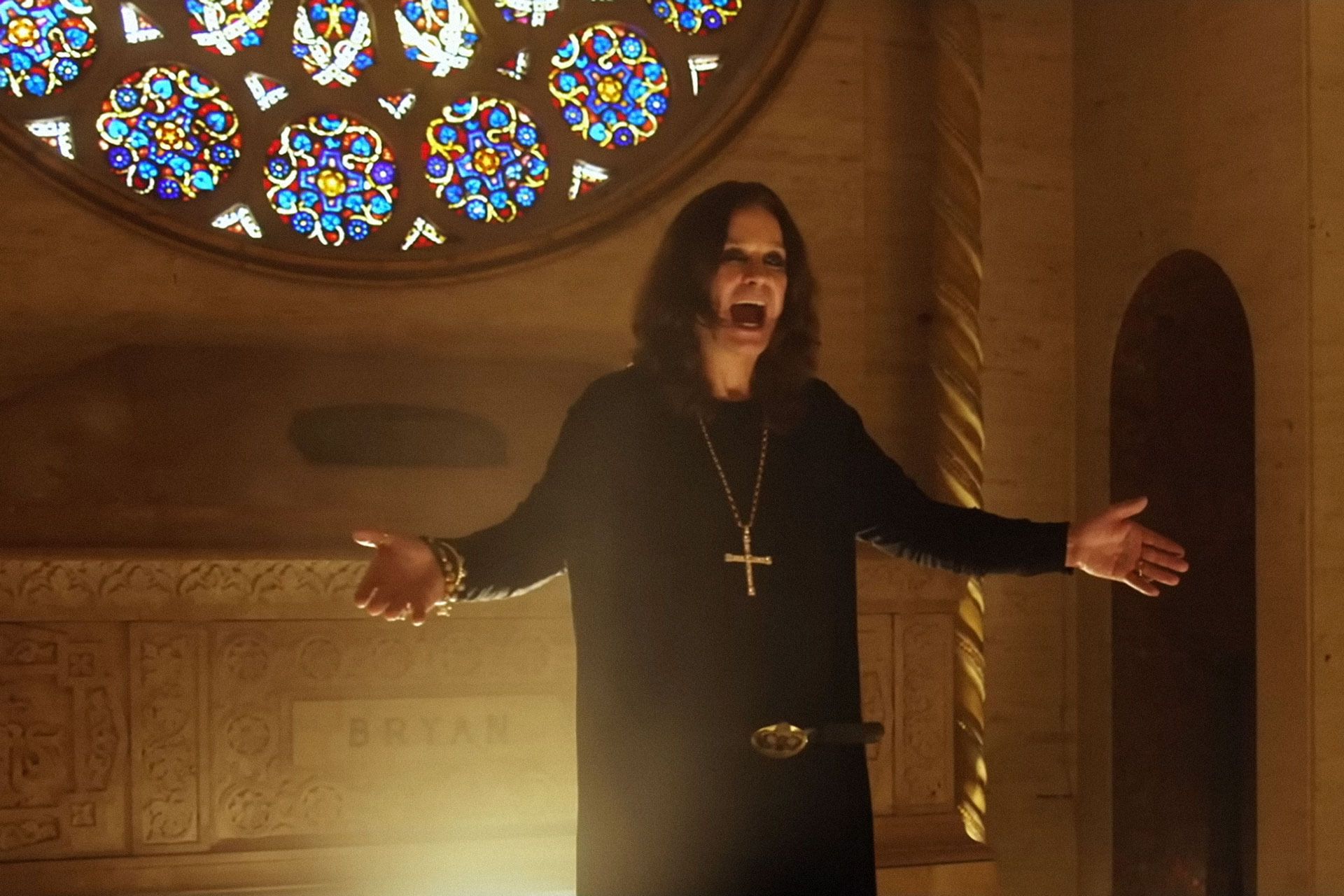
The main photo is a frame from Ozzy Osbourne’s music video “Life Won't Wait”. Source: YouTube / @ozzyosbourne
If you enjoyed this article, consider making a donation — one-time or, even better, monthly. Your support helps us motivate our authors and become better with every article.
Our organization is recognized by the Internal Revenue Service (IRS) as a 501(c)(3) tax-exempt, charitable organization, which means that all contributions made to us are tax-deductible to the fullest extent permitted by U.S. law. Individuals may generally deduct charitable contributions of up to 60% of their Adjusted Gross Income (AGI) for cash donations made to qualifying 501(c)(3) organizations. For donations of appreciated assets (such as stocks or other long-term capital assets), the deduction is typically limited to 30% of AGI, based on the fair market value of the asset. C-corporations may deduct charitable contributions of up to 10% of their taxable income for donations made to eligible charitable organizations.
By submitting a donation, you confirm that you have read and accept the following documents: Privacy Policy and User Agreement, and also give consent to the processing of your personal data.
If you would like to unsubscribe from a monthly donation, please email us at: [email protected]