Russian authorities have been restricting internet freedom for years. But recently, these restrictions have reached unprecedented levels and even surpassed China’s Great Firewall. The blockades are undermining the economy and sparking protests, yet the FSB, which now oversees control of the Russian internet, is not backing down.
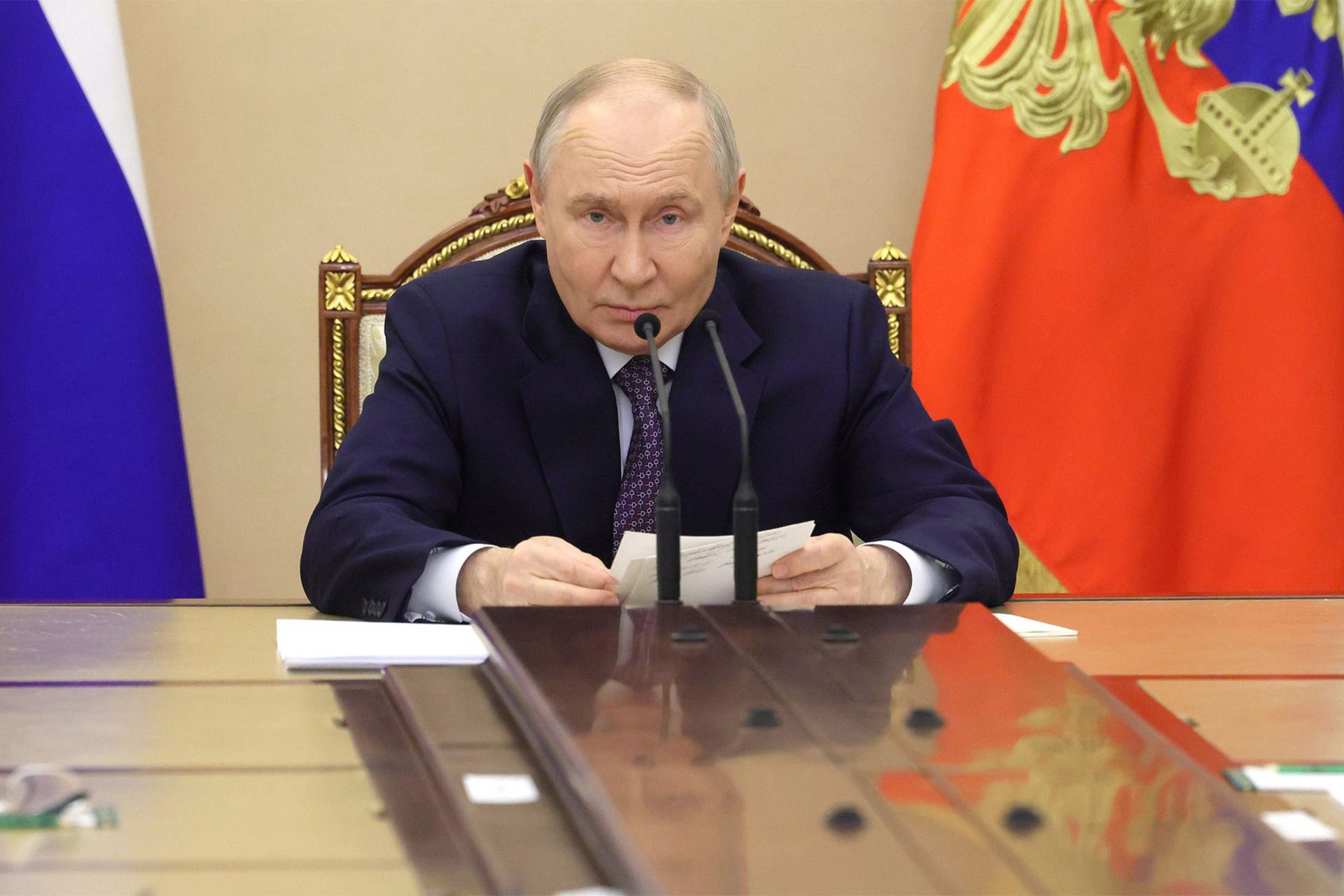
Vladimir Putin at a meeting on election security, April 28, 2026. Photo: kremlin.ru
The Chinese internet was originally created as a system rather isolated from the global network. But this was offset by the active development of domestic social networks, search engines, video channels, messengers, marketplaces, and so on. As a result, the public didn’t protest much—Chinese culture is quite self-sufficient and, by its nature, deeply different from the West. In China, there is no widespread demand for constant monitoring of American or European news (it’s mainly of interest to expert circles).
The situation is different with Runet, which, on the contrary, was built from the very beginning in the 1990s as an integral and fully integrated part of the global internet. Therefore, current attempts by the authorities to isolate Russia from the world wide web inevitably generate protest sentiment. Moreover, domestic technology platforms like VKontakte or Rutube are significantly inferior in quality to their Western and Chinese counterparts.
For example, in China, mobile internet is not cut off, and access to banned sites can be bypassed using VPN technologies. In Russia, however, a system for tracking VPN use on users’ devices has already been implemented. While there are currently no penalties for using it, that may be the next step.
As for mobile internet, it is regularly shut off in most Russian regions. Authorities explain this measure as a way to combat Ukrainian drones, but Ukraine itself is also attacked by Russian drones, yet mobile internet there is not turned off—except during air raid alerts, and not for entire weeks. So the problem lies elsewhere.
Since modern business is closely tied to internet technologies, it suffers enormous losses from these restrictions.
For example, in Moscow alone, five days of mobile internet outages cost up to 5 billion rubles (more than $63 million). By the end of 2025, Russia topped the global list of countries with internet restrictions, and experts estimate its total economic loss from blockades and shutdowns at $11.9 billion.
Nevertheless, the authorities claim that most Russians “understand the need” for such blockades. Moreover, they have allocated another 12 billion rubles ($159 million) to continue the process. They also plan to require all Russian social networks, video services, and marketplaces to distribute official propaganda. In addition, they plan to revoke licenses from more than 90% of independent internet providers who do not always comply with strict government blocking requirements. Meanwhile, large state-affiliated mobile operators have begun to massively restrict their subscribers’ internet access, citing “fraud prevention.”
In Russia, practically all global social networks have already been disabled. For example, Facebook and Instagram have been designated “extremist.” Watching YouTube without a VPN is nearly impossible, as it is deliberately slowed down. Popular messengers like WhatsApp and Telegram are also blocked. Many Russians living abroad have lost the ability to call or even message their elderly relatives who remain in Russia.
Instead, the authorities are pushing a “state messenger” called Max, but most Russians refuse to switch to it. The main reason is that it is clearly a spyware app that reads all user data from phones and passes it to the security services. In addition, it is technically unstable and lacks many of the features found in other well-known messengers, such as end-to-end message encryption.
But the privacy of personal correspondence, although enshrined in the Russian Constitution, is of no concern to the current authorities. On the contrary, they are seeking to violate it completely. For example, the Prosecutor General’s Office wants to obtain even extrajudicial (!) access to Russians’ smartphones, justifying it as “fighting crime.”
The Russian Ministry of Digital Development is preparing to introduce fees for all foreign internet traffic. The government has also banned the import of Starlink terminals, which allowed people to use satellite internet without any blockades.
This isolation of Russia from the global internet and the sharp increase in mobile communication restrictions are gradually provoking public protests. And not just among opposition-minded people, but even among Kremlin-loyal officials and Z-ideologues.
For example, many of the latter are used to running their own Telegram channels, but now they are losing this ability and are protesting, starting to talk about a “digital concentration camp.” Sometimes even well-known regime propagandists and formerly ultra-loyal cultural figures have joined the protests.
Even such a high-ranking official as Sergey Mironov, leader of the “A Just Russia” party and former chairman of the Federation Council, spoke out sharply against blocking Telegram.
Overall, the situation is beginning to resemble a split among the elites, which usually precedes political changes in any country. In addition, these blockades have significantly lowered Putin’s approval rating.
Sources at Bloomberg believe that under these circumstances, the Kremlin might ease some restrictions. However, this seems unlikely.
In Putin’s Russia, censorship has become an end in itself, and the authorities are unwilling to relax it for fear of losing stability. They are afraid of repeating the experience of Perestroika in the late 1980s, when the lifting of censorship quickly led to a civic awakening and, ultimately, the collapse of the totalitarian regime.
Anonymous Russian officials say that almost all of them are against internet shutdowns and blockades, except for one agency—the FSB. But Putin trusts his long-time colleagues there and listens to their viewpoint. He even appointed the FSB’s Second Service—the same one that organized the poisoning of Alexei Navalny—as responsible for “cleansing” Runet and messengers.
Moreover, according to Radio Liberty, FSB officers not only demand tougher restrictions, but they and their close relatives are also making good money by implementing technologies and producing equipment for internet blocking.
This creates a kind of vicious circle: as a result of the blockades, the economy suffers and protest sentiment grows, Putin’s own ratings are rapidly falling, but the authorities stubbornly cling to censorship, thereby pushing the country toward a social crisis. Meanwhile, Putin instructs the government to develop artificial intelligence technologies. But this looks completely absurd and utopian, since AI technologies only work hand in hand with internet freedom, and in an environment of severe restrictions, blockades, and network isolation, their development is impossible. Even his closest allies, such as Igor Sechin, say that creating a “sovereign” AI is technically unfeasible.
And in general, the attempt to cut society off from the global internet is in direct contradiction to the modern world. In the end, this may result in a repeat of the Nepal events of September 2025, when authorities’ attempts to block the internet led to mass protests and a change of government in Nepal.
If you enjoyed this article, consider making a donation — one-time or, even better, monthly. Your support helps us motivate our authors and become better with every article.
Our organization is recognized by the Internal Revenue Service (IRS) as a 501(c)(3) tax-exempt, charitable organization, which means that all contributions made to us are tax-deductible to the fullest extent permitted by U.S. law. Individuals may generally deduct charitable contributions of up to 60% of their Adjusted Gross Income (AGI) for cash donations made to qualifying 501(c)(3) organizations. For donations of appreciated assets (such as stocks or other long-term capital assets), the deduction is typically limited to 30% of AGI, based on the fair market value of the asset. C-corporations may deduct charitable contributions of up to 10% of their taxable income for donations made to eligible charitable organizations.
By submitting a donation, you confirm that you have read and accept the following documents: Privacy Policy and User Agreement, and also give consent to the processing of your personal data.
If you would like to unsubscribe from a monthly donation, please email us at: [email protected]