This is the final text about the problems of mass migration in Europe. More precisely, about the myths that make people think that migrants, especially from Muslim countries, are Europe's main problem. That the economy (for example, the German one) is stagnating because Germany has turned into either a transit point or a boarding house. Where new residents don't want to work, but to live on benefits.
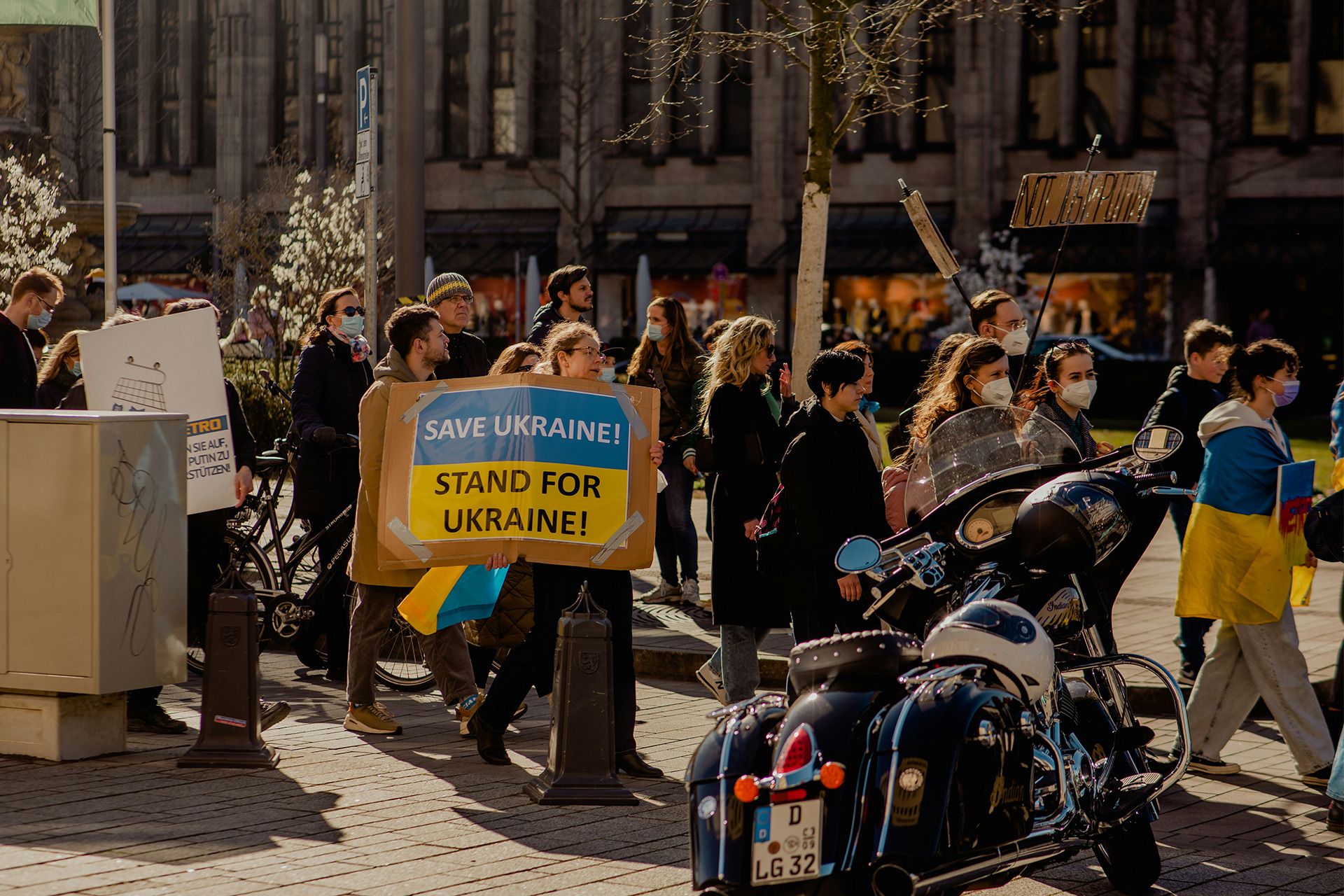
Demonstration in support of Ukraine. Düsseldorf, March 2022. Photo: Eugenia Pan'kiv via Unsplash
The previous text from the series “Migrants: The End of Europe?” can be read here
A few spoilers are needed here.
First. I myself wouldn’t mind living in Germany on benefits, if I had the right to do so. I have zero complexes about it. I’d write a novel and receive Bürgergeld. Look, Limonov also lived on welfare in the USA. That’s when he wrote four of his best books, including “It’s Me, Eddie.” They weren’t published, but the benefits were paid. And to hell with the well-wishers and their “have you tried mopping floors?” Well, you go mop if you can’t do anything else.
Second spoiler. No flow of refugees can cause as much damage to a country’s economy as one well-rooted native: for example, a native Bavarian, Christian Democrat Jens Spahn. While he was Germany’s Minister of Health during Covid, he organized mask procurement in such a way that, according to the Audit Office, the budget lost about 7 billion euros. With possible lawsuits taken into account—about 10. That’s about as much as his party colleague, German Chancellor Friedrich Merz, recently promised to cut from social benefits. And it’s roughly the same amount paid annually to one and a half million Bürgergeld recipients. But Spahn is still in the game: he’s now, cutie, leading his party’s faction in the Bundestag.
Third spoiler (or is this already the main text?). You can, of course, criticize Germany for “stupid leftism,” for “encouraging social freeloaders.” But it’s silly. Germany is a social state, as written in Article 20 of its constitution. And Article 16a enshrines the right to asylum. These are the very frameworks that define Germany with its current quarter of migrant blood. And it’s always been like that. The world’s first pensions? — Germany, 1889. The world’s first social housing? — The Fuggerei in Bavarian (Germany didn’t even exist yet) Augsburg, 1514.
So today’s benefits are a long-standing tradition of the Sozialstaat, the social state. And you can move this frame left or right, up or down the European wall. But the landscape in it will always be distinctly German. With all its differences from the USA, where there are fewer social guarantees and a higher chance of dying in poverty (although, to be fair, also a greater chance of making it to the top…)
But let’s get back to migrants. Or rather, to the feeling that they’ve overloaded the German social boat so much that it’s about to sink.
Overall, the sense of a heavy load is correct. But it’s completely wrong to think the boat might sink. Its buoyancy has actually increased since those now-nostalgic years when hundreds of thousands of Syrians, Afghans, and Iraqis hadn’t yet headed for Germany, and Merkel hadn’t yet uttered the famous “Wir schaffen das”—“We can handle this.”
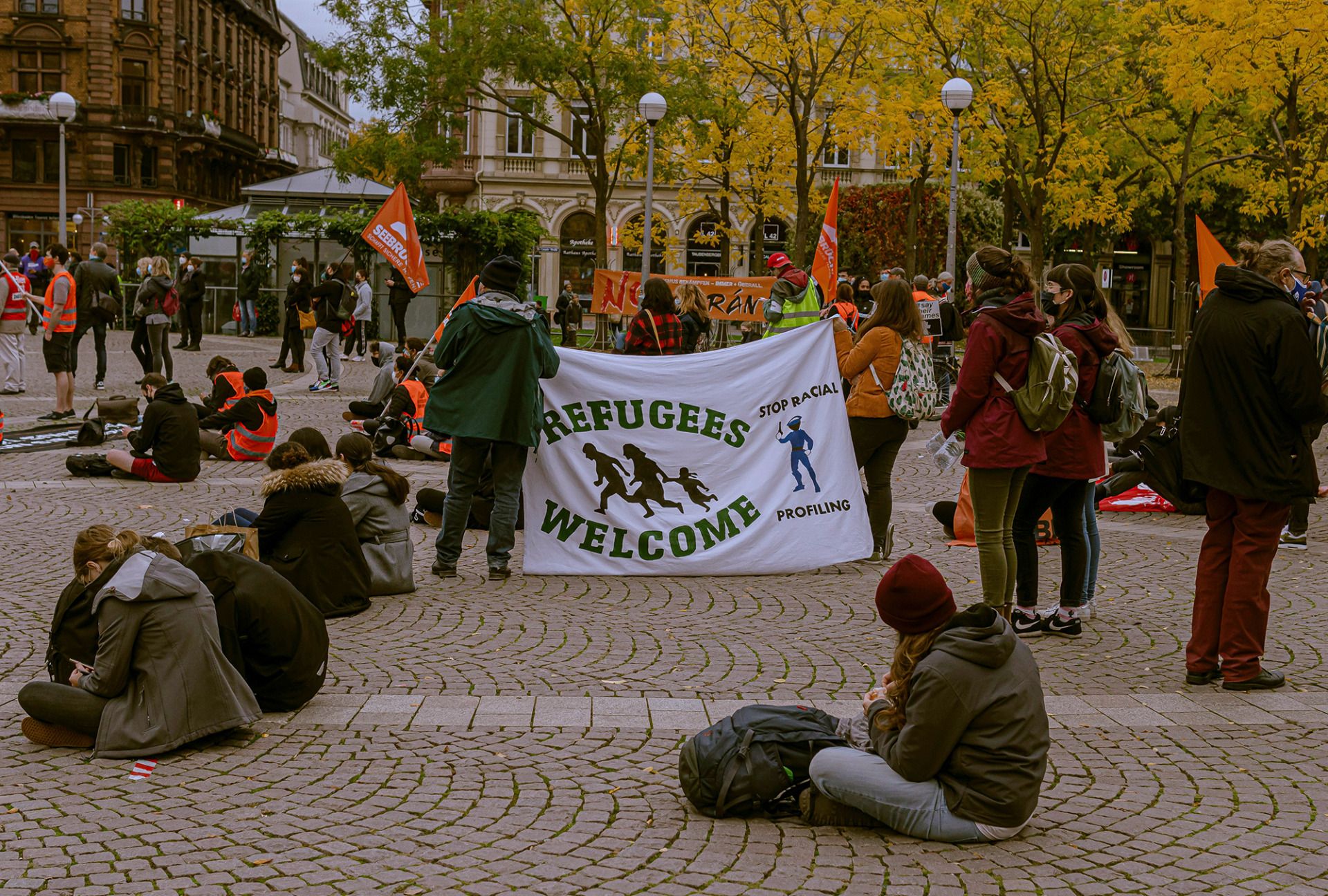
Wiesbaden, October 2020. Photo: Folco Masi via Unsplash
The Bundesagentur für Arbeit, the German Federal Employment Agency, regularly publishes data on how many German citizens and non-citizens receive basic social benefits. In June 2010, among them were 3,951,916 able-bodied Germans and 984,242 able-bodied foreigners: overall, 4 Germans for every 1 foreigner. The same ratio a year later. On the eve of accepting Syrian refugees (but after Croatia joined the EU), in June 2015, there were changes, though not dramatic: 3 Germans for every 1 foreigner.
But in December 2025—pa-pa-pa-pam!—among benefit recipients, 53% are Germans and 47% are foreigners. Roughly one to one, if you round it. Among the migrants: 606,508 Ukrainians, 440,136 Syrians, and 198,714 Afghans.
But before shouting “disaster!”, let’s look at changes in another important indicator. This is Regelleistungsberechtigte (RLB)—the total number of people “on welfare.” This includes everyone: those with and without German citizenship, able-bodied and not. So, in December 2025, there were 5.186 million RLB in Germany. In the wonderful year of 2010—6.415. And in the even more wonderful 2006, when there were neither wars nor refugees—7.199 million. Graphs show that from 2006 to 2021, the total number of RLB steadily declined year after year. After that, it fluctuated around 5.4–5.5 million, which is lower than in 2018. Yes, despite the pandemic and war, despite 1.3 million Ukrainian refugees and a million refugees from Syria, Iraq, Afghanistan, and Iran (these countries are often grouped together in the statistics).
This means Germany’s economy doesn’t have indigestion. But what it does have is a slow rate of digestion.
It’s not at all that migrants in Germany want to be “social tourists” (that’s exactly how Merz described Ukrainian refugees a few years ago). The point is, integration mobility in Germany is slow, medieval. And it’s not just about how quickly you can learn the very difficult German language
The German labor market, in its basic principles, is still like a guild system. Existing work skills (can you do it?—then go ahead!—as in Russia) mean nothing in Germany without certification, and even the grumpy advice from compatriots to “go be a janitor” doesn’t work. First, there are no janitors with brooms in Germany; all street cleaning is mechanized. Second, to operate a street sweeper you need an Ausbildung and a certificate issued upon completion. Ausbildung is an apprenticeship stage, usually lasting three years. Without it, you can’t work as a plumber, electrician, hairdresser, or cashier in a supermarket… How else? After all, a certified German plumber, after fixing a toilet, doesn’t take cash. He sends an invoice by mail, which is paid via bank transfer. The invoice means both a guarantee for the work and responsibility if the neighbors downstairs get flooded. Of course, you have to pay for the reliability of a certified craftsman, and not just with money. Certified specialists are in short supply. The plumber definitely won’t come the same day. When? In a week. In three. In a month. If you can’t wait, you’ll have to look for an illegal Russian, Ukrainian, Croatian, Polish, or Iranian worker, who’ll come almost immediately but will work for cash and without guarantees… Germany is not just medieval or conservative, but stubbornly set in its ways. Doctors still use faxes here, and textbooks for foreigners come with CDs. I wouldn’t be surprised if Spahn and Merz communicate by carrier pigeon.
And this is no exaggeration. On Facebook, I follow a Ukrainian refugee, an IT specialist from Chernihiv, Dmytro Sylenko. He rushed to Germany under shelling with no money, a laptop that got damp in a basement, and a change of underwear in a skinny backpack. “No equipment or side jobs, no decent clothes, no savings,” he describes himself back then. “And then you go to the Jobcenter with a very specific request: ‘Help me find a job. Any job. Fast.’ But you hear something else: ‘Don’t rush. First the language. Then integration. Then, maybe, work. Maybe you’ll go to university? Maybe you’ll stay longer?’ At that moment I physically feel for the first time: the system doesn’t share my urgency. It has its own pace: courses, paperwork, plans.”
Sylenko isn’t stupid: he quickly realized his previous work experience meant nothing in Germany, learned the language, and is now wrestling with the Ausbildung system. He worked as a data administrator for ten years, but his school certificate has a “C” in math, so the German oak tree is still staring at the calf in sorrowful bewilderment.
And whoever you talk to, it’s the same story. The German system doesn’t need people who can modernize it. It needs people who fit, even if only into a hopelessly outdated standard.
So it’s not that migrants don’t want to learn the language, integrate, or work. It’s the German system that resists change.
Yes, it’s said aloud that migration is a good thing; it’s repeated again and again that the labor market needs four hundred thousand new workers every year. And it is a good thing, and those workers are right outside the window. But only by themselves. I’ve asked Germans several times: “Here’s a million Ukrainian refugees. How many extra German teachers will be needed for their integration? And where will you find them?” — “Hmm…” — “You can’t just announce a master’s program and wait three years, can you?” — “But you can’t teach without a teaching qualification, right?”
As a result, my Ukrainian friends who fled bombs in Dnipro back in November managed to enroll in courses only at the end of April.
They receive benefits, of course. Just like my namesake Sylenko. Maybe one day they’ll get tired of fighting and realize that, even with higher education, after Ausbildung they’ll end up with a dreary job somewhere in a DHL sorting center, with a salary that, after taxes and rent, leaves little more than they’re getting now “on welfare.” Then they’ll learn every trick to stay on benefits, and quietly work on the side: breeding cats (600 euros for a non-pedigree kitten—yes, I was shocked by the prices too!), moving and assembling furniture, moonlighting as tilers, electricians, or plumbers without any certificates… In other words, they’ll game the German system for their own benefit. Which will allow them, if not to brag on social media, to spend a couple of weeks every summer at Lake Como in Italy.
And honestly, I won’t cast the first stone at them for that.
If you enjoyed this article, consider making a donation — one-time or, even better, monthly. Your support helps us motivate our authors and become better with every article.
Our organization is recognized by the Internal Revenue Service (IRS) as a 501(c)(3) tax-exempt, charitable organization, which means that all contributions made to us are tax-deductible to the fullest extent permitted by U.S. law. Individuals may generally deduct charitable contributions of up to 60% of their Adjusted Gross Income (AGI) for cash donations made to qualifying 501(c)(3) organizations. For donations of appreciated assets (such as stocks or other long-term capital assets), the deduction is typically limited to 30% of AGI, based on the fair market value of the asset. C-corporations may deduct charitable contributions of up to 10% of their taxable income for donations made to eligible charitable organizations.
By submitting a donation, you confirm that you have read and accept the following documents: Privacy Policy and User Agreement, and also give consent to the processing of your personal data.
If you would like to unsubscribe from a monthly donation, please email us at: [email protected]