Let’s imagine for a moment that by some magical means Russia managed to get all sanctions lifted without exception, annexed all the territories Putin talks about, reduced the military budget, and began living as if nothing had happened. This is exactly what a huge number of people living in Russia dream of.
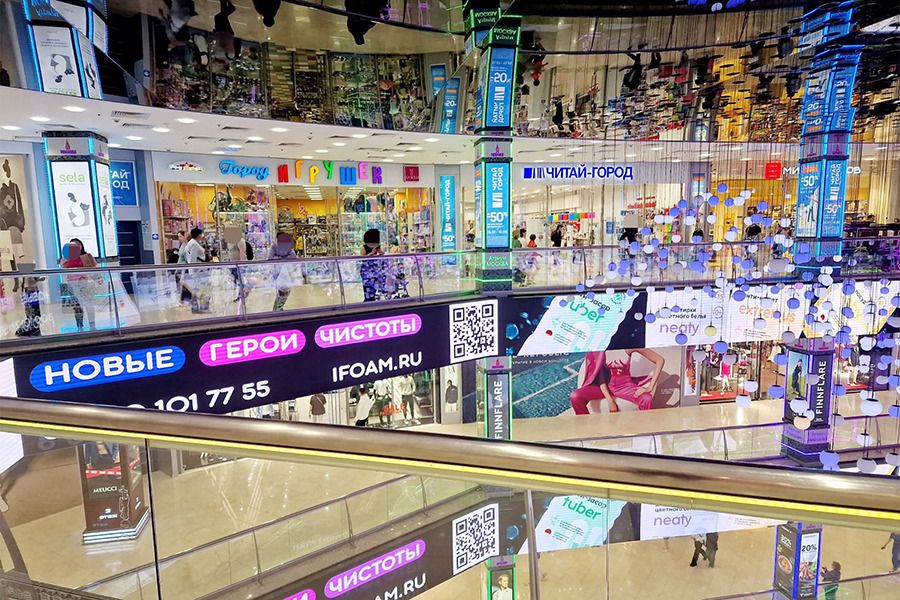
Atrium Mall. Photo: atrium.su
So, let’s imagine that it all worked out.
Let’s start with the fact that the problems of the Russian economy began even before Crimea. By 2010, its growth rates had already declined, despite high oil prices. The reason for this slowdown was the exhaustion of the recovery growth of the Russian economy triggered by the reforms of the 1990s. To move forward, it was necessary to fundamentally change the priorities of economic development, switch to models based on innovative technologies, and restructure the Russian economy towards exporting new high-performance services.
There was a chance for this: a competitive IT sector appeared in Russia, a modern financial services market began to take shape, demanded beyond the country’s borders. But by that time, the Russian elites had firmly taken control of the energy sector, and they had little interest in anything beyond it. At the same time, there was an understanding that developing new competitive and free industries carried the risk of losing power inside the country. And all possible development scenarios were blocked.
Over the past 15 years, the situation has only worsened. Opportunities to export high technology have been completely lost. The demographic situation has deteriorated significantly. The level of coercive pressure in the economy has increased substantially.
New problems have been added to the existing ones, caused by aggressive Russian policies and internal property redistribution.
If in 1990 the Russian market was of great interest to foreign companies, today its potential is assessed much more modestly. The risks of doing business in Russia have grown enormously, while profitability has decreased.
I would add that foreign companies entered the Russian market very slowly, gradually building partner networks, organizing production, and preparing personnel and infrastructure. All this groundwork was almost completely destroyed over the past three years. This means that any foreign firm entering the Russian market will have to start building its partner network all over again from scratch. However, in conditions of labor shortages and a market flooded with Chinese goods due to “parallel imports,” this will be much more difficult.
Only companies selling mass-market consumer goods will enter the Russian market. Most likely, we will again see shopping centers filled with familiar clothing and footwear brands such as Zara or H&M. They can easily come, but they can just as easily leave if the situation changes again.
European Mall. Photo: DR
There is another problem. Many foreign companies that left Russia effectively lost property that was taken from them “by the rules” or bought out for pennies. These companies are unlikely to re-enter the Russian market, and current Russian owners will certainly not want to return the property to them. I find it hard to imagine how to resolve a potential conflict between McDonald’s and “Vkusno i tochka” or between Carlsberg and “Baltika.”
Something similar will happen with the aircraft fleet, which was acquired through leasing but was then effectively appropriated by Russian companies that re-registered these planes within Russia.
This means that starting cooperation from scratch will definitely not work. Russia faces numerous lawsuits that will not improve the country’s reputation.
Problems with outdated transport infrastructure remain unresolved. This is clearly visible in the example of Russian Railways. The problem of old coal-mining regions, such as Kuzbass, has worsened. And ahead looms the green transition, which no one has canceled, only its timeline has been pushed several years forward.
The newly annexed territories will also require enormous expenses. First, these are regions with outdated industry, which Ukraine had to heavily subsidize. Over 11 years of military conflict, it has degraded even more. Second, the territory of the regions Russia claims is roughly comparable in total area to a decent federal subject or even a small country.
If hostilities end, Russia will gain vast areas where demining, reclamation, and industrial rebuilding will be necessary. Some industries, such as coal, are now simply pointless to restore. Russia cannot even profitably sell its own coal.
Moreover, very few workers remain in these territories. Some fled the war, others died after being forcibly mobilized. Investments in these lands can only be state-funded, as returns on investment will take an infinitely long time. Additionally, the region is flooded with weapons, so it will likely have to be kept under special status for a long time, including border control with the rest of Russia.
In summary, it can be concluded that there will be no serious economic growth in Russia even if all sanctions are lifted and the war ends victoriously.
For such growth to occur, either free resources (labor and capital) or investments bringing new technologies are needed. Russia has no free labor resources. Nor does it have unused production capacity. As I have already said, one cannot count on foreign investment either.
Moreover, the demographic situation in Russia is such that in the next five to seven years, Russia will lose at least 300,000 working-age people annually.
Certainly, a short-term surge in economic activity is possible as a result of the end of hostilities and rising hopes for the future. But it will end quickly, because Russia has not solved any of the problems it faced 15 years ago and has worsened them through military actions, massive migration, and loss of export markets.
Sooner or later, all these problems will have to be addressed, regardless of when and how the war ends. And the sooner Russian society realizes these problems, the greater the chances of solving them in the near future.
If you enjoyed this article, consider making a donation — one-time or, even better, monthly. Your support helps us motivate our authors and become better with every article.
Our organization is recognized by the Internal Revenue Service (IRS) as a 501(c)(3) tax-exempt, charitable organization, which means that all contributions made to us are tax-deductible to the fullest extent permitted by U.S. law. Individuals may generally deduct charitable contributions of up to 60% of their Adjusted Gross Income (AGI) for cash donations made to qualifying 501(c)(3) organizations. For donations of appreciated assets (such as stocks or other long-term capital assets), the deduction is typically limited to 30% of AGI, based on the fair market value of the asset. C-corporations may deduct charitable contributions of up to 10% of their taxable income for donations made to eligible charitable organizations.
By submitting a donation, you confirm that you have read and accept the following documents: Privacy Policy and User Agreement, and also give consent to the processing of your personal data.
If you would like to unsubscribe from a monthly donation, please email us at: [email protected]