The opening of Europe’s main contemporary art exhibition this year was accompanied by noisy protest actions. But the Biennale will run through the end of November, and there is certainly plenty to see here besides the closed doors of the notoriously scandalous Russian pavilion.
Photo:
The loudest protests this year took place on the Biennale’s opening day — May 6, when the feminist art groups Pussy Riot and Femen staged a 20-minute demonstration against the opening of the Russian pavilion. The curator of the Ukrainian pavilion, Ksenia Malykh, did not take part in the protests. And when asked why, she replied: “We have a different strategy. We are here to bear witness. Our presence is the answer”.
The Ukrainian presentation includes the installation “Security Guarantees” — a sculpture of a deer suspended from a crane a few meters from the Russian pavilion. Artists Zhanna Kadyrova and Denys Ruban cast it in 2019 in Pokrovsk (Donetsk region), using the pedestal on which a Soviet fighter jet had previously stood. The deer imitates the fragile shape of paper origami, but is “folded” out of concrete, hinting at the Budapest Memorandum signed in 1994 between Ukraine, the United Kingdom, the United States, and Russia. Under it, Ukraine voluntarily gave up its nuclear arsenal in exchange for security guarantees that, in practice, turned out to be made of paper.
In 2024, when the front line came right up to the city, the deer was evacuated under artillery fire — it was not designed for transport and required a special engineering solution. On its way to Venice, the sculpture traveled on a crane through Warsaw, Berlin, Brussels, and Paris — the same route taken by millions of Ukrainian refugees. Video documentation of this journey is presented in Ukraine’s pavilion at the Arsenale.
***
More protests during the opening days than the Russian pavilion drew only the Israeli one. But once you step inside, you realize that the artist Belu-Simion Fainaru exists in a completely different time and space than the loud activists. He brought to Venice his 2015 work inspired by the poetry of Paul Celan — a Jew who survived the Holocaust and yet wrote in German, the language of his people’s killers. His “Death Fugue” begins with the line “Black milk of dawn we drink it at evening” — an image where life and death are inseparable. Fainaru translates this image into water: an Israeli irrigation system for automatic watering lets drops fall into a black basin — a silent drawing on the surface of the water, like unceasing tears mourning the dead. Against the backdrop of organized actions, solitary statements looked more interesting. Some were “quiet” and soundless — such as the action by Ukrainian artist Daria Koltsova: for several weeks she hung Ukrainian military uniforms out to “dry” on clotheslines in the windows of various apartments around the city — it was impossible not to notice. Others were bolder, like the message from former Russian artist Irina Revina-Hofmann, who openly laid out in front of the Russian pavilion a banner sign reading “To the war 926 km” and posed for the press in a fashionable suit with the words No Putin — No war on the back and a crossed-out symbolic portrait of Putin wearing a crown on a glamorous Hermès Birkin bag.
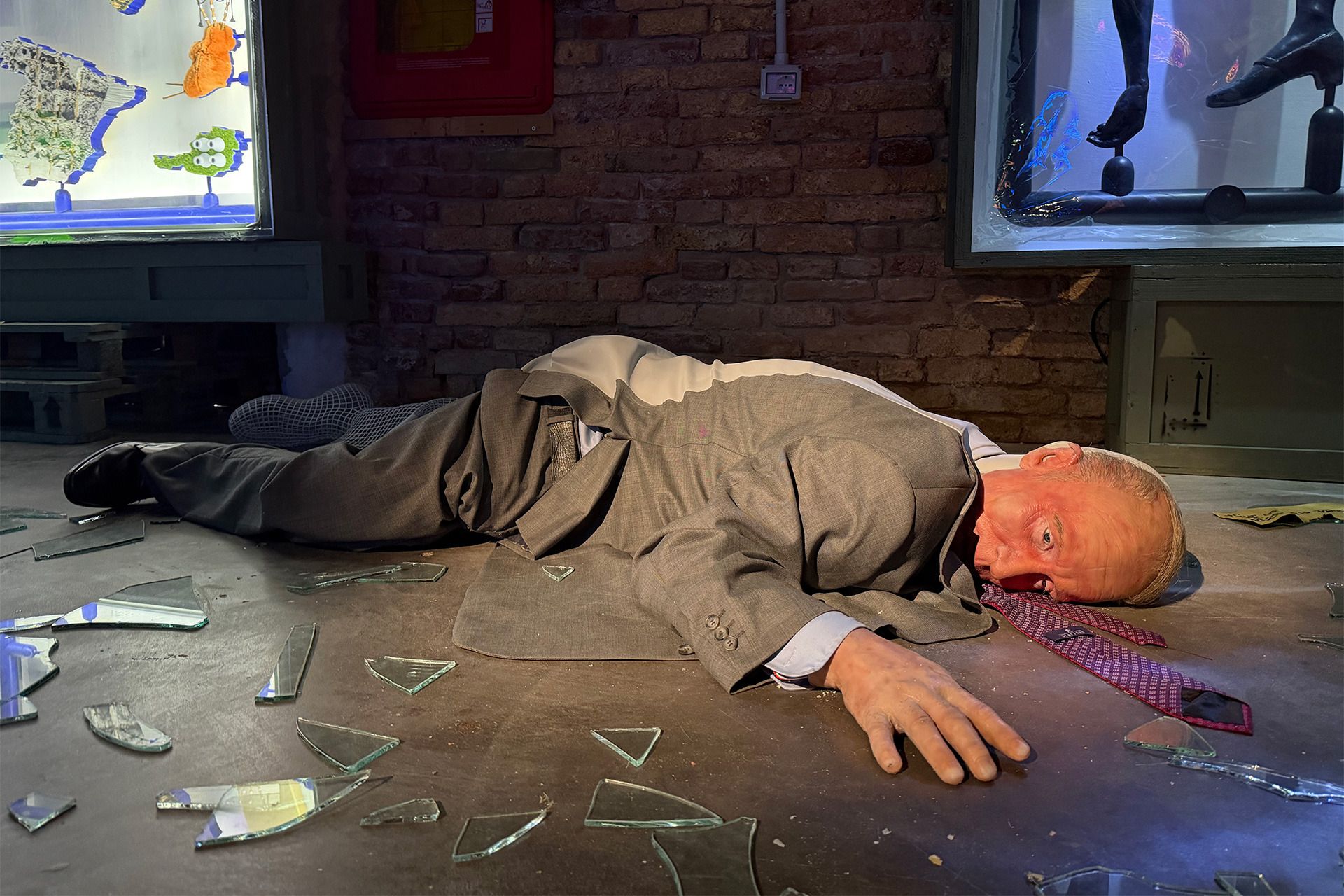
Standing apart is Arto-Calypsa, a solo exhibition by Czech artist David Černý, which, against the backdrop of other statements, sounds like a fist slammed on the table. In his immersive space in Cannaregio (in the northern part of Venice), monumental revolvers under the ceiling are aimed at each other, beneath them is a gaming table flooded with blood, over which toy tanks scurry non-stop. On the screen at the back of the hall an aircraft carrier advances toward the viewer — the pinnacle of engineering and military thought, created for humanity’s self-destruction. And two shockingly lifelike figures: one, in the center, resembling Trump, makes convulsive finger movements on an electric chair; the other — opposite, reminiscent of Putin — with the same convulsive motion is curled up on the floor amid shards of glass. On the walls are stylized portraits of Oppenheimer and da Vinci.
Černý has long been asking an uncomfortable question: where does violence take root — in human nature or in the brilliance of the mind?
The path from da Vinci’s inspiration to an aircraft carrier turns out to be frighteningly short.
***
The Biennale is not for casual onlookers: to walk through just the main venues in the Giardini gardens and the Arsenale, you need at least two days. The exhibition includes 100 (!) national pavilions, and a third of them are scattered around the city. Not to mention reading the wall texts, grasping the messages, making sense of this polyphony, and feeling what is real — what resonates and stays in your heart and memory. And what if you also let the torrent of pain and lived-through trauma pass through you? Treating the Biennale as entertainment is hardly possible: it is real work, but there is a hint. You can look at art through the lens of the Biennale’s central idea, evaluate who раскрыing the theme set by the curator, and, for example, условно divide the pavilions into “quiet” and “loud”, and then choose the best specifically for yourself.
This year, for the first time in its history, the main international contemporary art exhibition was headed by an African woman — Koyo Kouoh, a Cameroonian who grew up in Zurich and the founder of Raw Material Company in Dakar. She kept her illness secret and died of cancer at the age of 57, never seeing the opening, but managing to pass on to a team of five curators her groundwork and the main idea.
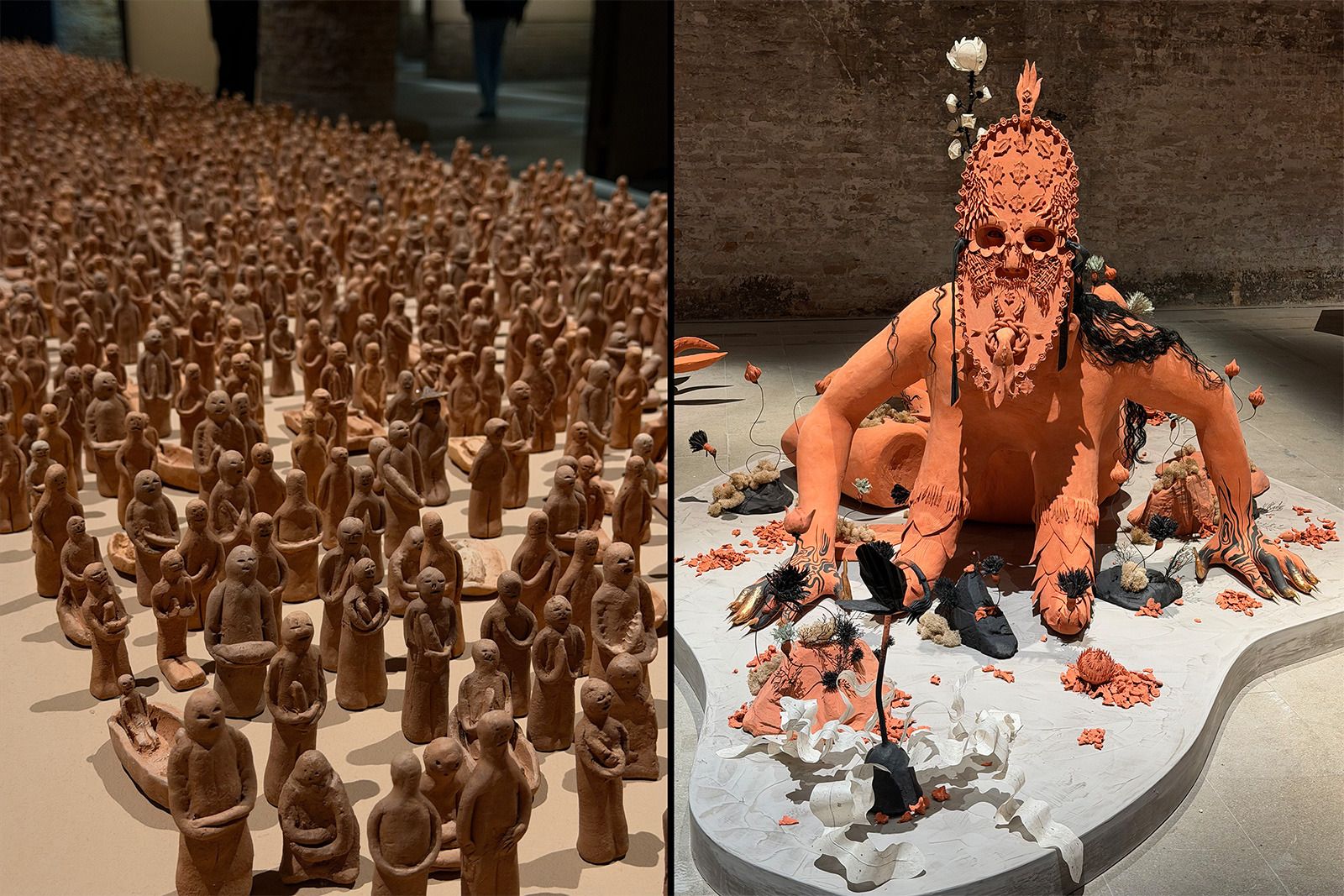
Kouoh was the first to give the floor to those the art world preferred not to notice: artists from Africa, Latin America, and Asia, descendants of enslaved and colonized peoples, emigrants without a past, refugees without a name — everyone who found themselves on the margins of history. They speak in the language of ritual and craft: they weave baskets and textiles, mold idols from clay and carve gods from wood, carrying them around the world like their own identity. They whisper of trauma and loss, of searching for roots where roots can no longer be found. This is the ragged chorus of those who stayed silent for too long and have finally been given a stage.
There are plenty of insinuating voices at the exhibition; a minor key sounds in Argentina’s pavilion, where you will feel with your body (more precisely, your feet) a “painterly” material — artist Matías Duville laid out a picture made of salt on the pavilion floor and drew the image on it with coal dust (salt as a base, a trace of ancient oceans and the slowness of geological time, and coal as organic matter turned into energy).
In the same vein is Canada — Abbas Akhavan’s pavilion Entre chien et loup (“between dog and wolf” — the French name for twilight, when silhouettes are indistinguishable and everything is ambiguous). The glass pavilion has been turned into a greenhouse with the humidity and temperature of the Amazon jungle: at the center are giant water lilies of the Victoria genus, native to South America but which became, in the Victorian era, a symbol of the British crown and a sensation at the Great Exhibition of 1851 in London. The artist sees a parallel in this: “A greenhouse and an art gallery are not so different. Both are spaces with controlled temperature where valuable living objects are kept. Both are ideological spaces of reverence, sacrality, and contemplation”.
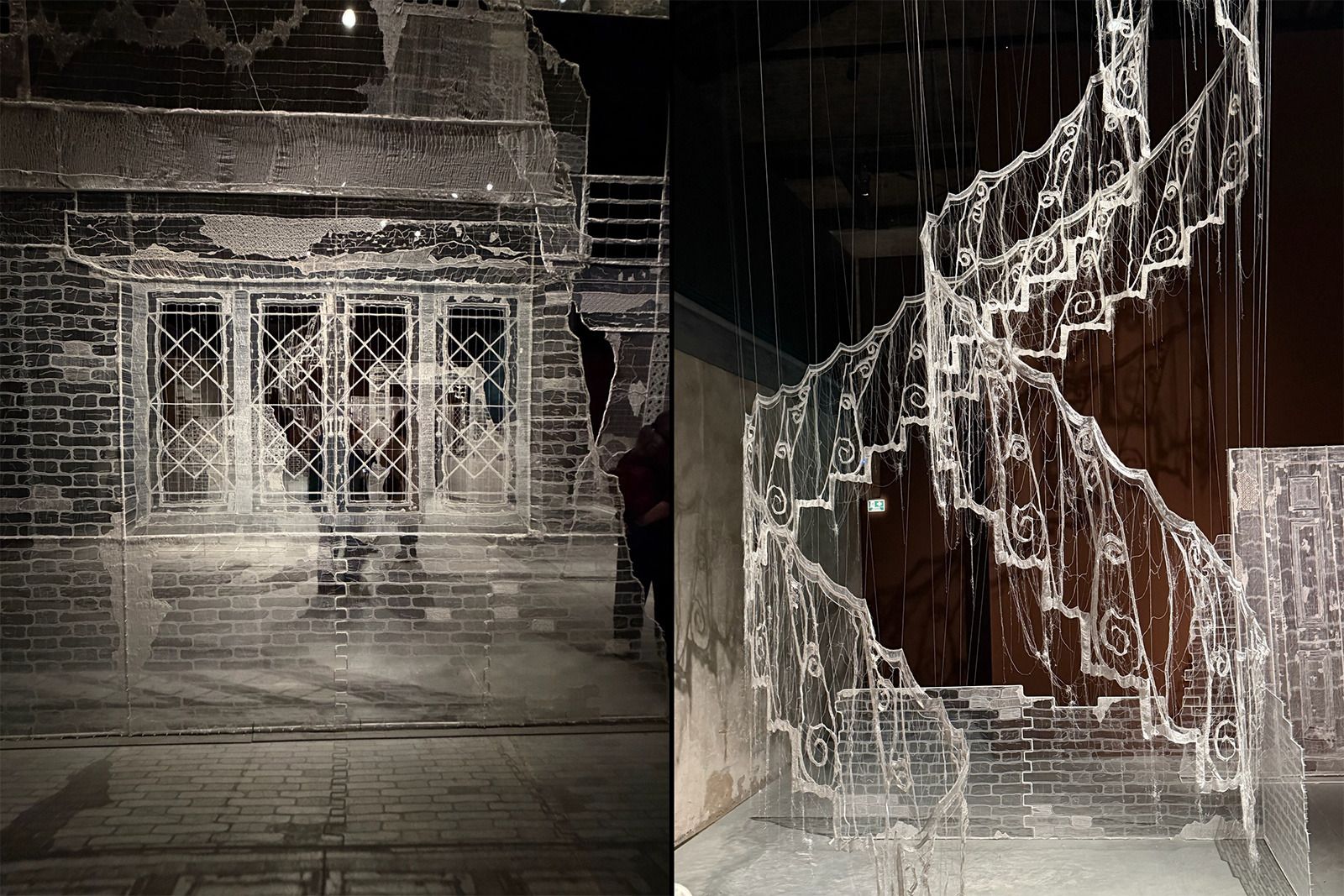
India created a little island of truly handcrafted Zen in Venice: five artists work with clay, bamboo, thread, and papier-mâché — the way generations did before them, with a мастерством and elegance entirely uncharacteristic of contemporary techniques in art. The pavilion’s theme is home as an idea, not as an address; in a dark hall, tropical flowers floating in the air come to life, and a bamboo nest-house beckons. But the central work draws the most attention — the ghost of a house made of lace. Sumakshi Singh grew up in different cities across India, but her favorite home was her grandmother’s mansion in Delhi, where the women of the family embroidered together in the garden. After her grandfather’s death, the house was demolished — land in Delhi became too expensive to keep a mansion with a garden there — and Singh recreated it life-size out of threads: transparent, almost weightless, but absolutely alive. A home that cannot be fully restored because it was never truly permanent.Walls made of air, rooms made of memory — and you no longer want to leave this revived lace dream of childhood.
Although perhaps the most perfect fit for the idea of In minor keys happened in the Vatican pavilion.
The Vatican appeared at the Biennale relatively recently (in 2013), when Pope Benedict XVI decided to restore the living connection between the Church and contemporary art, but each of its messages lands in every cultural media “hit parade”. To maintain an equal dialogue with the Biennale’s prepared, meaning-seeking audience, the project usually enlists the heavy artillery of the field — the best curators and artists in the world — and this year is no exception. “The ear is the eye of the soul”: a sound installation in a 17th-century монастырский garden. Curators Hans Ulrich Obrist and Ben Vickers brought together 24 artists — Brian Eno, FKA Twigs, Patti Smith, Jim Jarmusch — around the figure of the medieval abbess and composer Hildegard of Bingen, who believed that sound is a form of knowledge. They, in turn, created an endless musical composition of 24 fragments flowing into one another as you, wearing headphones, walk through the barefoot Carmelite garden. It’s easy to linger there for an hour — and come out a different person, as after a prayer.
***
And yet there are noticeably more “loud” and triggering statements at the exhibition. Belgium’s pavilion will deafen you in the literal sense — it hosts sound performances: musicians and dancers climb wooden structures, beat drums, smash ceramic tiles with words in different languages. The title It never SSST — “it never goes quiet” — is not a call for silence, but a diagnosis: the artist places you inside modern life, where your head is flooded with questions, noise, and catastrophes, and the only way to be heard is to shout louder than everyone else. In the neighboring building is the Netherlands pavilion, where once an hour a hundred viewers are let in, and then the doors are closed and, over 20 minutes, steel shutters slowly seal the windows and all openings through which light could enter the hall. Meanwhile, a performer from Dries Verhoeven’s team deafens you with guttural cries of platitudes like Enjoy life and Love yourself, plunging you into total darkness and making you think about what contemporary Europe really is: a once bright, open-to-the-world home that is sealing its shutters tighter and tighter — and convincing itself that everything is fine. The message is intentionally ambiguous — and everyone leaves with their own nightmare.
However, there is a method for which contemporary art is often criticized — entry through the naked body and through taboo. Topics that in polite society are not принято to talk about. At this Biennale, three pavilions proved that it works flawlessly: the lines at their doors speak for themselves, despite all the public “ew”.
Luxembourg presented La Merde — literally “Shit”: an immersive audiovisual installation centered on a film whose main character is an anthropomorphic figure of excrement. You sit in a capsule-like video hall; on the screen in front of you is a charming feces, seductively flirting with the audience in a meowing voice à la Marilyn Monroe. It is so sincere and insinuating that at some point you forget that a screen stands between you. Behind the provocative title and form is a conversation about shame as a social mechanism: how society decides which bodies are tolerable and which must be pushed out of view.
Denmark turned its pavilion into something between an elite fertility clinic, a porn set, and the waiting room of a biotech startup. Artist Maja Malou Lyse builds on research according to which VR pornography increases sperm motility. She asks what images really do to our bodies — and предлагает you test this experience yourself in a pavilion with a huge semicircular screen and explicit videos on the edge of what is permissible.
But the absolute champion in lines was Austria — you have to stand at the entrance to the national pavilion for at least an hour, no exceptions. Once an hour, in front of the pavilion entrance, the nude performer Florentina Holzinger climbs into the dome of a bell engraved with the Latin phrase O tempora o mores — “Oh времена, oh morals!”, hangs upside down inside it, and becomes the living “tongue” of the bell, swinging it with her body. At that moment, the cameras of practically every other phone at the exhibition are trained on her — much as, perhaps, on a medieval square when onlookers would flock to watch a public execution to the звон of the bell (times may have changed, but morals, as we see, not so much).
Florentina Holzinger’s practice combines performance, dance, opera, and theater, at the intersection of feminism, Viennese Actionism, body art, and spectacle culture. Before the Biennale she was well known in the European theater and performance world, but 2026 turned her into an international sensation. In her performance theater they speak a radical visual language: through the naked body, extreme acrobatics, and self-harm, and only in women’s voices: Florentina’s troupe consists exclusively of Amazon-like women, whom she calls nothing other than sisters.
The Austrian pavilion itself, curated by Holzinger, is a closed ecosystem powered by the отходs of the audience itself. Visitors can use two blue bio-toilets — their contents go through a filtration system and into a central reservoir, where for hours a nude performer in a diving mask remains in the water. She watches the chaos around her — and watches you. In the “machine room”, attendants unsuccessfully try to cope with the brown sludge bursting from valves and pipes: they scoop with buckets, plug, repair — and cannot manage. Nearby is a snake-woman spinning around her axis in inhuman acrobatic poses, guarded by a robot dog circling her. In the next hall, a huge weather vane slowly rotates with bronze and “living” female sculptures suspended from it, and opposite, a jet ski circles on the water — a monument to a tourist экологическая catastrophe. Everything turns in circles, and everything is closed, like a hopeless loop that starts over every hour: the удар of the bell, acrobatics, swimming, archery — athletics, ritual, and catastrophe at once.
All of this is Venice as a flooded city of the future, an overpopulated tourist amusement park that has spun out of control because of our indifference and greed. Holzinger does not moralize or comfort — she mercilessly places you inside the system of which you are also a part, with no way out — and invites you to feel it in your body. We are all accomplices.
In this year of not-accidental coincidences, when the Biennale jury resigned at the very beginning of the show and the system of national pavilions is falling apart from contradictions, the symbolism of a broken sewage system sounds especially accurate.
***
I spent 10 days at the Biennale — quite a lot for immersing myself in the main program and dozens of exhibitions in the parallel program (which in themselves are a topic for a separate article), and I needed just as much time to initially digest what I saw and formulate it into this text (even though it clearly takes more time for full reflection). As a sensitive person, I couldn’t help reacting emotionally to this battlefield. And in the background I was constantly thinking about how difficult it is, amid the noise of loud statements, to hear quiet voices and whether they are appropriate now — in a world that is feverish and bursting at the seams — is it even really possible to hear them against this backdrop? Which messages will we respond to sooner, which will hit us where it hurts: the brutal and merciless Austrian pavilion or the meditative and prayerful Vatican pavilion? Who will be able to reach a greater number of hearts?
It seems this is the main question every thinking visitor should pose to themselves when attending the world’s главного art event this year. For the first time in the Biennale’s history, responsibility for choosing the best national pavilion has been handed to the public — a viewer vote has been introduced. And this is a unique experiment, the results of which we await on November 22, the last day of the Biennale.
If you enjoyed this article, consider making a donation — one-time or, even better, monthly. Your support helps us motivate our authors and become better with every article.
Our organization is recognized by the Internal Revenue Service (IRS) as a 501(c)(3) tax-exempt, charitable organization, which means that all contributions made to us are tax-deductible to the fullest extent permitted by U.S. law. Individuals may generally deduct charitable contributions of up to 60% of their Adjusted Gross Income (AGI) for cash donations made to qualifying 501(c)(3) organizations. For donations of appreciated assets (such as stocks or other long-term capital assets), the deduction is typically limited to 30% of AGI, based on the fair market value of the asset. C-corporations may deduct charitable contributions of up to 10% of their taxable income for donations made to eligible charitable organizations.
By submitting a donation, you confirm that you have read and accept the following documents: Privacy Policy and User Agreement, and also give consent to the processing of your personal data.
If you would like to unsubscribe from a monthly donation, please email us at: [email protected]