When information appeared about Vincent Garenq’s upcoming film, one immediately thought it would be about freedom of speech, about radical Islamism, about society’s fear of it. But the director chose a different angle — this is a film about how the state does not protect its citizen, who is simply doing his job
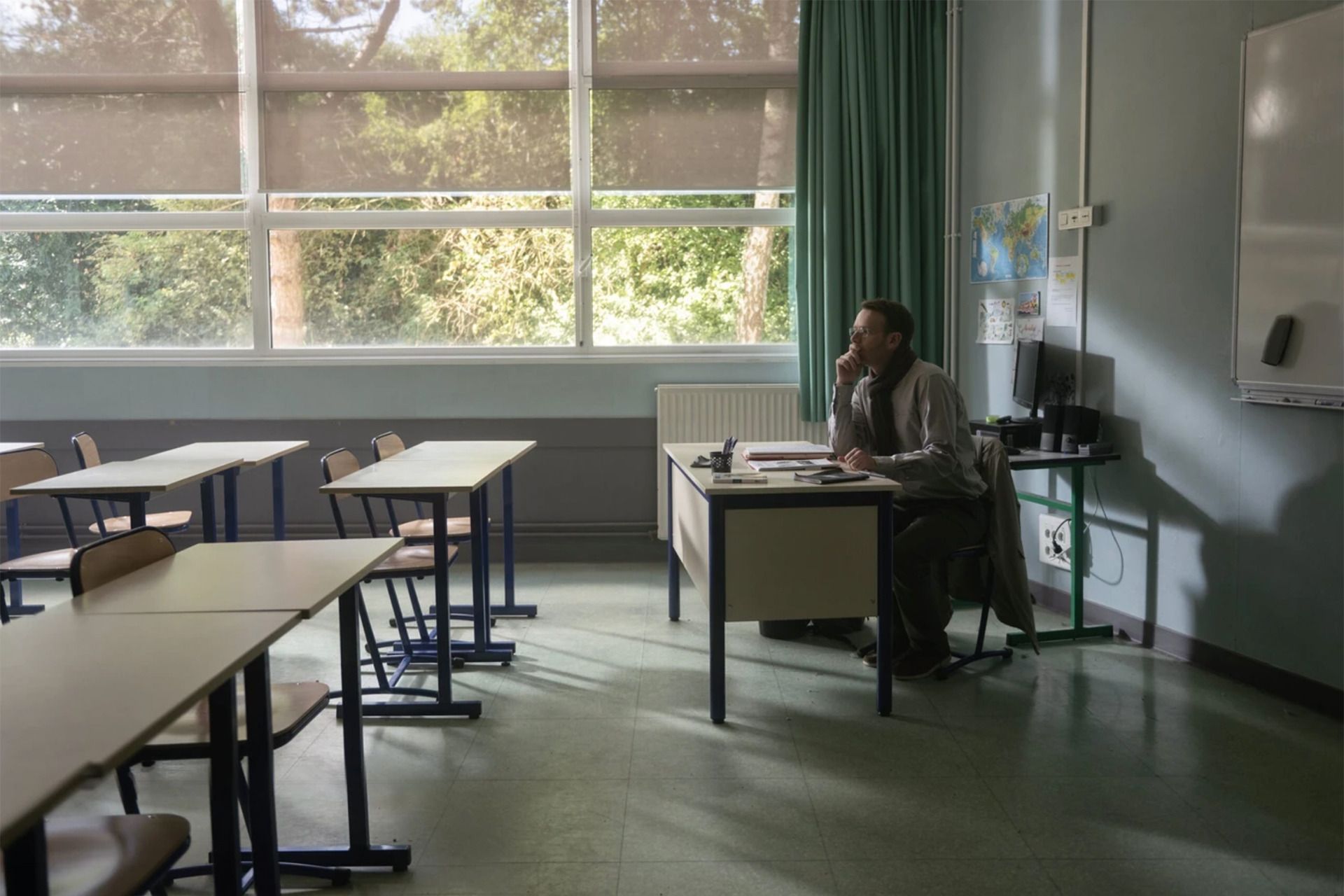
A still from Vincent Garenq’s film “L’abandon” (2026)
On October 16, 2020, 18-year-old Abdoullakh Anzorov attacked schoolteacher Samuel Paty, inflicted several fatal knife wounds on him, and then cut off his head. The pretext for this horrific murder was the teacher’s showing of cartoons from the magazine Charlie Hebdo, featuring, among others, the Prophet Muhammad, during a lesson devoted to freedom of speech.
Before showing and discussing the drawings, Samuel Paty suggested that Muslim students leave the classroom, warning that the cartoons might seem offensive to them. Several people left. Soon their classmate Zaina Chnina, who was not at school that day, reported Paty, claiming that he had allegedly caused a scandal during the lesson and expelled her from the classroom for protesting the showing of the cartoons.
Anzorov was shot dead immediately upon arrest; the instigators of the harassment received lengthy prison terms; several teenagers who, for money, agreed to point the killer to his teacher also ended up in prison. Chnina was sentenced to a year and a half suspended. In addition, Anzorov’s accomplices who supplied him with the knife received prison terms. The administration of the school where Paty worked sympathized with the teacher when the Islamists’ harassment began, but took no measures to protect him. The local police also did nothing, despite threats against him.
This is what French director Vincent Garenq’s film “L’abandon” is about. The film was shown at the most recent Cannes Film Festival in the Un Certain Regard section. Since the film is not planned for Russian distribution, it has no official Russian title — “L’abandon” can be translated as “Abandoned”, “Betrayed”, “Left”, and even, perhaps, “Left to Fate”. The last translation seems the most accurate.
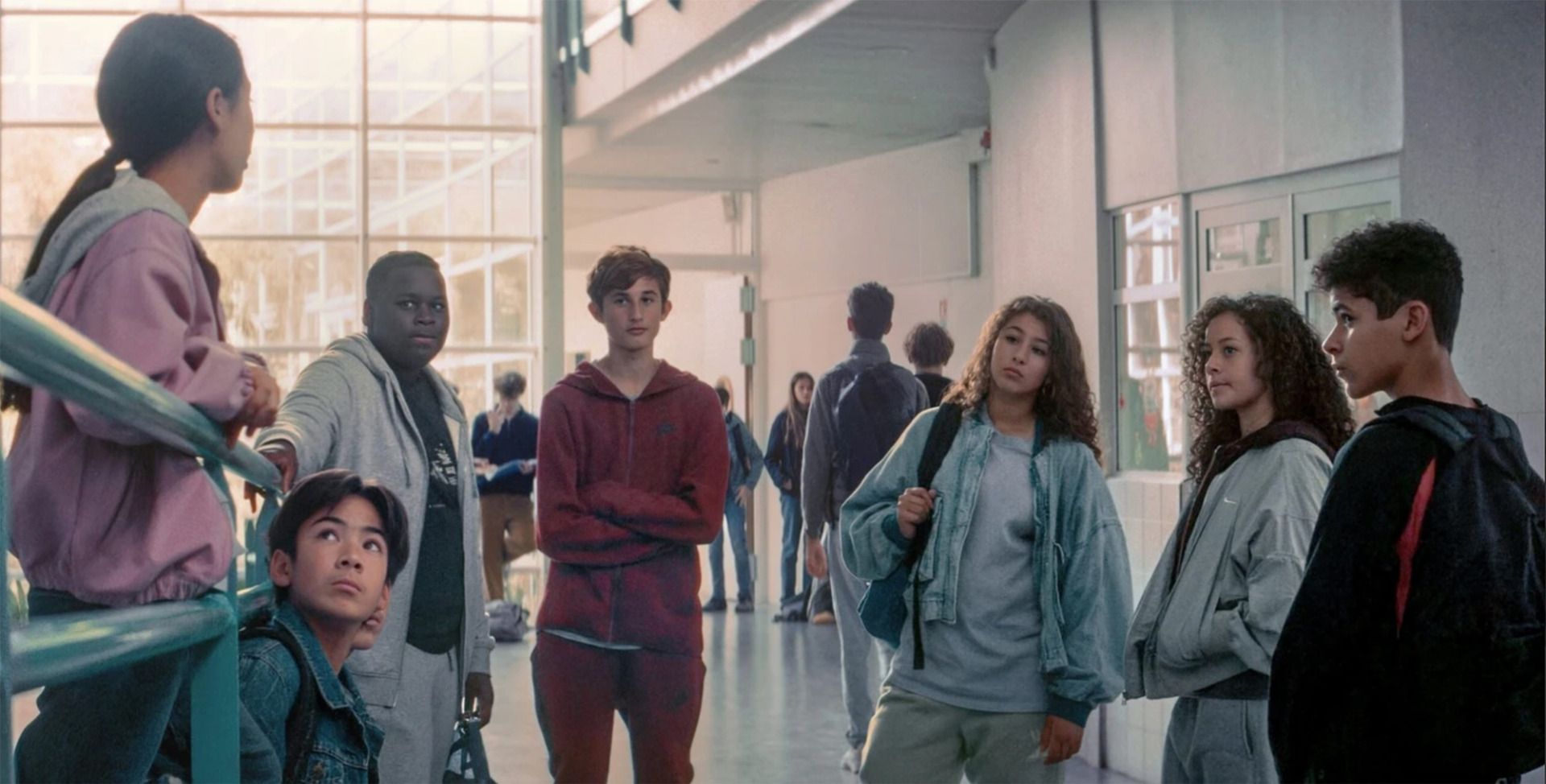
A still from Vincent Garenq’s film “L’abandon” (2026)
When information appeared about Garenq’s upcoming film, one immediately thought it would be about freedom of speech, about radical Islamism, about society’s fear of it. But the director chose a different angle — this is a film about how the state does not protect its citizen, who is simply doing his job. “Left to Fate” is the story of the last 11 days of Samuel Paty’s life, beginning with that ill-fated lesson in which freedom of speech was discussed and ending with the murder.
The film is made with extreme care, so the depiction of the teacher’s harassment by aggressive Islamists is merely a hook that real radical Islamists seized upon in order to accuse the director of Islamophobia. There is nothing of the kind in the film. Those who started the harassment, which ended with such a horrific outcome — first and foremost the lying student’s father and an alleged representative of an imam — are indeed shown as cruel, aggressive people, people of a completely different culture, trying to adapt French society to their unshakable beliefs. But how else could they have been portrayed after they initiated a large-scale harassment campaign against a person who did not fit their worldview? Perhaps those reproaching the film’s authors for Islamophobia wanted everything in the film to be “not so clear-cut”? But this tragedy is absolutely clear-cut, and Garenq does not try to make bows in the direction of terrorists driven mad by impunity. He is interested neither in hidden motives, nor does he explore the psychology of brazen radicals. And this entire on-screen story is directed first and foremost against French society itself, which expresses sympathy for the unfortunate man in words, but is incapable of preventing the impending crime.
That is both the film’s strength and its weakness at the same time. Garenq does not turn Paty into either a martyr or a hero. He is an ordinary, modest teacher, accustomed to doing his work the way it is done in the French Republic, for which freedom of speech and secularism are important pillars of democracy. Paty is not a fighter for freedom of speech, which in recent years in France has not been experiencing its best times; he is not a symbol of resistance. And he dies not as a symbol, but as an ordinary person. Antoine Reinartz plays Samuel that way — young (the character is clearly younger than his real-life prototype), somewhat timid, endowed with a good sense of humor, but unable to stand up for himself. In short, not a heroic personality at all.
The care with which Garenq made the film is unemotional and at times resembles a screen adaptation of the corresponding Wikipedia article — just a chronicle of events, no journalistic or polemical fervor, no omissions, not a single extra word or extra camera movement. We see only the mechanism of the tragedy, step by step, without authorial assessments. But this meticulousness has a reverse side as well: it is evident that the authors, avoiding judgments, are afraid to call things by their proper names. Garenq places responsibility on Paty’s surroundings — it was precisely their indecisiveness that doomed the teacher to a terrible death.
And here a paradox arises, which Garenq apparently did not realize when conceiving the film. Speaking about the moral indecisiveness of state institutions, the director himself becomes a hostage to that caution. It is as if every second he is balancing between the fear of saying too much and the fear of saying too little. And thus we get an ultra-correct film about an ultra-incorrect reality. Because of this paradox, the film became the subject of heated debate in France. In addition to those who, predictably and unfairly, reproach Garenq for Islamophobia, two other radically opposite positions emerged. The first: the film accuses the state education system and, more broadly, all state institutions. The second: Garenq tries too delicately to avoid the real causes of the tragedy.
The controversy sparked by this far-from-the-strongest film turned out to be more important than the film itself. This is not a debate about a film, but about a country. About that France which proclaimed and proclaims freedom of speech as one of the main values of the republic. About a country in which secularism is considered unshakable. About a state in which each individual person is a priori valuable and protected.
But freedom of speech, secularism, and the value of human life, as it turns out, work exactly up to the moment when it becomes time to defend them and when one has to pay a high price for them. And when that moment comes, fears crawl out — the fear of going against political correctness, the fear of being accused of racism, the fear of actively taking a person’s side if that person suddenly does not fit into the new reality. The murder in the film “Left to Fate” is, in general, secondary, strange as that may sound. The murder is the consequence of the main “action”, which happens earlier and off-screen. Therefore there is no victory of good over evil in the film, and there cannot be a saving catharsis, just as there is no sacrosanct question “who is to blame?”. Garenq avoids not only the answer to this question, but the question itself. As a result, “Left to Fate” is not so much an artistic or political statement (it is still far from either), as a mirror reflecting the absence of political will in the state. Garenq clearly did not mean this, but it is the result that is judged.
If you enjoyed this article, consider making a donation — one-time or, even better, monthly. Your support helps us motivate our authors and become better with every article.
Our organization is recognized by the Internal Revenue Service (IRS) as a 501(c)(3) tax-exempt, charitable organization, which means that all contributions made to us are tax-deductible to the fullest extent permitted by U.S. law. Individuals may generally deduct charitable contributions of up to 60% of their Adjusted Gross Income (AGI) for cash donations made to qualifying 501(c)(3) organizations. For donations of appreciated assets (such as stocks or other long-term capital assets), the deduction is typically limited to 30% of AGI, based on the fair market value of the asset. C-corporations may deduct charitable contributions of up to 10% of their taxable income for donations made to eligible charitable organizations.
By submitting a donation, you confirm that you have read and accept the following documents: Privacy Policy and User Agreement, and also give consent to the processing of your personal data.
If you would like to unsubscribe from a monthly donation, please email us at: [email protected]