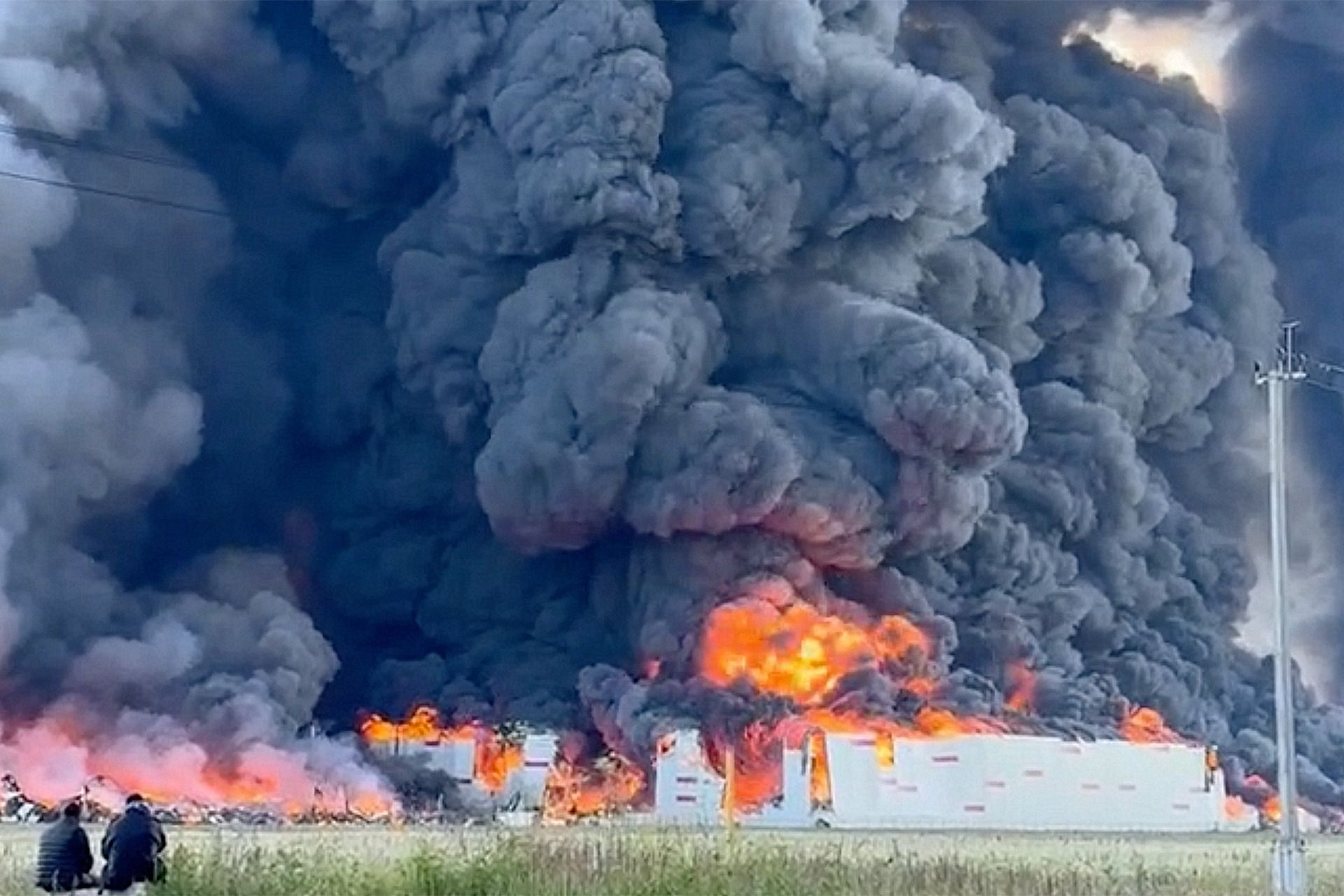
After a series of massive strikes on Wildberries warehouses, hundreds of amateur videos with the same content appeared on social media: sellers, in tears, talk about multimillion losses and complain that the state offers them no help, while the marketplace’s payouts are incomparable to the damage suffered. In early July, Wildberries introduced a new version of its offer, recognizing drone attacks as force majeure — and is now no longer obliged to compensate sellers for losses. Economist Nikolai Kulbaka is convinced: all this is not the fault of one specific company, but a systemic pattern of modern Russian capitalism.
Fire at the Wildberries logistics center in Elektrostal, July 18, 2026. Frame from video: Telegram channel Exilenova+
What Wildberries looks like after the change of owners
Over the past year, Wildberries has begun to become deeply embedded in big state business. It is now hard to say how its de facto merger with VTB is structurally organized, but in essence it is becoming a fairly important element of trade in today’s Russia.
The thing is that through this company a huge flow of gray imports is entering Russia. And the entire parallel import system is set up for certain beneficiaries who are not very well known. Perhaps this is [the key beneficiary of Wildberries after the merger with the Russ group, billionaire Suleiman] Kerimov, perhaps it is [VTB Group president and chairman of the management board Andrey] Kostin, perhaps someone else — we cannot say for sure. But on the scale of the Russian economy, this is already a quite tangible figure.
According to statistics, retail trade accounts for about 10% of Russian GDP. About half of that share comes from marketplaces. And about half of the marketplaces’ share is Wildberries. That is a huge amount of money. [Wildberries’ turnover for last year is estimated at 6.1 trillion rubles, Russia’s GDP exceeded 214 trillion rubles — Most Media]
And it is clear that the greater Wildberries’ power as a major player, the more the company squeezes money out of everyone who provides it with revenue. Because, basically, they have nowhere else to go.
If you are a small entrepreneur in a small town, then you have two options for growth: either you are limited to a local small market, or you go to Wildberries. But then you become completely dependent on the marketplace — on which goods can be sold there, what commissions it sets for you, and so on.In other words, you have no way to influence the conditions of your work.
Why Wildberries sellers do not defend their interests together
Theoretically, if this were a normal state, impoverished merchants could unite into a kind of trade union that would defend their rights. But in Russia this is a taboo topic: independent trade unions are dispersed, organizers are imprisoned. At the same time, Wildberries sellers are spread across the country and cannot unite.
As a result, each person who goes bankrupt on Wildberries sees it as their own personal story of failure, not as a systemic picture of the entire industry, where small players have very little chance of survival.It does not matter what exactly caused it: fluctuations in the Russian market, the global situation, or drone raids — in any case, a small player has practically no chance of fighting Wildberries.
In fact, Wildberries sellers are the new proletariat, only there is no Marx to describe their drama.
In some sense, the proletarians of Marx’s time even had it easier to fight for their rights. When several thousand people are at one enterprise, they can easily be organized, rallied, and brought out on strike. Today, however, we see how difficult it is, for example, to organize collective action in the taxi market, where aggregators work much like marketplaces. Because they are distributed and physically far apart, and because it is impossible to coordinate their actions, these small players are effectively deprived of the ability to fight collectively for their rights.
That is why Wildberries can do whatever it wants with its sellers. The company knows that new sellers will definitely take the place of those who go bankrupt.
On a national scale, as far as I remember, about 300,000 people actively sell on Wildberries. Even if 20% of them were affected by Ukrainian drones, 60,000 people scattered across the entire country is a very small lobbying force that can simply go unnoticed.
Who should save Wildberries sellers
In principle, the company should not face serious claims: Wildberries did not start this war, and Wildberries is not responsible for the lack of air defense around its warehouses. These are questions for the state, which collects taxes, uses them to organize the army and a huge military-industrial complex precisely so that none of this happens.
And of course, in theory, the state should compensate all business losses in such a situation. But in Russia the state does not care about this at all. This is very clearly seen in the case of the oil industry: there is really no help from the state to oil workers during air raids.
Remember how in the film “Station for Two” Nikita Mikhalkov’s character said [to his lover on a date], “Verunchik, do it yourself, yourself, yourself”? That is exactly the slogan of the Russian state.
If the state did not help the oil workers who feed modern Russia, then counting on it to start saving some unfortunate small entrepreneurs affected by Wildberries is highly doubtful.
But the state understands that this is a conflict. The state understands that this is a problem that is spreading virally across social media.There are hundreds of videos, if not thousands, and the number of views is already much higher. What will the state do under these conditions? It will pressure Wildberries so that the company helps its suppliers. And Wildberries, naturally, is forced to react to this to some extent — of course not in full, not in any real sense.
But there are two points here. First: as soon as the company starts helping, it means that it takes responsibility on itself. There is no longer any talk that the state should be responsible for this — it has shifted it onto Wildberries. And then the complaints will no longer be against the state, which did nothing, but against Wildberries, which paid, but too little. And the state, as it were, has nothing to do with it.
When Tatyana Kim said in one of her recent interviews that Wildberries is protected by air defense forces, it is clear that they do not have their own air defense. At best, they can assemble several mobile groups that will try to shoot down drones with some kind of small arms — there is no Voentorg in Russia where you could buy an anti-aircraft gun.And although the company can well afford it financially, a second problem arises here. Let us imagine that Wildberries starts surrounding itself with machine-gun nests, TORs, “Buks”. In that case, it effectively turns into a military target. That is just as dangerous as installing anti-aircraft systems on the roofs of residential buildings.
How the drone attack crisis will end for Russian marketplaces
Just a week ago, [massive] AFU strikes on Wildberries seemed extremely unlikely. Now it is obvious that all Russian warehouse complexes are in the risk zone. This changes the rules of the game on the market. It means that the insurance system is changing and the increased costs will have to be built into the price of the goods. I suspect that Wildberries and Ozon will revise their relationships with sellers, factoring in the risk of losing goods.And once again, this will not be in favor of sellers or buyers.
I also suspect that one of the reasons Wildberries excluded compensation for damage from drone strikes from its contracts with sellers is that insurance companies refuse to insure this risk. I do not think this is Wildberries’ own initiative. It is simply becoming not very profitable for insurers.
The same problem arose when the Ukrainians began attacking “river-sea” vessels — and insurers refused to insure cargo. Then the government suggested that insurers and shipowners create something like a mutual aid fund: chip in yourselves, and then the affected parties will receive payments. In other words, once again, “do it yourself, yourself, yourself”.
Once again: in the case of military actions, such risks are still the prerogative of the state. But since Russia is not officially waging war — only a “special operation” — the state does not want to take responsibility for business losses. It was the same during the pandemic: the state did not declare a state of emergency so as not to pay anyone.
It turns out that the state can do whatever it wants, but bears no responsibility at all.
Why does the Russian authorities act this way?
Yes, this is a corporate state. In some sense, the Soviet Union was also a corporate state. But there, for political reasons, the working class had to be in the lead. And although trade unions in the USSR dealt with distributing sanatorium vouchers rather than fighting for workers’ rights, a certain level of protection for the working class was built there.Then it migrated into the market economy. And so we have, on the one hand, remnants of the welfare state, and on the other hand, a rather wild capitalist market, and a rather right-wing one at that.
This combination is interesting because the remnants of the welfare state in Russia are gradually being burned away. The state is seizing more and more spheres of influence, pushing private business out of them — and at the same time reducing the protection of everyone who is in those spheres. And money is a pity, and there is less and less of it — which is why pensions and the subsistence minimum in Russia are ridiculous and are unlikely to grow in the coming years.
Recently, labor law on overtime changed in Russia. Not in favor of workers, of course. The number of overtime hours that can be worked without pay has almost doubled. It is clear why this is happening: the military-industrial complex is unable to find the necessary specialists for the increased tasks in the labor market — and wants to load the existing ones without hindrance. There is a huge amount of overtime work there. And it simply needs to be legalized. Since this cannot be legalized only in the military-industrial complex — it would look too strange — unpaid overtime work is being legalized everywhere. The problem of exploiting people is rearing its head in full.
In fact, today in Russia a corporate state is combined with some kind of devilish chaebolization, as a result of which large semi-state holdings emerge. And note: all these companies are set up very cleverly.On the one hand, they operate according to quite market rules — and as market players they are ready to pressure their workers.On the other hand, they live on state money, go to the state for money, and obey state actions. This applies to Wildberries, Gazprom, Russian Railways, and many other companies.
For workers and for Wildberries’ small partners or the taxi market, this is a wild and harsh capitalist market. For owners and top managers, for themselves, it is salaries, bonuses, and premiums, just like in the best capitalist companies. But they all sit on the state’s support and carry out the state’s wishes.
Such is the public-private partnership: all the roots go to the private owner, the small producer, the ordinary worker, and all the tops go to the beneficiaries and the state. Monstrous inequality. This is already a well-formed system. And, to be honest, I do not really know how to break it.
Russia today is one of the world’s “leading” countries in terms of inequality. The Soviet Union had a huge state share, but there was no such glaring inequality. I had the chance to see state dachas of retired Soviet ministers — they are in no way comparable to today’s oligarchic complexes spread over several hectares with golf courses, fur storage rooms, and poles for collective striptease.
At the same time, a large state share that in fact takes everything from everyone, and wild inequality — this is a nonsense that does not exist anywhere. In the United States, yes, there is huge inequality, but the state’s share in the economy is very small.In Europe, the state’s share is large, but social protection is also quite high there. But combining predatory capitalism with a high state share in the economy is, in general, the know-how of the current Russian system. And as soon as you start fighting these rules of the game, you are effectively opposing the state that established them.
Is a precariat revolt possible in Russia?
What has always been the threat to business from the proletariat? That they will stop work. A strike is the main weapon of workers at European enterprises, which they successfully used in Marx’s time and continue to use today. It is easy to imagine a garbage collectors’ strike somewhere in Europe: the trash is not collected, everyone sees it.
But it is much harder to imagine a taxi strike in a modern European city.
Now let us look at a typical Wildberries pickup point in some Russian settlement. The owner of this point, that same precarious merchant, is the only one like that in the whole settlement. And by local standards, he may even be considered a well-off person. Well, you go out with a placard in a solo picket in front of your pickup point. No one will support you — they will say: man, you’re just spoiled rotten. They simply will not understand you, because you are speaking a different language, your problems are incomprehensible to your neighbors, and they will not go out to protest against Wildberries with you.
You see, when there is a strike at an enterprise, everyone is in plain sight there. Strikebreakers are condemned by everyone. That is why the whole team comes out, and that is its strength. But Wildberries sellers simply have nowhere to gather together. There is no such gathering point.
Yes, if 100,000 Wildberries sellers from across the country came to protest in Moscow, that would be powerful. There would definitely be people willing to join them, and for the authorities it would be a catastrophe. But imagining that level of organization in Russia is unrealistic.
In France or Poland, farmers can gather from across the country to head to Paris or Warsaw — the transport accessibility and distances are completely different. In the scale of Russia, it is like traveling through several neighboring regions. That is why a nationwide protest by small Wildberries entrepreneurs is simply impossible.
If you enjoyed this article, consider making a donation — one-time or, even better, monthly. Your support helps us motivate our authors and become better with every article.
Our organization is recognized by the Internal Revenue Service (IRS) as a 501(c)(3) tax-exempt, charitable organization, which means that all contributions made to us are tax-deductible to the fullest extent permitted by U.S. law. Individuals may generally deduct charitable contributions of up to 60% of their Adjusted Gross Income (AGI) for cash donations made to qualifying 501(c)(3) organizations. For donations of appreciated assets (such as stocks or other long-term capital assets), the deduction is typically limited to 30% of AGI, based on the fair market value of the asset. C-corporations may deduct charitable contributions of up to 10% of their taxable income for donations made to eligible charitable organizations.
By submitting a donation, you confirm that you have read and accept the following documents: Privacy Policy and User Agreement, and also give consent to the processing of your personal data.
If you would like to unsubscribe from a monthly donation, please email us at: [email protected]