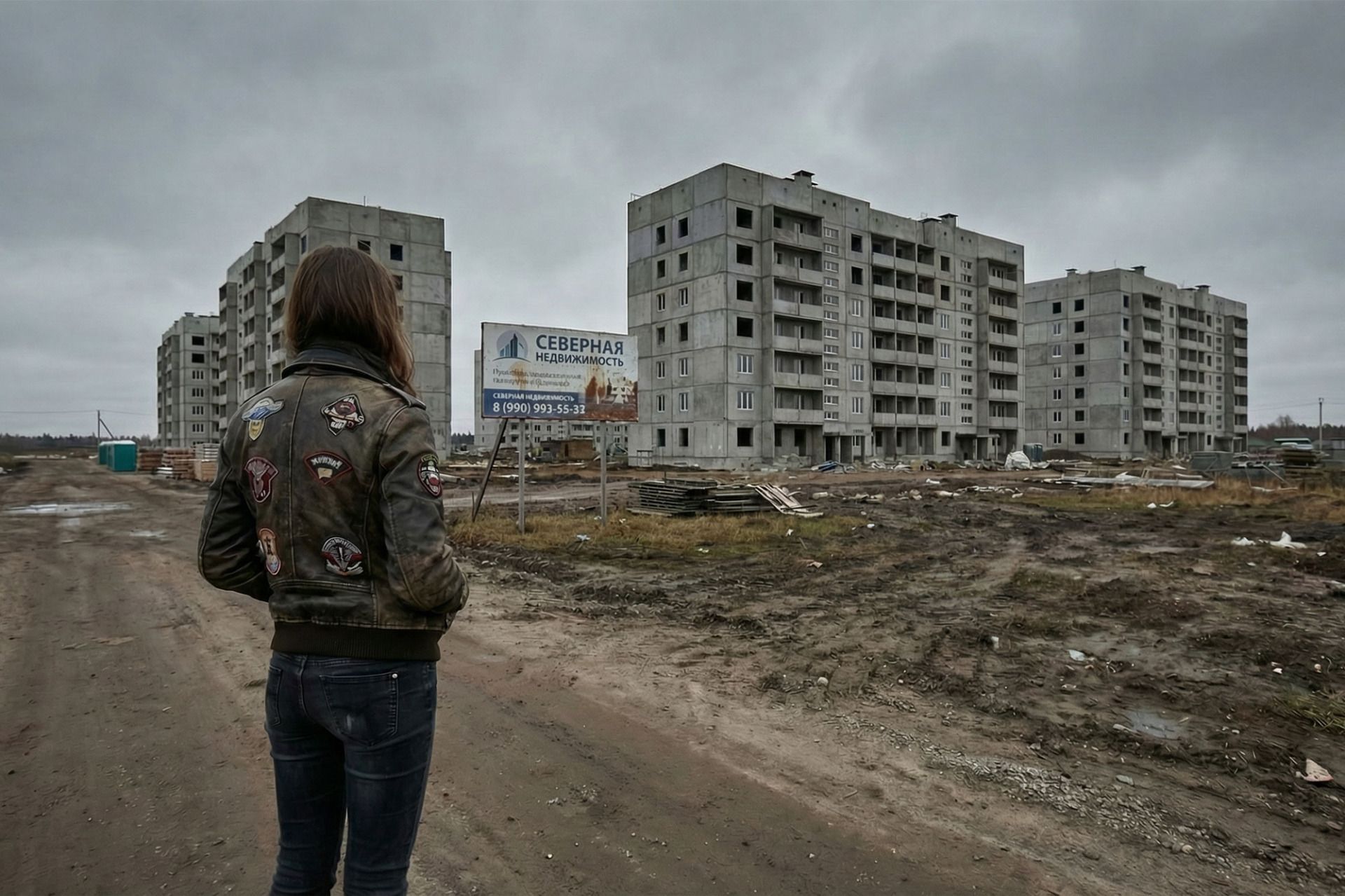
I wandered through neighborhoods of new developments, trying to at least convince myself that selling such a future to living, thinking people, with a 30-year mortgage, wasn’t a crime. I honestly tried to break myself and become a successful person against my own nature. Here’s how it went—and here’s how it ended.
Illustration: Google Nano Banana
Material prepared by the team of the project “Blue Capybaras“, where mentors work with aspiring journalists.
It was the spring of 2024. I just wanted to jump into the real estate price bubble and quickly earn enough for a car. I sent my resume to every agency with open positions on HH and waited for replies.
The top agencies turned me down immediately, which wasn’t surprising: no matter how smoothly I could talk, they only hire people with relevant real estate experience. A few second-tier outfits and all the no-names invited me for interviews. I invited myself over to a friend’s place to use her steamer, tidied up my best suit, petted her dog, hugged her kid, got a free lunch, then put on my best human face and went off to the interviews.
When the HR manager at the first agency said they had a five-day office week from 9 to 5 and a mandatory dress code, I wished them a speedy bankruptcy. Because, to put it gently: if your base salary is 10k, you have no right to care where and how I work, and you shouldn’t even mention discipline. Then I found out that a 10k salary is actually pretty decent: in real estate, it’s normal practice not to pay agents anything except commissions.
At the next place, they told me outright that I wasn’t a good fit, and that stung. No one had ever dumped me on the first date before.
At the third agency, a fairly well-known name, I lasted a whole two days. I was attracted by: the supposedly loyal management, a training system, high commissions, a convenient office location, and the free coffee machine. In reality, “loyalty” turned out to be plain indifference, and the “training system” was just a three-day video marathon with a test interview at the end, after which trainees are thrown into a sea of cold leads and told, “swim, sausages.” You sit making cold calls for weeks or months—if you’re lucky—until your first closed deal, and only then do you get access to the real database. I wasn’t okay with this nonsense either, so I moved on.
At the fourth place, I was greeted at the door by Galya from Irkutsk. She’d worked in administration, then moved to St. Petersburg for a better life and became a realtor. In the early 2020s, she split from a big agency, took a few colleagues with her, and decided to do her own thing, so she wouldn’t have to answer to anyone. Chubby Galya explained how things worked there, snorting with laughter at my jokes. I knew right away we’d get along—I love women like her, they’re fun and share their food. So I stayed there.
***
Formally, the duties of an agent, as listed in job ads and explained at interviews, are as follows: selecting properties based on client requests; organizing viewings; knowing the neighborhoods, layouts, and prices; supporting the transaction (contracts, deposits, advances); coordinating with banks, developers, the land registry, and notaries.
Sounds reasonable, right? But I’m not really a realtor, as you may have noticed—I’m a deserter with a map of minefields, so here are the facts. Let me clarify that everything below applies to the mass market segment—I have no idea how the rest works.
The entire sector lives off commissions from developers and sellers of secondary housing—that’s the main income. Agencies position themselves as external sales offices. “We don’t represent any specific developer, our database includes all developers and all properties. We’re independent experts focused solely on the client’s needs. Our services are free for you—the seller always pays the agent,”—this is the mantra every rookie must memorize and repeat at every client contact.
You could end the analysis here: if you’re not the one paying the specialist, then they’re not working in your interests.
The agent’s job isn’t to help you solve your housing problem. The agent’s job is to speed up the conversion of human vulnerability into a financial obligation, because they get a cut from every contract. Their job is to steal you from other jackals, lock you in, create an illusion of urgency so you don’t have time to think, “handle” all your objections with a script, get you to the deal as quickly as possible, and close it at any cost.
An agent will never say:
“Bro, you’re a waiter, you can’t afford a mortgage.”
“With your budget, there are no livable options here and there never will be. I recommend Voronezh.”
“Kudrovo isn’t a garden city, it’s a branch of hell. You’re buying chronic exhaustion and social isolation on an installment plan.”
“You’d be better off hiring a real lawyer and buying a Khrushchyovka.”
“This is unsellable—you won’t be able to offload it even to the bums of the future. Move your money to Kazakhstan, everything’s about to collapse.”
“No, you won’t get a decent refinancing rate: you have a bankruptcy on record, it’s a miracle anyone approved you for a loan at all.”
“Live with your grandma for a couple more years, she doesn’t have long left.”
What an agent will say:
“Let’s use a consumer loan for the down payment, I’ll help you set it up properly.”
“Why not top it up with a mortgage?”
“It’s a young, developing location. Once the infrastructure is built, it’ll be much more expensive.”
“With your actual salary, you won’t get approved—you’ll need to embellish things a bit for the bank.”
“When rates go down, prices will go up. Buy now, you can refinance later.”
“Real estate always appreciates. When you get an inheritance, you can pay off the loan early and even have enough for a room.”
An agent will always try to push you toward new builds, because resales are slow, tedious, and legally complicated. Resales require time, responsibility, real expertise. And for that, the client pays out of pocket—convincing someone to hand over their own money is much harder. The agent doesn’t want to deal with that—they have KPIs, zero base salary, and a cold database. They don’t care if you can pay your mortgage in five years, if the location is livable, if a clinic will be built, or if there’s a place to walk your dog. They don’t think you might be better off saving more, or that you have panic attacks on crowded buses and are scared by the sound of planes landing. Caring isn’t part of this profession—it lowers conversion rates. The agent just wants to close the deal and collect their commission.
The agent’s commission is 1.5–4% of the apartment price, already factored into the cost. The developer doesn’t care who gets it—an outside seller or their own manager. For certain properties, they might raise it to 6–10% to motivate agents to push unsellable units. Of this, the agency takes 30–80%. All respectable organizations, of course, have KPIs. Here’s how it works: one deal a month—20% of the commission; three deals—40%; more than five—you can keep 60–70% of your revenue. I’m simplifying and not getting into the details of assignments and resales—the numbers may vary a bit, but the pattern is the same everywhere. Payouts at the end of the month, cash in an envelope. Salaries are rare, official contracts too.
Is it possible to keep empathy, ethics, and principles in a job like this? Absolutely not. Even the most decent person, placed in this incentive structure, becomes an operator of violence.
There are more than a thousand such agencies in St. Petersburg, plus every developer has their own sales office. Who uses them? Lol, nobody. If someone is sane and wants to buy with a specialist, they look for a realtor by recommendation or go to a company with a name. So where do the incoming leads come from? Everyone I know works about the same way: using fake accounts on Avito and DomClick, they post bait ads with no real details—just a layout, a rendering, and an obviously low price. These are aimed not at informed buyers, but at confused, tired, uneducated, frightened people. That’s how the selection works. These ads are called by naive workers and barely literate heirs—they make up the database that agents then process.
***
Processing protocol:
Answer the call.
Gently “detach” the client from the specific ad that caught their interest. Any argument can be used: it’s an assignment, it’s an apartment hotel, completion is next millennium, there’s an encumbrance, etc.
Once the client is convinced that this particular property definitely doesn’t suit them, slip in that we’re actually an agency, we have 80,000 apartments in our database, and we can start searching for them right now.
Find out their solvency, budget, and readiness to move forward with a deal.
Talk their ear off, chat about needs, locations, layouts, floors, infrastructure, and pretend to do a thorough search.
Cheerfully announce that five hundred options match their criteria and get them into the office for a face-to-face meeting.
If you lose them at any stage, call back in a few days with a news hook and try again.
Why all this? Here’s a quote from a training manual I took as evidence when I quit (the editorial office has a copy of the document):
“It’s important to remember that clients usually start searching for an apartment on various platforms themselves, because they don’t know enough about the purchase process or the benefits of professional assistance. They’re focused on the result (buying a property), not on working with a specific agent. They get a lot of annoying, similar calls from other managers. This causes fatigue and lowers engagement. Your job as a specialist is to grab the client’s attention, explain the value of your service, and build communication in a way that keeps them interested in continuing with you!”
The real work begins when the person comes to the office. Here you have to conduct a thorough interrogation disguised as an interview: establish the purpose of the purchase, family composition, decision-makers, all their wishes and motivations, get under their skin, probe boundaries, and most importantly—find out everything about their money. What cash they have, where it’s from, if there’s anything else, what income, what loans, what’s being sold, at what stage, any expected inheritance. During the conversation, we need to figure out where the red lines are and how we can move the client: in square meters, location, price, or completion date. When we’ve checked everything off the checklist, we move on to the actual search.
Illustration: Midjourney
Any good salesperson always sells not the product, but the story. For a real estate agent, the story is: it won’t get better, prices are rising, you can’t save up, there’s nothing to wait for, you need to buy immediately. He’s a priest of an apocalyptic cult, where salvation is a studio with a view of a wasteland and debt until you die. That’s why, in 99% of cases, the search includes bargaining: your needs don’t match your possibilities—where are you willing to compromise? Move out of town, take on more mortgage, settle for a box instead of a real apartment. Decide here and now—there won’t be a second chance.
The next step is to “fix” the client in the realtor database “TrendAgent.“ You enter the client’s passport details and ”lock“ them to yourself, so no other agent can take them. Then comes support, showings, mortgage, deal, commission.
In the end, the agent’s skill is to make sure the person who planned to buy with cash and settle in a decent area doesn’t put off the purchase or buy a rundown resale on CIAN, but instead walks out with a mortgage in Murino and feels like a winner. In plain Russian: to ruin people’s lives so well that they’re actually grateful for it. That’s true professionalism.
***
Galya took her little business very seriously. She set up a cozy office with a fridge and coffee machine, wrote a manual, created a training program, caught some newbies on HH, and trained them with full responsibility. She gave us lectures and tests, reviewed our calls, rehearsed scripts with us, played out various situations, backed us up at meetings, scolded us for mistakes, praised us for successes, comforted and encouraged us.
She really did try to raise us into model predators. It’s not her fault it didn’t work out—she did everything she could.
Besides me, there were three other trainees at the agency.
Sonya earned a degree in philosophy but couldn’t find a job in her field. The market doesn’t need philosophers, it needs sales managers. She meticulously studied the geography of Novoselye, learned all the ins and outs of subsidized mortgages, knew the material better than any of us, and educated me in the smoking room about subsidies, but she couldn’t talk to people at all. Galya believed in her and spent an hour every day practicing call techniques, but Sonya would go cry in the bathroom every time someone swore at her on the phone. After two weeks, she left us.
Illustration: Midjourney
Marina was paying a mortgage for a new build in Rybatskoye and raising her son alone. She rarely came to the office, only for client meetings and mandatory debriefs, but I listened to her calls—they were technically flawless. Marina was a bright blonde, watched her figure, dressed stylishly, and had elaborate manicures. Sometimes in the smoking room, she entertained us with gossip about people I didn’t know or stories about her ceramics classes. Marina had worked in sales for ten years. She was doing well—she closed her first deal at the agency in a week and a half.
We also had Slavyan. He weighed about 150 kilos, wore a suit with a bow tie, and was cheerful and witty. He’d just turned 28, and we called him “skuf.” He took detailed notes, stayed late, replayed his calls, made transcripts, and analyzed his mistakes. He’d trained as an agronomist but worked as a courier and was paying off a loan for a Nexia. Once in the smoking room, Slavyan told me how he survived a severe depressive episode, wanted to jump out a window, ended up in a psych ward, gained weight on tranquilizers, then met a girl, fell in love, and proposed. He needs at least a million for the wedding, and to earn that by next summer, he went into real estate.
As for me, I sabotaged the actual work as much as I could but studied very diligently. Galya tried to make me cold-call people, but instead, I made her give me lectures on mortgages. I explained that I wasn’t ready to go into the trenches without a flak jacket. Why practice talking on the phone, I said, when I’m already good at talking—my problem is I don’t know anything. Working in real estate without understanding the subject is irresponsible and immoral—I’m not selling vacuum cleaners, I’m selling homes. They looked at me like I was crazy, then gave up and let me do what I wanted—after all, they didn’t have to pay me a salary.
I spent dozens of hours at “TrendAgent,” studying presentations on different properties, installment plans, mortgage contracts. I went to Bugry, Novosaratovka, Shushary, and other satellite towns—parasites of St. Petersburg—where the biggest housing construction of recent years is happening. Everywhere the same landscape: an empty field, reachable only by two trains and horseback, with a concrete high-rise body storage in the middle. No schools, no clinics, not even a fire station—just beer joints, shawarma stands, and pickup points for marketplace orders. Developers finish the buildings, but infrastructure lags behind. Around are wastelands and years of construction ahead, not a park or a tree in sight. Wind and dust, endless traffic jams. Somewhere nearby is an airport, somewhere a landfill. Someday they promise everyone a metro, but new stations in St. Petersburg open once a decade.
Illustration: Google Nano Banana
I wandered through neighborhoods of new developments, trying to at least convince myself that selling such a future to living, thinking people, with a 30-year mortgage, wasn’t a crime.
***
I honestly tried to break myself and become a successful person against my own nature. I answered incoming calls during my shifts and almost never made outgoing ones. In a month and a half, I managed to sell one studio in a notorious long-term construction to the heir of a stinky communal apartment—and almost sold a two-room flat in Kudrovo to a large family from Ingushetia. But not one of the twenty banks we applied to approved them for a mortgage.
Another client, without telling me, went straight to the sales office, where the developer’s manager reassigned him and took my well-earned commission. This made me furious. I spent hours arguing with the developer’s office, TrendAgent support, yelled at the client, and then gave up and started cold-calling the database with iron determination to get a new meeting the very next day. And I got one—a guy looking for an investment property. Let’s call him Sergey Gennadievich.
Sergey Gennadievich came to the office at the appointed time on Sunday, sat in the guest chair, and told me the following story. He inherited half of a three-room Khrushchyovka on Novocher from his late mother. He and his sister sold it for a good price, and now he’s looking to invest the capital to get passive income and live comfortably. He’s ready to manage the property and organize short-term rentals. His capital is enough for a one-bedroom in Yanino, but the problem is that nobody wants a short-term rental in Yanino. However, Sergey Gennadievich came up with a brilliant business plan. In the village of Pesochny near St. Petersburg, there are three cancer centers, one of them federal. Cancer patients and their relatives from all over the country come there for treatment and need a place to stay. The price for short-term rentals there is nearly as high as in the city center during peak season, while the price per square meter is about the same as in Shushary. He’s buying an apartment for cash and is ready to sign a contract today—my job is simply to find the perfect investment property for him and support him through the deal. That’s it, easy game.
I listened to Sergey Gennadievich very carefully, told him to go to hell, and walked him to the elevator. Then I closed my laptop, finished my coffee, spun around the office chair (I was alone and had always wanted to do that), grabbed my milk from the fridge, left my pass and company phone on Galya’s desk, handed the keys to the security guard, and left.
The pigeon at the gate nodded to me respectfully. The one-eyed cat from Galernaya rubbed its head against my leg. I went back to my communal apartment, wrote on the wall in red paint “call yourself a punk—live badly,” and went off to the woods to contemplate another defeat, as any proper tragic hero of Russian literature should. I’m a little comforted by the fact that I drank at least three thousand rubles’ worth of coffee during my time there.
***
I’d like to add that all this happened quite a while ago, in terms of how quickly reality changes these days, before the widespread adoption of the “Dolina” scam scheme. Back then, from inside the market, right at the front lines, Soviet panel buildings on the outskirts and communal rooms converted into “studios” (legally, with approved renovations!) in the center seemed like salvation—the last possible compromise. Of course, it’s not an urban utopia, but at least it’s a reasonable environment with decent infrastructure. I have absolutely no idea what people are supposed to do today. Even if I’d managed to stay a realtor, I’d still have quit by now, because this is where the line is drawn.
New builds in and around St. Petersburg are unfit for living, and the ones that are fit are unaffordable; even the best lawyer can’t guarantee you won’t get scammed in the resale market as long as there’s this loophole in the law called Article 177 of the Civil Code (on invalidating deals with people incapable of understanding their actions). Yes, such cases are a tiny percentage of all real estate transactions, but they’re usually fatal for buyers, and the public outcry is huge. Plus, from January 2026, the St. Petersburg renovation program is back on after being frozen for four years by protests from Khrushchyovka residents. It’s not as inhumane as originally planned, but it’s still very suspicious. Renters in this country are completely powerless and unprotected—they can be thrown out on the street at any time for no reason. Legally—with three months’ notice; in reality—even with a contract, which is rare, a person without a home usually has no resources for court—they just need to find somewhere to sleep.
It’s a structural dead end on all fronts. The only recommendations are a yurt, a camper, a dugout in the woods, nomadism, or refusal as the only possible answer. Or marginality as the last form of dignity.
If you enjoyed this article, consider making a donation — one-time or, even better, monthly. Your support helps us motivate our authors and become better with every article.
Our organization is recognized by the Internal Revenue Service (IRS) as a 501(c)(3) tax-exempt, charitable organization, which means that all contributions made to us are tax-deductible to the fullest extent permitted by U.S. law. Individuals may generally deduct charitable contributions of up to 60% of their Adjusted Gross Income (AGI) for cash donations made to qualifying 501(c)(3) organizations. For donations of appreciated assets (such as stocks or other long-term capital assets), the deduction is typically limited to 30% of AGI, based on the fair market value of the asset. C-corporations may deduct charitable contributions of up to 10% of their taxable income for donations made to eligible charitable organizations.
By submitting a donation, you confirm that you have read and accept the following documents: Privacy Policy and User Agreement, and also give consent to the processing of your personal data.
If you would like to unsubscribe from a monthly donation, please email us at: [email protected]