“Most” columnist Dmitry Khmelnitsky has been trying for 50 years to reconstruct the life story of the outstanding artist Viktor Lobachev. All that is known about him so far is his name and the period of his work: the late 1930s.
This story began in the late 1960s when the grandmother of one student came to the director of Leningrad school No. 103, Iosif Vol'fson, asking him to take books and papers left by her deceased relative—the widow of some artist. There was nowhere to store the archive, and the woman was ready to hand it over as waste paper. Among the books, mostly on film history and architecture, there was a small folder with drawings and sketches. In the mid-1970s, Vol'fson gave them to me.
At first glance, it was clear that the drawings represented enormous artistic and historical value. They were unsigned, but some books bore the owner's name—Viktor Lobachev. On some pages, the name appears repeatedly, as if the writer was working on perfecting the signature.
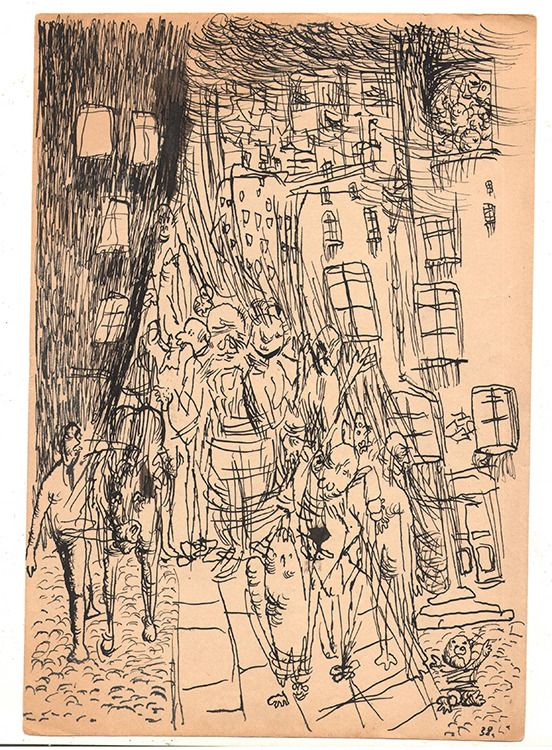
Several drawings are dated—'37' and '38'. I was unable to obtain any information about the author.
I tried asking my architecture professors at the Academy of Arts, Armen Barutchev and Igor Fomin, who studied in the 1920s, about Viktor Lobachev. Without success. The drawings interested them, but the author's name was unknown to them. Art historians specializing in Soviet graphics of the 1930s also had no knowledge of Viktor Lobachev. I deeply regret that in my youth and naivety I didn’t take the opportunity to search the Leningrad archives, for example, the Artists’ Union archive. I am sure references to Lobachev would have been preserved there. Now, from Berlin, I can no longer do this.
Judging by the drawings and notes, in the 1930s he designed Soviet holidays, illustrated books, and gave lectures. The style of the drawings is characteristic of the 1920s. Lobachev likely studied either shortly before the revolution or soon after. He was not a very young man in the late 1930s—the graphics are completely mature and confident, and the drawing technique is perfected. There is no hint of apprenticeship.
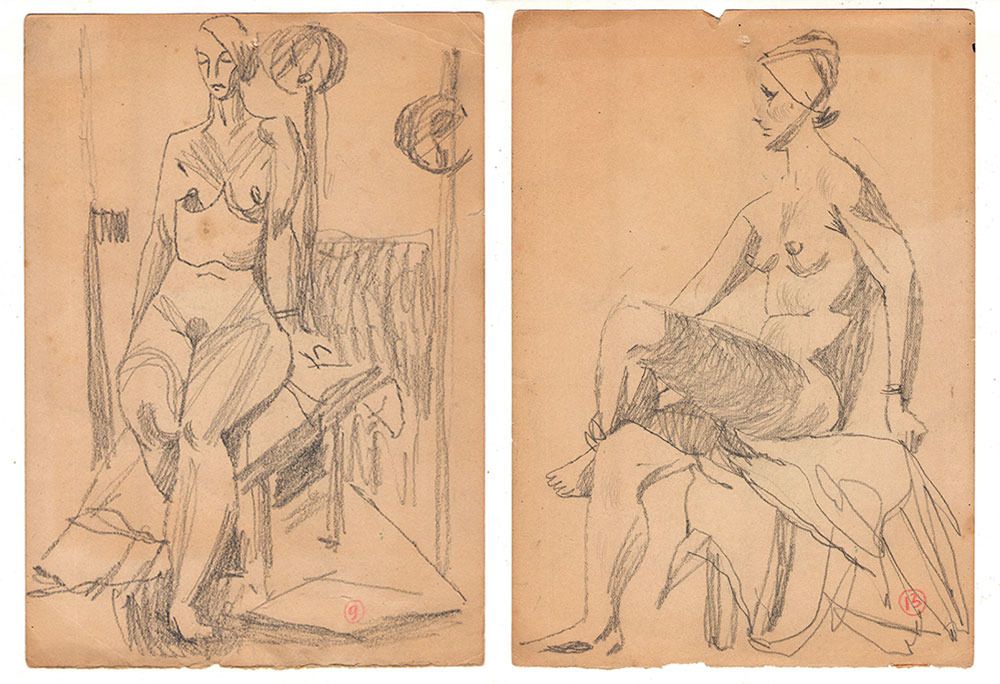
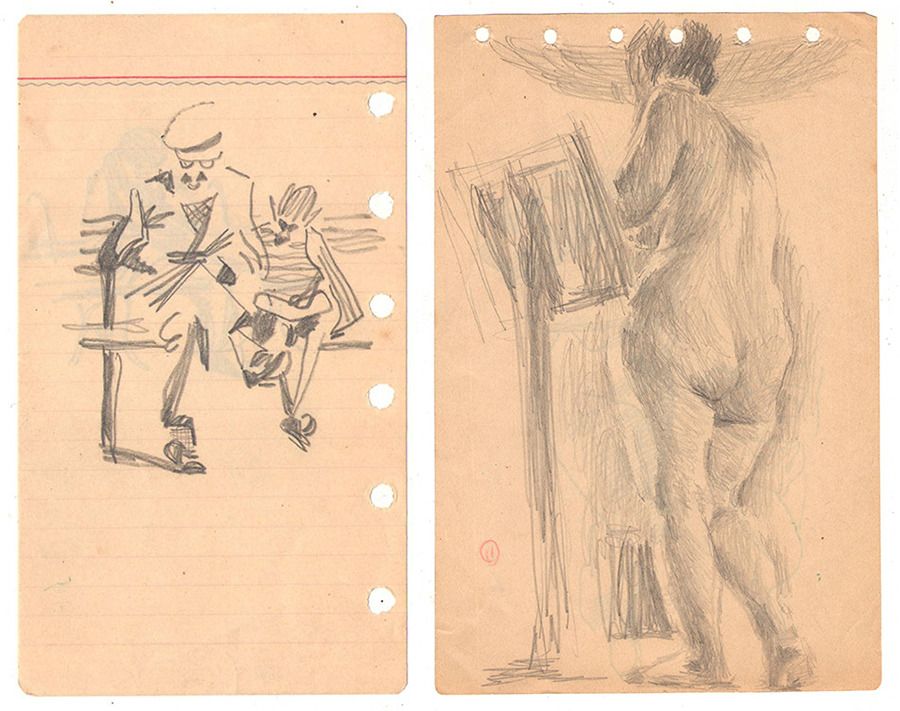
Most likely, he was not a painter by education either, but rather a graphic artist. Perhaps even a sculptor or architect. This is evident in the nude drawings. They have the plasticity typical of sketches by sculptors or architects accustomed to working with real, not illusory, mass.
Almost all the drawings in the collection were probably made within a narrow timeframe—most likely in the late 1930s. These works contain clear reminiscences and images from Picasso’s “Guernica” (1937) and no realities related to the beginning of World War II. The lecture topics written on a scrap of paper clearly belong to peacetime.
Lobachev apparently did not survive the following few years. He could have died at the front or during the blockade, but then it would have been reflected in his papers, and his name would have appeared on the list of deceased members of the Artists’ Union (I did not find it there). Most likely, he was repressed around 1938. This assumption is supported by the nature and themes of his graphics, which reveal the inner world of this man. People like him had little chance of surviving the 1930s.
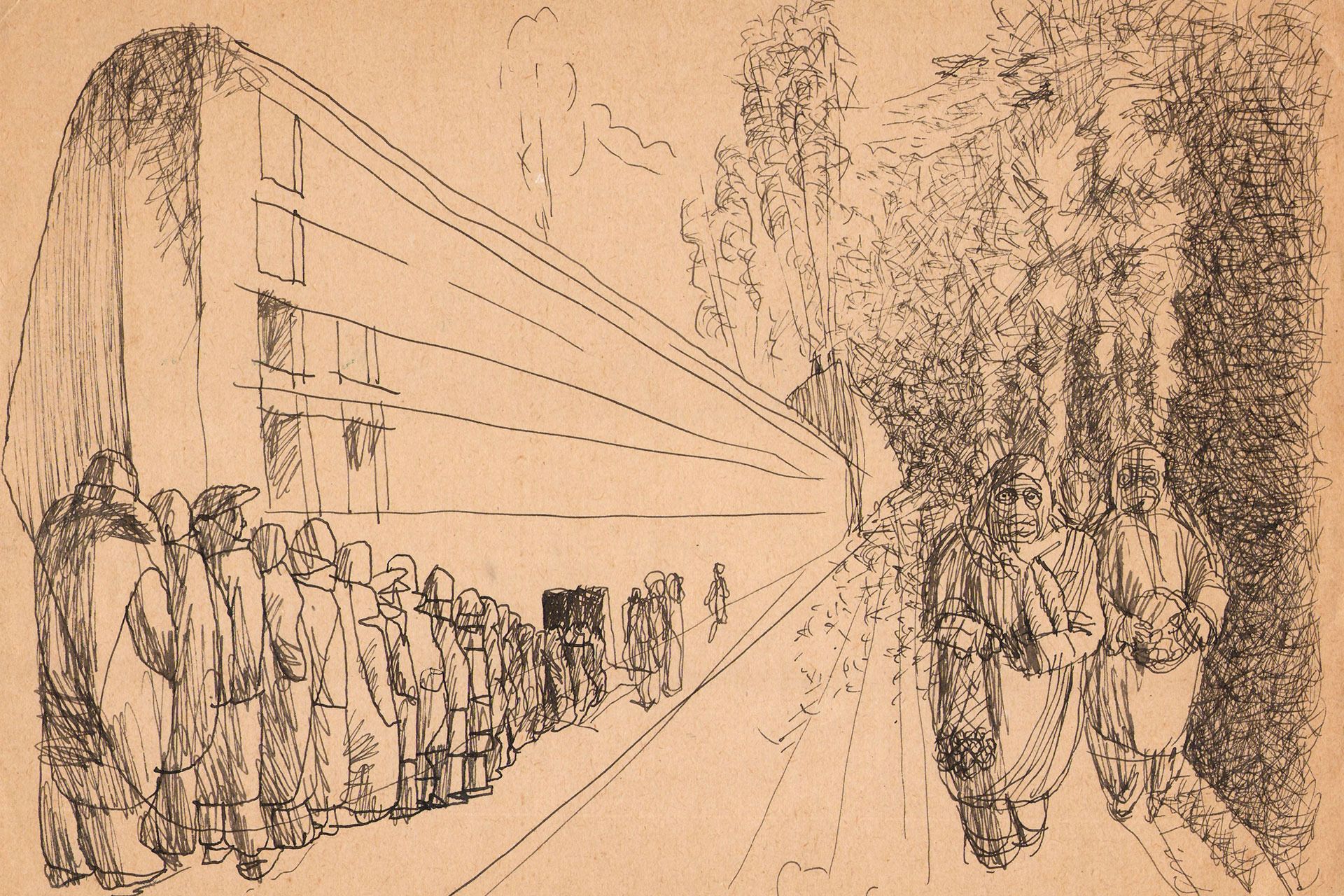
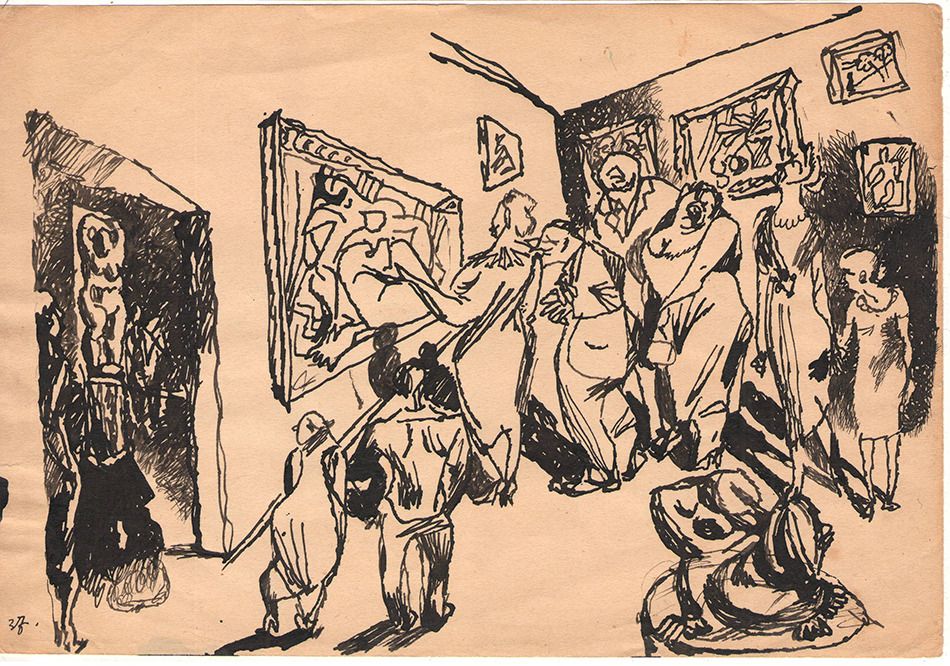
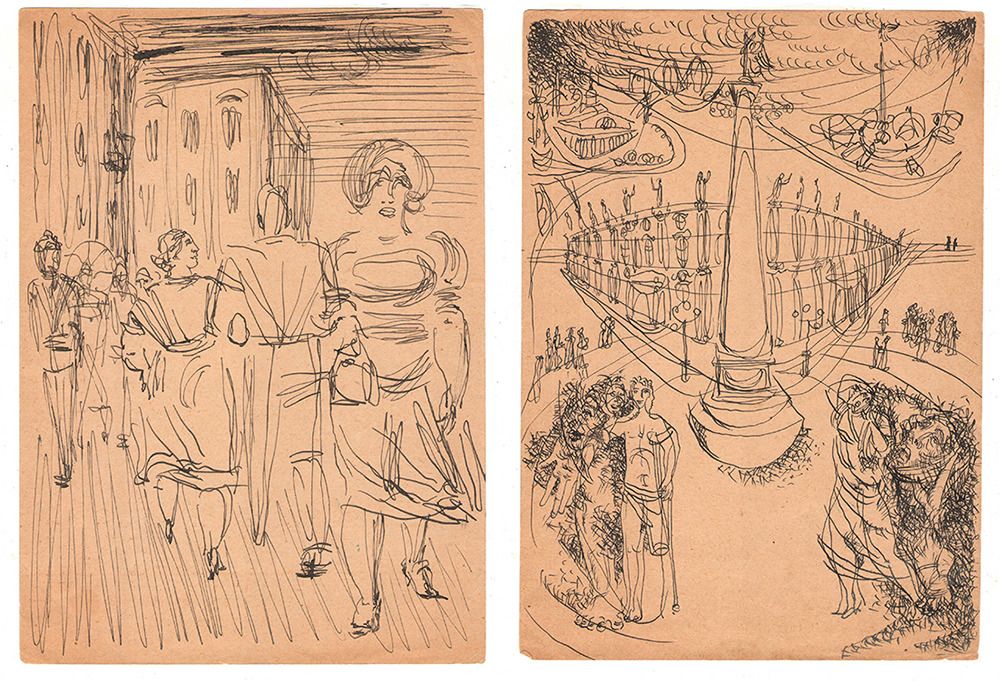
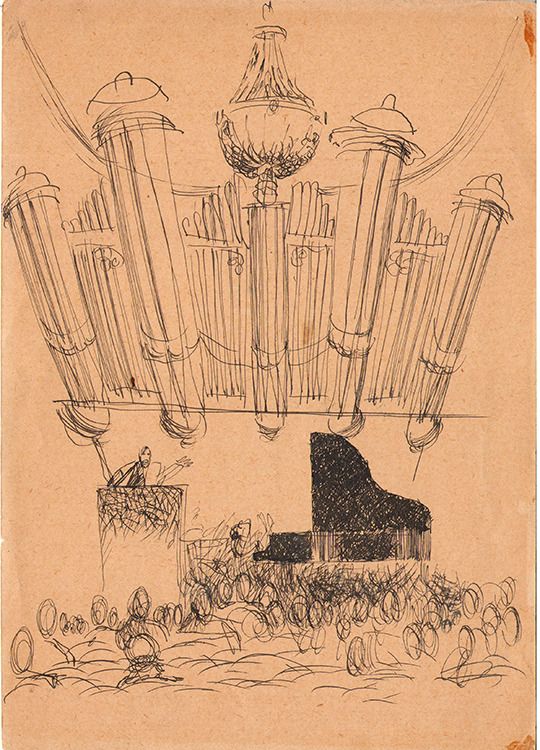
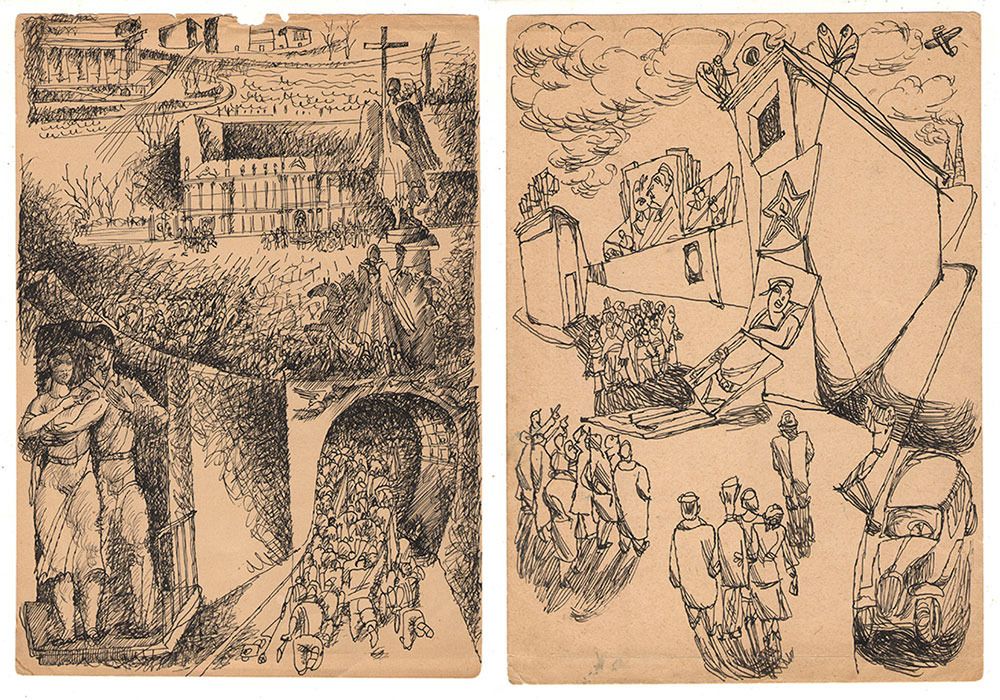
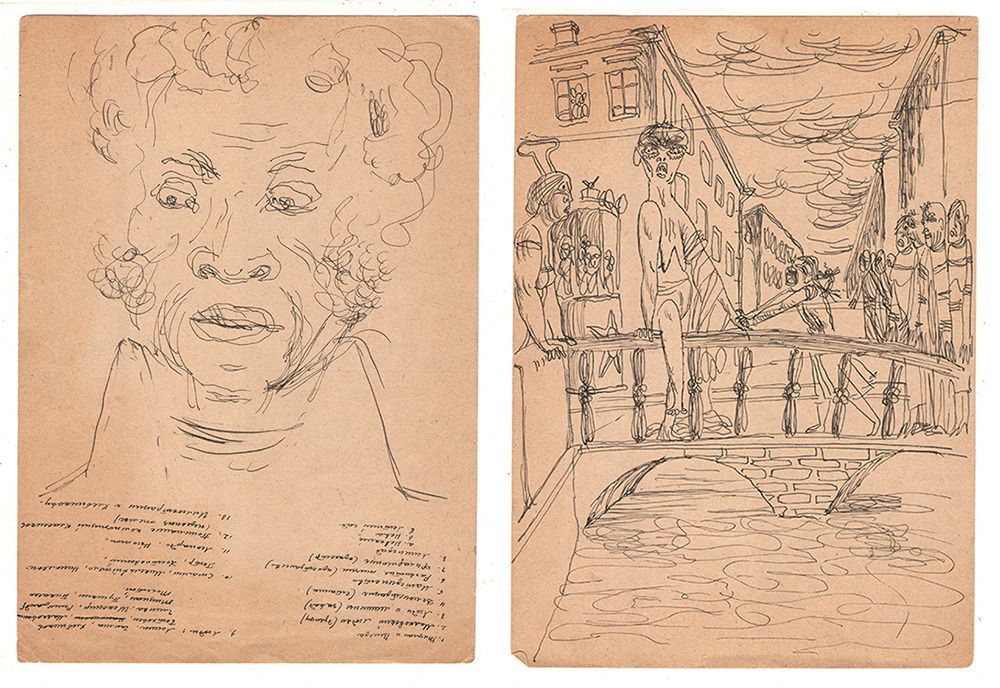
The drawings can be divided into several groups. The first and most important group consists of graphic compositions made with a pen (sometimes thick, sometimes very thin) on small sheets of dense, yellowed paper. They are clearly not intended for publication, but it is evident that the author himself values them. Despite their small size, the compositions are sometimes very complex and intricately developed. Some drawings are dated.
These are clearly not sketches but finished graphic sheets. Most are devoted to Leningrad to some degree. Among them is “Report at the Philharmonic” (possibly a drawing from life)—half-empty rows of seats, a speaker at the podium, organ pipes raised above the hall, and a sinister black wing of a grand piano in the middle of the stage. “Taking of the Winter Palace” is a drawing clearly inspired by a scene from Eisenstein’s film but completely alien, even hostile, to Eisenstein’s pathos. Seen from above, Palace Square is depicted in a sharp, twisted perspective, caricatured sailors running under the arch of the General Staff building, the Winter Palace with barely visible barricades in front, a shooter on Vasilyevsky Island behind, and above the entire coiled composition—a completely non-caricature angel from the top of the Alexander Column. The graphics are astonishingly light, free, yet extremely precise and tense.
No less striking is the composition provisionally titled “Hanging Posters.” Again, a street seen from above, sparse figures of onlookers with dark shadows watching workers on a rooftop pulling up parts of a giant poster. Nearby are already hung portraits of leaders, where the faces of Stalin and Molotov can be discerned. A government car stands to the side. This drawing and many others exude the unique and authentic atmosphere of the 1930s. The author is so skilled with the pen that he pays no attention to formal correctness of the depicted. Some compositions (“Attempted Suicide,” for example) seem almost naive, others are exquisite and precise to the limit. The subject itself suggests the technique.
Another group of drawings consists of illustration sketches—for Bernard Shaw’s “Pygmalion,” for a book of Jack London’s stories. Lobachev was interested in biblical themes. Among the drawings are beautiful, sometimes almost surreal compositions on the themes of “Expulsion from Paradise,” “Susanna and the Elders,” portraits of Charlie Chaplin, and Pushkin.
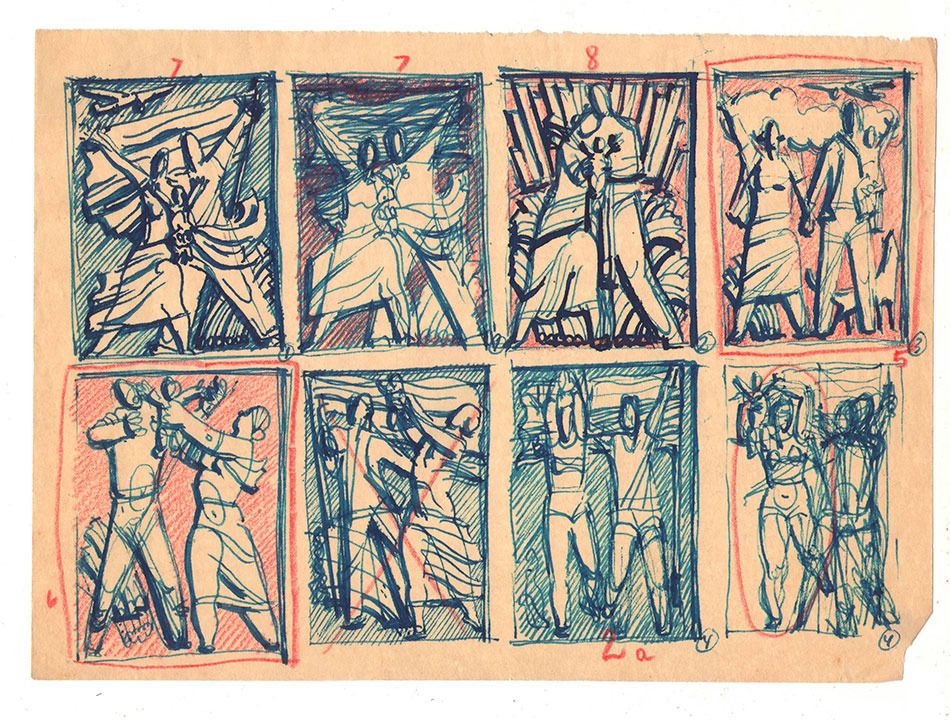
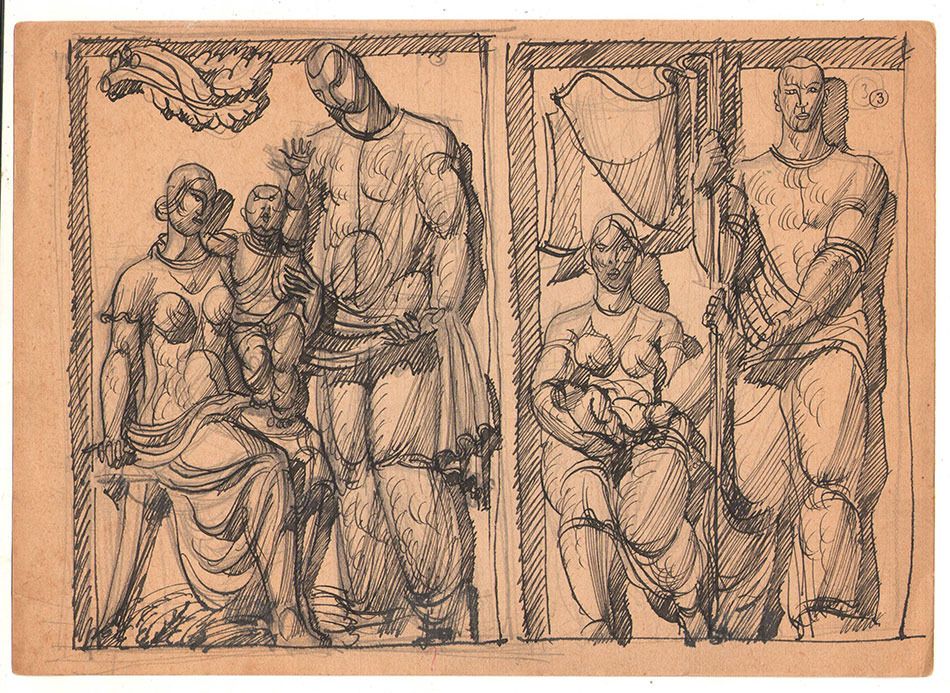
There is a series of sketches of typically Soviet patriotic bas-reliefs. For example, the composition “Mother and Child.” There are many of them, and on some faces acquire a somewhat inhuman, openly sinister expression, contradicting the official solemnity of the image.
A separate group consists of remarkable nude drawings (pen and pencil) and casual sketches of people and street scenes on tiny notebook sheets. Among them are masterpieces.
I hope that publishing Viktor Lobachev’s drawings will help find at least some information about the fate of this outstanding artist.
If you enjoyed this article, consider making a donation — one-time or, even better, monthly. Your support helps us motivate our authors and become better with every article.
Our organization is recognized by the Internal Revenue Service (IRS) as a 501(c)(3) tax-exempt, charitable organization, which means that all contributions made to us are tax-deductible to the fullest extent permitted by U.S. law. Individuals may generally deduct charitable contributions of up to 60% of their Adjusted Gross Income (AGI) for cash donations made to qualifying 501(c)(3) organizations. For donations of appreciated assets (such as stocks or other long-term capital assets), the deduction is typically limited to 30% of AGI, based on the fair market value of the asset. C-corporations may deduct charitable contributions of up to 10% of their taxable income for donations made to eligible charitable organizations.
By submitting a donation, you confirm that you have read and accept the following documents: Privacy Policy and User Agreement, and also give consent to the processing of your personal data.
If you would like to unsubscribe from a monthly donation, please email us at: [email protected]