More than 30 years after the massacre of Bosnian Muslims by Serbian nationalists in Srebrenica, the world is once again remembering those nightmare events — this week, their chief organizer died. At the same time, for modern Serbian far-right activists and their platonic Russian fellow travelers, Mladić, like the organizers of other mass killings in former Yugoslavia in the 1990s, remains a hero.
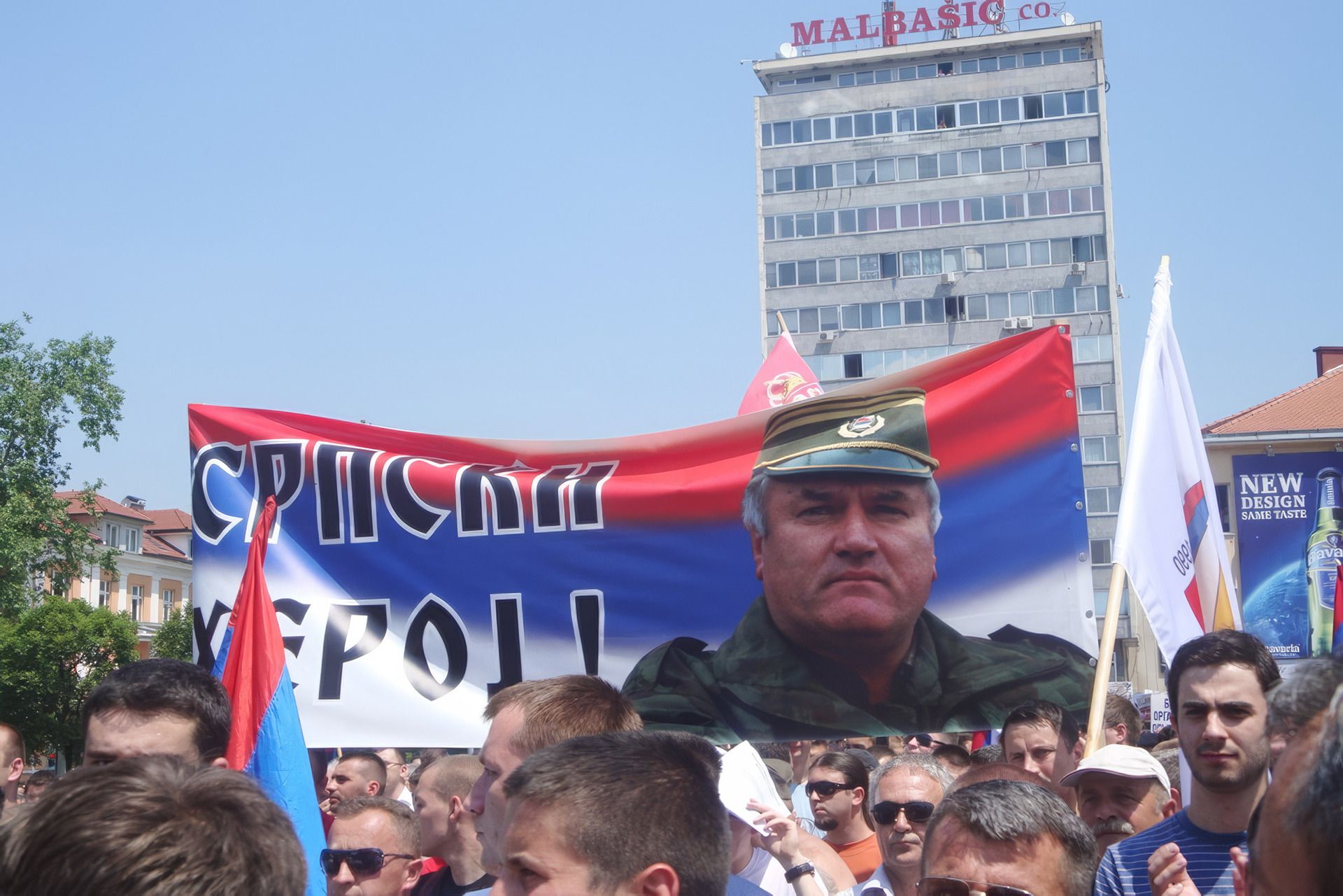
A rally of Ratko Mladić supporters from the Bosnian Serb part of Bosnia. Banja Luka, May 2011. Photo: Wikipedia / Rade Nagraisalović
There is a common saying: war goes on until the last soldier is buried. It can be supplemented: and when a war criminal is buried, war flares up again. The news that on August 27, 2026, Serbian general Ratko Mladić, known for atrocities during the Yugoslav conflict, died in a Hague prison showed that even 30 years after those Balkan horrors, nothing and no one has been forgotten.
Official Belgrade immediately made its sympathy for the deceased quite clear. Serbia’s justice minister Nenad Vujić said that the very fact that Mladić wore general’s epaulettes obliges the authorities to give him a state funeral. The Bosnian and Croatian sides reacted, as expected, very sharply: in the mid-1990s, Mladić did not merely command troops, but carried out the massacre in Srebrenica — the largest mass killing in Europe after World War II. Serbian nationalists answered their neighbors’ condemnation with fresh bows to the general.
In Serbia and in the Bosnian Republika Srpska, Mladić still remains a hero. Supposedly a real leader, a warrior hero, he defended his people from enemies. War crimes? It is all not so clear-cut, nothing happened, and if it did, they deserved it themselves. Not coincidentally, over the past few years the Slavic brothers here have been actively supportedby Russian diplomats and pro-government media.
So it is worth reminding ourselves that in The Hague, General Mladić was not imprisoned because of Bosniak slander or Western whim — he was serving the sentence handed down for a crime proven in court. And a crime exceptional in its monstrosity.
Tito’s skeleton
In the 1990s, the breakup of socialist federal Yugoslavia was extremely painful for all its constituent parts. But it turned into the greatest catastrophe precisely for Bosnia and Herzegovina. And this is no accident: socialist Bosnia was the only republic of the SFRY in which there was no absolutely dominant ethnic group.
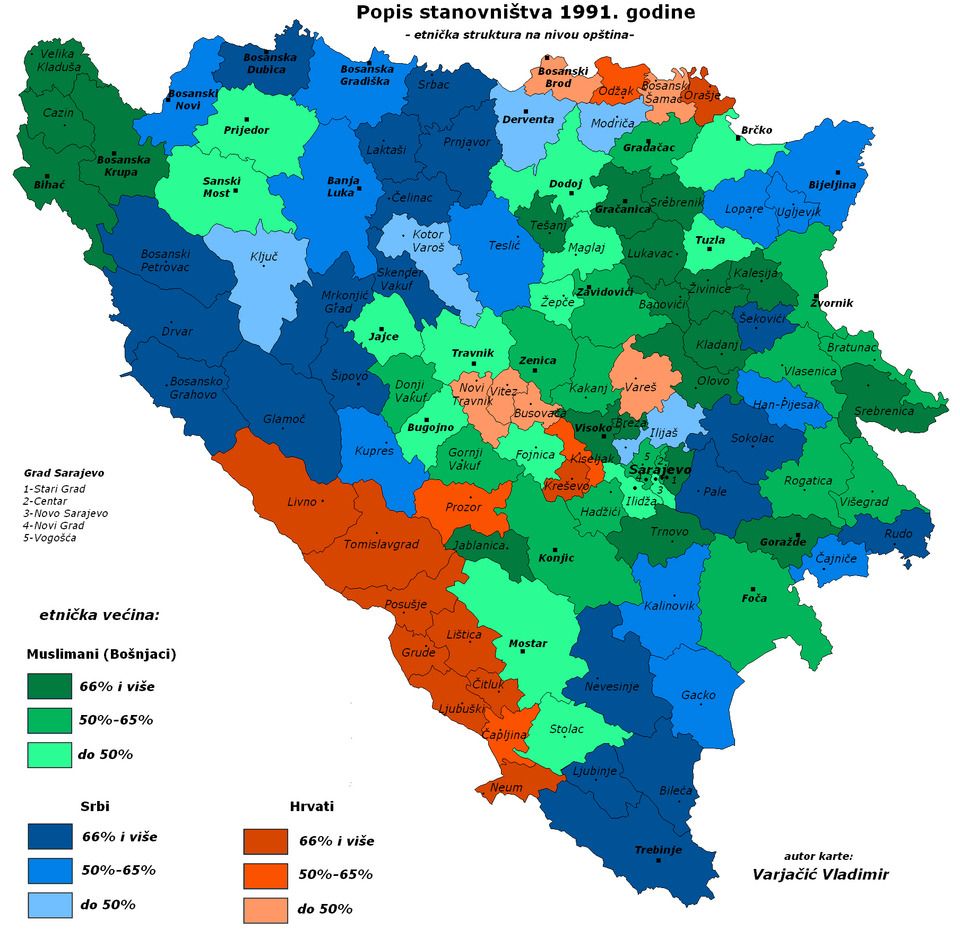
Ethnic division of Bosnia as of 1991: shades of red show districts with a Croatian majority, green — Bosniak, blue — Serb. Map: Wikipedia / Варја
The titular group here was considered to be Bosniak Muslims, but they made up only about 45% of the republic’s population, compared with 15-20% Croats and 30-35% Serbs (and there were even more “Serb” areas in prewar BiH than “Muslim” ones). Among both minorities there were plenty who wanted to redraw the republic’s borders in order to reunite with their compatriots — respectively, with “Little Yugoslavia” and Croatia. Hotheads in this milieu did not even consider the Bosniaks their equals: supposedly, they were not even a nation, but merely Turkified descendants of despicable Ottoman collaborators.
To some extent, Croatian and Serbian irredentism was held back by the fact that all Bosnian communities lived scattered. It was even more impossible to divide the major cities, where people of different backgrounds had lived side by side for generations, among the three peoples.
In addition, in the 1960s and 1970s, stable economic growth worked against interethnic squabbles in Yugoslavia. Bosnia was almost its main beneficiary. The historically underdeveloped territory regularly received subsidies from the center; modern enterprises were built here, and new jobs were created. But in 1980 Tito died, and the state he had built began to crack at the seams.
Tito’s successors had no way to pay the international loans taken out during the dictator’s lifetime. And the different Yugoslav peoples equally believed that they were the ones bearing the burden for their negligent neighbors.
A joke popular among Serbs in those years is telling: supposedly Tito left his cars to the Slovenes, his yachts to the Croats, and only his skeleton to us (a reference to the politician’s funeral in Belgrade’s “House of Flowers” mausoleum). Similar sentiments were shared by more and more people among the Yugoslav peoples. At the turn of the 1980s and 1990s, nationalists came to power in all the republics. The history of a united Yugoslavia ended — the history of the Yugoslav wars began.
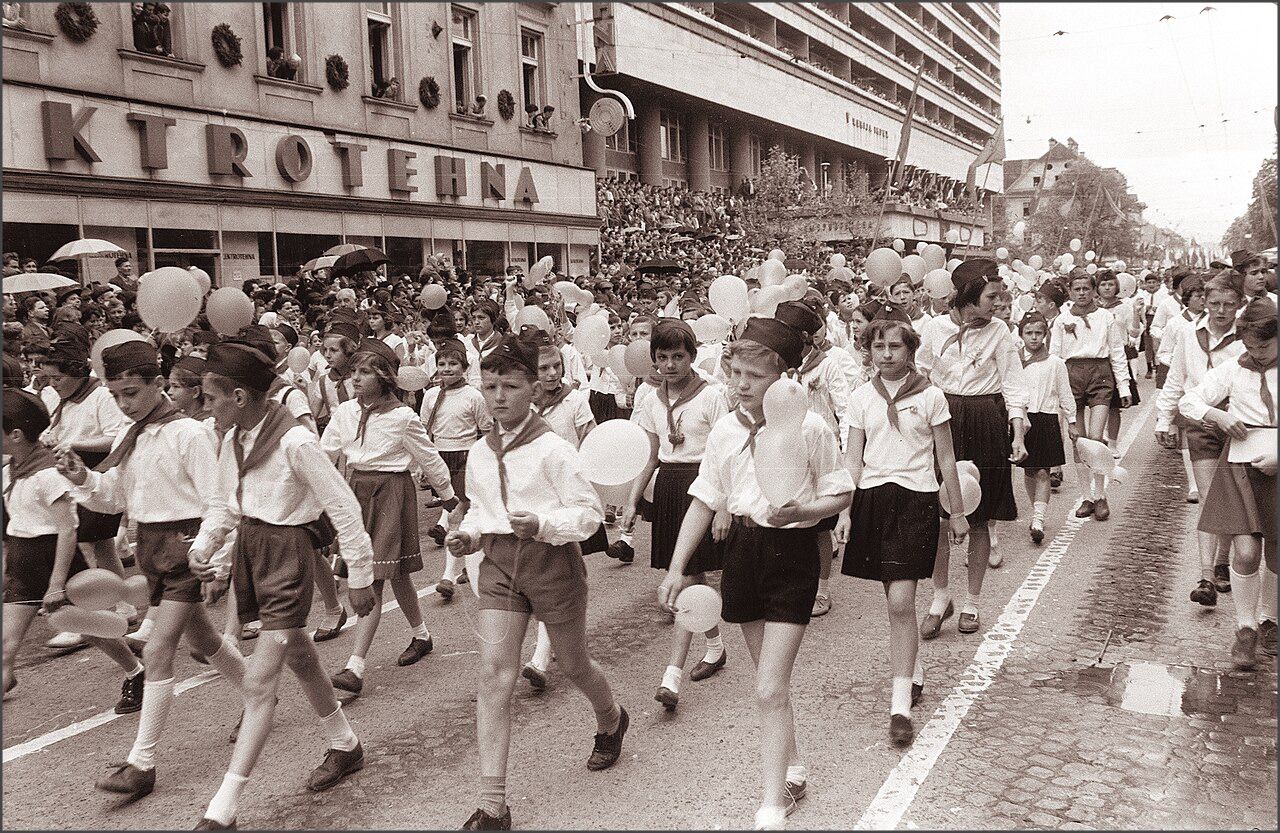
May Day demonstration in socialist Yugoslavia. Ljubljana, 1961. Photo: Wikipedia / Gal
War across all lines
In December 1990, dissident anti-communist Alija Izetbegović was elected leader of Bosnia. He advocated the republic’s withdrawal from the SFRY, but at first he did not want to anger “his” Serbs. Only on March 1, 1992, was independence proclaimed in Sarajevo following a referendum (the Serbs boycotted it, but the Croats supported secession), and it immediately received worldwide recognition. But at the same time, the self-proclaimed Serbian Republic of Bosnia and Herzegovina, or simply Republika Srpska (RS), already de facto controlled the northwest and east of the country.
By spring 1992, war was already raging in the country between the three main communities. It should be noted that this tangled conflict is a topic for a separate series of articles. In the context of the genocide in Srebrenica, it is important to keep the following circumstances in mind:
- Each of the three peoples represented a warring side. At the same time, the Bosnian Muslims (together with a loyal minority of Serbs and Croats) de facto embodied the state that was legitimate under international law;
- The war was fought without clear front lines, as if in pockets. As a result, territories controlled by one camp did not form continuous masses on the map. Enemy enclaves were often hidden within them.
- On each side, not only regular troops but also numerous paramilitary structures and volunteers from different countries fought.
- Since June 1992, UN peacekeepers had been deployed in Bosnia. Usually their forces and powers were not enough to prevent the systematic war crimes of all the parties involved. However, at times NATO aircraft used bombing to prevent attacks by Serb forces on areas declared “safe zones” by the blue helmets.
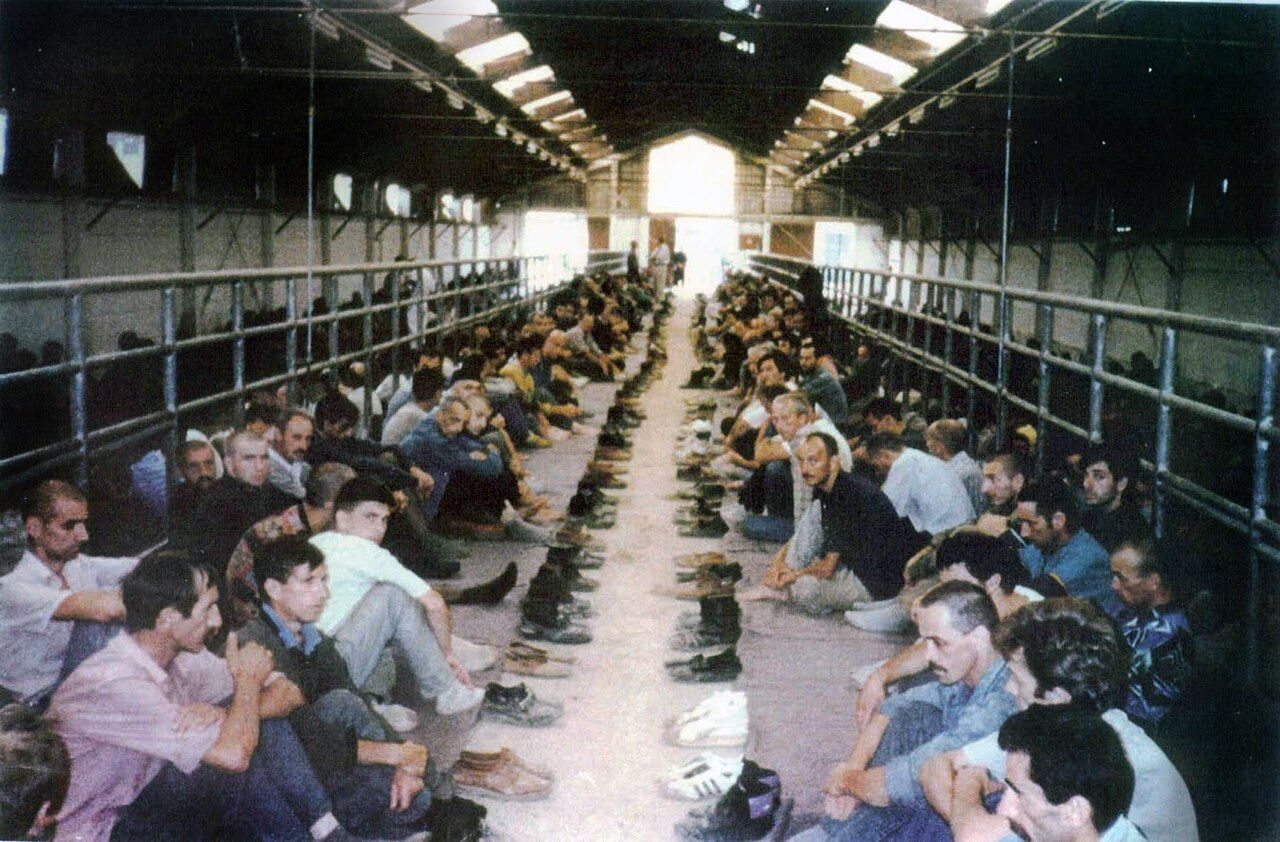
Bosniak refugees in the Serb concentration camp of Manjača, 1992. Photo: Wikipedia / International Criminal Tribunal for the former Yugoslavia
In spring 1994, a turning point for the entire conflict took place in Washington. By then, Serb formations were winning the war and controlled about 75% of the entire country. Then their opponents, with Western mediation, formed an alliance with each other. On March 18, 1994, the Croats renounced their self-proclaimed state of Herzeg-Bosnia and entered into a single Federation of Bosnia and Herzegovina with the Bosniaks.
After the Washington Agreement, the Bosnian Serbs found themselves in a strategically difficult situation. In 1995, the political leader of the unrecognized Republika Srpska, Radovan Karadžić, and its military commander-in-chief, Ratko Mladić, decided to correct the situation with a strike on Srebrenica.
The mining town was one of the last Muslim enclaves in eastern Bosnia, which was largely under Serb control. And Mladić considered Srebrenica superfluous on the map.
The 52-year-old general, like all his comrades and opponents, had grown up in Tito’s Yugoslavia, which was emphatically anti-nationalist. Mladić showed no xenophobia then, remained a loyal member of the Communist Party, and in the 1991 census identified himself not as a Serb but as a Yugoslav. All the more surprising, then, that a few months later the general had become a militant fighter for the Greater Serbian idea.
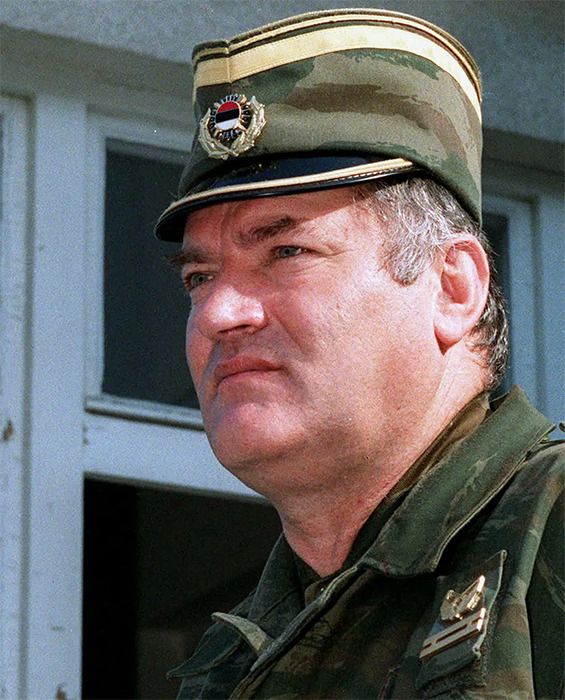
General Ratko Mladić, 1993. Photo: Wikipedia / Keystone
Today one can only guess what exactly caused the former pan-Slavist to revise his views so radically. The horrors of war? Crimes by Croatian and Muslim formations? Or perhaps personal circumstances: in spring 1994, under unclear circumstances, Mladić’s daughter took her own life? The fact is that the Serbian troops entering Srebrenica were now led by a very different officer from the one who had served in the SFRY army.
The city of unwanted people
As early as May 12, 1992, the parliament of the self-proclaimed RS adopted the declaration “Six Strategic Goals”. One of them stated that both banks of the Drina River, which historically separated Serbia proper from Bosnian lands, should be Serbian. In other words, the authors of the document made it clear that Muslims should not be near the Drina.
Srebrenica violated the “Six Goals” by its very existence. It stood right on the border, yet almost 80% of its population was Bosniak. Moreover, as already noted, during the war the town of 6,000 became one of the main Muslim refuges in the entire country. Its population increased several times over. The leaders of the Bosnian Serbs saw these people as an obstacle to their lofty geopolitics.
“We will gain nothing if we kill [only] 50,000 Muslims. Our true priority is the elimination of the Muslim population [as such]. Muslims are the common enemy, ours and the Croats’, and we must corner them so that they cannot get out”
- from Ratko Mladić’s diary
At the very beginning of the war, Srebrenica was controlled by the Serbs. But in May 1992, the town was retaken by the Muslim commander Naser Orić, who made it something like his base. From there, his militia periodically raided Serb-held areas. Later, pro-Serb authors shifted part of the responsibility for the tragedy of 1995 onto Orić. It was claimed that his antics supposedly provoked the retaliatory brutality. Although, of course, the deaths of dozens of Orthodox Christians at the hands of Srebrenica militants in no way justify the subsequent killings of thousands of local peaceful Muslims.
One must not forget another circumstance either: on April 18, 1993, the UN Security Council, by Resolution No. 819, declared Srebrenica a safe zone free of armed presence from any side. This status was to be ensured by a contingent of peacekeepers, mostly soldiers from the Netherlands. On paper, both Serb and Bosniak formations recognized the town’s new status, but in practice things were much more complicated. Orić’s men were in no hurry to surrender the weapons they had accumulated, and Mladić’s subordinates did not lift the blockade of Srebrenica.
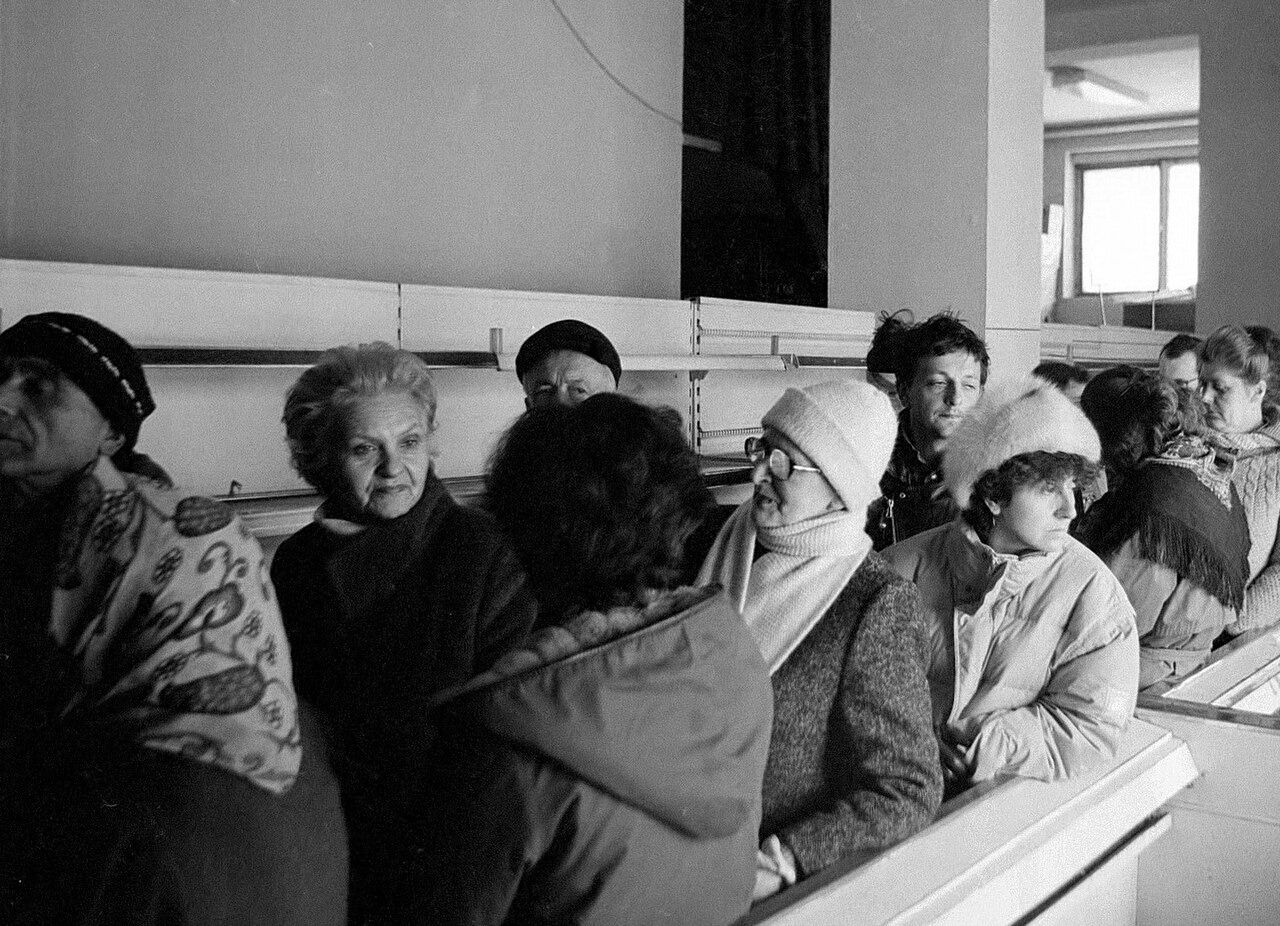
Residents of Bosnian Sarajevo queue for food during the siege of the city by Serb formations, winter 1993. Photo: Wikipedia / Christian Maréchal
Meanwhile, despite shortages of food and drinking water, new columns of Muslim refugees kept arriving there in 1994-1995: the original population grew to 50,000-60,000 people. This seems illogical, but one should not forget that in the rest of eastern Bosnia things were even worse for the Bosniaks, and in Srebrenica the Dutch peacekeepers promised at least some protection.
Dutch peacekeepers in the vicinity of Srebrenica, 1994. Photo: Wikipedia / NIMH, Ministerie van Defensie
By the summer of 1995, overcrowded and half-starved Srebrenica stood on the brink of humanitarian catastrophe. Orić and his staff fled by air to the rear of the Bosnian forces. The remnants of the Muslim forces near the enclave were exhausted people in civilian clothes with hunting rifles.
Not peacekeepers at all
On July 6, 1995, the Serbs went on the offensive. The Drina Corps of RS troops under General Radislav Krstić, relatively small in number (about 2,000 men) but well armed and trained, literally made a single leap toward Srebrenica. The group also included the Bosnian Serb commander-in-chief himself, General Ratko Mladić — the same man who considered the destruction of 50,000 Muslims insufficient for his goals.
Lieutenant Colonel Tom Karremans, who commanded the Dutch blue helmets, requested an airstrike from NATO to stop the Serb troops. But the allies, citing bad weather, canceled the attack. Then the Dutchman himself, under threats from Mladić and Krstić, gave up any resistance. Serbian nationalists effectively took Karremans’s men hostage and threatened revenge for any activity by Western aircraft.
On July 11, Mladić and his entourage triumphantly walked through the empty streets of Srebrenica. By then, the local Muslims had either taken shelter at the peacekeepers’ base in the nearby village of Potočari (mostly women, children, and the elderly), or headed toward the nearest place under the control of their fellow countrymen — the city of Tuzla (usually young men and middle-aged men, including the remnants of Orić’s units). On July 12, Krstić’s corps blocked the Dutch base in Potočari. The uninvited guests demanded that Karremans hand over the Bosniaks who had come to him. During the negotiations, the Serb generals assured the foreigner that the Muslims had nothing to fear: they would supposedly be taken to Tuzla, where they would be exchanged for VRS prisoners of war.
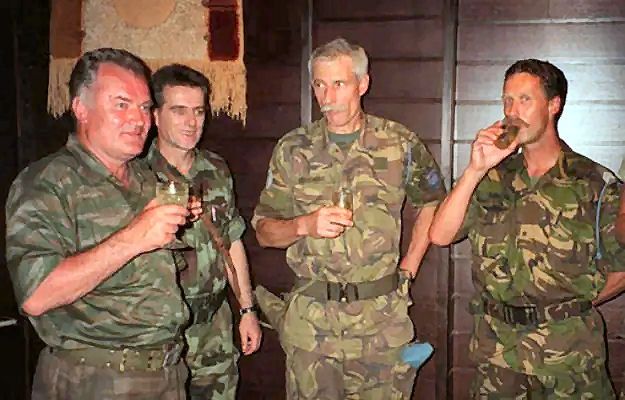
Dutch commander Karremans (center) drinks with Mladić (left) during negotiations on July 11, 1995. The photo was later used as symbolic proof of the peacekeepers’ involvement in the killings in Srebrenica. Photo: Wikipedia
The Serbs went to great lengths to pretend to be peaceful. Mladić himself, in front of the cameras carried by the videographers trailing him, handed out sweets to Bosnian children. Yet even then, one did not need to be Konstantin Stanislavski to recognize the obvious falseness. As soon as Karremans handed over the people who had trusted him (including local staff working at the base!), the Serbs immediately began separating families. Both frail old men and very young boys, as well as the few adult men, were put on buses separate from the women. And among the Bosnian women, VRS soldiers selected young girls — apparently as future sex slaves.
“The Serbian army [of the self-proclaimed RS] and their volunteers disarmed the Dutch soldiers, put on Dutch uniforms, and dispersed among the people. They searched for people by first and last names, took the girls away, led the young men off. Life in Potočari stopped. It was impossible to feel alive while watching people being killed, raped, and killed“
- Zumra Šehomerović, eyewitness
Later, these accounts were confirmed by veterans of the Dutch battalion: the most impatient of Mladić’s men were already killing and raping in Potočari, literally in front of the peacekeepers. A medic who served in the battalion recalled how, during the filtering process, he accidentally came across a gang rape of a Muslim woman by RS troops. Neither the medic nor his comrades did anything to stop the criminals.
Kidnap, destroy, conceal
After returning home, Karremans repeatedly stated that during the hours of his de facto surrender he supposedly had no idea about the true intentions of Mladić and his men. Supposedly they were just loading people onto buses, saying they would take them back to the Bosnian Federation. How could he have stopped the Serbs, and what could he have offered in return, if he had neither fuel nor transport? The officer was caught lying by former subordinates. The Dutch battalion surgeon, Ger Cremers, claimed that he was personally present when his commander, watching RS soldiers lead the Bosniaks away, said: “This will not end well”.
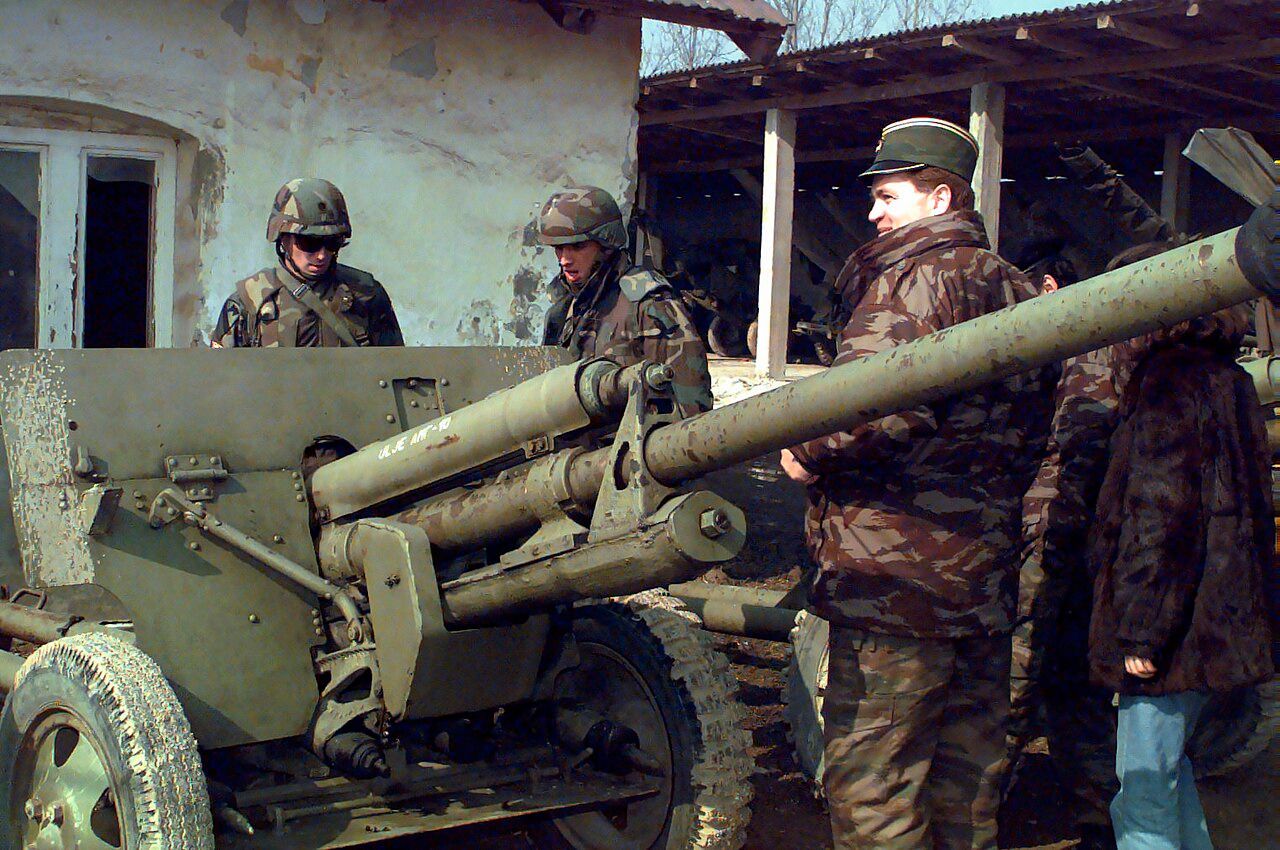
An officer of the Army of Republika Srpska (right) shows an anti-tank gun to American peacekeepers. Bosnia, 1996. Photo: Wikipedia / SPC GLENN W. SUGGS (USA)
Indeed, as early as July 13, Mladić’s men began mass executions. In the valley of the Cerska River, RS fighters killed the first several dozen doomed people. Over the next two weeks, the massacre was methodically repeated in new places. The Serbs killed both Muslims seized at the Potočari base and those who tried to reach Tuzla. The few survivors testified that the killers lured lost travelers using false shouts and radio transmissions over walkie-talkies taken from the Dutch. The killings were unquestionably planned — there is no doubt that Mladić, Krstić, and their comrades had settled everything among themselves even before the capture of Srebrenica.
A wide range of people took part in the killings. Above all, fighters from the aforementioned Drina Corps of the VRS were involved. These included the Zvornik and Bratunac brigades, as well as various special units, all recruited from Orthodox natives of eastern Bosnia; many there surely had to kill familiar Muslim neighbors. Local Serbs were aided by special formations such as the notorious “Scorpions” unit, which included volunteers from “Little Yugoslavia” supervised by the Belgrade state security service. Incidentally, one of their fighters had the sense to film the executions and then lose the tape, which later greatly helped the international judges.
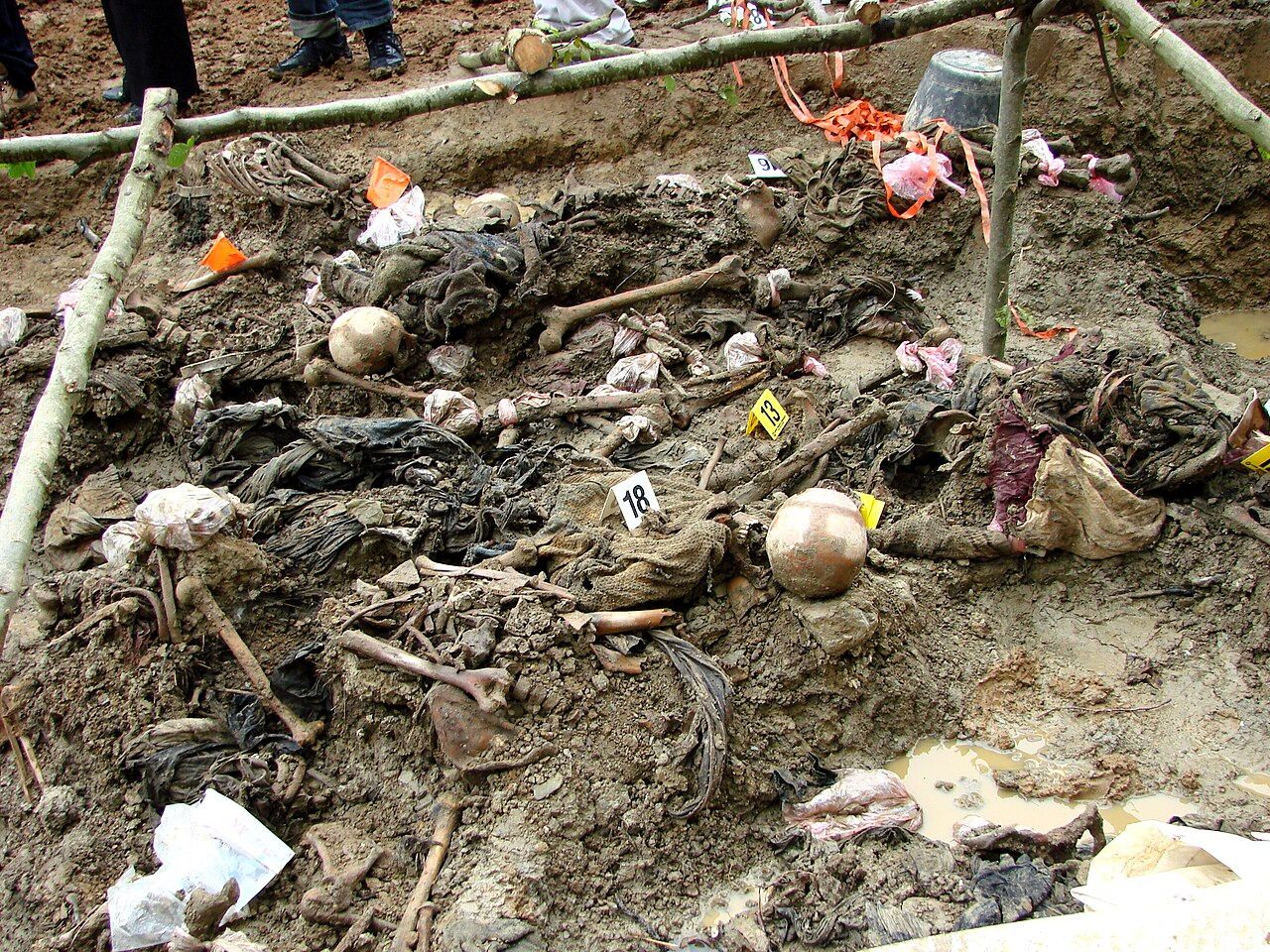
One of the exhumed mass graves in the vicinity of Srebrenica, 2007. Photo: Wikipedia / Adam Jones
The killers transported the captured Bosniaks in groups of several hundred to the execution sites. There were about 30 locations within a 60-kilometer radius north of Srebrenica. There the victims were held for a short time without water or food in improvised prisons: barns, schools, football fields. First the victims were starved and beaten, and the few identified soldiers of the Bosnian army were interrogated for form’s sake. Then everyone was shot or, less often, blown up with grenades.
“They lined people up in front of us; everyone was in civilian clothes. The commander shouted for them to turn their backs. As soon as they did, we opened fire. How many did I kill then? I think about 70 people. Did any Muslims try to resist? One tried to run; ours shot him”
- Dražen Erdemović, participant in the Srebrenica genocide
RS soldiers usually brought excavators to the execution sites right away in order to bury the bodies in mass graves. Later, the organizers of the killings systematically carried out horrific “reburials”: they dismembered the corpses and scattered the remains of the same people across different pits, hoping to confuse the trail. Already in the 2010s, many relatives of the victims said that specialists found the DNA of their loved ones in different graves, and the agonizing process dragged on for many years.
Sent to Žepa
In the mid-2020s, the Memorial Center in Potočari confirms 8,372 victims of the mass murder in Srebrenica. Pro-Serb authors usually claim that this number is greatly exaggerated. Supposedly, several thousand Bosnian soldiers killed in battle were added to the victims of individual executions. Pro-Muslim speakers, by contrast, argue that Mladić’s militants destroyed no fewer than 10,000 people, but not all burial sites have yet been found and studied. The second view is probably closer to the truth. In the vicinity of Srebrenica, the remains of people killed in the summer of 1995 are still being found. Thus, in the summer of 2025, the remains of seven Bosniaks found in 2024-2025 were buried at the memorial center.
And there may have been even more killed Bosniaks. After the fall of Srebrenica, RS formations took the neighboring Muslim enclave of Žepa. But the hundred peacekeepers from Ukraine stationed there showed more principle than their Dutch colleagues. After difficult negotiations, the Ukrainian commander, Colonel Nikolai Verkhoglyad, secured the unhindered departure from Žepa of all 5,000 Muslims who were there.
The international command later repeatedly praised the Ukrainians for their resilience and professionalism. But back home, the peacekeepers did not receive any honors. Apparently, the Kyiv politicians of the time considered this risky for relations with Moscow, which was traditionally close to the Serbs.
Relatives of the reburied victims of the tragedy pray at their resting place, 2007. Photo: Wikipedia / Adam Jones
However, no friendly force could help the organizers and perpetrators of the Srebrenica killings hide the largest mass murder in Europe since World War II. Bosnian RS did not achieve military victory over the Muslim-Croat Federation and in November 1995 signed the compromise Dayton Accords with its former enemies. And then it emerged that at least eight Bosniaks had miraculously survived the Srebrenica massacre, hiding behind the bodies of their slain compatriots. Their testimony was taken up by the International Criminal Tribunal for the former Yugoslavia (ICTY). In 1996, the Muslim accounts were joined by testimony from the other side — the Serb Dražen Erdemović, who had taken part in the massacre, voluntarily surrendered to international justice. Then several more comrades from the VRS and volunteer units joined him.
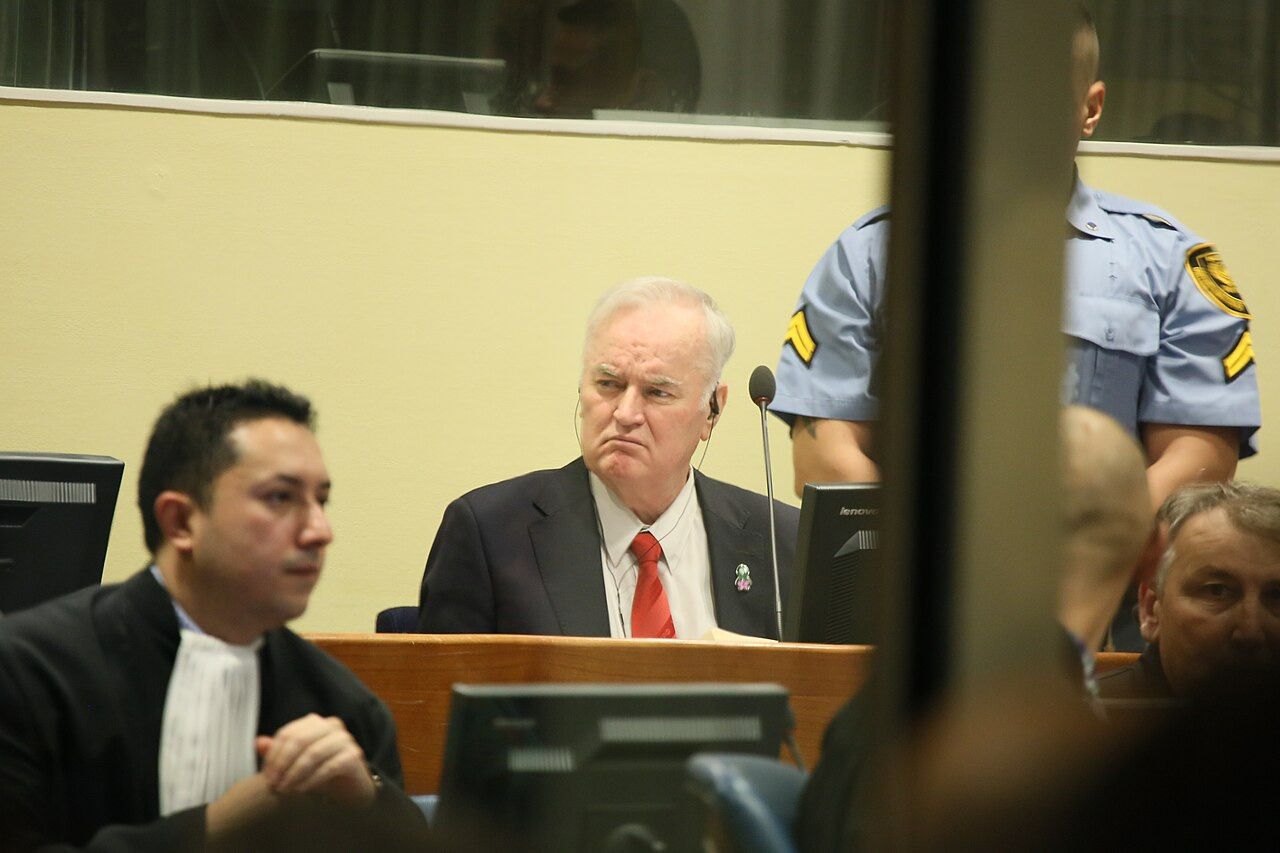
At the turn of the century, the ICTY and the national justice systems of Bosnia and Herzegovina, Serbia, and Croatia рассмотрело several dozen cases related to the Srebrenica massacre. Almost 50 criminals were sentenced in total to 700 years in prison (for example, in the early 2000s the aforementioned General Krstić was sentenced to 35 years behind bars). Four more received life sentences, including Ratko Mladić (in 2017) and Radovan Karadžić (in 2019), who had hidden from justice for years. International judges ruled that both RS leaders did not disband their subordinates but consciously cleansed the territories they considered historically Serbian of Muslims.
Ratko Mladić at trial in The Hague, November 22, 2017. Photo: UN International Criminal Tribunal for the former Yugoslavia
“I naively believed that after the Hague tribunal and the verdicts against the [Bosnian Serb] leaders, other dictators would think twice before following in their footsteps. But that did not happen; history keeps repeating itself, and the world keeps forgetting”
- Robert McNeil, British forensic expert, participant in the identification of the remains of Srebrenica victims
On February 26, 2007, the International Court of Justice officially recognized the Bosnian tragedy as genocide. Two years later, the European Parliament declared July 11 the European Day of Remembrance for the Srebrenica genocide. In 2015, the United Kingdom brought a similar initiative to the UN Security Council, but then the draft was vetoed by the Russian delegation. Nevertheless, in May 2024, the UN General Assembly, on the initiative of Germany and Rwanda, finally established a worldwide day of remembrance for the Bosnian catastrophe of 1995.
The second point of the document condemns any denial of genocide as a historical event.
***
For modern Serbian far-right activists and their platonic Russian sympathizers, Mladić, like the organizers of other mass killings in former Yugoslavia in the 1990s, still remains a hero. American psychiatrist Scott Alexander called this phenomenon “the toxoplasma of rage”: one group rallies around an ambiguous or even openly toxic symbol in order to confront a hostile environment.
A community angered by something chooses a deliberately provocative marker in order to reliably separate “us” from “them”. On this principle, in the United States during the Vietnam War, the far-right public obsessed over Lieutenant Bill Kelly, who staged the horrific massacre in the village of My Lai (Song My) on March 16, 1968. Half a century later, Russian nationalists, following the American example, turned Colonel Yuri Budanov into a cult figure. The entire heroism of the Russian Armed Forces officer who fought in the North Caucasus consisted of raping and killing a Chechen girl, but for the far right at the “Russian Marches” this also looked like heroism: as long as it was in defiance of the “Kremlin scum” and “liberasts”.
So Serbian society, with its glorification of Ratko Mladić, is neither better nor worse than many other peoples who have experienced a similar defeat in a shameful war. One can only guess how many new heroes will be found by nationalists in Russia to replace the long-forgotten Budanov after the “special operation” in Ukraine finally ends.
If you enjoyed this article, consider making a donation — one-time or, even better, monthly. Your support helps us motivate our authors and become better with every article.
Our organization is recognized by the Internal Revenue Service (IRS) as a 501(c)(3) tax-exempt, charitable organization, which means that all contributions made to us are tax-deductible to the fullest extent permitted by U.S. law. Individuals may generally deduct charitable contributions of up to 60% of their Adjusted Gross Income (AGI) for cash donations made to qualifying 501(c)(3) organizations. For donations of appreciated assets (such as stocks or other long-term capital assets), the deduction is typically limited to 30% of AGI, based on the fair market value of the asset. C-corporations may deduct charitable contributions of up to 10% of their taxable income for donations made to eligible charitable organizations.
By submitting a donation, you confirm that you have read and accept the following documents: Privacy Policy and User Agreement, and also give consent to the processing of your personal data.
If you would like to unsubscribe from a monthly donation, please email us at: [email protected]