Electoral procedures in autocracies are a special process. Here, what matters is not so much the official results themselves, but whether the system can first organize them without unnecessary noise and then sell them both inside the country and beyond its borders. And it seems that the current administration of Kassym-Jomart Tokayev has managed this quite well. A report by “Most” from Astana.
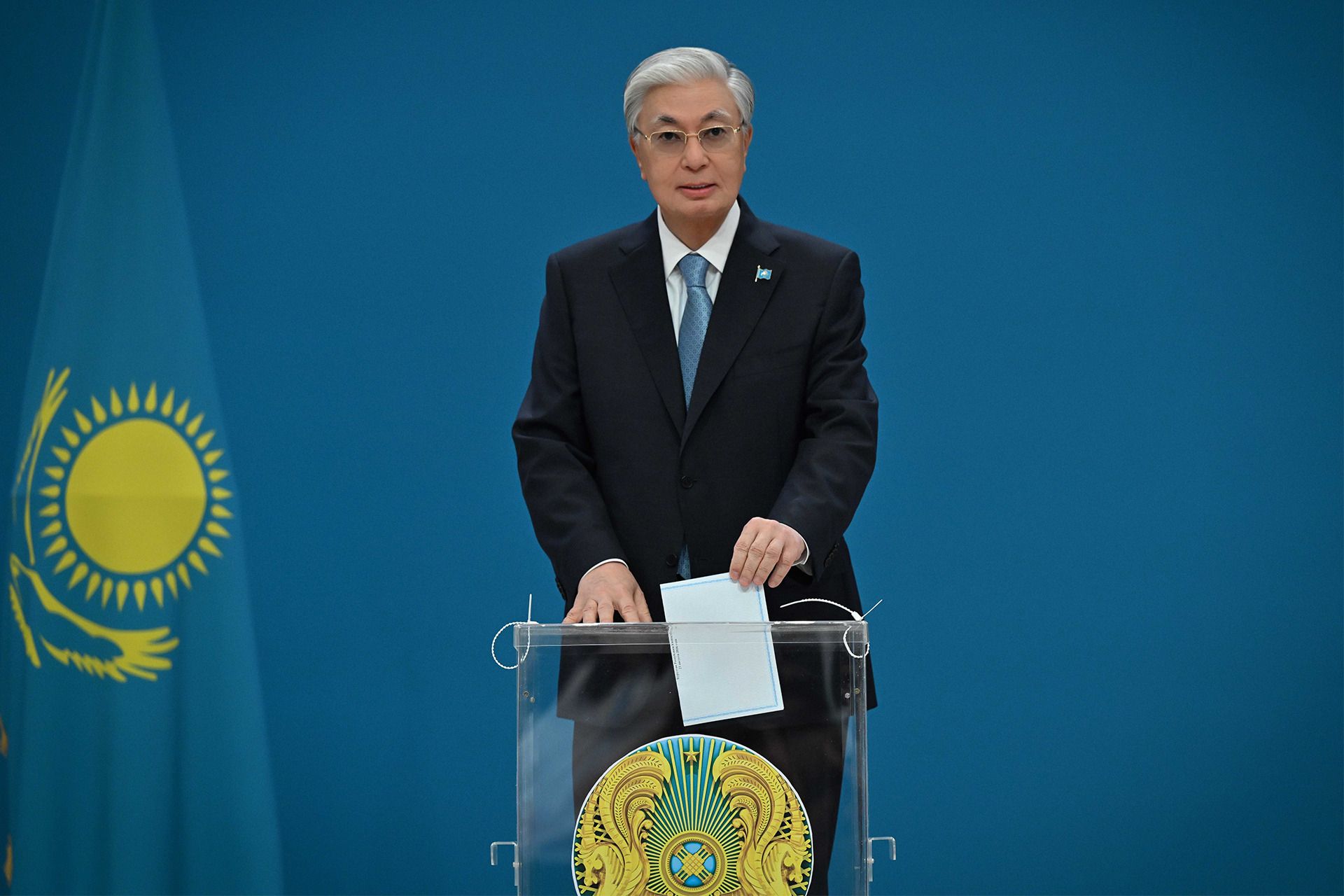
President of Kazakhstan Kassym-Jomart Tokayev casts a ballot at a polling station located in the Palace of Independence. Astana, August 23, 2026. Photo: Official website of the President of the Republic of Kazakhstan
Sunday, August 23, was rainy in Astana. Perhaps the precipitation kept some residents at home, who had honestly intended to fulfill their civic duty. At one of the polling stations in the very center of the capital — opened, contrary to post-Soviet custom, not in a school or another budget institution, but in a branch of a private bank — around two in the afternoon there was no crowd.
A well-dressed woman in glasses who came to the station did not immediately understand that she had not come to the wrong door. No one met her at the entrance except a bored bank security guard.
- Oh, the elections are here, right? So where is everybody?
The commission chairwoman, who quickly arrived, assured the guest: everything was fine, there was no mistake, voting was taking place here. And there was no crowd because usually most people participate diligently in the morning, she explained in a confident tone.
- Or come in the evening if you need a queue. Many people, on the contrary, wait until the last minute, — the chairwoman added authoritatively.
But at that moment exactly one voter was casting a ballot at the station — a pretty girl of about 25. In response to her question about whether she could take a selfie next to the ballot box, the commission members unanimously assured her: of course, she could. The only thing not allowed was for marks on the ballots to appear in the frame; these are the new requirements of Kazakh legislation (and violators of this strange ban were fined in different regions of Kazakhstan).
- Oh, good. Then I’ll send it to the family chat and to my friends. None of them wants to vote. Maybe if they see it, someone will go.
Meanwhile, Telegram channels, citing the republican CEC, cheerfully reported that turnout in Astana had already surpassed 40%. Although what was happening on the streets and in the courtyards of the capital did not really suggest any electoral fever. Rather, everything indicated that the million-strong city was living its usual weekend life.
A little later — in the evening at a bar — we accidentally overhear a conversation at the neighboring table among a group of men of a somewhat informal appearance.
- So, did you go vote in the elections? — asked a rather imposing bearded man of his friends.
- What, are decent people still allowed in there?
- No, there aren’t any people there at all, only parties left.
- Well then, what’s the point of them? “Amanat” is there, “Respublica” with “Ak Zhol”, and who else?
Neither the bearded man nor his friends could remember any more parties. After a couple of remarks, the conversation moved on to other topics, and the group did not return to politics.
A couple more hours later, Kazakh media reported the preliminary election results. The formally newly born but in fact already ruling “Ädilet” unsurprisingly won more than 70% of the vote. Four of the six participating systemic parties also crossed the five-percent threshold. But what is the significance of what happened for the key country of Central Asia?
“Legacy” in “Justice”
Let us begin with the formal side of the matter. On August 23, 2026, deputies to the Kurultai were elected in Kazakhstan for the first time. That is the name given to the country’s new 145-seat unicameral parliament after the spring constitutional reform. Previously there were two chambers, the Mazhilis and the Senate; now there is only one. One cannot help but note the linguistic beauty of what happened: two bodies with names of Arabic and Latin origin were replaced by one that is purely Turkic in origin and etymology.
“The upper chamber was always effectively appointed. It mostly included representatives of the ruling party, which dominated local representative bodies and municipalities that formed the senate’s deputy corps. The senate’s functions were mainly to supervise and filter the decisions made by the multiparty Mazhilis. Now that will no longer be the case”
- Kazakh politician and member of the “Ak Zhol” party Azat Peruashev — on the meaning of abandoning a bicameral parliament
Seven alliances competed in the election. The winner is clear — the already mentioned “Ädilet” (“Justice”) headed by former head of the presidential administration Aibek Dadebai. This is a classic post-Soviet ruling party, where instead of a clear ideology there is amorphous centrism, calls for innovation and modernization, and constant emphasis on loyalty to the presidential course.
What distinguishes the Kazakh hegemon from similarly minded ruling parties in Russia, Azerbaijan, or Uzbekistan is perhaps only a love of rebranding. The name adopted at the end of last spring is already the fourth in its 27-year history. Legally, however, this is not a simple renaming, as was done before, but a complete relaunch. Formally, “Ädilet” was founded from scratch on May 7 by a group of officials and businessmen, and only afterward did the “old” ruling party “Amanat” (“Legacy”) suddenly announce a merger with the newcomers.
In their own way, the interests of the other six officially registered parties are the Kazakh systemic opposition. Some of them are domesticated non-systemic forces that once criticized even Nursultan Nazarbayev; others are organizations created “turnkey” in the 2020s. Together they play a very different role from the likes of LDPR and CPRF in Russia. These parties do not ennoble the ruling party with their exaggerated madness; instead, they perform civil society and appeal to the protection of the rights of individual social groups or the solution of specific problems. For example, “Auyl” (“Village”) represents farmers, while “Baytaq” is the local version of Europe’s “greens”.
It is interesting that both the left and market agendas are championed by two forces each. On the socialist field, the social democrats (OSDP) and the People’s Party oppose each other; on the center-right, “Ak Zhol” (“Bright Path”) and Respublica. Naturally, relations within these pairs are not simple; there is constant infighting over who is “real” and who sold out. And yes: by all the laws of the genre, the systemic opposition is much more active in gnawing at itself than in trying to attack “Amanat” / “Ädilet”, while not forgetting to emphasize its deep respect for President Tokayev personally.
The fundamental homogeneity of the registered parties is also confirmed by journalist Murat Daniyar, author of the popular YouTube channel JURTTYŃ BALASY. In one of his last videos before the election, Daniyar highlighted three points common to the programs of both “Ädilet” and its nominal rivals:
- avoiding specifics on how certain socio-economic proposals will be implemented;
- attributing already existing state initiatives to their own program;
- ignoring the issue of civil rights and freedoms in Kazakhstan. The only exception here, Daniyar said, was the OSDP — the social democrats had the courage to cautiously acknowledge that in this area things in the country are not entirely smooth.
Some of Daniyar’s colleagues were even more categorical in their assessments. For example, journalist Asem Zhapisheva in her Telegram channel directly called acquaintance with the programs of Kazakh parties pointless: “Not a single measurable goal, not a single concrete commitment, no plans, not a single concrete position on any issue, just a salad of words. An outrageous level of airiness”.
Putting on the shackles
However, voices such as Daniyar’s or Zhapisheva’s did not sound particularly loud before the election. In 2025-2026, several prominent Kazakh journalists became defendants in criminal cases and were found guilty by the court.
Thus, on July 31 in Almaty, former CEO and editor-in-chief of KazTAG Asset Mataev and Amir Kasenov were sentenced to one year and three months of restricted freedom — with a subsequent five-year ban on journalism. On paper, both were convicted of defamation in an investigation about Freedom Finance and its shareholders.
This was followed, on August 3 and 18, by similar sentences for two more journalists, Alexandra Alekhova and Gulnara Bazhkenova. Formally, again, no politics: the first was sentenced to three years suspended with a five-year deferral (illegal dissemination of personal data), the second to eight years in prison with a two-year deferral (defamation, embezzlement, and illegal entrepreneurship). And these are only the most high-profile cases, not counting those where journalists are still under investigation or awaiting official charges.
Representatives of Kazakh media at a press conference with the head of the Republic. Astana, August 23, 2026. Photo: Official website of the President of the Republic of Kazakhstan
It is not surprising that most Kazakh media greeted election day in the right mood. Most reports breathed with almost Komsomol enthusiasm. The elections were competitive, international observers were present, and there was no sign of gross violations. At the same time, the sympathies of most voters were evident, as was their civic stance. People go to the elections as if to a holiday: in Almaty region, a young couple прямо at the polling station held a gender reveal party, and in Aktobe, parents who already had a child organized a tusaukeser for the little one by the ballot boxes.
Tusaukeser is a traditional Kazakh ritual. For one-year-old children, symbolic shackles are cut from their feet and they are sent forward along a carpet path, where several objects await them (money, a book, a ball, etc.). It is believed that the child’s fate will depend on which object they take in their hands.
Also, in a subdued manner, various agencies released the preliminary results of the election on the night of August 24. “Ädilet” received the more than 70% predicted by polls, with a similar turnout figure. Four more parties crossed the five-percent threshold: about 6.3% for “Auyl” and between 5.5 and 5% for the parties Respublica, “Ak Zhol”, and OSDP.
For the first time in 14 years, the People’s Party — successor to the split Communist Party of Kazakhstan, once the most important of the systemic opposition forces — failed to enter parliament. Most likely, the overly “Soviet” image of the NPK became too toxic for it. The younger left electorate preferred the more Europeanized OSDP over the post-communists, and in Akorda (as the presidential administration is called in Kazakhstan) they decided not to save old partners who had discredited themselves too much with their openly pro-Kremlin orientation.
After the elections — elections
In the 20th century, autocracies did not favor either parliaments themselves or elections to them. Some regimes reduced the procedure to a ceremonial, no-alternative vote; others managed perfectly well without parliaments as such.
But in the 21st century it is the opposite: autocrats hold elections with particular enthusiasm and respect for the letter of the law. It becomes important for them to show that in their countries everything is just like in Denmark or Australia: there is secret voting, international observers, and fair competition among political forces of different ideologies. In Kazakhstan, by the way, over the past 36 years the parliament — under different names — has already been elected ten times.
In the context of Central Asia, this paradox is aptly compared to the culture of local weddings — events as beautiful as they are costly for practically all their participants. After all, what is the point of the parents of the newlyweds emptying their savings and taking out loans for a few hours of celebration? But for Kazakhs and their neighbors this is of fundamental importance. Only in this way can one both uphold the family’s prestige and assess the generosity of the new relatives, and test old friends — who will help with what at the right moment during the extremely drawn-out wedding marathon.
The same goes for parliamentary elections. First, this procedure reminds citizens that they are still the bearers of the country’s sovereignty and that it is their decisions that determine the future. Second, the elections show the world around them that Kazakhstan has a parliament, elections, and parties with a quite modern and secular rhetoric. Third, each such event also serves as a kind of mutual review of the president and his elites. The head of state makes sure that the силовики, the civil bloc, and big business are not plotting anything against him, while the elites make sure that the current leader is still strong and can deliver the needed electoral result.
If compared with the Russian analogue, the elections to the Kazakh Kurultai differ in two ways: voting is only by party lists, without single-mandate candidates, and the ballots still include the almost forgotten in Russia “Against all” option.
It seems that this year President Tokayev succeeded both for the domestic and the external audience. On the one hand, the ruling party is guaranteed to receive more than three-quarters of the seats in the first Kurultai; on the other, the systemic opposition will be represented there by as many as four parties. Given the previously adopted provision on diversity in party lists (at least 30% of seats there must go to women, young people, and people with disabilities), this will make it possible to speak of the more than inclusive character of the updated Kazakh parliament.
Tokayev himself made national and world media headlines on election day thanks to a strange reflection on how Kazakh men and women should greet each other when meeting (“traditionally”, without excessive hugs and kisses). This speech, which is not very typical for a politician, somehow overshadowed in the media the fact that he also said a couple of rather interesting things on the merits. First, Tokayev reminded everyone that according to the constitutional amendments, Kazakhstan is supposed to have not only a president but also a vice president, who will be appointed in the coming days: “It will be a well-known person whom you know very well”. Then the head of state stated that he has not yet decided whether he will use the Constitutional Court’s decision to run for a new term.
In short, no sooner had Kazakhstan elected a parliament than a presidential vote was already looming on the horizon. So who after that will say that there are no elections in the country?
If you enjoyed this article, consider making a donation — one-time or, even better, monthly. Your support helps us motivate our authors and become better with every article.
Our organization is recognized by the Internal Revenue Service (IRS) as a 501(c)(3) tax-exempt, charitable organization, which means that all contributions made to us are tax-deductible to the fullest extent permitted by U.S. law. Individuals may generally deduct charitable contributions of up to 60% of their Adjusted Gross Income (AGI) for cash donations made to qualifying 501(c)(3) organizations. For donations of appreciated assets (such as stocks or other long-term capital assets), the deduction is typically limited to 30% of AGI, based on the fair market value of the asset. C-corporations may deduct charitable contributions of up to 10% of their taxable income for donations made to eligible charitable organizations.
By submitting a donation, you confirm that you have read and accept the following documents: Privacy Policy and User Agreement, and also give consent to the processing of your personal data.
If you would like to unsubscribe from a monthly donation, please email us at: [email protected]