Near Lesnaya metro station in St. Petersburg, at 61 Lesnoy Prospekt, stands a building with columns. This is the “house of specialists,” built in the 1930s in the style of Stalinist neoclassicism. Creative and scientific intelligentsia lived here, including artist Nathan Altman, radio engineer Mikhail Bonch-Bruevich, and writer Alexander Kuprin. It was from here that many were taken during the “Great Terror.” Now, plaques of the “Last Address” project are installed on the house for former residents who became victims of political repression in the USSR. The last two names appeared on the facade on Sunday, December 14 — on the day of remembrance for academician Andrei Sakharov. A “Most” correspondent attended the ceremony for installing the memorial signs.
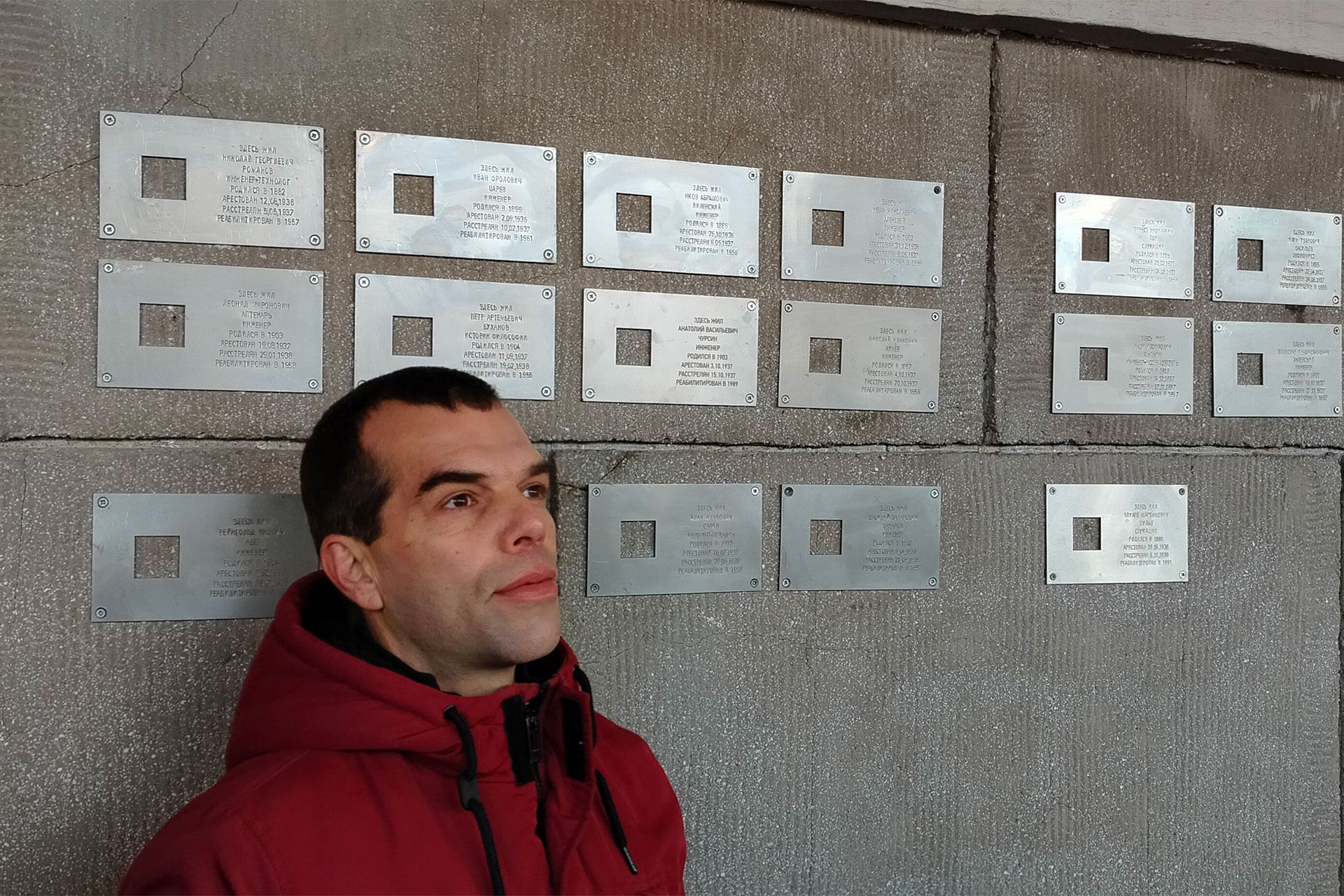
Omar, great-nephew of the repressed Anatoly Chursin, at the house of specialists with “Last Address” plaques, December 14, 2025. Photo by Svetlana Li
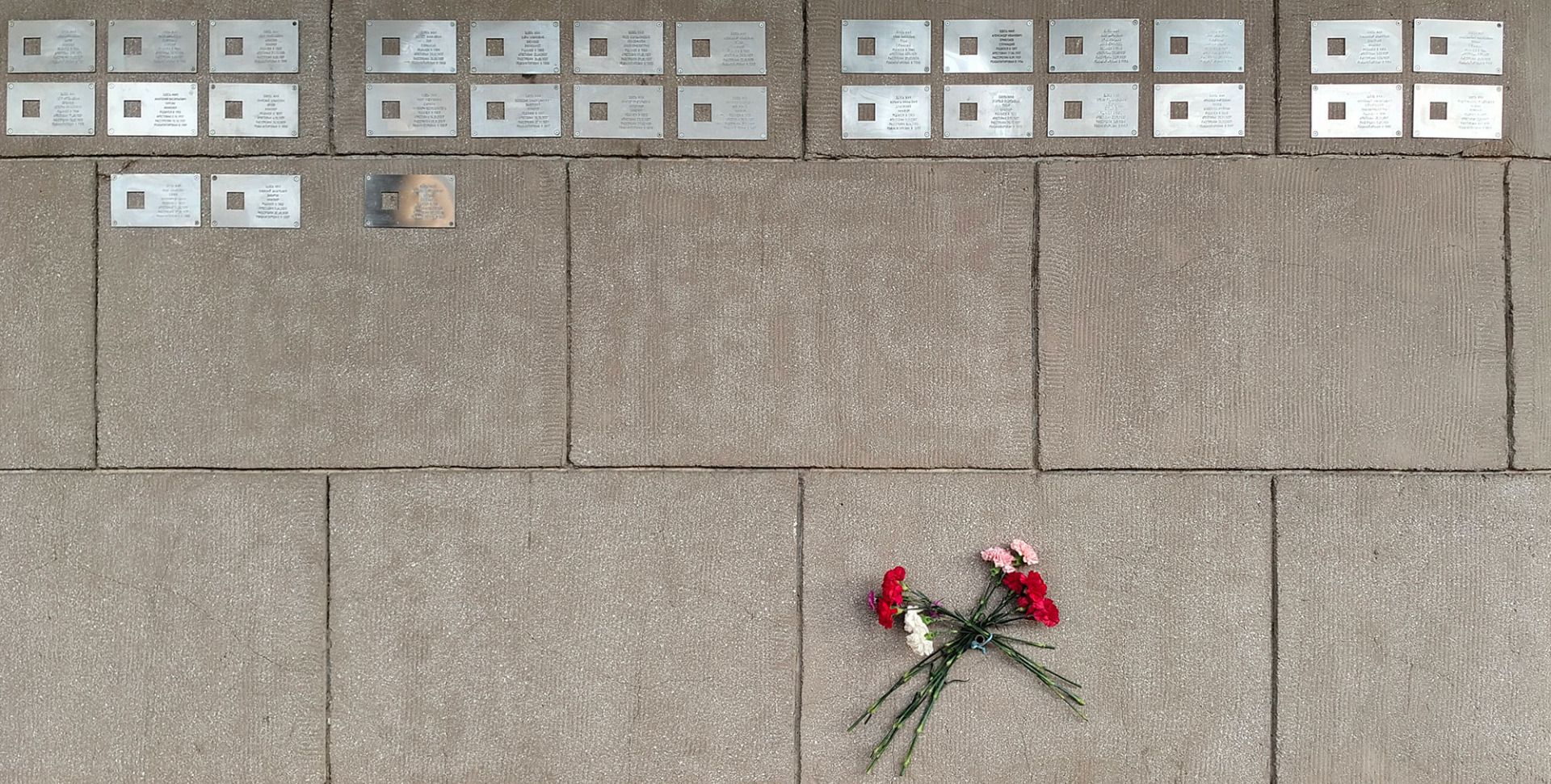
The project “Last Address” was founded in 2015. “One name, one life, one sign” is its main principle. The foundation installs memorial plaques in memory of victims of Soviet political repression. All plaques are made identical. On a stainless steel plate the size of a postcard (11x19 cm), information about the repressed person is manually engraved. Nothing extra: only the full name, profession, dates of birth, arrest, death, and rehabilitation. And in place of a photograph, there is a cut-out square—left empty.
Plaques can be found on building facades all across Russia—from Vladivostok to Arkhangelsk. In Moscow, there are more than 700 “Last Address” signs, and in St. Petersburg—over 450 (in 2025, 10 signs were installed in the cultural capital). Memorial plaques also exist in the Czech Republic, Georgia, France, Moldova, Germany, and Ukraine; for example, in Kyiv itself there are about 20 plaques.
In recent years, memorial signs have repeatedly been torn down. But in such cases, activists install temporary cardboard ones in their place, and then—permanent ones again.
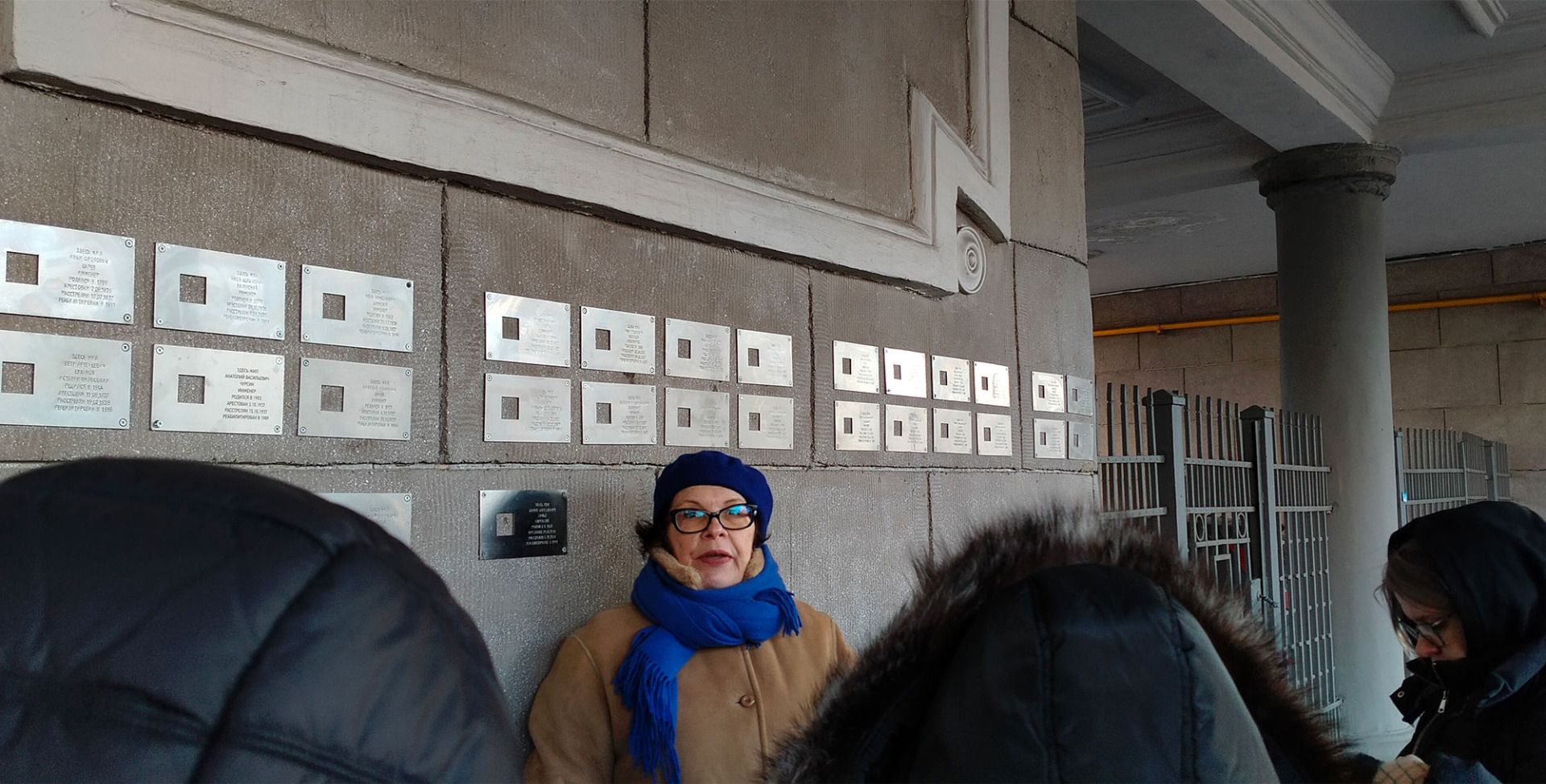
At 61 Lesnoy Prospekt, plaques were also installed in several stages: from 2016 to 2023, activists hung 34 signs, but after a complaint on the “My St. Petersburg” portal, they disappeared from the wall. Then, a printed list of repressed residents appeared in their place, followed by cardboard plaques. They hung for about a year, but this spring, “Last Address” staff reinstated 34 metal signs in place of the old ones—and added two more names. The last in the list of 38 repressed residents of the “house of specialists” were Alexander Yermolaev and Anatoly Chursin: their memorial plaques were only installed on December 14, 2025.
City-cemetery
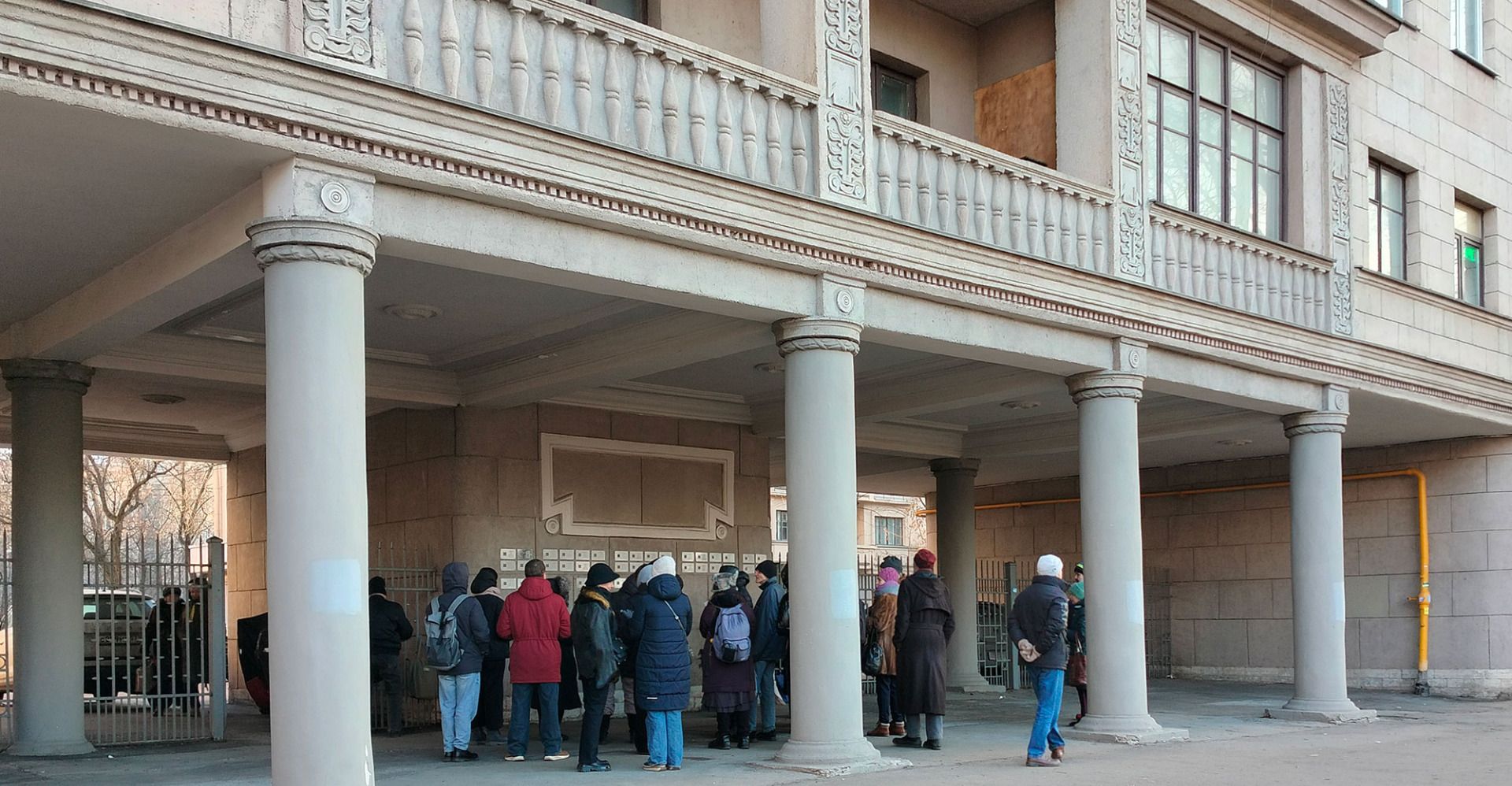
On one of the shortest days of the year, December 14, St. Petersburg has unusually sunny weather, but the frost is so sharp that it makes your eyes water. By noon, about thirty people approach the “house of specialists” to take part in another “Last Address” ceremony. The organizers “drill in”—that is, they screw two more plaques to the wall, where 36 are already attached. They bear the names of Alexander Yermolaev, director of the Agricultural Museum of the Leningrad Regional Land Administration, and Anatoly Chursin, senior engineer at Lenenergo.
Participants of the “Last Address” memorial ceremony. St. Petersburg, December 14, 2025. Photo by Svetlana Li
According to the rules of the “Last Address” project, anyone can apply for a memorial plaque—the main thing is that the residents and owners of the house agree to the installation. This time the initiator was Elena Shpilyuk, a teacher at Herzen State Pedagogical University. She came to the ceremony wrapped in a dark coat with a fur-trimmed hood: only a gray shawl and attentive eyes under glasses are visible.
Elena says she was at the previous plaque installation ceremony in spring 2025 at 61 Lesnoy Prospekt (“it was a very cold day, just like today”). Then Elena saw notches on the wall for two more plaques and thought someone had removed the memorial signs. This had already happened, for example, on the Karpovka embankment with the plaque for director Vsevolod Meyerhold. “There are two reasons why plaques are removed: the first is vandalism. No one really wants to look for them. The other is when the general council of residents says after the plaques are installed—no, we don’t want the house to look like a cemetery,” Elena explains her concerns. But it turned out that at the “house of specialists,” “Last Address” staff had deliberately left space for plaques for Chursin and Yermolaev.
“They always say ‘don’t turn the city into a cemetery’—but it’s already a cemetery. We didn’t turn it into anything,” says Elena Shpilyuk with conviction.
It’s important to her that people know the name of every repressed person. “Rows of plaques, like in a crematorium, and still empty spaces... I felt like I was in Yad Vashem: it’s very hot there, in Israel, but inside the museum you’re chilled to the bone. It’s not right when there are empty spaces“—that’s how the teacher explains why she wanted new plaques to appear on the wall.
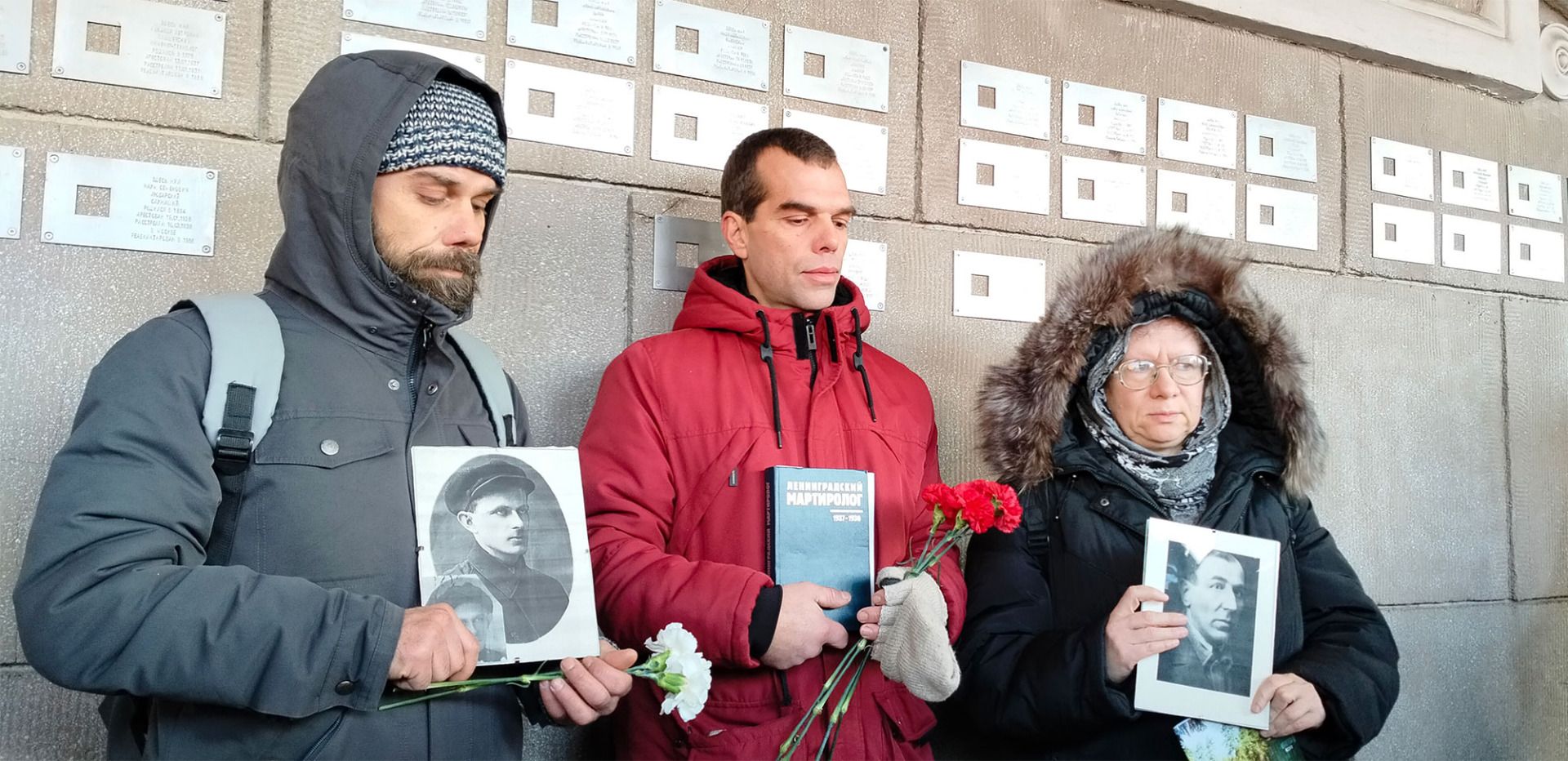
Herzen University teacher Elena Shpilyuk (right) by the “Last Address” wall. Photo by Svetlana Li
As the applicant, Elena has the right to screw in the last screw that fastens the plaque to the facade. She leans her left hand on the wall, almost lies down, reaches with her right hand to the plaque with Yermolaev’s name—it’s in the top row—the screwdriver shakes. Two ceremony participants come to help and finish the job.
“In this screw is all my memory“
The screwdriver remains in the hands of a young man in a red jacket—this is Omar, great-grandnephew of Anatoly Chursin. Anatoly had a younger sister, Klavdia, who kept searching for her brother, refusing to believe he’d been executed. Her great-grandson and his brother only found out about the plaque installation by chance—volunteers from “Last Address” contacted the family.
Omar has known about the “house of specialists” since childhood: his grandfather Vladimir used to take him to one of the buildings—showing where an aerial bomb had fallen. It went through all the floors but didn’t explode, “it just lay there in the entrance hall at the bottom,” the man told the “Most” correspondent. Another childhood memory is connected to the nearby railway bridge: “Grandpa always showed us the place under the bridge where, during the blockade, he first saw a dead person. That story was burned into my memory.”
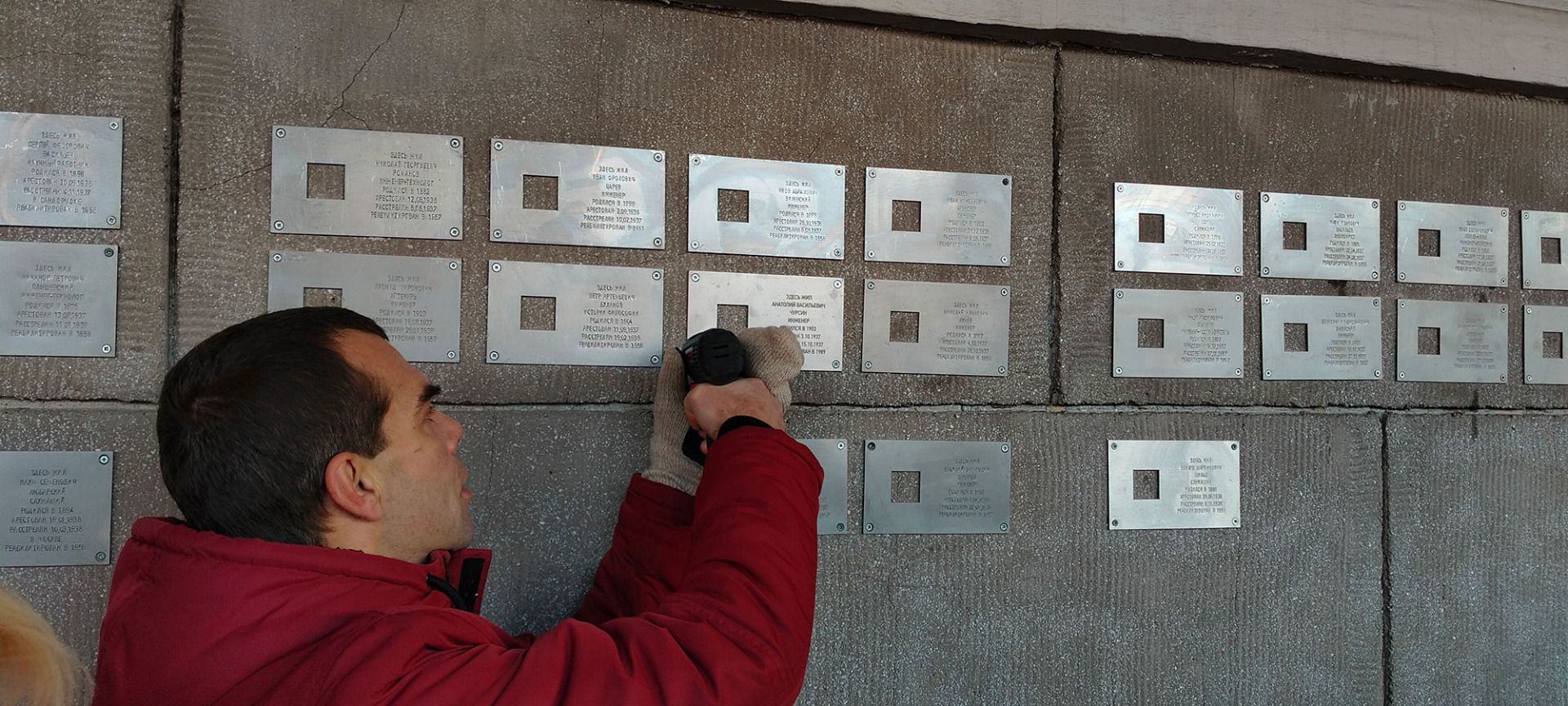
Omar firmly screws in the last screw into the memorial plaque for his repressed relative. In Omar’s face, you can see features of Anatoly Chursin: the same sharply outlined oval, determined gaze, straight nose.
Looking somewhere over the heads of those gathered, Omar says: “In this screw is all my memory. I want my memory to be as sharp as this screw, this self-tapping screw. I screw it into my head. I screw it into my memory.”
Omar installs a “Last Address” plaque in memory of his repressed great-grandfather. Photo by Svetlana Li
Cars drive along Lesnoy Prospekt, a tram rattles past. To hear better, people instinctively move closer and form a tight semicircle by the wall.
“I didn’t know there were so many wonderful people in this world, in this city—brave and responsible,” Omar continues. “At my children’s school, they have ‘Conversations about Important Things’ every Monday. But I tell them that the real conversations about important things happen at home. And here, by this wall, our conversation is happening. Today, it certainly takes great courage from you—to those who keep the memory. Memory is the guarantee that we won’t repeat the mistakes of the past.”
The St. Petersburg native, together with his brothers, works in archaeology at the Institute for the History of Material Culture of the Russian Academy of Sciences. “For us, mass graves, single graves, ruined burial sites, places where people once lived, all archaeological monuments—this is ordinary history. I understand how easy it is to forget everything if you don’t remember it,” Omar shares.
He steps away from the wall and merges with the other participants. No one applauds; only the noise of the road is heard.
“A manifestation of rotten liberalism”
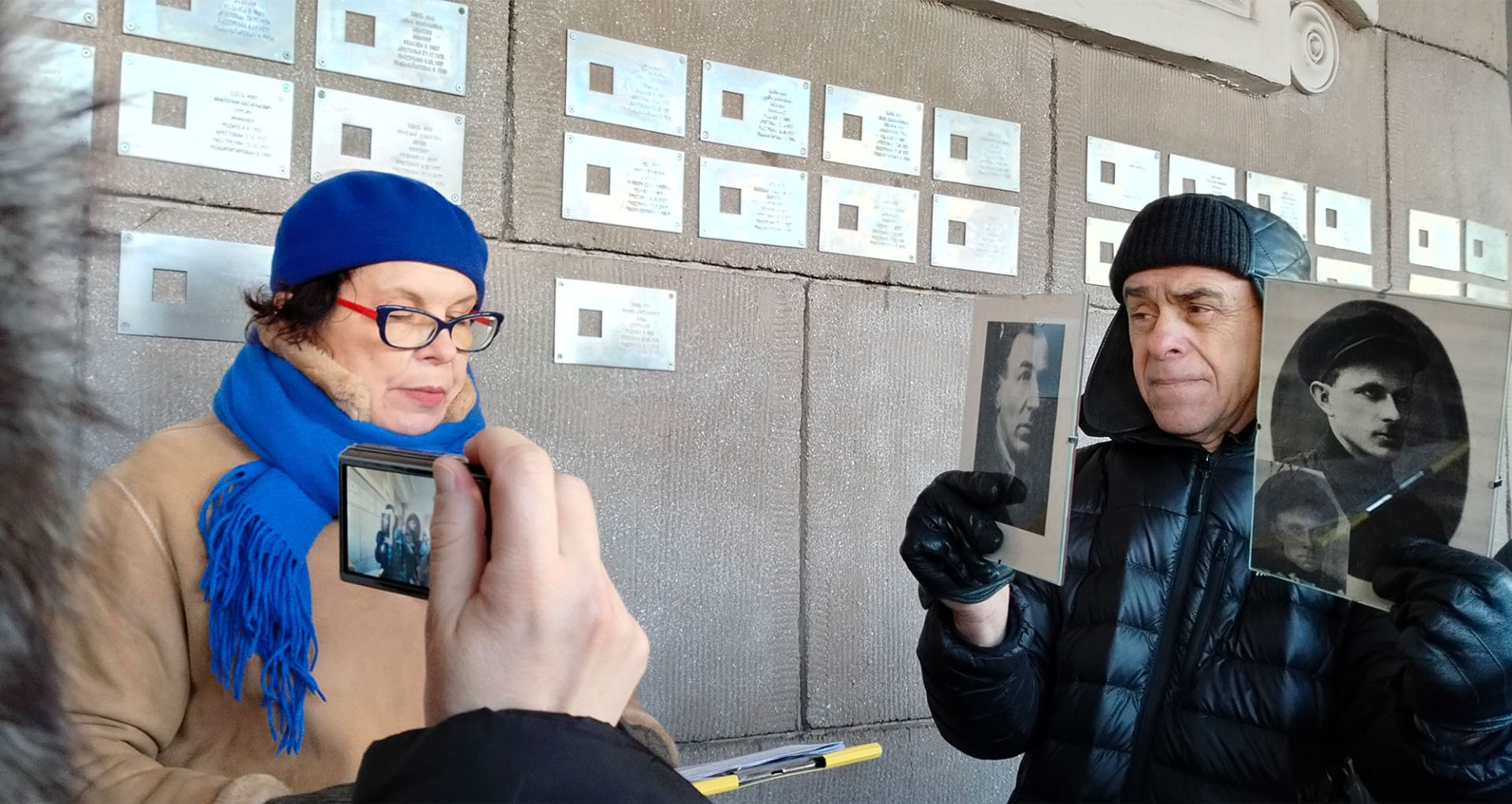
Stepping forward is Marina Demidenko, an employee of the “Last Address” foundation, in a blue scarf and beret, holding a yellow folder with printed documents. The St. Petersburg resident reads out the biographies of the two people whose plaques were installed today. Another activist, in a hat with strings—often worn by children—holds photos of the repressed during her speech. After the ceremony, he will take off his gloves and rub his hands for several minutes: they are red from the cold.
Photo: Svetlana Li
Alexander Ivanovich Yermolaev was from the peasants of Tver province, a party member. He worked at a factory, served in the army, was the “chairman of the committee of village poor and for youth organization” in his village, completed a three-month agitator course for the Red Army, and entered workers’ faculty. In 1926, he became a member of the 10th Leningrad Soviet, a few years later finished graduate school, and became a research associate. “He seemed very socially active, a community person, what we’d now call an extrovert,” shares Marina Demidenko, who painstakingly collected information about the repressed man in archives.
Alexander Yermolaev worked in the Leningrad Regional Land Administration—“Last Address” experts know of 30 employees of Lenoblzem who were repressed during the Soviet terror. The first accusation (“covering up Trotskyist activities” of club members, “manifestation of rotten liberalism,” “opportunistic conciliatory attitude toward hostile counterrevolutionary elements”) ended for Alexander with a reprimand. He lived with his wife and daughter at 61 Lesnoy Prospekt, apartment 37. But in 1937 they came for him again.
Another resident of the “house of specialists,” Anatoly Vasilievich Chursin, was born in Orenburg province. He then came to Leningrad and graduated from an institute there. He worked as a senior duty engineer at “Elektroset” (now “Lenenergo”). He lived with his younger sister and her son in apartment 201. He was arrested in October 1937. In total, more than 120 people at “Lenenergo” were repressed during the years of Soviet terror. In their memory, a stele with the names of “Lenenergo” employees who suffered during the terror was installed at Levashovskaya wasteland.
Alexander Yermolaev was accused of participating in a terrorist counterrevolutionary organization engaged in undermining state property. Anatoly Chursin was accused not only of participating in a counterrevolutionary organization, but also of treason and sabotage. However, both shared the same fate—they were executed in 1937. Yermolaev was 39, Chursin was 33.
Folder labeled “Executioners”
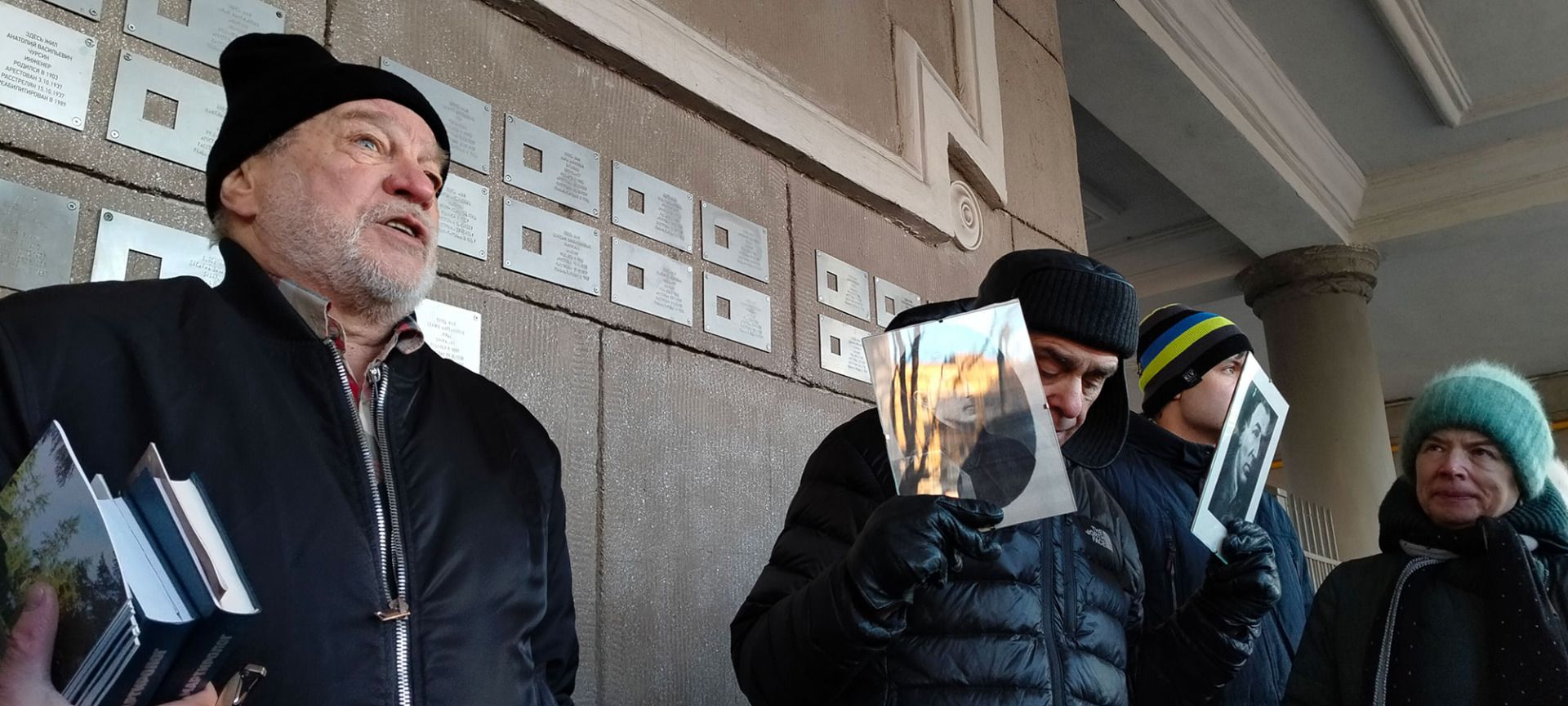
Among the bundled-up people stands out a man in a half-unzipped jacket and without gloves, holding books. He seems not to feel the cold. This is historian Anatoly Razumov, who studies mass repressions in the USSR and heads the “Returned Names” center at the Russian National Library. Under his editorship, the “Leningrad Martyrology” was published, listing repressed residents of Leningrad. But as Dmitry Likhachyov noted in his foreword, “in essence, all residents of Russia are here—in this list of the executed: either acquaintances, or acquaintances of acquaintances, or acquaintances of their acquaintances.” The names of residents of the “house of specialists” are included as well.
Historian Anatoly Razumov (far left). Photo: Svetlana Li
“Nineteen thousand executed in Leningrad—all are included in the four volumes of the ‘Leningrad Martyrology,’” says Razumov. But he admits that not everything is yet known: for example, it’s still unclear where more than 500 Solovki prisoners were sent from SLON (Solovki Special Purpose Camp) in December 1937.
The researcher believes the condemned may have been taken to the mainland. “We continue to search and believe that the most likely place of execution for this group of prisoners is the area of Lodeynoye Pole. Yuri Dmitriev searched there, Marina Muravyova searched there… Someday we will find this place. It will be found or declassified, if we live to see the next thaw,” Anatoly Razumov assured those gathered.
For help preparing the “Leningrad Martyrology,” Anatoly Razumov also turned to his colleague—Vladimir Dmitrievich Chursin, a bibliographer at the Russian National Library. His father was sent to a camp, and Vladimir himself lived with his mother in his uncle’s apartment as a child. His uncle’s name was Anatoly Chursin.
“For Vladimir Dmitrievich, Stalinist terror was a lifelong memory; he could never get away from it. During the great thaw of the mid-1980s to early 1990s, he collected every publication, every clipping about the executioners. He even had a special folder labeled ‘Executioners,’” the historian shares. According to him, these materials are now in the “Returned Names” center and are used for research.
Anatoly Razumov read out Vladimir Chursin’s recollections of the day his uncle was arrested: “When I opened my eyes on the morning of October 3, 1937, the first thing I saw was things scattered on the floor. Underwear, shoes, newspapers, letters, a primer and notebooks from my brand-new schoolbag—I’d been going to first grade for a month. My mother noticed my surprise. ‘They even searched under your mattress, they lifted you up, and you didn’t notice!’ I, an eight-year-old boy, already knew what ‘taken away’ meant.”
Vladimir Chursin died in 2021, before the memorial plaque for his uncle was installed.
“It’s much warmer by this wall now”
After Anatoly Razumov’s speech, “Last Address” staff member Marina Demidenko announces the end of the ceremony. Despite the frost, people don’t leave right away: regular participants meet their acquaintances. It’s hard to approach Marina: she is surrounded by people, each engrossed in conversation with her. A dark-haired, curly woman even invites her to go dancing in the evening—“after all, it’s Hanukkah today!”
NGO “Last Address” employee Marina Demidenko. Photo by Svetlana Li
Marina is at first wary of the “Most” journalist: “I don’t like all these questions and answers—they’re empty.” But then she admits that each such event is “very emotionally draining.”
Although “Last Address” is an official organization registered with the Russian Ministry of Justice, the project has faced resistance from Russian authorities and pro-government activists for several years.
“We do our work, even though vandals and authorities remove (tear down!) our plaques. Imagine—you work legally, but your fence is constantly broken and your property is stolen… But you wouldn’t shut down your business, would you? So we keep working. There aren’t even any lofty motives here,“ Marina reflects. She mentions in passing that the ”Last Address“ project participants do have something in common: conscience, pain, and a desire for change.
“If you don’t call death ‘death,’ and evil ‘evil,’ if you don’t mourn the grief, if you don’t receive an apology for what was done—this pain will go on, we’ll keep stepping on the same rake,” the activist is convinced.
Marina is supported by Alexander, a calm man with a tousled mustache and beard, who has participated in “Last Address” events since 2018, “when I thought repression hadn’t touched my ancestors.” He wonders why anyone needs to be told why such events are important: “Where else should we go, if not here? These are our fathers, grandfathers, great-grandfathers, mothers, grandmothers, great-grandmothers… These are our ancestors. These are Petersburgers, Russians, compatriots—people who died for nothing. You don’t have to be a descendant or know your family tree back seven generations to feel it.”
A couple of years ago, Alexander found documents about his great-grandmother’s brothers: they were arrested on suspicion of counterrevolutionary activity (they were Finnish subjects, their father was an entrepreneur). But in a rare case, “somehow they got out of the Lubyanka basement and died a natural death in Europe.”
Photo: Svetlana Li
After the installation of the memorial plaques, Omar tells the “Most” correspondent: “In a way, we’re all a little lost today. But this event is absolutely clear and unambiguous. Here, by this wall, you become an adult. You become responsible: for your own fate, for your family’s past, and for your country’s past. Here arises a sincerity that is so hard to find even within yourself today. When the war began, I had a big question—whether to stay in the country or to leave. Many people around me left. And I kept thinking: where is that point after which a person must gather their things, take themselves and their family, and leave their homeland… Some part of me emigrated inside—I think healthy people understand that. But I still stayed in Russia. By this wall, it’s much warmer now than anywhere else. That warmth comes from the people.“
An hour after the “drilling in,” the space by the wall finally empties. Passersby pay no attention to the plaques. Only on the neighboring facade, as if echoing them, a blue inscription remains from the last war: “Citizens! During artillery shelling, this side of the street is most dangerous.”
If you enjoyed this article, consider making a donation — one-time or, even better, monthly. Your support helps us motivate our authors and become better with every article.
Our organization is recognized by the Internal Revenue Service (IRS) as a 501(c)(3) tax-exempt, charitable organization, which means that all contributions made to us are tax-deductible to the fullest extent permitted by U.S. law. Individuals may generally deduct charitable contributions of up to 60% of their Adjusted Gross Income (AGI) for cash donations made to qualifying 501(c)(3) organizations. For donations of appreciated assets (such as stocks or other long-term capital assets), the deduction is typically limited to 30% of AGI, based on the fair market value of the asset. C-corporations may deduct charitable contributions of up to 10% of their taxable income for donations made to eligible charitable organizations.
By submitting a donation, you confirm that you have read and accept the following documents: Privacy Policy and User Agreement, and also give consent to the processing of your personal data.
If you would like to unsubscribe from a monthly donation, please email us at: [email protected]