Who today could take responsibility both for continuing support of Ukraine, for rearming Europe, and for organizing a more autonomous security system? Obviously, in the absence of competencies within the EU in defense policy, this mission should be taken on by the leading European countries — in fact, these are the countries of the Weimar Triangle. The first signs of agreement between them, shown in the May visits and negotiations, inspire cautious hope. There are no other contenders for such a role anyway.
In 1991, the foreign ministers of Germany, France, and Poland announced the creation of a mechanism for regular trilateral consultations, which was named the “Weimar Triangle.” The times were turbulent. The reunification of Germany, the dissolution of the Warsaw Pact, the end of Soviet dominance in Eastern Europe, as well as the collapse of the USSR created an unprecedented political situation in a short period, which required Europeans to seek new approaches. Revolutionary changes in the east of the continent were accompanied by deepening integration of Western European countries. All of this needed to be discussed somehow and solutions to current problems sought. In particular, one of the main European tasks at that time was to find the same reconciliation between Berlin and Warsaw following World War II that had already taken place between Berlin and Paris.
Obviously, Poland, which was going through the difficulties of painful reforms at that time, could not immediately claim the same degree of influence in Europe as France and Germany — neither economically, politically, nor militarily. Nevertheless, its potential as the largest country in Eastern Europe was unquestioned. Joining the EU and NATO, as well as high economic growth rates, strengthened Poland's position in Europe, and the Paris–Berlin–Warsaw line appeared as the natural geographical basis of the tripartite alliance.
Nevertheless, over the past 30-plus years, news from the Weimar Triangle has been extremely sparse, and there are many explanations for this. On one hand, mechanisms for regular consultations existed within the EU and NATO, so there was no need for additional meetings. On the other hand, political obstacles arose. In the mid-2000s, right-wing conservatives from the Law and Justice party (PiS) came to power in Poland for a long time, and relations with Brussels did not develop smoothly; in this conflict, Berlin and Paris were clearly not on Warsaw’s side. On European security issues, Poland and Germany primarily relied on American guarantees, rejecting French ideas about gaining greater autonomy. The Weimar Triangle essentially remained a club for optional meetings where the interlocutors could neither say nor offer anything new to each other.
The war in Ukraine and the clear tendency of the US to distance itself from European affairs have greatly changed the situation. Security issues have come to the forefront.
American guarantees within NATO look increasingly problematic. Coordinating positions among the 27 EU countries takes a lot of time and encounters numerous difficulties. In these circumstances, leading European countries are returning to the practice of making decisions at the national level, without abandoning the idea of European solidarity but combining it with direct bilateral and multilateral consultations and actions. The participants of the Weimar Triangle may be catching a second wind.
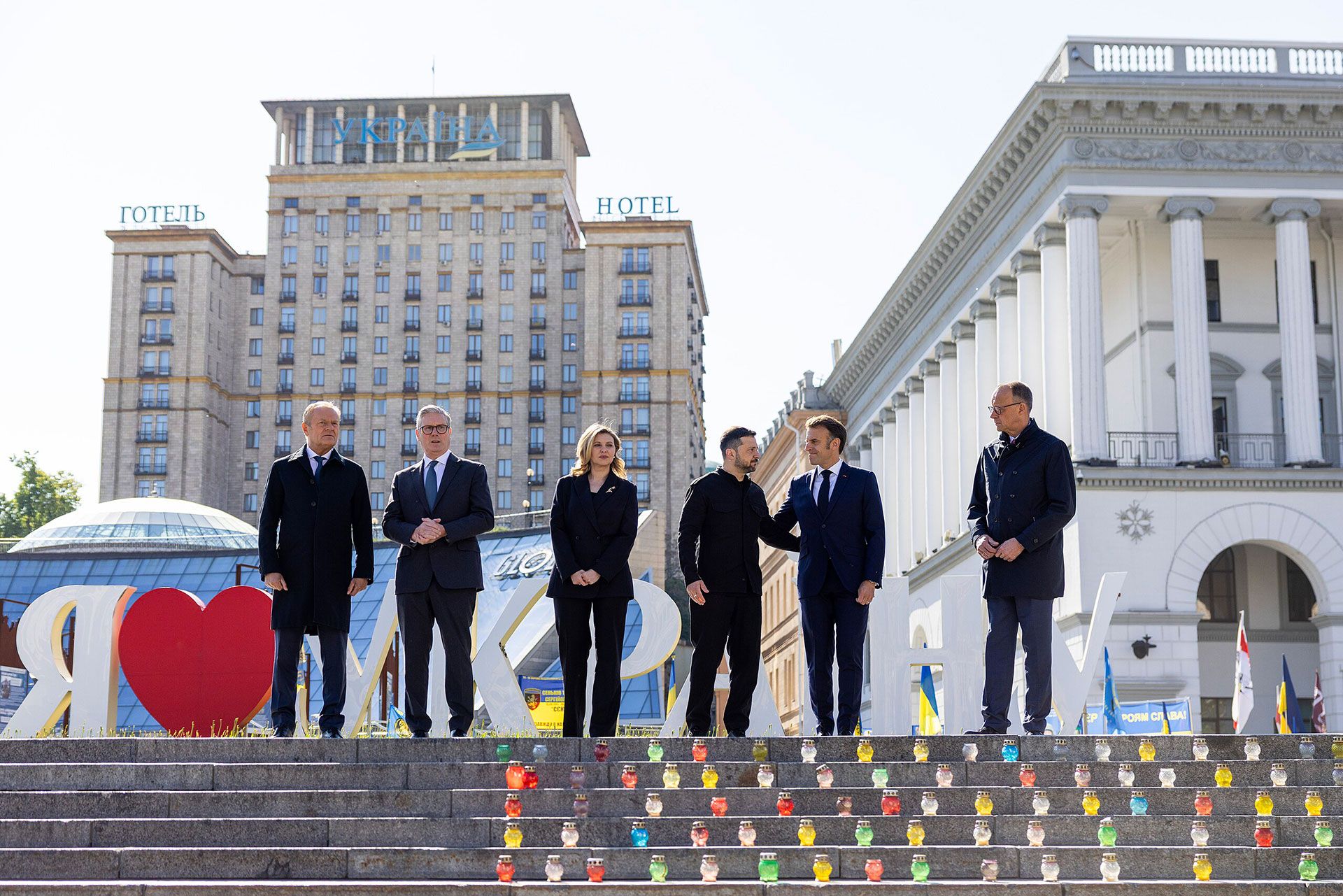
President of Ukraine Volodymyr Zelensky, President of France Emmanuel Macron, Chancellor of Germany Friedrich Merz, Prime Minister of Poland Donald Tusk, and Prime Minister of the United Kingdom Keir Starmer at the candle lighting ceremony on Maidan, Kyiv, May 10, 2025. Photo: Simon Dawson / Downing Street, 10
France and Germany
New German Chancellor Friedrich Merz made his first foreign visit on the morning of May 7 to Paris, and by the evening of the same day was already in Warsaw. The day before, his confirmation in office in the Bundestag did not go smoothly and required a re-vote by deputies. But this unpleasant episode hardly means a weakening of the federal chancellor’s position, since no one in the ruling coalition is interested in early elections. Thus, the leaders of France and Germany have two years in reserve to attempt to reach a new level of allied relations corresponding to a new stage in history.
Even before officially taking office, Friedrich Merz made a number of notable statements. In particular, he allowed for the extension of France’s and the UK’s nuclear guarantees to Germany and spoke about supporting Ukraine much more decisively than his predecessor Olaf Scholz. According to Merz, the German army should become the strongest in Europe. It is hard to say to what extent these plans will become reality, but such declarations have not been made by German leaders before.
Historically, the Franco-German alliance was at the foundation of both the creation and development of the EU.
The reconciliation of de Gaulle and Adenauer ended a more than century-long era of hostility between neighbors, which was extremely destructive and dangerous considering two world wars — and allowed the start of an unprecedentedly long period of peace in Europe. In recent decades, the leaders of France and Germany have constantly met with each other. Some imbalance in the status of the two countries — Germany’s economic power not matching its political weight and, conversely, France’s high political status despite relatively modest economic achievements — seemed to complement the allies mutually, and their joint position appeared impressive.
Nevertheless, since the 2000s, disagreements have accumulated between Paris and Berlin. These include France’s chronic inability to control its budget deficit and public debt (by the end of 2024, the budget deficit was 5.8% of GDP, and debt 113% of GDP), which always irritated prudent Germany; differing approaches to nuclear energy; Germany’s commitment (as the main exporter in the EU) to free trade with the rest of the world, while France favors protectionist measures; and divergent views on European security, with France wary of relying too much on the US and Germany unwilling to hear about any security guarantees other than American ones. Additionally, the personal relationships between the last two federal chancellors, Angela Merkel and Olaf Scholz, with French presidents left much to be desired.
It is obvious that resolving all these disputes quickly will not be possible. At a brief press conference in Paris, Friedrich Merz called for the swift ratification by the EU of a free trade agreement with South American countries belonging to the Mercosur group. At the same time, he was well aware that France does not approve of this agreement and proposes amendments. But if opinions on some issues do not coincide, it is possible, if desired, to focus on those areas where understanding is achievable. And such space for Franco-German cooperation undoubtedly exists recently — support for Ukraine and the search for new approaches to European security.
Following the meeting with Merz, Emmanuel Macron announced the creation, together with Germany, of a “Council on Defense and Security.” Of course, it cannot be ruled out that another empty bureaucratic structure has emerged — but on the other hand, if Paris and Berlin really seek “answers to common strategic challenges,” a format for negotiations and decision-making is necessary. For example, in 2017, a large joint project SCAF (Future Combat Air System) was launched, which is supposed to replace modern military aircraft. To date, nothing is known about the state of affairs in this project, and all news is limited to stories about a complex preparatory stage. Meanwhile, for rearming Europe, Franco-German cooperation is key from the perspective of producing the latest weapons.
France and Poland
On Friday, May 9, French President Emmanuel Macron and Polish Prime Minister Donald Tusk signed an agreement in Nancy to strengthen military cooperation, which provides not only mutual assistance in case of attack but also counteraction to “foreign interference and cyberattacks.” The location was chosen deliberately since Nancy was the place of exile in the 18th century of Stanisław Leszczyński, the deposed King of Poland and a generous patron of the arts.
President Macron on this occasion repeated his reflections on the national nuclear doctrine. In it, the use of atomic weapons is conditioned on the threat to “the vital interests of France,” which are not disclosed. According to Macron, these “vital interests” also include the security of “key partners” in Europe. However, one can note some evolution in the French president’s views. Not long ago, he spoke about extending the French “nuclear umbrella,” as a replacement or duplication of US guarantees, to close neighbors, primarily Germany — but now it turns out that France’s “vital interests” can easily extend to Poland, where, by the way, there is no American nuclear weaponry.
The US permanent representative to NATO, Matthew Whitaker, stated a few days ago that
a significant reduction of American military presence in Europe is planned soon. At the same time, the most significant US army units in terms of numbers are currently stationed in Germany and Poland.
Berlin’s and Warsaw’s plans to rapidly increase the combat readiness of their armed forces find indirect confirmation in Washington’s distancing from European affairs. In these circumstances, France, as a nuclear power, producer of modern weapons, and possessor of a capable army, is a natural interlocutor and ally for Germany and Poland, with whom efforts can be coordinated, setting aside past disagreements, at least temporarily.
Ukraine
On Saturday, May 10, the Weimar Triangle was fully represented at the highest level in Kyiv, together with the British Prime Minister Keir Starmer who joined them. After consulting personally with Ukrainian President Zelensky and by telephone with US President Trump, the European leaders issued an ultimatum to Russia, demanding an immediate 30-day ceasefire on the front. In case of Moscow’s refusal, new sanctions were expected to be introduced, supposedly stronger than previous ones. The further development of events is well known: there was no ceasefire, nor are there sanctions yet, but some strange negotiations are going on, resembling an amateur performance for an undemanding audience. At the same time, various aid packages to Ukraine from European countries and the EU continue to be allocated.
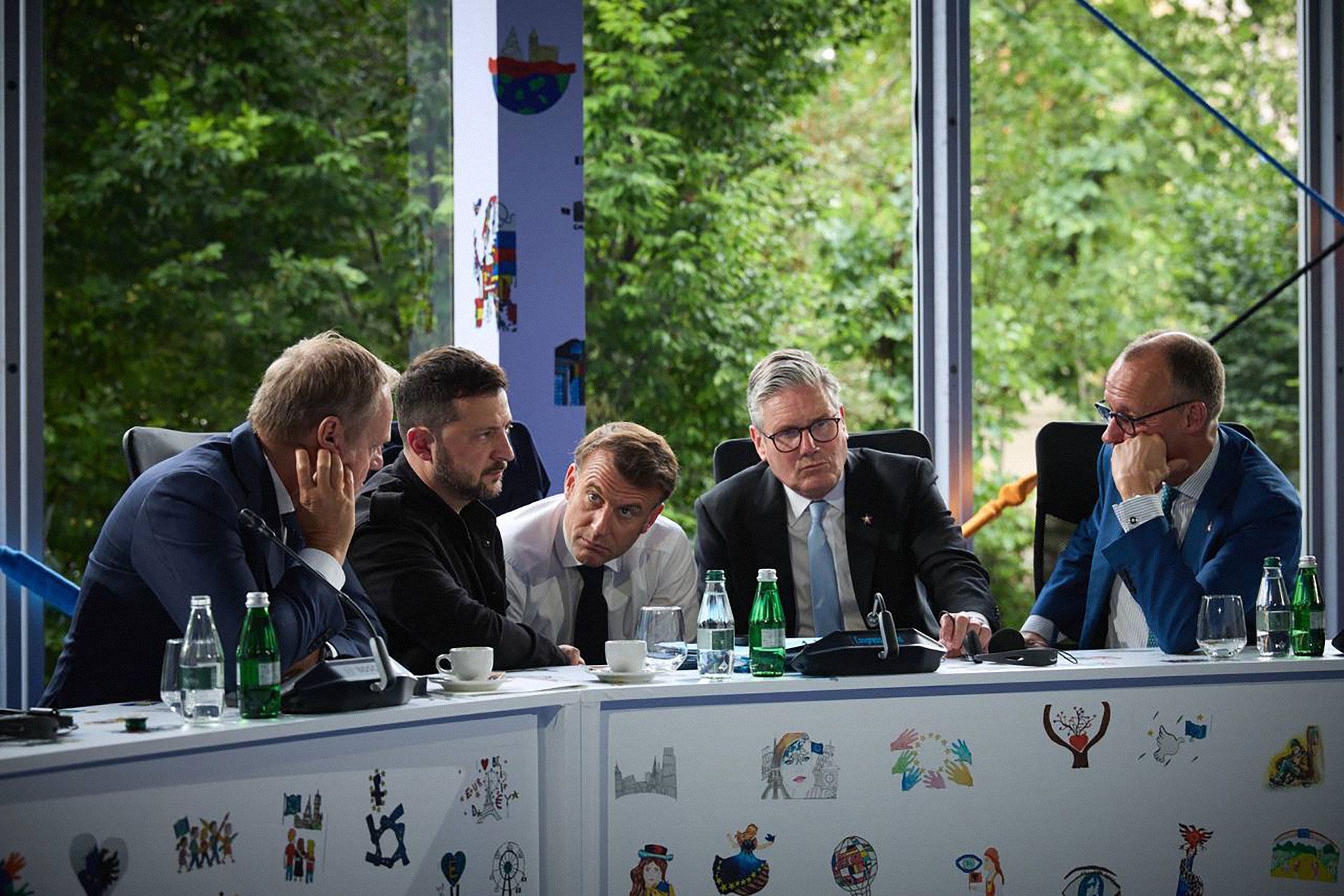
Donald Tusk, Volodymyr Zelensky, Emmanuel Macron, Keir Starmer, and Friedrich Merz. Fot. Office of the President of Ukraine, president.gov.ua
Nevertheless, even this impressive but fruitless visit of European leaders to Kyiv was significant as a sign of unconditional support for Ukrainian resistance from leading European countries. This support is often criticized for being insufficient and indecisive, but its components were formed under conditions when no one in Europe — neither governments, nor societies, nor producers, nor armies — was prepared for a major war. Today, the situation is further complicated by the position of the new US administration, which is clearly not inclined to spend funds on aid to Ukraine.
But who could take responsibility both for continuing support of Ukraine, for rearming Europe, and for organizing a more autonomous security system? Obviously, in the absence of competencies within the EU in defense policy, this mission should be taken on by the leading European countries — in fact, these are the countries of the Weimar Triangle. The first signs of agreement between them, shown in the May visits and negotiations, inspire cautious hope. There are no other contenders for such a role anyway.
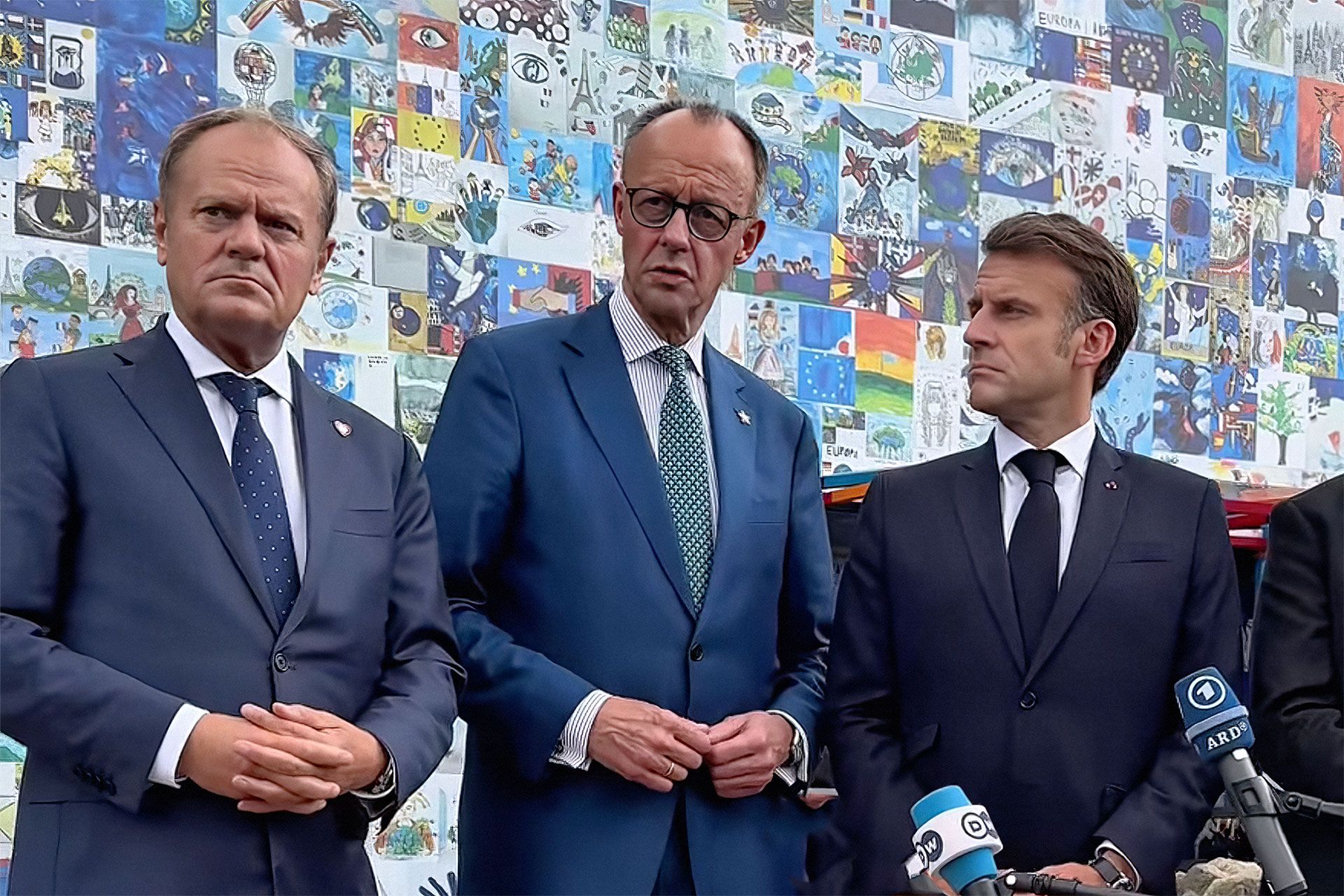
Main photo: Polish Prime Minister Donald Tusk, German Federal Chancellor Friedrich Merz, and French President Emmanuel Macron. Source: Friedrich Merz’s Instagram
If you enjoyed this article, consider making a donation — one-time or, even better, monthly. Your support helps us motivate our authors and become better with every article.
Our organization is recognized by the Internal Revenue Service (IRS) as a 501(c)(3) tax-exempt, charitable organization, which means that all contributions made to us are tax-deductible to the fullest extent permitted by U.S. law. Individuals may generally deduct charitable contributions of up to 60% of their Adjusted Gross Income (AGI) for cash donations made to qualifying 501(c)(3) organizations. For donations of appreciated assets (such as stocks or other long-term capital assets), the deduction is typically limited to 30% of AGI, based on the fair market value of the asset. C-corporations may deduct charitable contributions of up to 10% of their taxable income for donations made to eligible charitable organizations.
By submitting a donation, you confirm that you have read and accept the following documents: Privacy Policy and User Agreement, and also give consent to the processing of your personal data.
If you would like to unsubscribe from a monthly donation, please email us at: [email protected]