On the walls here, you can see gigantic portraits of Putin, icons, and vinyl records of Vysotsky and Okudzhava (all in one office), lower-level employees are scolded with quotes from Pasternak and Zabolotsky, and TV host Ekaterina Andreeva gives advice on how to properly cope with the anger of superiors at a “Znanie” society lecture.
Photo: Press Service of the Russian Ministry of Culture
Morning. “Shout Past Me”
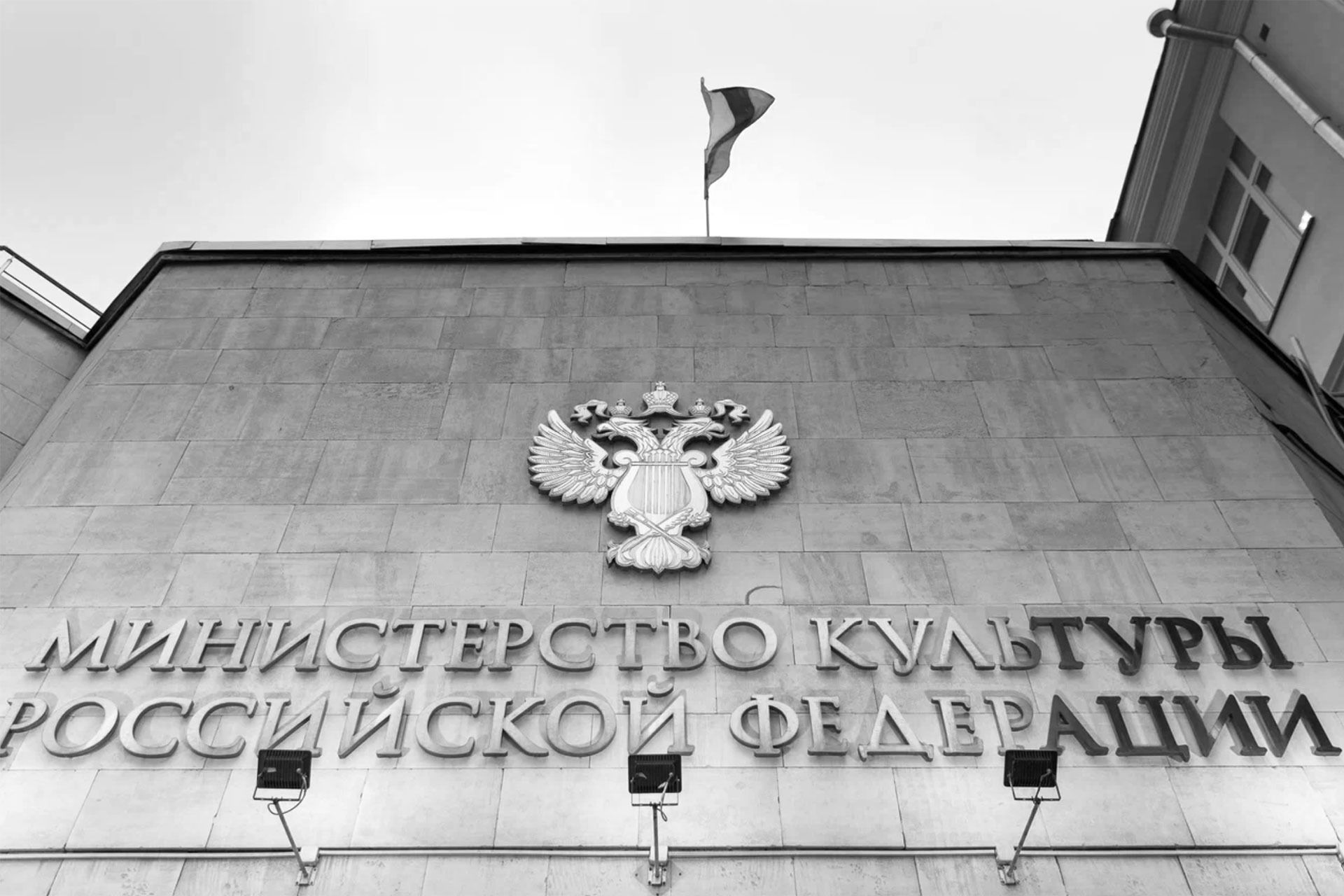
A gray morning, employees gather at the ministry building with the Russian coat of arms on its pompous facade – it was built in the 18th century, later rebuilt, and in the 1920s it housed “Sovkino.” At the entrance, there’s a magnetic strip for belongings, although no one inspects bags.
- Tap the “wooden card” and go through, — the guard hands a temporary pass on a white plastic card to the intern without asking for a passport.
The ministry takes on interns a couple of times a year – students and university graduates up to 27 years old with Russian citizenship. To apply, you need to write an essay and pass an interview. Some wait years for an invitation. Everyone is vetted by security: a candidate is blacklisted if, for example, their data appears in a leak from the “Smart Voting” site. The best participants are added to the ministry’s youth personnel reserve – there’s room to grow.
Posters line the corridor walls: “Have you filed your tax return?” in the style of the Soviet “Did you volunteer?” and warnings that corrupt officials will be punished. Nearby is a QR code for donations to DPR fighters.
A queue forms by the elevator like for a minibus: only four women fit inside, and even they breathe down each other's necks. A man arriving wishes everyone a good morning and habitually takes the stairs. The elevator moves slowly, allowing the ladies to discuss important gossip:
- Did you go to Ekaterina Andreeva’s lecture?
- So pointless, just wasted time! She came in an oversized jacket, looks much slimmer in photos.
- The staff tried to set up the lighting to show her in the best light – after all, we have professionals working here.
- She was supposed to talk about a healthy lifestyle…
The lecture “The Power of Words and a Healthy Lifestyle” by TV host Ekaterina Andreeva was held at the ministry together with the “Znanie” society. The largest auditorium—the former cinema hall—was allocated for the event. Organizers asked department heads to let employees attend during work hours.
At the lecture, attendees learned that a woman should be soft, smooth, and tender like dough. According to Andreeva, exclaiming “wow!” denies oneself. It's better to say “now that’s something!”. And finally, a genuinely useful tip for the ministry: when your boss yells at you, mentally repeat “shout past me,” and it will get easier.
The elevator doors open. The women exiting wish each other a good day.
Meetings. “You Can't Handle Women Any Other Way!”
The Department for Educational Work and Enlightenment Projects – ERPPEP (the ministry loves abbreviations) is located a bit off from the main building; it used to house RosKultProject. You get there through a service yard where employees smoke beside trash containers and well-fed rats scurry around. The department, which promotes “traditional values,” occupies a spacious open-plan office with transparent “aquarium” offices for the director and deputies. More precisely, director and deputy directors: most ministry employees are women.
The deputy minister coordinating the department’s work sits in the main building with other deputies. He’s about 45 years old, with a wolf avatar from “Nu, pogodi!” on Telegram. He’s never married but has a two-year-old son. The deputy sets aside gifts brought by guests at business meetings for his son—like Christmas tree soldier ornaments in a music box with military songs. He’s held this position since late last summer; previously, he headed an NGO organizing youth events in Crimea. Now representatives of that organization come to the ministry to discuss new projects with the former director.
After moving into his predecessor’s office, he hung vinyl records of Vysotsky and Okudzhava on the walls, and in the red corner—on the safe—placed icons. Next to the government phone is a full-wall graffiti-style portrait of the president with the quote “Culture is our spiritual backbone.”
Rare meetings with his participation are conducted in a low tone. “Don’t compare an ass to a finger!” the deputy minister shouts at a department head who tried to give an example from past experience. Then he gets even louder: “I’m fed up, our meetings are like a meat grinder because we’re still at zero level! What am I supposed to show the minister…”
Employees often run out of the office in tears, cry in the department, write resignation letters of their own accord—and come back to work the next day as if nothing happened. In the deputy minister’s Telegram channel, he explains his way of conducting meetings with Pasternak’s poem “I want to get to the very essence of everything”: “Today I tried to explain roughly the same thing to my employees. It came out loud, in prose, and less skillfully.” At work, explanations are simpler. According to witnesses, after a particularly loud meeting, the deputy minister left the office and said: “You can’t handle women any other way: they don’t understand.”
Lunch. “They Dump All the Patriotism on Us, What the Hell Is This?”
At lunch (if there’s time), employees go to the cafeteria aptly named “Cultural People.” Many bring home containers and heat their meals in the microwave. Over food, they discuss why the young assistant to the deputy minister works a crazy schedule with almost no days off and has accompanied the deputy for about 10 years, since he was the director of the NGO. Is she building a career or just in love?
The head of the educational work department, a determined woman in her early 40s, affectionately calls everyone “girls”—a few men mixed into the female team have already gotten used to it. She got to the main ministry through a promotion from the Kursk regional ministry of culture. Her mother and son stay in Kursk and sometimes visit her; she takes them to Moscow theaters. When an alert is announced in her homeland, she stays up at night watching drone arrivals. She deliberately doesn’t read other news. Instead, she participates in paid women's “happiness marathons,” “tuning into love,” and runs in the mornings. During Orthodox fasting, she drinks water at banquets instead of alcohol. Asked if it’s hard to keep the restrictions, she says the hardest part is not swearing.
She’s always on high alert—the deputy minister can call her off any planned meeting, presenting it as a fait accompli: needed in five minutes. A driver brings her to work while subordinates are still on the subway, and in the evening, when employees who stayed late on urgent tasks leave, her “aquarium” office light is still on. The official has an important mission—to carry out the president’s decree “On Approving the Fundamentals of State Policy for the Preservation and Strengthening of Traditional Russian Spiritual and Moral Values” regarding educational work.
The Department for Educational Work appeared in the ministry last fall. It includes several divisions: partner network development, interaction with young creative professionals, educational programs for public administrators, and one responsible for enlightenment projects. Earlier this year, a project office for the Special Military Operation opened—organizing filming about the combat actions in Ukraine and supporting “necessary” projects, such as Olesya Shigina and her patriotic festival “Cinema in the Service of the Fatherland.”
Employees periodically grumble: “We are responsible for education, but they dump all the patriotism on us, what the hell is this?” They lack monitors and chairs—one-third bring their own laptops. The best holiday gifts here are considered a keyboard with a mouse and a trash bin.
The administrative service excuses itself: many people, little equipment. The minister is busy: she flies either to meetings with Abkhaz colleagues or to the pope’s inauguration.
Photo: Ministry of Culture and Tourism of the Moscow Region
Internal department meetings take place weekly. Some tasks come “from above”: for example, to promote holidays that have not yet caught on with the public—such as National Unity Day and State Flag Day. For this, the ministry created the project “State Holidays Laboratory,” where holidays were assigned to large Russian companies like Yandex, Sberbank, and Rosatom.
Another ministry project is helping with the social rehabilitation of returning “SMO veterans,” involving them in government structures and cultural projects. Former fighters are planned to be hired by the Ministry of Culture. The ministry and the “Association of SMO Veterans” signed a cooperation agreement.
The ministry sends lists of “desired” plays on the topic of military actions to the country’s main theaters: for example, the plays “Just Live”, “Staff Clerk”, “Bear” and nine others—all part of the “SMO: True Stories” project funded by a presidential grant. Vladimir Mashkov, head of the Union of Theater Workers, is a frequent guest at the Ministry of Culture; every confident employee has a photo with him.
Evening. “The Soul Must Work”
Many at the ministry came from related fields: personnel reserve, the mayor’s press service of a regional capital, youth policy, or forum projects. Many are from Kursk—as employees joke, the director evacuates his own. Some go home to their families on weekends. Not all are officially on staff. Many are initially assigned to another organization—the same NGO where the deputy minister was general director. It’s easier to process documents this way: these employees don’t have “civil servant” status.
Rotation happens so often that the phone directory can’t keep up—after an employee leaves, their name still appears when a new person calls an internal number. Newcomers on the ministry portal are greeted with a presentation and a welcome from the minister—and invited to participate in federal government sports events.
In the women’s restroom in the evening, there’s a queue at the sink: everyone washes cups accumulated during the day after visitors. There is a dishwasher, but it’s rarely used—it can’t wash porcelain dishes. They especially carefully wash the deputy minister’s favorite cup—with a white and blue pattern. Serving tea in it to someone else or drinking from it themselves is forbidden: it’s taboo.
Ordinary ministry officials leave work on time only on holidays. Even the owner of the white and blue cup often stays late. “The soul must work day and night, day and night!”—this quote from Zabolotsky illustrates a photo of the expressively ajar door of his office on his Telegram channel.
If you enjoyed this article, consider making a donation — one-time or, even better, monthly. Your support helps us motivate our authors and become better with every article.
Our organization is recognized by the Internal Revenue Service (IRS) as a 501(c)(3) tax-exempt, charitable organization, which means that all contributions made to us are tax-deductible to the fullest extent permitted by U.S. law. Individuals may generally deduct charitable contributions of up to 60% of their Adjusted Gross Income (AGI) for cash donations made to qualifying 501(c)(3) organizations. For donations of appreciated assets (such as stocks or other long-term capital assets), the deduction is typically limited to 30% of AGI, based on the fair market value of the asset. C-corporations may deduct charitable contributions of up to 10% of their taxable income for donations made to eligible charitable organizations.
By submitting a donation, you confirm that you have read and accept the following documents: Privacy Policy and User Agreement, and also give consent to the processing of your personal data.
If you would like to unsubscribe from a monthly donation, please email us at: [email protected]