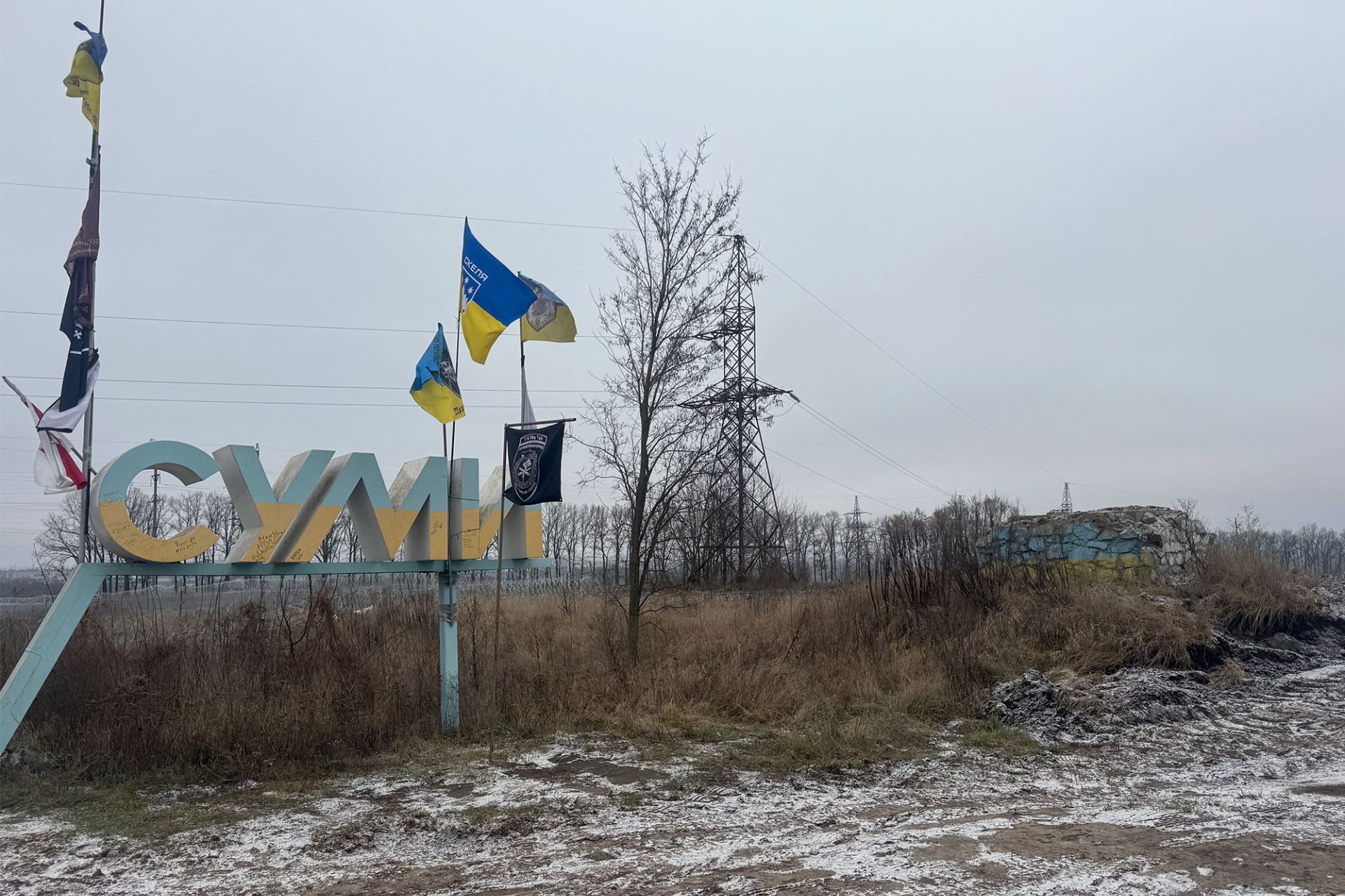
The Ukrainian city of Sumy is located 30 km from the Russian border and 20 km from the front line. A correspondent from “Most” visited there before the New Year holidays
Last spring, through mutual acquaintances, I managed to get in touch with the organizers of press tours to Ukraine from the “Freedom of Russia” Legion (LSR), which is part of the international division of the Main Intelligence Directorate of Ukraine (HUR), and submitted my candidacy for consideration. Within a few weeks, my participation was approved. The visa was issued at the end of November, about three months after submitting the documents. On December 6, I boarded a plane to Warsaw, then late in the evening I traveled to Przemyśl—a Polish city on the border with Lviv Oblast—and switched to a train to Kyiv.
At the station in Przemyśl, Ukrainians and Poles are quickly let through the border line, but I, with my Russian passport, am asked to go last and, until the line is finished, to sit aside. The same thing happened when boarding the train and again on the train when we entered Ukrainian territory: until two in the morning, border control officers approached me several times, checked my documents, consulted with each other, and finally stamped permission to enter the country. Half-asleep, I hear the train driver announce that there are military personnel on our train and ask for respect and gratitude for the defenders of Ukraine. The passengers applaud. The display in the carriage shows public service announcements—I remember an instruction on what to do if children have a panic attack during shelling, and a video from the heating company with the words “it will be warm for us, but hot for the occupier.”
The next time I open my eyes, we are already near Kyiv—I decide to check Google Maps to see how much farther we have to go and see the blue geolocation dot near the town of Fastiv in Kyiv Oblast. Just two nights before, drones had hit the train station in Fastiv. A few minutes later, I see the burnt-out station and several damaged trains through the window. After a while, our train stops: it will arrive in Kyiv two hours later than planned because repair crews need to fix rails damaged by the drone strike.
I go straight from the train to the hotel, where two young men in civilian clothes are already waiting for me as escorts. I have a couple of hours before leaving for Sumy to walk around and eat. I go into the chain café “Puzata Hata” near Khreshchatyk and am surprised by the lack of a language barrier—when I can’t remember a Ukrainian word and say the Russian equivalent, no one reacts negatively. On my way out of “Puzata Hata,” I record my first “circle” on Telegram for my friends, who were very worried about my safety as I left for Poland. In the background, the sound of a mobile generator is clearly audible—most establishments in Ukraine have acquired them due to constant Russian attacks on energy infrastructure.
After lunch, my escorts and I get into a civilian car and head to Sumy. This is the city I wanted to visit the most—there is relatively little coverage about it compared to other Ukrainian border regions. The front line is 20 kilometers from Sumy, and the Russian border in Kursk Oblast is just 30 kilometers away.
It’s about a four-hour drive from Kyiv to Sumy. On the road, both of my companions introduce themselves as HUR officers. One is about 25, the other about 35. Both, according to them, were born in Russia but have spent most of their lives in Ukraine, and with the start of the war, joined the “Freedom of Russia” Legion. N. and K. (they asked not to use their names or call signs) say that they themselves do not fight, only occasionally visiting positions as part of the LSR press service.
In Ukraine, people don’t drive slower than 90 kilometers per hour on highways—a sign of the war: this reduces the chance of being hit by drones. The road from Kyiv to Sumy goes through Romny. Early on, you can feel the impact of Russian strikes on substations—there is no street lighting at all, nor are there lights along the highway. I turn on notifications in Sumy regional Telegram channels to monitor missile threats and power schedules for the next day. In the end, I didn’t have problems with electricity—hotels have their own generators. But city residents aren’t always so lucky—sometimes there’s no electricity for up to 20 hours a day.
N. and K. take turns driving. They warn me that in case of an air raid alert, we’ll have to drive from memory without maps—GPS is jammed as soon as the siren goes off in the region.
At the entrance to Romny, we encounter our first checkpoint, where our documents are checked—this time, thanks to the HUR escort, everything goes quickly. On the sidewalk along the dark highway, a father and daughter are walking. The girl holds a phone with the flashlight on. However, in some places, the dark streets are lit by store, pharmacy, and gas station signs—even New Year’s garlands hang on one supermarket. On the Romny-Nedryhailiv highway, a military truck has veered into a ditch and hit a car.
Already approaching Sumy, eight kilometers from the city, anti-drone nets appear over the checkpoints. A small line of cars is checked by soldiers, and among the concrete blocks along the road, the Ukrainian flag flutters. I ask N. if there are shelters in the hotel. “If it’s your time, it’ll find you anyway,” he laughs in response. K. adds that two things save you at war—alcohol and dark humor.
***
There is a shelter in the hotel after all—almost all basements in public places have been allocated for them. The first thing that catches your eye in rooms in this front-line city is the huge panoramic windows opposite the beds. This is dangerous in case of explosions, but of course, no one planned for war when designing hotels.
In the evening, the grill bar “Sazha” in the city center is two-thirds full. To my right sit two women in their 60s, with two bouquets of roses in a vase on their table—apparently after some celebration. On the left, a man in his 30s hugs a woman in a short skirt and polka-dot tights. From the hall with wooden tables and soft brown chairs, you can go out to a glassed-in terrace, where garland lights twinkle, but it’s quite empty—at most five visitors. A young waitress explains that the electricity was only recently turned on on the terrace and it’s still cold there.
In just an hour and a half, at 10 p.m., curfew will begin, but some tables have “reserved” signs, and others clearly aren’t in a hurry to leave. A few minutes later, the windows on the terrace shake, and Telegram monitoring channels report missile danger and drones being shot down over the city. I finish my hearty borscht and leave the establishment.
Outside, it’s cold, the wind is blowing, and again there’s no lighting—I even have to turn on my phone flashlight with 3% battery left. A few people pass by, and at that moment there’s an explosion. The street is instantly lit up by a yellow-orange glow in the sky.
“Those are ours,” I hear from somewhere in the distance. Dozens of rockets are visible on the horizon, launching from one point—meaning Ukrainian air defense is really working.
Rockets begin to fly overhead in red flashes. Occasionally, you hear the sound of a lawnmower—these are “Shaheds” flying toward the Zarichnyi district, the area closest to Russia, which is hit most often. There are no sirens on the streets—apparently, the air raid alert was only given in the Sumy district. Near the hotel entrance, three local staff smoke, paying no attention to the explosions overhead.
In total, Sumy was attacked by about 15 drones overnight—they hit energy facilities, but some airborne targets were shot down over the city. That’s why there’s no water in the taps in the morning, and no electricity in homes. And at night, it snowed—a little, just dusting the grass and roof tiles with a thin layer.
***
“When I was walking in Kyiv, there were no guys, only girls,” says a middle-aged man as he returns his room key at the front desk. When I hear this, I remember that I also didn’t see young men in the capital—mostly women, children, and pensioners on the streets.
A couple comes out of the hotel room: a young man in camouflage and a red-haired girl, both talking on their phones in Ukrainian, saying goodbye to the administrator in Russian. During Soviet times, many villagers moved to Sumy, so almost everyone in the city speaks Ukrainian—or rather, Surzhyk with a predominance of Ukrainian vocabulary. In large cities near the Russian border, like Kharkiv, on the contrary, you rarely hear Ukrainian spoken. But Sumy is a relatively small regional center: as of 2025, it had a population of 268,400.
In the morning, there is no war in the city—at 9 a.m., buses and minibuses drive by, and dozens of people gather at the stops. There are a lot of cars, too, even though there were plenty on the roads during the night shelling.
I have breakfast at a café. At the next table, a Ukrainian serviceman chooses dishes from the menu.
“I’ll have the waffle with salmon, please,” he says.
“We don’t have it,” the waitress replies.
“What do you have?”
“Everything else.”
“No waffle with chicken either?”
“No, we don’t have electricity right now, so we can’t make it,” she explains.
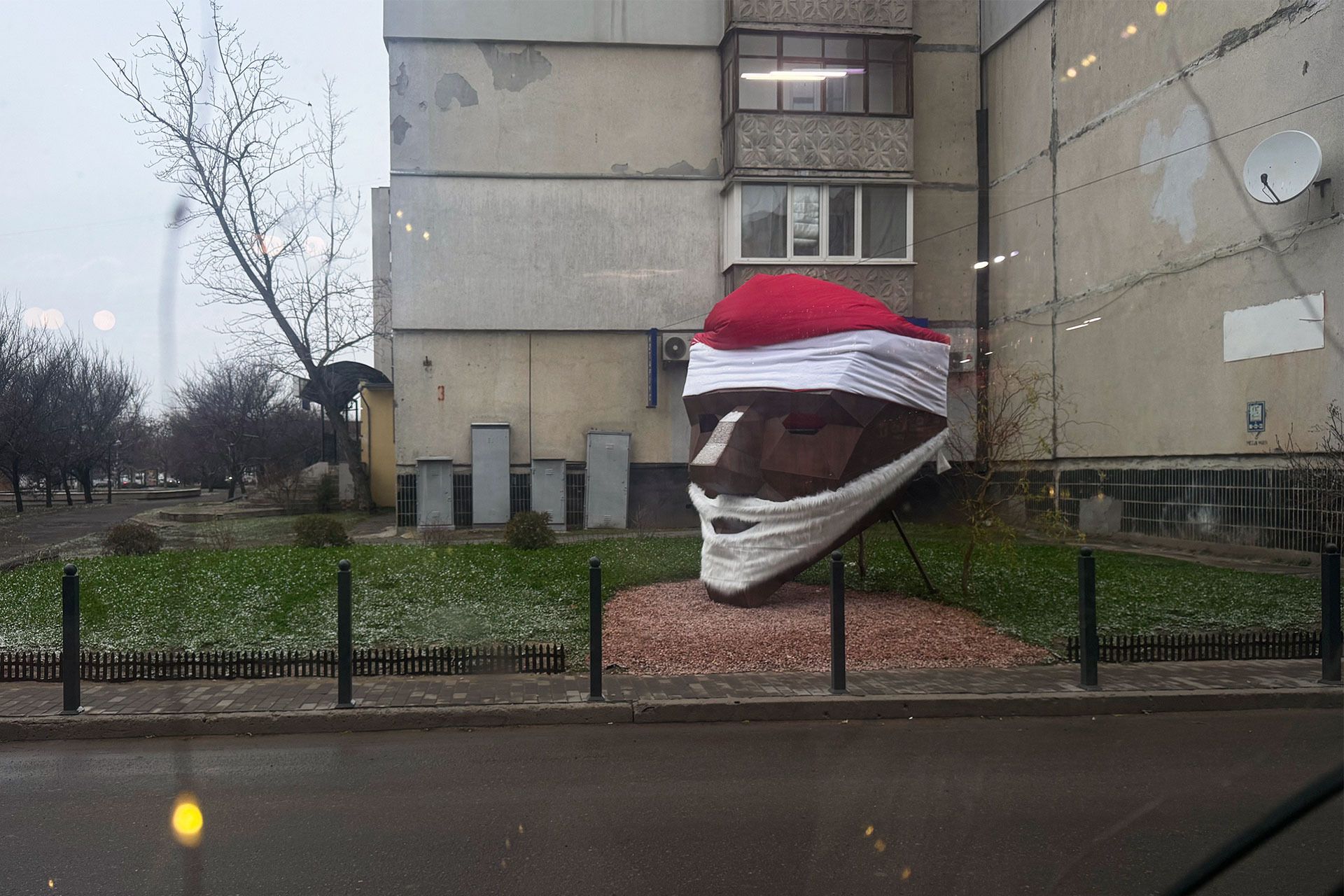
In the coffee shop parking lot stands a sculpture of Father Frost made of rusty metal with a red fabric hat, and nearby two servicemen get into a car.
If you drive toward the much-suffering Zarichnyi district of Sumy, that is, toward the Russian border, the number of cars with black military plates increases. Some of them have anti-drone nets and electronic warfare systems against drones.
***
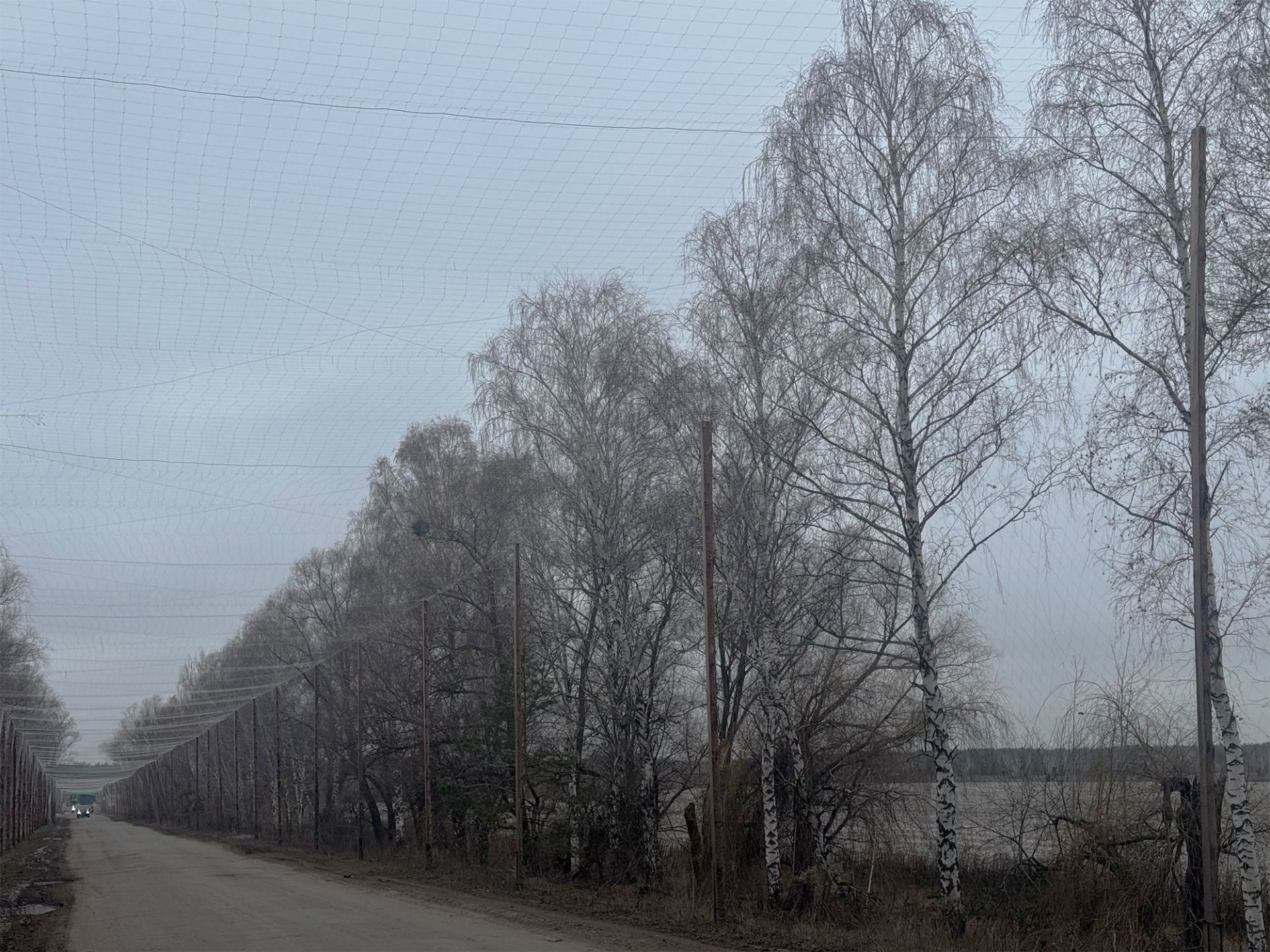
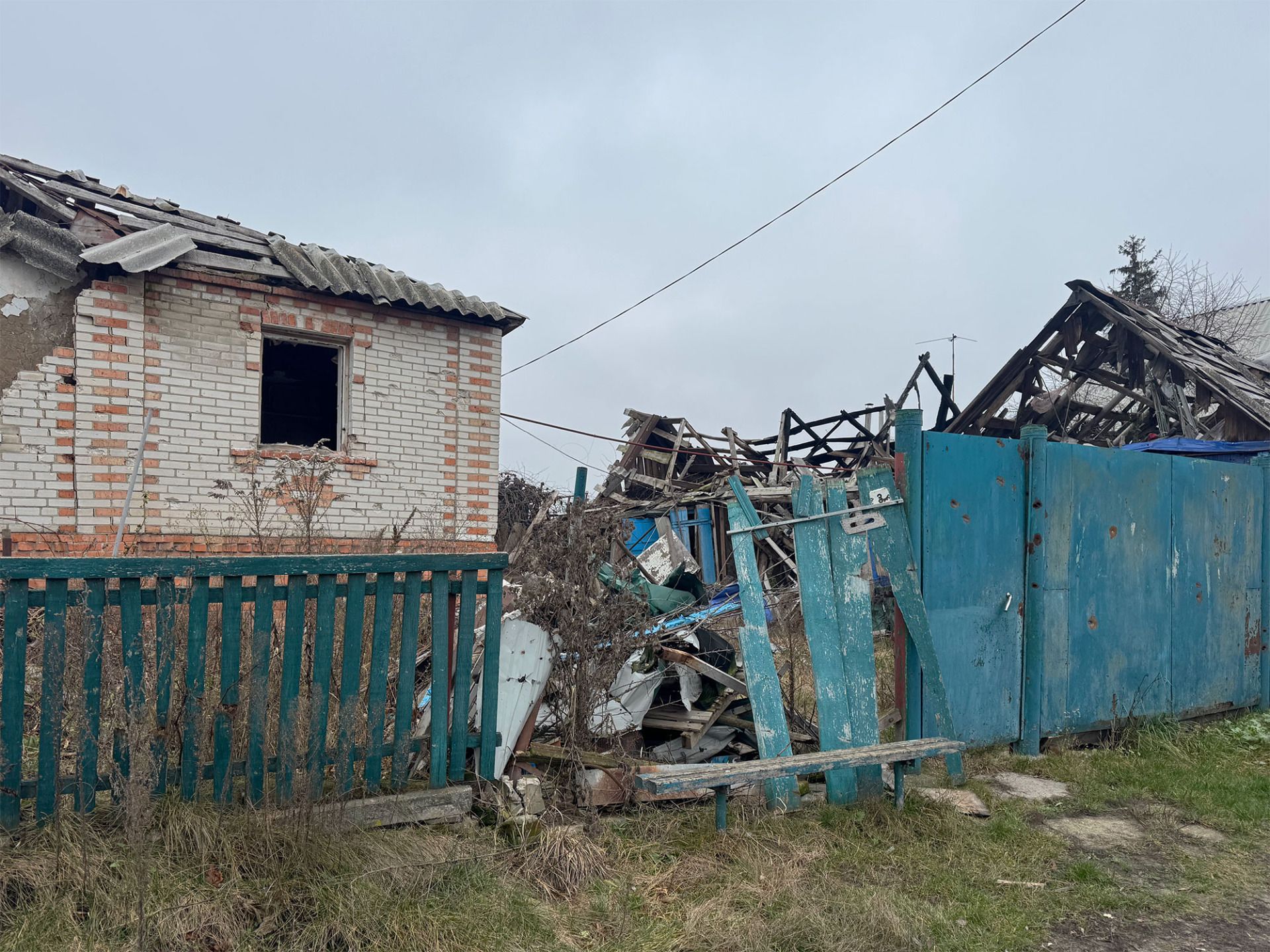
The closer you get to the city limits toward the border, the more houses you see with broken windows. Right next to them, on the road, electrical workers are repairing poles—maybe they were damaged just last night. Another military truck is seen at the entrance to the village of Lipnyak—it drives past a funeral services store with the sign “monuments.” Somewhere around there begins a road completely covered with anti-drone nets; on the roadside stand anti-tank “hedgehogs” of red metal, and a man with a backpack walks along the shoulder.
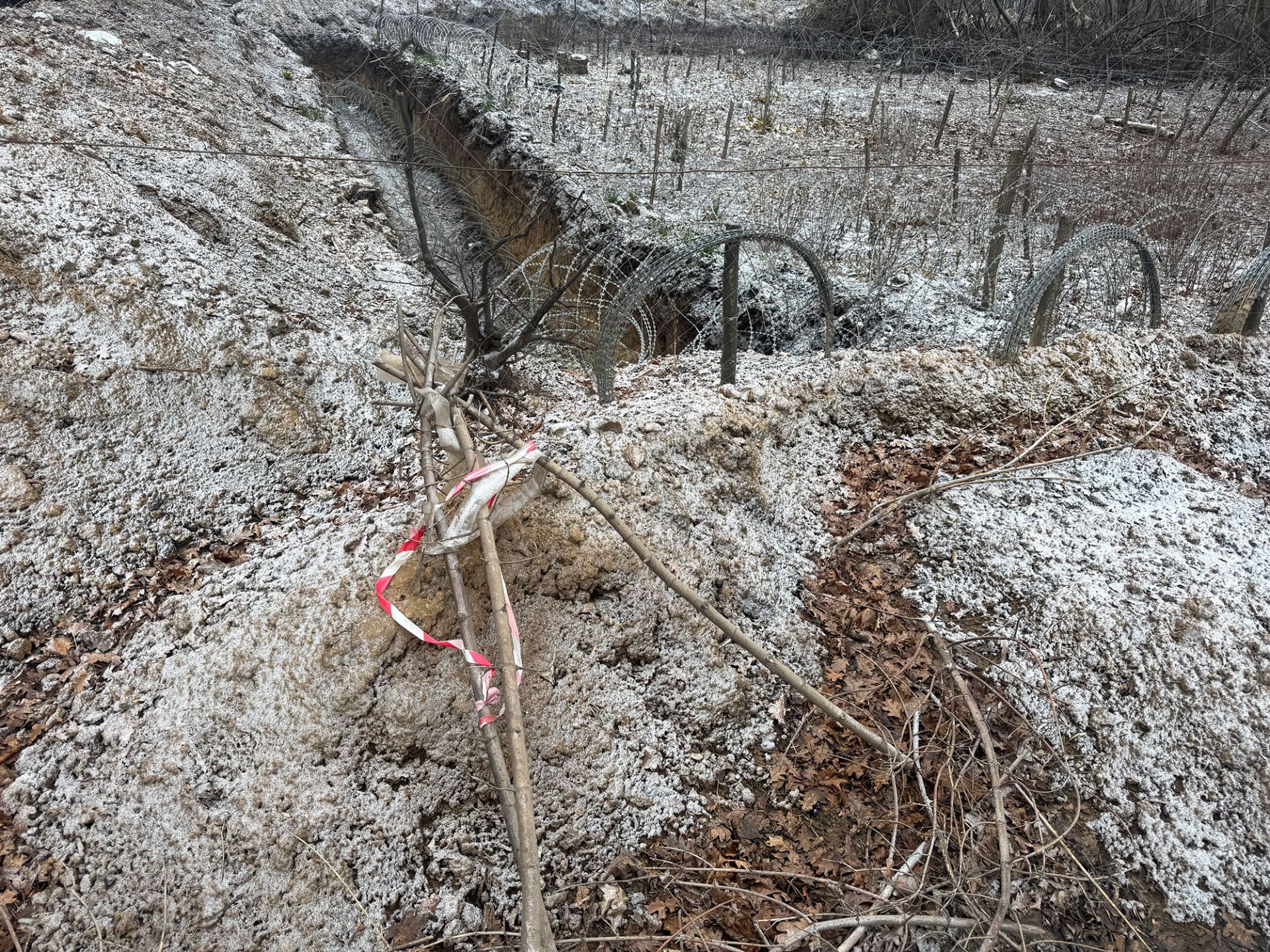
Past the checkpoint, you can see fortifications made of concrete pyramids just under a meter high—“dragon’s teeth,” used to block military vehicles. On the other side of the road is barbed wire lying on the roadside, and right there, solar panels on the ground. Around a beautiful two-story mansion with a terrace covering the whole roof are abandoned and ruined village houses. It’s hard to tell if they were like this before the war or if drones are to blame.
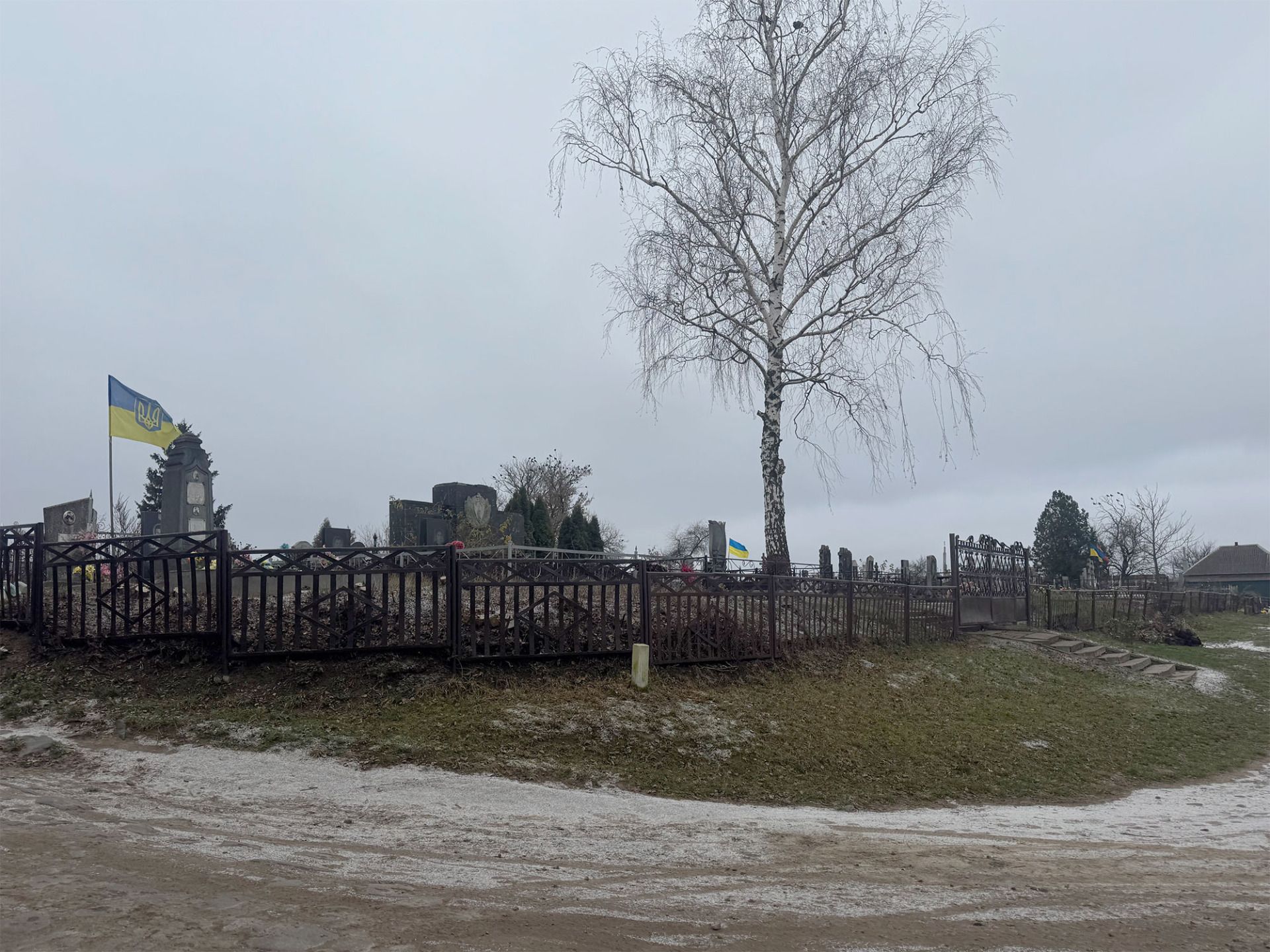
Before the war, 120 people lived in Lipnyak. In the center of the village is a large cemetery. Over many graves, Ukrainian flags flutter—meaning soldiers are buried there. Opposite the cemetery is a grocery store, near which two men are unloading a Gazelle truck. Inside, two young women arrange goods, and an older woman stands at the register. I ask if she’s afraid to work here.
“It’s scary, but are there other options? It’s scary, everyone’s scared, it’s scary everywhere,” she laughs.
From the shop window, you can see the panorama of the destroyed village, and I decide to take a photo. My plainclothes HUR escorts stand silently nearby and do not interfere.
“Why are you taking pictures?” the same saleswoman asks.
“I’m a journalist, writing a report, just photographed the drinks, I can show you,” I answer her in Ukrainian and show the photo on my phone.
“For what? To show what goods we have in the store?” she clarifies, either out of fear or distrust. I say yes and hurry out of the store so as not to make the saleswomen uncomfortable. Further down the road is a brick house with windows covered in plastic, and next to it a school building, which was barely damaged by strikes, but all the classrooms are empty. Some surviving houses are overgrown with grass, but in others, people clearly still live—smoke rises from the stoves.
Military vehicles with “mangals”—anti-drone nets on their roofs—drive across the bridge over the Psel River. On the roadside on the other side of the water, workers are building something, and nearby, soldiers with machine guns stand ready to shoot down drones. Next to them are small houses of a recreation base, which, judging by its condition, opened just before the war. In neighboring Olshanka, there is no life left—although no one was forcibly evacuated, most people left (before the war, 114 people lived there). Those few who remain stay at home. From one abandoned lot comes the honking of geese and barking of dogs, and a bird, looking like an owl, got tangled in the anti-drone net over the road and died.
Mostly, the abandoned houses are occupied by military personnel who rent them directly from the owners. “You left, at least left some kind of shelter—and even such a shack is rented out to the military,” says N. According to him, the state does not compensate military personnel for renting in the private sector.
In Olshanka, I met only an elderly man on the street, who quickly disappeared into his house, and an old woman who rode away on a bicycle. We head to Velyka Chernetchyna—the administrative center of the village council with a population of about 2,000. Here we have better luck finding people: two pensioners with shopping bags walk past ruined houses.
“More than one drone has flown over here, we’re afraid,” one of the women starts the conversation. “They fly all over the village, and they get shot down. How many Russians and Ukrainians Russia has already laid down—once we lived as brothers and sisters, there was a family on my street, the husband was Ukrainian and the wife Russian. There were so many such marriages, we lived and shared. And now, you see, they, these Russians, are happy that our children are suffering, everyone is suffering, everyone... It hurts, it really hurts.”
The pensioners say that since the war began, almost all farms in Velyka Chernetchyna have been destroyed by drones. Opposite us is an unfinished church: it was being built for years before the war started. Next to the church was a café, which on May 6, 2025, was hit by a Russian missile. Nothing remains of the café, and the blast wave also damaged a shop and several nearby houses—a 20-year-old woman was killed, and a woman and six children were injured. My second companion says that one of the injured girls had a fragment lodged in her eye that had to be left after surgery—the doctors still don’t know how to remove it safely.
“No one thought that we would have something like this in the 21st century,” she concludes.
According to N., there were quite a few people in Sumy region who “waited” for the Russian invasion.
“There were a lot of ‘waiters’ before 2022, now there are either those disappointed in Putin’s policies or those who don’t care—it’s all politics. That’s the whole point of terrorizing the civilian population—to tire people out so much that they say: whatever, let anyone be in charge, as long as they stop shooting,” he says.
You can’t really walk around the village—the nets are only stretched over the main road, and where there are paths to houses, FPV drones might be flying. Still, all the consequences of Russian shelling are visible—destroyed houses, broken roofs, and shattered windows everywhere.
***
After the border area, returning to Sumy is a relief—despite the nighttime air defense activity, you don’t feel a background sense of alarm in the city during the day. Even in the middle of a workday, the city’s beautiful coffee shops are full of people, and the squares and streets are tidy.
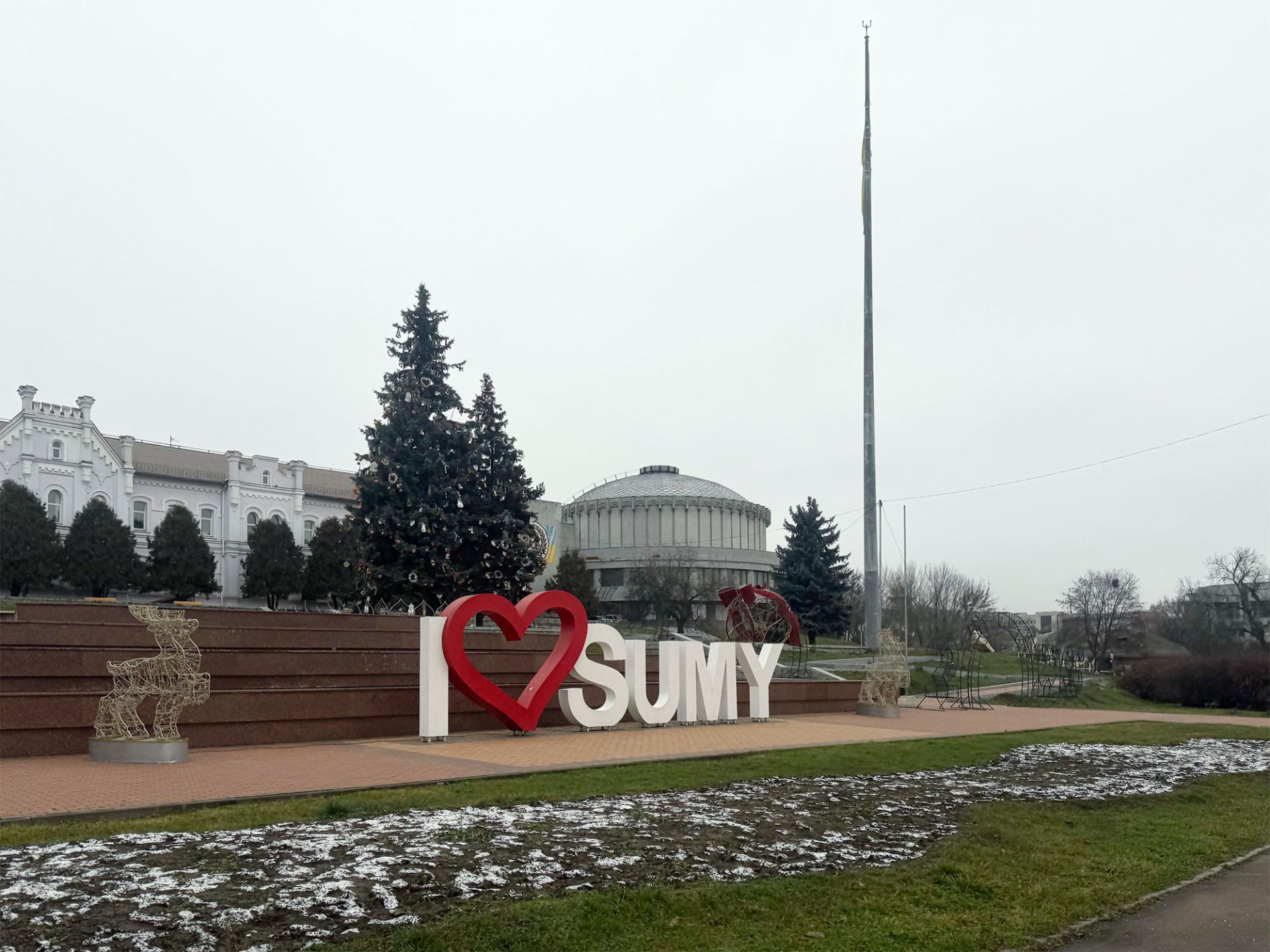
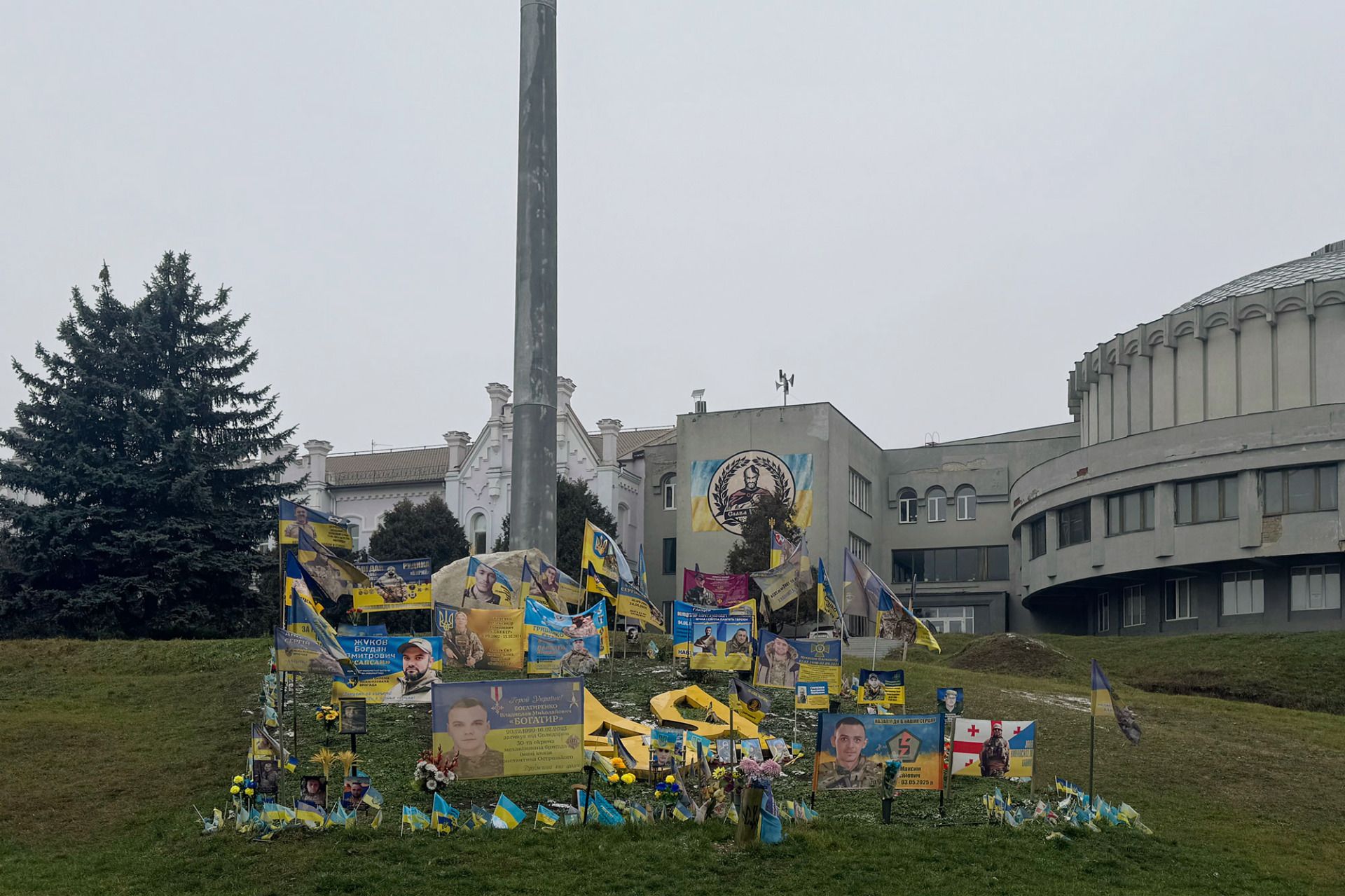
In the city center, there are New Year’s trees and a decorative sculpture with the inscription “I love Sumy” and a heart. Just like in many cities around the world, including Belgorod and Kursk on the other side of the border. Only in Sumy, next to this photo spot, there is a memorial to fallen Ukrainian soldiers, and above it, the Ukrainian flag. Nearby are two shopping centers, the Sumy Theater, and a monument to Mykhailo Shchepkin. In Russia, the native of Kursk province is honored as the founder of the Russian acting school, while in Ukraine he is considered a great Ukrainian actor: before moving to the Moscow Maly Theater, he performed in Little Russian theaters.
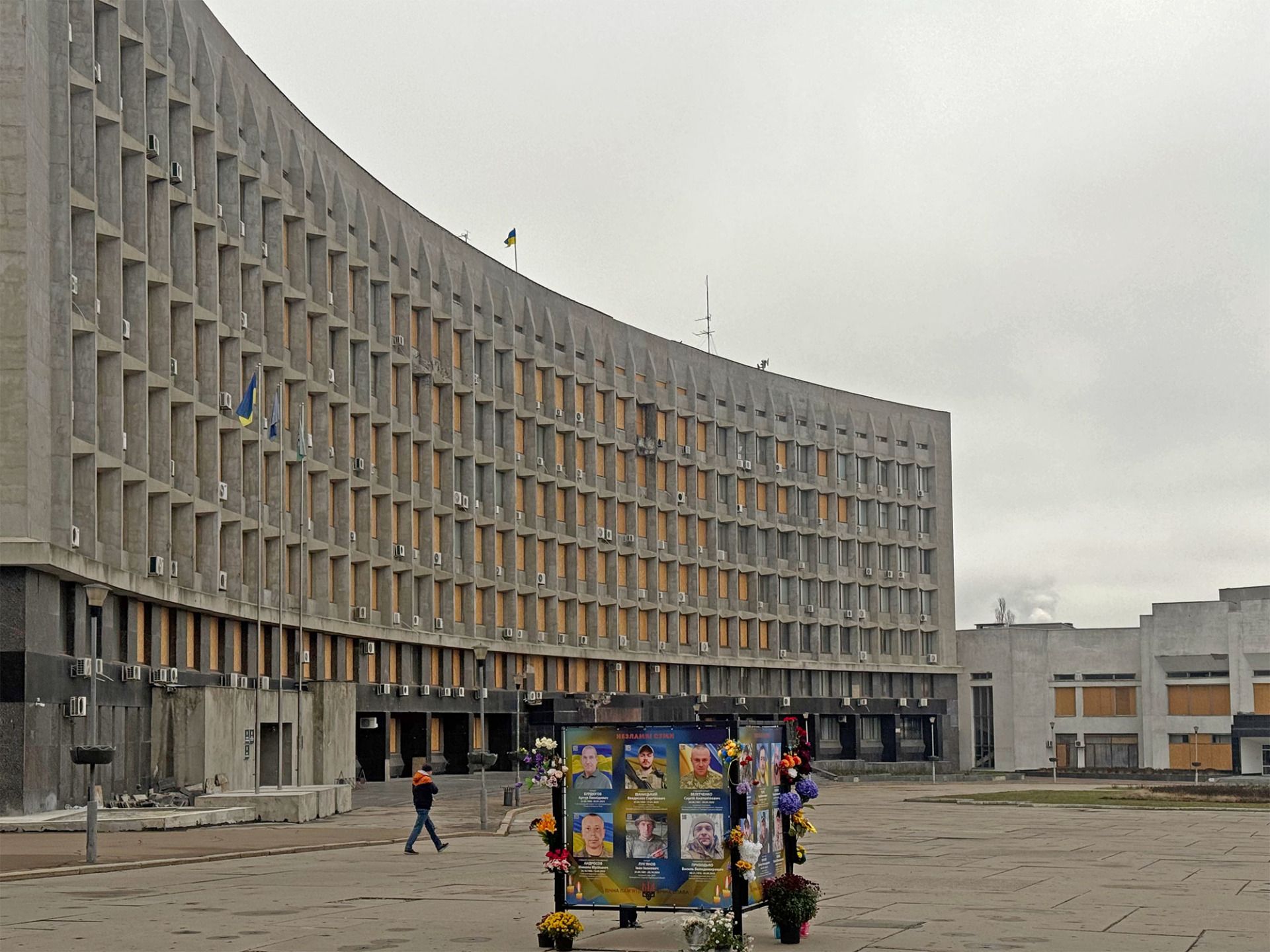
I walk past the Sumy regional administration and remember that in the summer a drone fell near the building. The broken windows aren’t noticeable—they are neatly boarded up with plywood. In front of the administration building are posters with the faces of fallen Ukrainian soldiers.
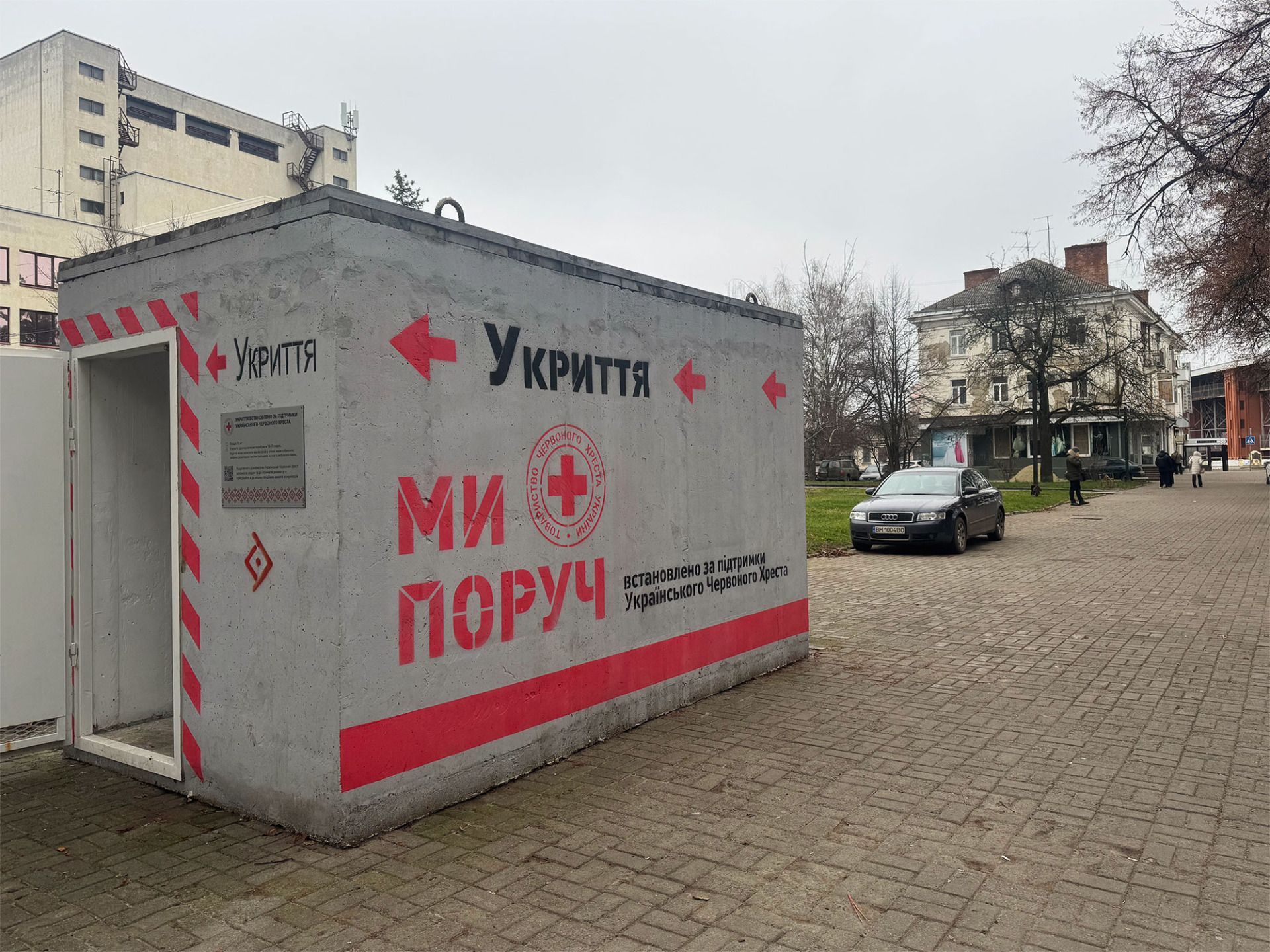
Scattered around the city are several concrete shelter boxes with wooden benches inside. Since the beginning of the war, they have appeared in Ukrainian cities shelled by the Russian army. Later, similar shelters appeared in Russian border cities, which are shelled in response by the Ukrainian military.
At bus stops, there are posters advertising military service contracts and signs asking not to photograph passing military vehicles, and in the middle of a small square, a sign reads, “I’m waiting because I love.”
In the evening, I get a takeaway coffee from a café near the regional administration building. It’s a café with a typical modern interior: dark walls, artificial plants, New Year’s garlands, and posters depicting Sumy. You could find such a coffee shop in any European city. Later, we have dinner at a restaurant serving Ukrainian cuisine. Looking through the panoramic windows, I think that this city was largely lucky to survive and not show signs of war, except for the threat of rockets.
The New Year in Sumy was celebrated relatively calmly. “There are a lot of people in the center: some are taking photos near the New Year’s decorations, others are hurrying about their business. Children are sledding, nearby is a fair, the smells of food, conversations, and laughter,” says the announcement for a video from the city’s “Kordon.Media.” However, at 12:30 a.m. on January 1, the air defense system was activated in the city. There were no deaths, injuries, or damage.
Disclaimer: As part of the “Freedom of Russia” Legion’s press tours for Russian journalists from independent media, Ukraine’s HUR books and pays for hotel rooms in border cities. That’s how the “Most” correspondent’s accommodation in Sumy was arranged.
If you enjoyed this article, consider making a donation — one-time or, even better, monthly. Your support helps us motivate our authors and become better with every article.
Our organization is recognized by the Internal Revenue Service (IRS) as a 501(c)(3) tax-exempt, charitable organization, which means that all contributions made to us are tax-deductible to the fullest extent permitted by U.S. law. Individuals may generally deduct charitable contributions of up to 60% of their Adjusted Gross Income (AGI) for cash donations made to qualifying 501(c)(3) organizations. For donations of appreciated assets (such as stocks or other long-term capital assets), the deduction is typically limited to 30% of AGI, based on the fair market value of the asset. C-corporations may deduct charitable contributions of up to 10% of their taxable income for donations made to eligible charitable organizations.
By submitting a donation, you confirm that you have read and accept the following documents: Privacy Policy and User Agreement, and also give consent to the processing of your personal data.
If you would like to unsubscribe from a monthly donation, please email us at: [email protected]