Today marks two years since the death of Alexei Navalny. On the eve of the anniversary, five countries (the United Kingdom, Sweden, France, Germany, and the Netherlands) issued an official statement that several independent laboratories had confirmed his poisoning with an extremely toxic substance—in essence, a chemical weapon. Only the Russian authorities had both the means and the motive to use it in the polar colony. On the anniversary of Navalny’s murder, the editorial team of “Most.Media” publishes a polemical essay by our reader I.B. from Russia. The anonymity requested by the author is necessary: the Russian authorities continue political repression against Navalny’s supporters even after his death.
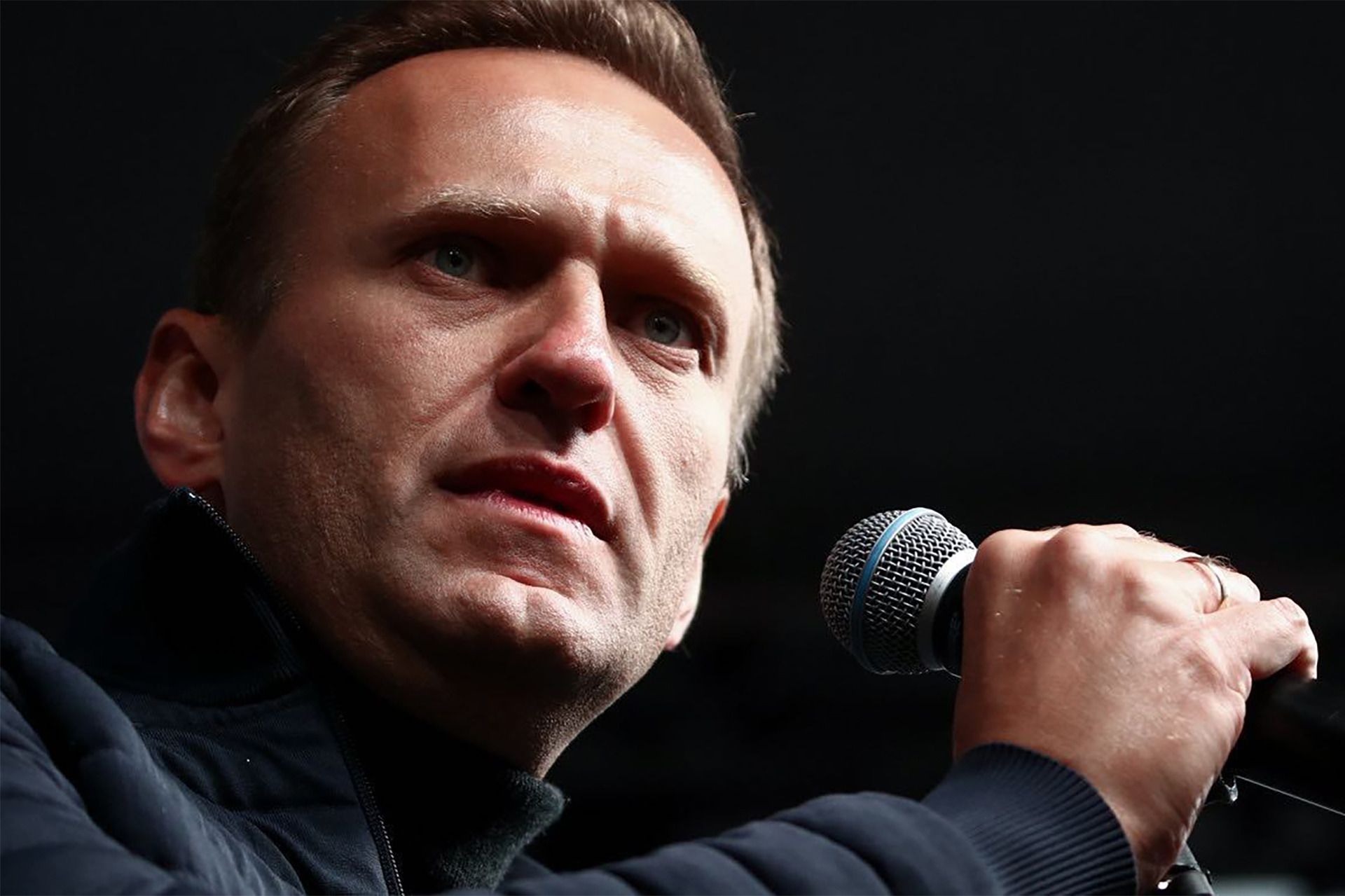
Alexei Navalny. Photo: Alexei Navalny's Facebook
This is a conversation about historical analogies. The very phrase tends to provoke understandable irritation and the urge to dismiss it. But, strictly speaking, the whole world is stitched together with metaphors, and metaphors, as we know, have their own logic.
It’s within this logic that we should challenge the comparison of Navalny to Robespierre, which was used in the headline of a “Most.Media” review of the collection by Philippe Bourdin and Michel Biard, “Robespierre. Portrait Against the Background of the Guillotine.” The clickbait metaphor (“A Dangerous Idealist Ahead of His Time: What Robespierre and Navalny Have in Common”) is jarring due to its historical inaccuracy and an openly questionable political subtext.
It takes a certain motivation to compare the leader of the Jacobin dictatorship to a Russian opposition figure whose political radicalism was limited to a single demand: to actually uphold the legal principles enshrined in the first two chapters of the 1993 Russian Constitution, which themselves are based on the 1948 Declaration of Human Rights. While Maximilien Robespierre, over five revolutionary years, went from a loyal bourgeois reformer to a fervent revolutionary involved in the violent experiment of building a new society with new laws, religion, and property relations, all of Navalny’s “utopia” and “dangerous idealism” boiled down to the dissident-era formula: “Follow your own Constitution.”
Still, we shouldn’t blame the reviewer or the editors of “Most.Media” for originating this absurd metaphor.
The label of “revolutionary” immediately stuck to Navalny during the height of the 2011–2012 winter protests. The entire set of associations circulated among the post-Soviet educated class—new Robespierre, new Lenin… and even, most amusingly, new Yeltsin.
Behind the arbitrariness of specific figures of comparison, however, stood a clear logic: Navalny was terrifying because he could neither be bought nor intimidated. In this sense, Robespierre’s shadow fell on any politician with firm convictions. The endless stream of suspicions and accusations only grew as Navalny’s popularity increased. The explanation is simple: all politics, it is believed, is about lies and deceit. Anyone who proves otherwise by example is either a dangerous revolutionary or such an unprecedented deceiver (“someone must be behind him”) that the familiar mobsters and crooks pale in comparison.
In his autobiography “Patriot,” published posthumously, Navalny writes about the Chernobyl disaster, which directly affected his Ukrainian relatives: “A very typical and utterly stupid response of Soviet, and later Russian, authorities to any crisis: ‘The interests of the population require that they be lied to endlessly.’ Otherwise, people, of course, would start running out of their homes and chaotically rushing about, setting buildings on fire and killing each other!” (Navalny. Patriot. p.33).
Alas, this opinion is entrenched not only among the elites. The idea that lying is the main attribute of politics is heard by many not as sarcasm or irony, but as a deep, and for some, the only political conviction. Any attempt to challenge it is seen as undermining the foundations of state existence. Such a perverted political philosophy shows that the traumas of the twentieth century have not been overcome and continue to project onto the present. Therefore, a conversation about metaphors of political experience in Russia is probably not useless.
What could one compare Navalny’s political fate to? If we were to compose “parallel lives” in the spirit of Plutarch, the analogy with Martin Luther King suggests itself (all the more relevant given the American-centric cultural outlook of the FBK founder himself).
To many, Martin Luther King also seemed a “dangerous idealist” in his demand to bring to life those constitutional principles that had long since been proclaimed. The position of Black Americans before the law in the US in the 1950s–60s is reminiscent of the position of Russians today: on paper and in words, they’ve long been considered people, but in practice, the authorities do not truly recognize them as such. The orator who called a generation to the struggle for civil rights, infecting not only immediate supporters but ultimately the entire American nation with his “dream,” serves as an example of the historical success of nonviolent resistance. The moral power that millions can feel within themselves breaks centuries-old institutions of coercion and inequality. Martin Luther King learned this from Mahatma Gandhi, and young Gandhi (who, like Navalny, began as a lawyer) was once inspired by Leo Tolstoy. None of these three thinkers promised quick change or prescribed step-by-step instructions for rebuilding society in the style of Robespierre, Lenin, or Mao Zedong.
The reviewer of Bourdin and Biard’s collection writes that Robespierre had no time, and at some point terror seemed “the way out of this dead end.” This is a very accurate observation. Robespierre, like all subsequent ideologues of terror, saw his bloody offspring as a temporary measure. He understood the value of human life, rights, and freedoms well, and could articulate humanistic ideals on paper. It was only cruel necessity that drove him to strangle a dangerous political process in the embrace of the guillotine.
What characterizes a politician, first and foremost, is how he thinks about time. But terror is the hysteria of reason. It is driven not by conscious will, but by so-called “necessity,” which says one thing today, another tomorrow, pushes one to cling to power with the last of one’s strength, and finally, having failed to win minds, orders the beheading of those who think their own thoughts instead of repeating what is said from a high podium.
The murder of Navalny was shocking above all because it was a crime against time. Navalny was the first major politician who did not emerge from the late Soviet or perestroika experience, but from post-Soviet life itself.
By killing him, the aging dictator guillotined the prospect of the future for a generation not of children but of grandchildren—those who were not scarred by any “greatest geopolitical catastrophe of the twentieth century.” The dream Navalny cherished under the name of the Beautiful Russia of the Future was not a utopia, but the most reasonable aspiration of a rising generation. What could be more natural than the thought that children should live better than their parents?
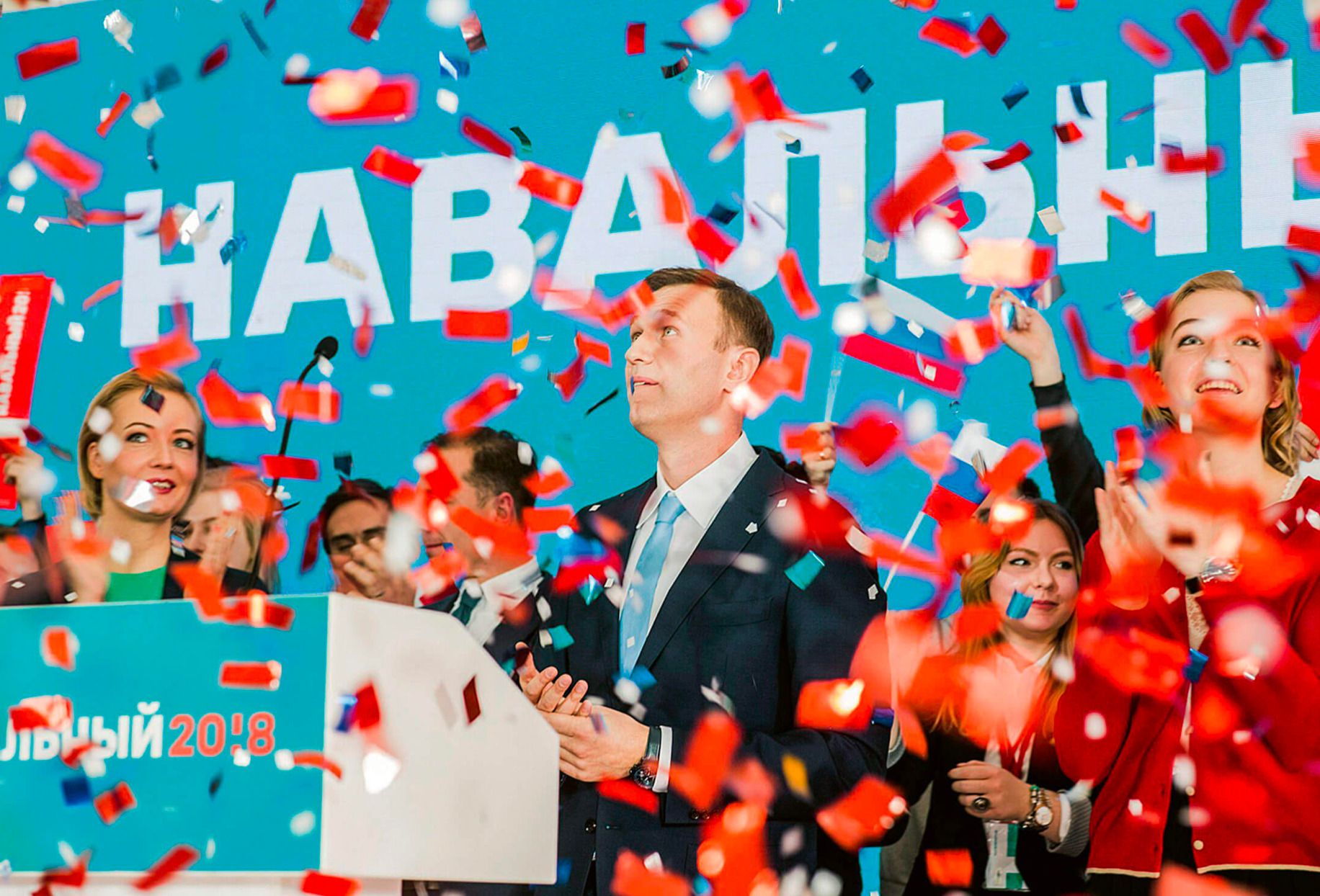
Alexei being nominated as a presidential candidate at a meeting in Serebryany Bor, 2017. Photo: Evgeny Feldman
With Navalny, a generation entered public life whose lives improved year by year in the 2000s, who wanted this forward movement to continue. Navalny’s supporters were not seeking bloody battles or distant ideals. The desire was simply to make the inherited family home a bit more comfortable, to live without quarrels and shouting, without a blaring television, maybe even without a carpet on the wall. And suddenly, while discussing renovation plans, a crazed parent douses the inherited home with gasoline and burns it down in the name of “stability and order.” In the flames of the 2020s, we have begun to forget that the promised land was not so distant or exotic just 10–15 years ago as it may seem now. Today, on the second anniversary of Navalny’s death, it’s already hard to recall what present he spoke for.
I write this text without the ability to sign it with my name. The right to speak under one’s own name has been taken from those who live in or visit Russia. He spoke for us. And he paid the price.
It is astonishing, but even the most intellectually sensitive people often find themselves at a complete loss when faced with his last and most significant act—returning to Russia on a Pobeda flight in January 2021. As if it’s unclear what was at stake, what was worth risking almost certain death, surrendering oneself into the hands of one’s killers. And yet, it was precisely this step that returned to us a collapsing present—as a sense of solidarity.
Alexei and Yulia returning to Moscow after five months of Alexei's rehabilitation in Germany, January 17, 2021. Photo: Alexei Navalny's Facebook
I remember cursing his decision that day, January 17, 2021. It was a painful feeling of moral hostage-taking: I was terrified of risking the daily life and work I had just managed to establish. But not going out to protest that day would have meant losing myself to my own past and future. Not going out would have meant locking myself in the cage of biological, everyday time—not just a private, but a purely primitive, animal existence. It was this very life that Navalny sacrificed for the sake of a shared present and a shared future. That’s what they tried to tear him away from with poisoning and criminal cases. In response, he stitched his fate forever with Russia’s political future.
The present revealed by Navalny is of a completely different kind than the accelerating, utopian time of modern-era revolutionaries. The age of feverish utopia-builders, prophets of the future, Russian intellectuals of the 1850s–1870s, whose lives burned between the writing desk (where groundbreaking scientific papers, novel manuscripts, and grand social reform projects lay side by side) and political exile, is gone. They saw the twentieth century through their frosty St. Petersburg windows and called it into being with all its breakthroughs and tragedies. But that century has ended, died with the Soviet Union, and its stench poisons today. Now, in Russia, the US, and China, three very un-Tolstoyan old men are slamming windows and barricading doors so that the spirit of the twentieth century does not dissipate. They want the present to stop advancing in the human sense, to exist only as technological progress.
The historical time that was buried under frozen earth in the Borisov Cemetery is of another nature. To understand it, one should read Navalny’s book “Patriot,” published six months after his death. However, for those who understood Navalny in life, it will say little new. The feeling one gets while reading it is similar to that of reading Tolstoy’s late essays—you’re amused by the rhetorical moves, but you already know every thought the author will express. The author’s personality, the whole course of his thoughts, is so familiar that nothing is surprising. You simply rejoice, as when meeting a close friend—he’s still the same, still true to himself. It’s no coincidence I mentioned the Russian classic twice. According to Kira Yarmysh, Tolstoy was perhaps Navalny’s favorite Russian writer. In 2022, he quoted him twice (the novel “Resurrection” and the 1904 diary) in his final speeches at court. I don’t know if Navalny read “The Path of Life,” Tolstoy’s last and posthumously published work, but he ends his own last and posthumous book “Patriot” with a distinctly Tolstoyan thought:
“Do you believe in the immortality of the soul and other cool things?
If the honest answer is ‘yes,’ then what’s there to worry about? Why keep mumbling to yourself a hundred times, reading a thick book lying in your nightstand: ‘Do not worry about tomorrow, for tomorrow will worry about itself’?“
What is my task? To seek the Kingdom of God and His righteousness, and everything else will be taken care of by old man Jesus and his relatives.“
Tolstoy in “The Path of Life” puts it this way:
“They say: a person is not free, because everything he does has its own cause, preceding it in time. But a person always acts only in the present, and the present is outside of time—it is only the point of contact between the past and the future. And so, in the instant of the present, a person is always free.”
The present affirmed by Navalny is a space of absolute freedom of choice. Previously, such moral force, if it entered politics at all, mostly came from outside: Tolstoy could invest his literary authority in public activity and openly challenge the state. Later, with this example before them, Solzhenitsyn and other dissidents, usually from literary or scientific (like Sakharov) backgrounds, entered open and mortal struggle with the regime. A rare exception was Anatoly Marchenko, whom Navalny himself often mentioned.
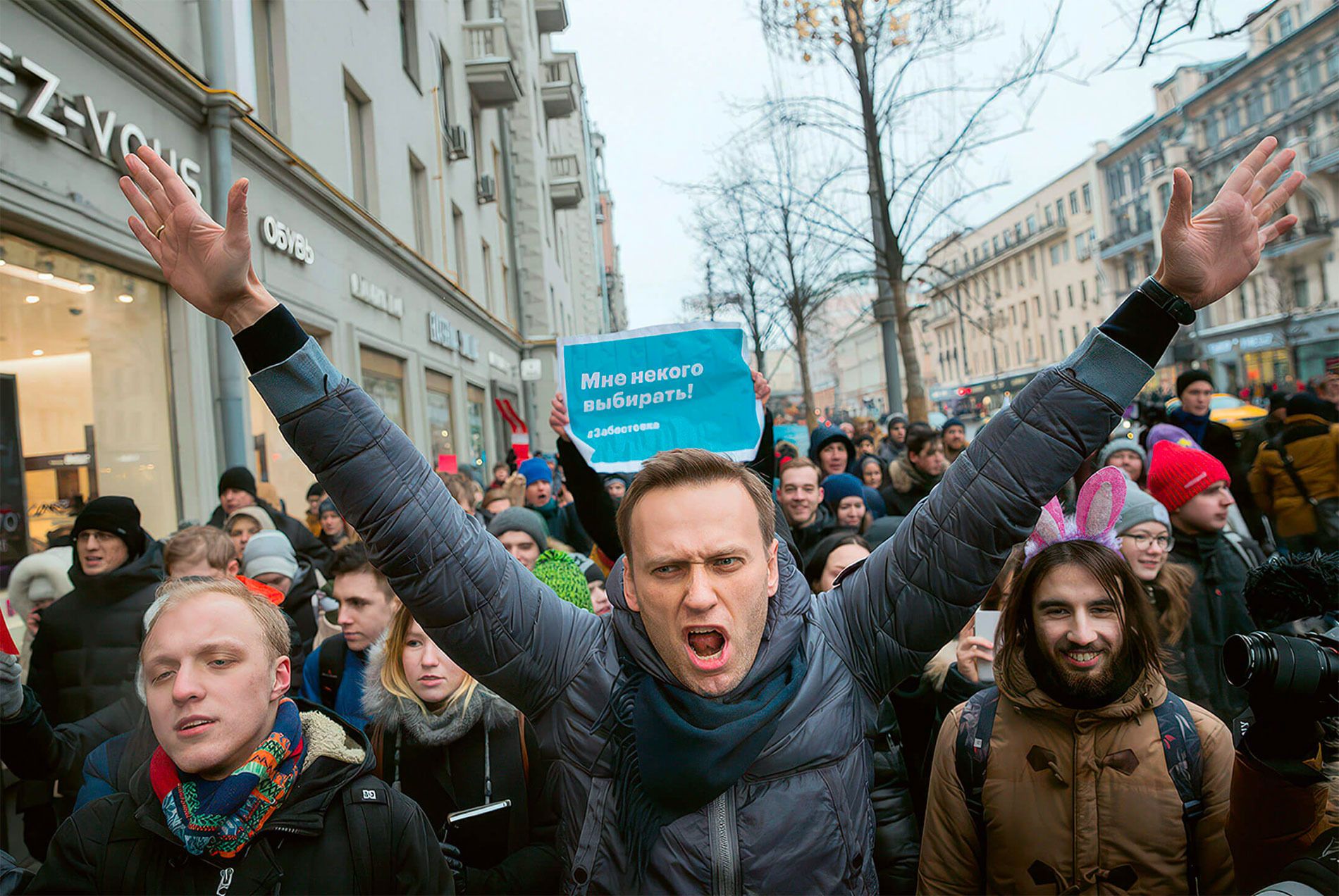
Alexei at the “Voters’ Strike” rally after being barred from the presidential election, 2018. Photo: Evgeny Feldman
In Russia, politics has always drawn its moral resources from literature. Navalny turned this relationship upside down. He was a politician and only a politician. Strictly speaking, he was the first republican politician in all of Russian history. Not a theorist, but a doer. To create the largest political structure (the existing parliamentary “parties” don’t really fit this definition), to involve tens and hundreds of thousands of people in activity, to achieve results in elections under conditions of total force, fraud, and exclusion—all of this was possible openly, without collusion with the authorities, and solely through the power of persuasion. This was unheard of in Russian history—and, frighteningly, it was heading straight toward popular sovereignty. For those who hold the apparatus of violence, accepting such a direction was impossible.
When a dictatorship destroys any space for political action, what remains? Only the moral, or if you will, religious perspective of choice. And that is always a choice in relation to death. It was under such conditions that Navalny made his gesture, overturning the logic of violence imposed on the country.
Navalny’s act is unprecedented in our history: have political leaders ever given themselves into the hands of executioners to affirm law and dignity in the face of brute force?
The plot of Christian literature, from the first Gospels to Harry Potter, became a real political scenario. The only possible one for someone who created the myth of the Beautiful Russia of the Future. I don’t know whether this act was motivated by Navalny’s own moral need or was a ruthless political calculation toward himself. But in the context of total purges, there was no stronger move against dictatorship than transferring the very confrontation into the absolute realm of myth.
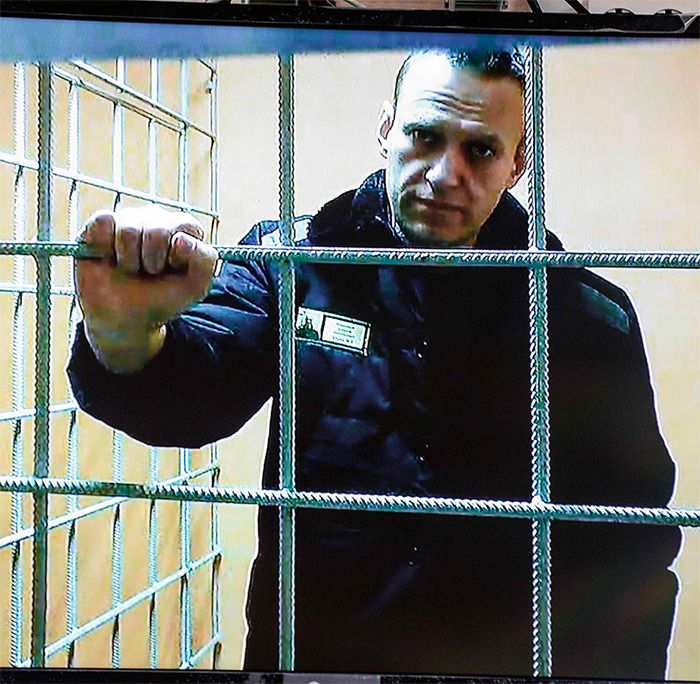
Alexei via video link from the colony during court, 2022. Photo: Denis Kaminev / AP / East News
We know that in the last months of his life, the Bible became his main reading. He had memorized the Sermon on the Mount in three languages. His political fate unfolded not by the laws of history, but by the laws of Christian revelation, which he himself chose and affirmed. In his characteristic manner—without pathos, with an unchanging smile and irony in every word. That’s how the book “Patriot” is written. This book frees you from the spell of history. It tells of correction and normalization, of how a half-educated guy from the 1990s, who cheated teachers and bought exams with bribes, grows up, frees himself from the influence of those around him, from the illusions of top-down democratic reforms, finds his love and himself in a passionate search for truth—not abstract, but concrete, legal, moral, and political. Always personal.
In the Beautiful Russia of the Future, there is no great dream or utopia. Simple things lie on the surface, like the first 64 articles of the Constitution. Like truth and lies, like good and evil. Always at hand. There’s no need to invent new words and ideas, though we will constantly have to work to make the old words come alive and work again. No need to invent legal innovations, though defending old principles will require considerable ingenuity. For the Russia opened by Navalny, there’s no need for a guillotine—only people who are aware of their human dignity. But the anthropology of tyranny, which assumes only instincts of fear and greed in everyone, cannot ensure stable control over any social structure more complex than a concentration camp. However, Navalny’s example showed that even a colony beyond the Arctic Circle can become a beacon of freedom and human dignity.
“For we are saved by hope. But hope that is seen is not hope: for what a man seeth, why doth he yet hope for?” (Apostle Paul. Romans 8:24).
If you enjoyed this article, consider making a donation — one-time or, even better, monthly. Your support helps us motivate our authors and become better with every article.
Our organization is recognized by the Internal Revenue Service (IRS) as a 501(c)(3) tax-exempt, charitable organization, which means that all contributions made to us are tax-deductible to the fullest extent permitted by U.S. law. Individuals may generally deduct charitable contributions of up to 60% of their Adjusted Gross Income (AGI) for cash donations made to qualifying 501(c)(3) organizations. For donations of appreciated assets (such as stocks or other long-term capital assets), the deduction is typically limited to 30% of AGI, based on the fair market value of the asset. C-corporations may deduct charitable contributions of up to 10% of their taxable income for donations made to eligible charitable organizations.
By submitting a donation, you confirm that you have read and accept the following documents: Privacy Policy and User Agreement, and also give consent to the processing of your personal data.
If you would like to unsubscribe from a monthly donation, please email us at: [email protected]