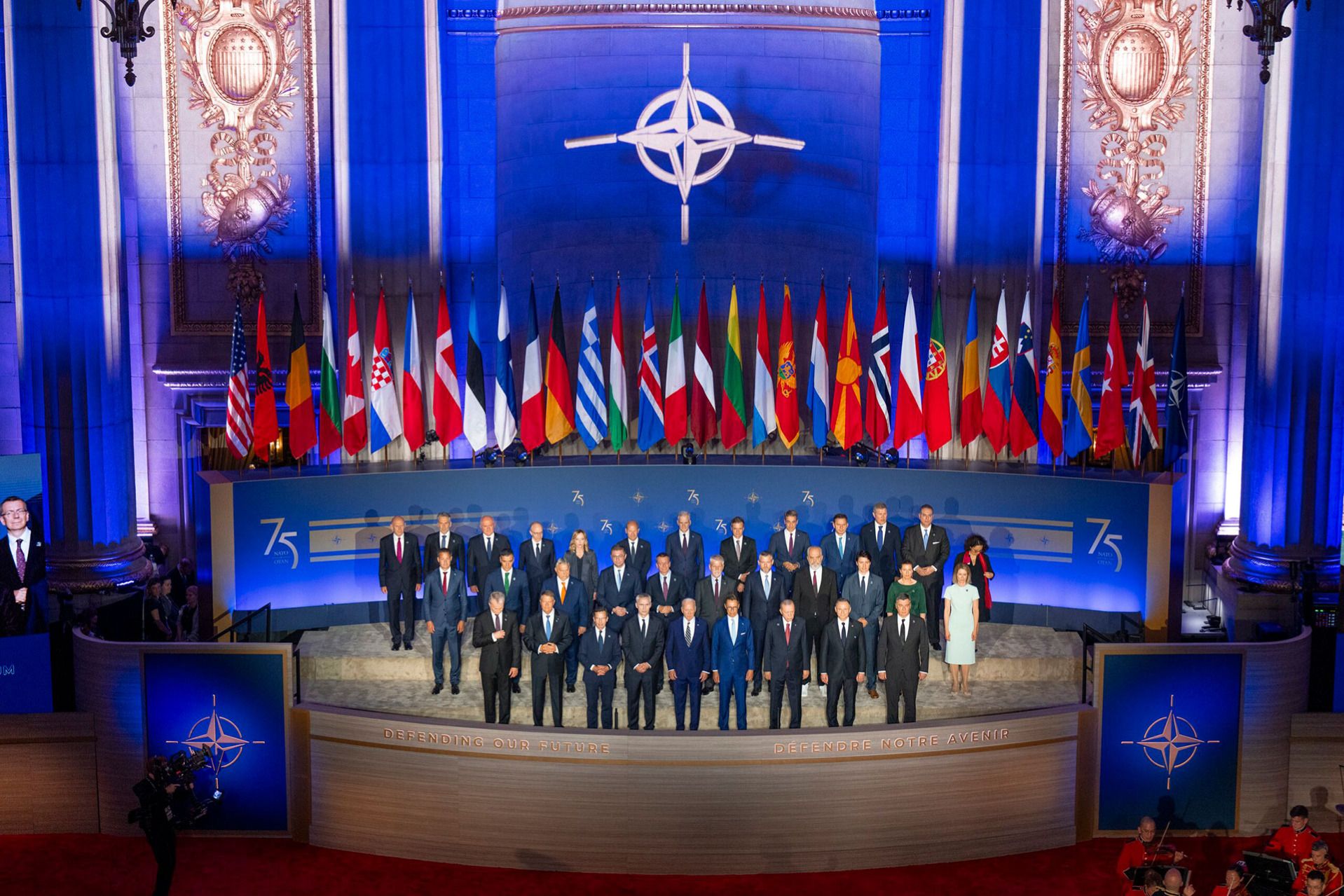
Recently, Republican Senator from Utah Mike Lee introduced a bill to withdraw the USA from NATO, calling it the “Unreliable Organization Act.” This came immediately after the two-day Alliance summit in The Hague. Mike Lee stated that “NATO has fulfilled its role” and accused the European members of the organization of “making American taxpayers pay their bills for decades.”
The defense spending issue raised by the Utah legislator is not new. Even during his first presidential term, Donald Trump demanded allies increase defense spending and expressed doubts about the viability of NATO. Meanwhile, prominent European politicians at that time also called for breaking ties with the American president.
Thus, early in Trump’s first term, British parliamentarians stated that the new American president would not be allowed to speak in Parliament during his visit to the UK, as such a speech is “not an automatic right but an honor that must be earned.” The leading German newspaper “Spiegel” expressed itself even more harshly, writing that “the President of the United States is becoming a danger to the whole world,” and therefore for Germany and Europe “it is time to prepare their political and economic defenses against the dangerous American president.”
Amid this discord, rumors emerged at that time that America might leave NATO. Congress, in turn, took steps to protect Alliance membership from unilateral presidential actions. In 2019, the House of Representatives passed a law prohibiting Trump from pursuing US withdrawal from NATO without approval from both houses of Congress. In December 2023, lawmakers reaffirmed the bipartisan procedure as part of the annual defense policy act, requiring the president to obtain Senate approval or Congressional legislation before withdrawing the US from NATO.
The likelihood that such a bill will be approved and the US will leave NATO amid growing global threats is quite low. NATO has many supporters even among Republicans, and Donald Trump himself recently asserted that the US is “fully committed” to Article 5 of the North Atlantic Treaty on collective defense. However, such discussions repeatedly raise the topic of Europe's need to build up its own defense capabilities without overly relying on the US.
Seven years ago, according to Polish Radio reports, the defense ministers of France, Germany, Belgium, the Netherlands, Denmark, the UK, Spain, Portugal, and Estonia signed a declaration to create the European Defense Initiative — a coalition of European countries whose troops would be ready to respond quickly and conduct military operations worldwide if necessary.
At that time, Russian media began spreading information that “the EU decided to create a military alliance to counter Trump,” led by France and Germany. Judging by the tone used by Russian propagandists in covering this news, they seemed to be satisfied with the creation of such a structure at that time.
On one hand, the Kremlin believed that defense alliances without US participation would be weaker anyway, and on the other, hoped that a new organization independent from America and free from the “Cold War legacy” could quite possibly get closer to Moscow. The calculation was this: the greater the rift between the US and Europe, the higher the likelihood of such rapprochement. In 2018, this topic was especially emphasized before the Putin-Trump meeting in Helsinki.
However, the situation has changed significantly now. Today, the main enemy in Moscow’s eyes is not even the US, but Europe itself, and leading pro-Kremlin analysts openly express their concerns about its rearmament. Meanwhile, this rearmament has indeed already begun. With or without NATO, in March this year the leaders of the European Union countries at an emergency summit in Brussels increased spending on military needs, in line with the European Commission’s plan to rearm Europe. This plan includes mobilizing an additional 800 billion euros and investing in Ukraine’s military-industrial complex.
Whereas Trump’s earlier demands for Europeans to increase defense spending were mostly met with negative reactions, now some European politicians support them. In particular, EU foreign policy chief Kaja Kallasstated that Trump is right to reproach Europe for spending too little on defense. She called on Europeans to “wake up” and emphasized the need to increase investments from EU member states, the private sector, and the EU budget. The Prime Minister of Poland, which currently holds the EU Council presidency, Donald Tusk, speaking at the European Parliament in Strasbourg, also said: “If Europe wants to survive, it must arm itself.”
Right now, Donald Trump demands NATO allies spend at least 5% of GDP on defense. Independent analysts claim that achieving such rates is impossible even for wealthy countries, meaning the American president and his circle still have a reason to threaten US withdrawal from NATO on the grounds that other Alliance members “are not fulfilling their obligations.”
However, it is clear that amid the ongoing full-scale war with Ukraine and growing threats to the Baltic countries and Poland, Europe will still strengthen its military potential as much as possible. In this case, even a hypothetical NATO split will no longer be a panacea for the Kremlin, and the threat of such a split will only encourage Europe to seriously engage in its own defense capabilities.
Illustration – group photo of NATO country leaders at the summit marking the 75th anniversary of the Alliance’s founding in Washington, 2024. In the front row, center – Joe Biden. Source: White House / Wikipedia
If you enjoyed this article, consider making a donation — one-time or, even better, monthly. Your support helps us motivate our authors and become better with every article.
Our organization is recognized by the Internal Revenue Service (IRS) as a 501(c)(3) tax-exempt, charitable organization, which means that all contributions made to us are tax-deductible to the fullest extent permitted by U.S. law. Individuals may generally deduct charitable contributions of up to 60% of their Adjusted Gross Income (AGI) for cash donations made to qualifying 501(c)(3) organizations. For donations of appreciated assets (such as stocks or other long-term capital assets), the deduction is typically limited to 30% of AGI, based on the fair market value of the asset. C-corporations may deduct charitable contributions of up to 10% of their taxable income for donations made to eligible charitable organizations.
By submitting a donation, you confirm that you have read and accept the following documents: Privacy Policy and User Agreement, and also give consent to the processing of your personal data.
If you would like to unsubscribe from a monthly donation, please email us at: [email protected]