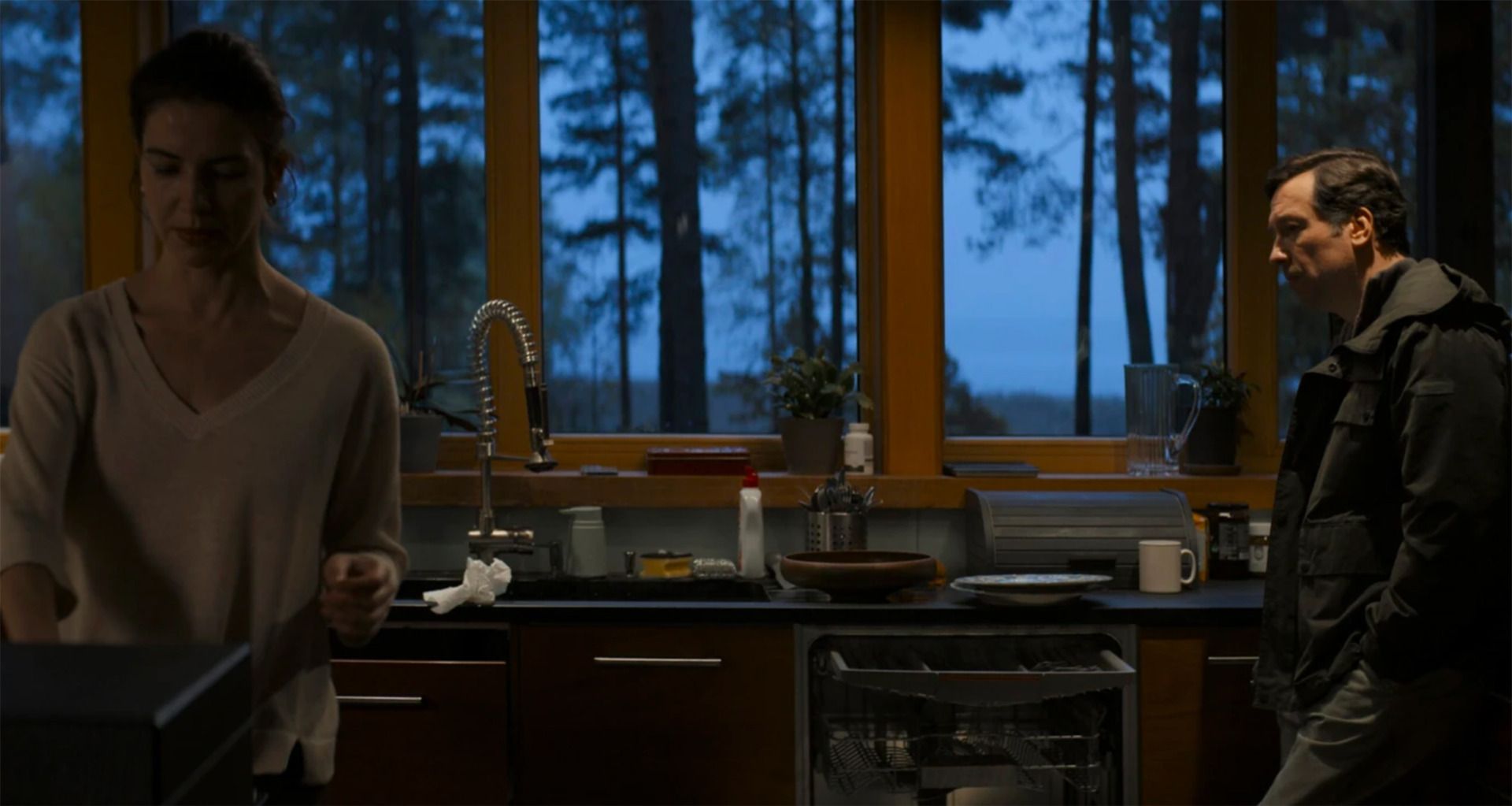
A gorgeous golden autumn somewhere in central Russia. September 2022. The war started six months ago, mobilization is underway, and people are confused. Those who are quicker, who have the means and the foresight, have already formed huge lines at Verkhny Lars. Meanwhile, in a luxurious villa on the lakeshore, a prosperous family lives — a successful entrepreneur, his beautiful wife, and their teenage son. The villa is beautiful and wealthy, but depressingly dull. Aside from the beauty of nature, everything here is boring. And despite the tender kisses of the characters, the air is poisoned by a lack of love. That distinct Russian lovelessness, which Zvyagintsev explored in his previous film and knows so well.
Andrey Zvyagintsev and Dmitry Mazurov (right) right after the screening of “Minotaur” at the 79th Cannes Film Festival. Still from video: SAMEER AL-DOUMY / AFP
The war instantly disrupted the peaceful life of Gleb (Dmitry Mazurov), interfering with his business — European borders are closed, Western partners are dropping out one by one. In Gleb’s office, employees watch videos about the queues at Verkhny Lars, while Gleb and his assistant Natasha (Varvara Shmykova) brainstorm what to do when employees start leaving en masse. The city mayor gathers a meeting of local businessmen to assign a task — an order has come down that all major companies must supply Moscow with cannon fodder. The larger companies must send the military office data on 25 employees who will be instantly mobilized, the smaller ones — 14 each.
The ancient Greek mythological Minotaur, a monster with the head of a bull and the body of a man, also demanded a sacrifice of 14 victims every nine years. The Minotaur is eternally alive. Gleb cannot afford to sacrifice 14 employees from his already rapidly shrinking company, and he makes a shockingly cynical decision that will save the company, but at the expense of other unsuspecting people.
The hardest part is the beginning. At the same time, Gleb begins to realize that his wife is cheating on him. The plot then takes a turn that could be mistaken for a detective story, but it is not. Zvyagintsev isn’t interested in detective stories — he’s more interested in dissecting the human soul, finding clots of darkness, and bringing them to the screen. Gleb is not going to suffer or reflect — he simply follows the well-known maxim, “no man — no problem.” He is a tank, crushing obstacles in his path. It’s no coincidence that after the terrible act that sweeps away his problems, we watch a freight train carrying tanks to the Ukrainian border for a long time. Steel knows neither doubt, nor reflection, nor love.
Dmitry Mazurov, previously known only for supporting roles in TV series, here with remarkable outward calm literally gives the viewer chills, conveying rapid burnout, shock, and unshakable confidence that love and peace can be achieved by force with minimal acting means. Before our eyes, his Gleb turns from an unflappable, prosperous businessman into a monster, yet without changing his calm and confident expression.
Cinematographer Mikhail Krichman, a longtime collaborator of Zvyagintsev, creates an absolutely sterile space, seemingly full of air, but it’s thin and poisoned — everyone here struggles to breathe, even the teenage son. It’s always quiet here, but it’s not a peaceful silence — it hides endless anxiety, mixed with fear and discontent, scattered with small details that unmistakably signal the time and place. “F... the war!” is written on the wall. A billboard on the highway with the portrait of a fallen hero — one of that terrible quota handed down from above. Tanks. Verkhny Lars. Only one scene is filled with cries and tears — the farewell to the front of a young man, where a mother, who had previously held herself with humble dignity, begins to sob desperately, trying to run after the bus taking her son to his death. There is another scene — wife Galina (Iris Lebedeva) in her luxurious villa yells at her family: “Again this Margherita pizza! Order something else for once! I can’t stand it!” Tragedy and “tragedy” unfolding in two separate societies that neither know nor understand each other.
Still from Andrey Zvyagintsev’s film “Minotaur” (2026)
The final title card states that the film is based on Claude Chabrol’s “The Unfaithful Wife,” released in 1969. The key elements seem the same — a jealous husband, a disappointed wife, the difficulties of disposing of a corpse — but that’s just the skeleton onto which Zvyagintsev has built uniquely Russian flesh and muscle. Especially well done is the scene where two police officers investigating the crime are ordered to drop the case — they got a call “from above.” “So what do we do now? — Nothing at all. Let’s go have lunch.” The audience, 90 percent of whom are foreigners, suddenly bursts out laughing. But for us, it’s not funny.
One small episode — a dinner in an expensive restaurant with Gleb and Galina and their friends (with Anatoly Bely and Artur Smolyaninov in roles important for understanding the atmosphere in Russian society) — and we see two typical attitudes of the so-called elite to what’s happening. “This isn’t my war. I’ll go to Thailand, wait it out until things settle down,” says Smolyaninov’s character. “Come on — what about defending the homeland?” Bely’s character retorts with a cynical chuckle. For both, the war is just an inconvenient, unexpected backdrop to their settled lives, and they prefer not to notice the tanks and billboards with the portraits of the dead.
The collapse of what was recently called the elite, Zvyagintsev shows mercilessly and concisely, but at the same time he manages not to lapse into moralizing, which he was somewhat guilty of in “Loveless.” Moreover, he even hints that the cynical characters are victims in their own way. It’s no coincidence that in the final scene we see Gleb, Galina, and their son Seryozha (Boris Kudrin) on a plane flying to Crete — as is known, the birthplace and home of the Minotaur. Three more victims of the monster, though they don’t know it yet. And under the plane’s wing are such beautiful clouds, but for some reason they look more like smoke from fires.
What the jury will decide — we cannot predict, the decisions of the judges here rarely coincide with the opinions of the press and festival guests. But that “Minotaur” is the main favorite of Cannes 2026 as of today is absolutely obvious, judging by the reactions of the international press and conversations at the festival.
If you enjoyed this article, consider making a donation — one-time or, even better, monthly. Your support helps us motivate our authors and become better with every article.
Our organization is recognized by the Internal Revenue Service (IRS) as a 501(c)(3) tax-exempt, charitable organization, which means that all contributions made to us are tax-deductible to the fullest extent permitted by U.S. law. Individuals may generally deduct charitable contributions of up to 60% of their Adjusted Gross Income (AGI) for cash donations made to qualifying 501(c)(3) organizations. For donations of appreciated assets (such as stocks or other long-term capital assets), the deduction is typically limited to 30% of AGI, based on the fair market value of the asset. C-corporations may deduct charitable contributions of up to 10% of their taxable income for donations made to eligible charitable organizations.
By submitting a donation, you confirm that you have read and accept the following documents: Privacy Policy and User Agreement, and also give consent to the processing of your personal data.
If you would like to unsubscribe from a monthly donation, please email us at: [email protected]