Ukraine — despite all the difficulties and the undeniable overall war fatigue — does not at all look like a side on the brink of collapse that must agree to peace at any cost.
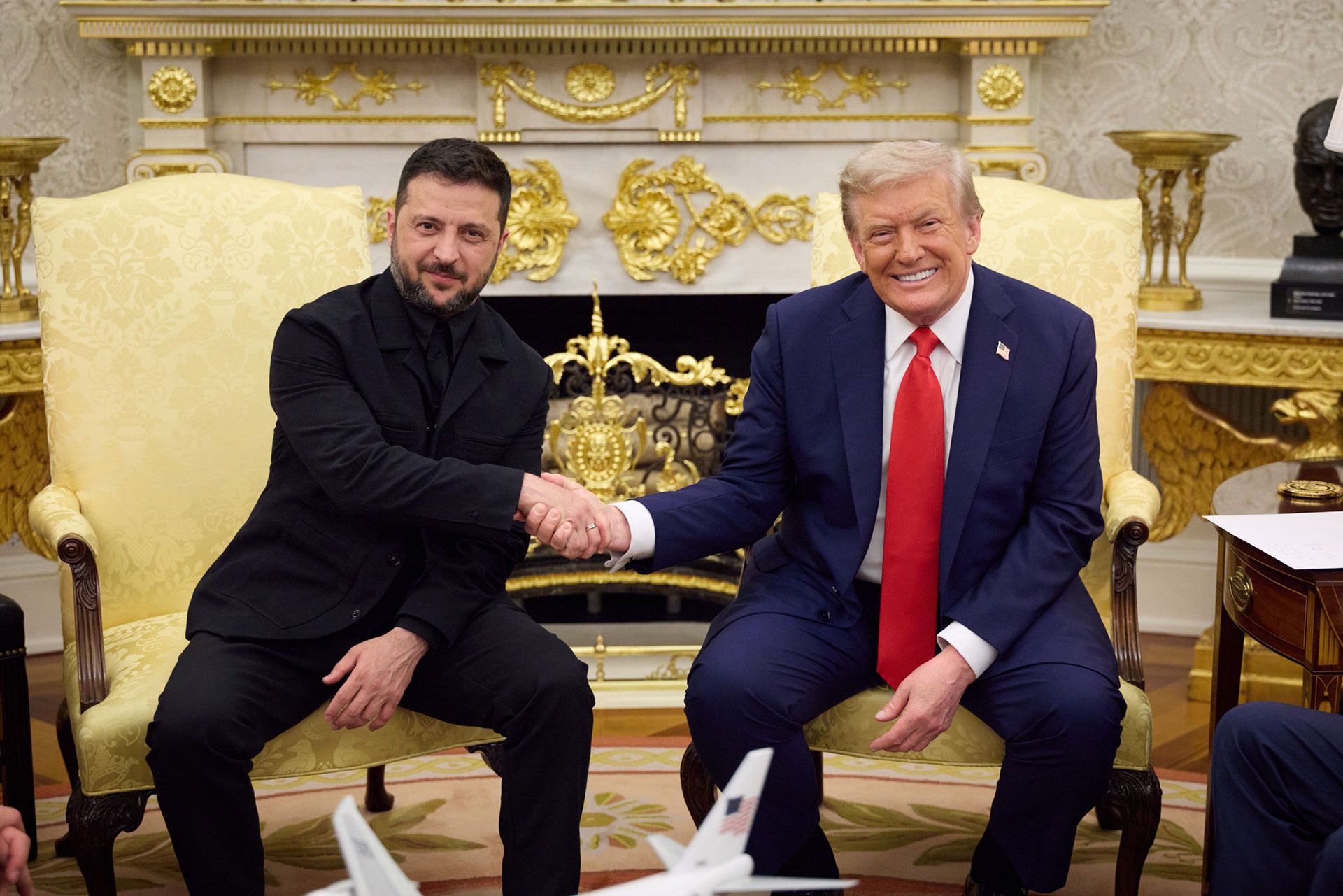
Volodymyr Zelensky and Donald Trump, August 18, 2025. Photo: Office of the President of Ukraine
“I think he wants to make a deal, you know? As crazy as that sounds,” — a accidentally turned-on microphone luckily caught a remark by Donald Trump addressed to French President Emmanuel Macron. “He” is the one who was not physically present at the White House on August 18, but whose phantom was surely felt by everyone gathered:, who had just met with the American leader a few days earlier on the other side of the United States.
As can be seen, Trump continues to hope for the Russian counterpart’s desire to conclude the infamous peace deal. At the same time, the US leader understands that for others this belief looks like madness. It seems that the tired jokes about a gullible American retiree deceived by a scammer from Leningrad are more fitting here than ever.
However, yesterday something new emerged in this narrative. Trump made it clear that he does not intend to “make a deal” on behalf of Putin — the latter must take this step himself, face to face with his Ukrainian counterpart. However, according to the US president’s apt assessment, for now this sounds more like madness.
In a suit and with cards
The August meeting between Donald Trump and Volodymyr Zelensky was, in a way, destined for success. It could hardly have gone worse than the memorable conversation between the two politicians at the White House six months ago — the one with the quarrel about etiquette rules and dress code in the Oval Office, along with the now-meme “Ukraine has no cards.”
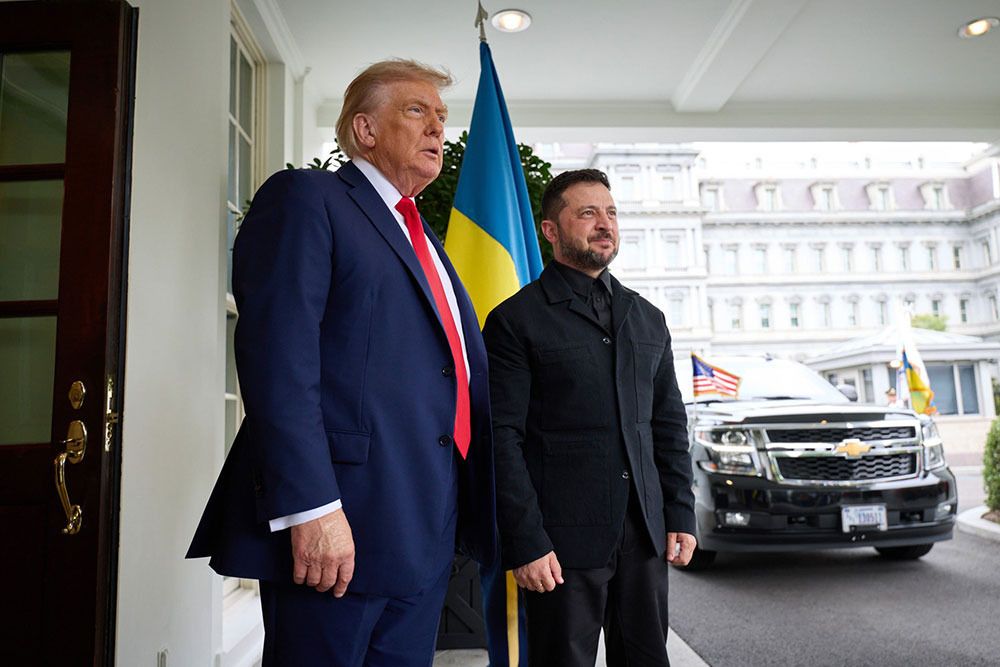
Donald Trump and Volodymyr Zelensky, August 18, 2025. Photo: Office of the President of Ukraine
Over the past six months, Zelensky has worked on his mistakes. Now the Ukrainian president appeared before Trump in a strict black suit. It is worth noting: journalist Brian Glenn, who had previously criticized the guest for his “disrespectful” military style back in February, personally praised his new look. The American, who the Russian colleagues encouraged with a whole bottle of vodka the day before in Alaska, apologized to Zelensky and emphasized that he “looks great.” The Ukrainian accepted the apology and even joked (“But you’re in the same suit. See: I changed, but you didn’t”).
Of course, more important for Zelensky was to show that he has not only a suit but also “cards.”
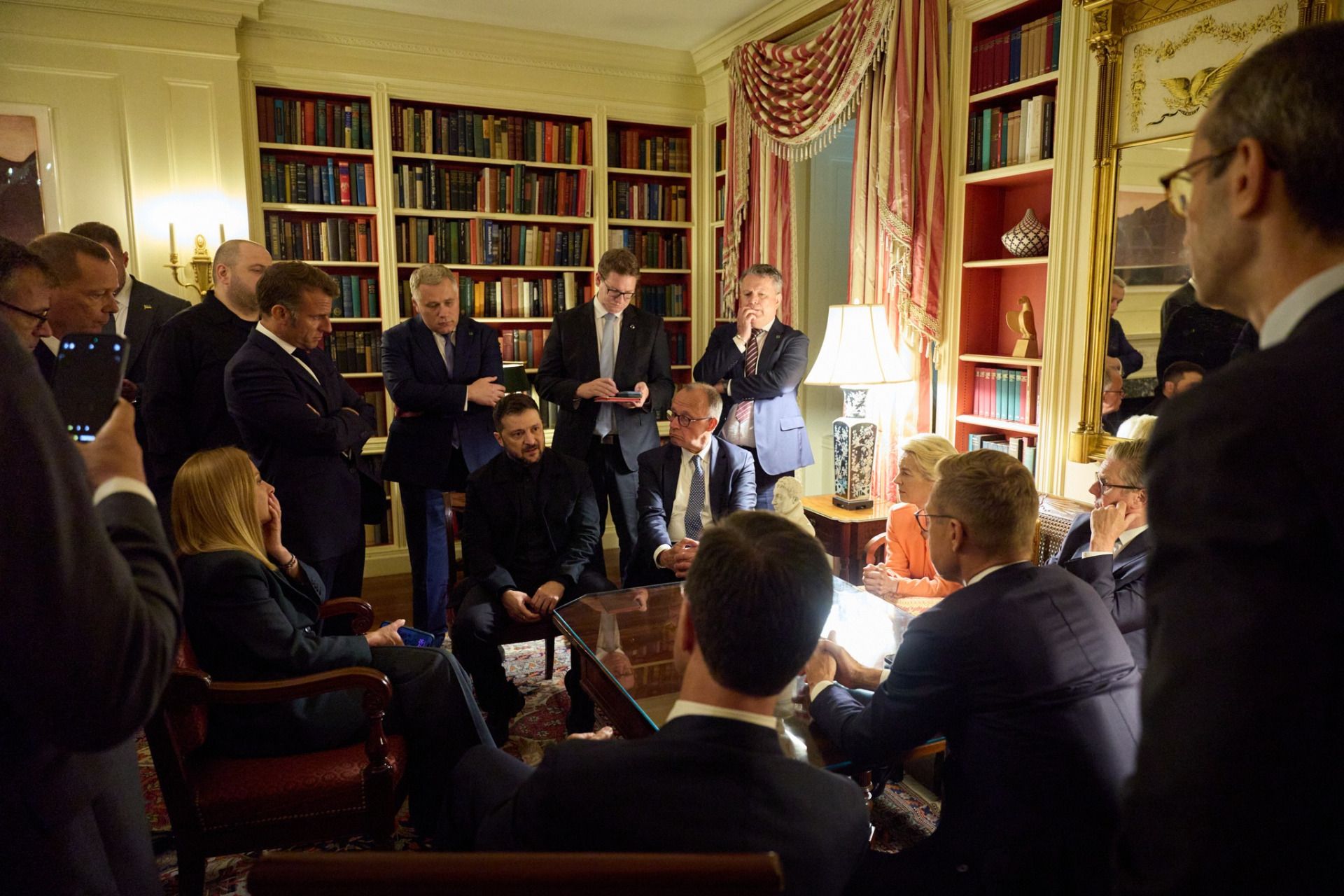
Firstly, a number of European leaders came to Washington with the Ukrainian — a clear demonstration that the EU and the UK have no intention of abandoning their ally. The delegation included German Chancellor Friedrich Merz, Finnish President Alexander Stubb, and Italian Prime Minister Giorgia Meloni: in short, those Old World politicians known for their good relations with Trump.
Left to right: European Commission Chair Ursula von der Leyen, UK Prime Minister Keir Starmer, NATO Secretary General Mark Rutte, President of Ukraine Volodymyr Zelensky, US President Donald Trump, French President Emmanuel Macron, Italian Prime Minister Giorgia Meloni, German Chancellor Friedrich Merz, and Finnish President Alexander Stubb. Washington, August 18, 2025. Photo: Office of the President of Ukraine
Secondly, the Ukrainian leader vigorously demonstrated that his country is not a side fighting on credit with foreign weapons but a potential global supplier of military equipment. Zelensky publicly stated that after the export opening, the US would begin buying combat drones assembled in Ukraine. It is no coincidence that the Ukrainian Armed Forces timed the tests of the “Flamingo” cruise missile with the Washington meeting — theoretically capable of hitting targets across the entire European part of Russia (in Russia itself, pro-government media hastened to assure that the “Flamingo” has “snail’s speed” and can easily be handled by domestic air defense).
Thirdly, the course of the fighting this past summer looks more like a Ukrainian “card.” Despite the concerns of Western analysts last spring, the Ukrainian Armed Forces are managing, albeit barely, the shortage of both ammunition and manpower. The Ukrainian front still holds. Even the recent breakthrough by Russian forces near Dobropillia (a real Brusilov-style offensive by the standards of this war) was eventually stopped by defenders without catastrophic consequences for the key point of their defense in Donbas, Pokrovsk.
In other words, Ukraine — despite all difficulties and undeniable overall war fatigue — does not look like a side on the brink of collapse that must agree to peace at any cost. The meeting on August 18 showed that Trump, if not enthusiastic about Ukraine’s “cards,” at least acknowledges their existence.
Want Donbas? How about Florida?
But what does the American president want from an evidently disliked and largely imposed partner in the form of Ukraine? Six months ago, Trump (among other things) reproached Zelensky for allegedly unwillingness to cease fire, and now everything has turned upside down.
By late summer, the 47th US president no longer considers a ceasefire a priority. Now his logic is reversed: since the warring sides do not want to first stop fighting to sign a peace agreement, let them make a deal and then cease hostilities. Of course, there is little more sense in this “rethinking” than in rearranging the quartet of animals from Krylov’s fable. Trump himself explained the shift in priorities like this:
“I don’t think you need a ceasefire. I know it would be good. I like the idea of a ceasefire for one reason: you immediately stop killing people. But we can make a peace deal while they fight. Strategically, this [ceasefire] might not be good for one side.”
There can hardly be any doubt which of the two warring sides is meant here. Let’s say it out loud for the president: it is the Russian Federation, or more specifically, its political leadership. Judging by Kremlin actions and statements, they consider their army and rear as something like a bicycle that can only keep balance while moving — moving through the ruins of Ukrainian cities and their own countless corpses. However, neither the first nor the second concerns Moscow, but any ceasefire without pre-agreed bonuses is seen as a risk — it would look like a military defeat for the Russian Armed Forces with all the consequences.
The Americans apparently sense this Kremlin fear and want to help their Russian counterparts. The logic is clear: let them get at least something tangible and not yet completely destroyed (for example, the Sloviansk-Kramatorsk agglomeration) to sell to the pro-war public in Russia as a victory. The Russians will get a “prize,” calm down, and stop the war. Europe, of course, dislikes this line of thought; Chancellor Merz said directly on the matter:
“Russia’s demand that Ukraine withdraw troops from Donbas can be compared to demanding the US give up, say, Florida.”
But in Zelensky’s office, apparently, they resign themselves to the prospect of the inevitable. Even before the Washington summit, the Ukrainian president silently acknowledged the impossibility of restoring his country’s constitutional borders. At the meeting itself, if the WSJ leaks are to be believed, he did not outright deny Trump’s idea of land swapping — “exchanging territories” with Russia. Most likely, Kyiv is inclined to share its lands with the enemy in exchange for still unclear security guarantees from the West — no other way out is currently visible for Ukrainians.
The killer isn’t in this room
One could already write a lengthy academic article about how, when, and why Trump’s approaches to resolving the conflict in Ukraine have changed. Over the past seven months, the White House occupant has clearly grown tired of these attempts. He no longer wants to play first fiddle here, and the obvious dream of the US president is simply to seat Putin and Zelensky in the same room, and then they’ll work something out.
By the way, the Ukrainian leader at this stage of negotiations again showed he has mastered the unspoken rules of communication with Trump. No “no” and direct objections, always say “yes,” and be happy with any POTUS ideas as if they were your own. A personal meeting with Putin? Great, he himself has proposed it many times! That’s when we’ll personally discuss who should give up which territories. European leaders approved Zelensky’s line of thinking. Friedrich Merz went the furthest, cynically suggesting that the Russian head might not have the courage for a rendezvous with his namesake from Kyiv.
Volodymyr Zelensky with leaders of EU countries and the UK. White House, August 18, 2025. Photo: Office of the President of Ukraine
Trump himself immediately informed Putin about the idea of personal talks between the leaders of the two warring states by phone. Only the Russian authorities did not confirm their readiness for such a meeting in response. Putin’s aide Yuri Ushakov’s comment rather suggests that Merz’s taunt is not unfounded: “In this regard, in particular, the idea was discussed that it would be necessary to explore the possibility of raising the level of representatives of the Ukrainian and Russian sides, that is, those representatives who participate in the mentioned direct negotiations.”
Meanwhile, the demonstrative agreement and emphasized gratitude to Trump from the guests became the leitmotif of the entire summit in Washington. Zelensky alone said “thank you” to the White House host at least 16 times in his opening remarks. The EU and UK leaders behaved similarly. From the outside, it resembled a parody of the opening of a classic British detective like Agatha Christie’s “The Blackbirds” — unfriendly brothers gather around the long-hated patriarch of their family and diligently pretend respect and love before him.
True, the genre’s law requires the mysterious death of the estate owner, but in this narrative, quite different people are dying. The very day of August 18 in Ukraine began with new airstrikes on Kharkiv, Sumy, and other places, again with casualties among civilians of various ages. On the night of August 19, the country was again hit by missile attacks and swarms of Russian drones — all just days after the red carpet, handshake, and Melania Trump’s letter to Putin asking not to kill children.
If you enjoyed this article, consider making a donation — one-time or, even better, monthly. Your support helps us motivate our authors and become better with every article.
Our organization is recognized by the Internal Revenue Service (IRS) as a 501(c)(3) tax-exempt, charitable organization, which means that all contributions made to us are tax-deductible to the fullest extent permitted by U.S. law. Individuals may generally deduct charitable contributions of up to 60% of their Adjusted Gross Income (AGI) for cash donations made to qualifying 501(c)(3) organizations. For donations of appreciated assets (such as stocks or other long-term capital assets), the deduction is typically limited to 30% of AGI, based on the fair market value of the asset. C-corporations may deduct charitable contributions of up to 10% of their taxable income for donations made to eligible charitable organizations.
By submitting a donation, you confirm that you have read and accept the following documents: Privacy Policy and User Agreement, and also give consent to the processing of your personal data.
If you would like to unsubscribe from a monthly donation, please email us at: [email protected]