In the tenth year of Emmanuel Macron’s rule, French society is deeply disappointed in him, and the political system is destabilized. Many voters now see voting for Marine Le Pen and her “National Rally” as the only way to express anger and distrust toward this system.
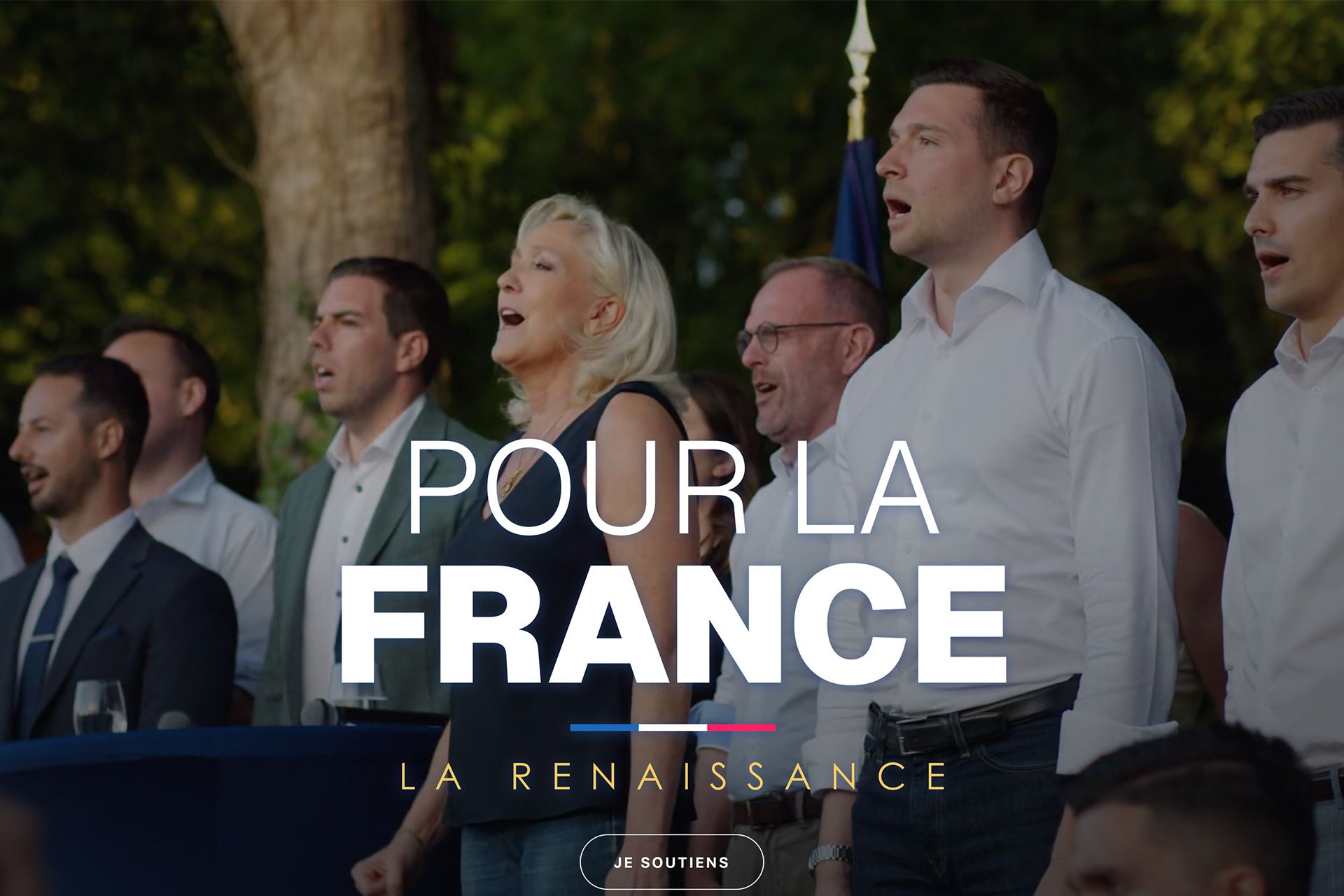
The homepage of Marine Le Pen’s party’s official website
The French presidential election is due to take place in less than a year. Over the past few months, French politicians and the media have talked about nothing but the upcoming presidential race. However, it took until July 7 for the Court of Appeal’s decision in the case involving the assistants of “National Rally” MEPs to finally determine the list of candidates who had taken up positions at the starting line.
“Clean hands and a head held high” — for many years, this was the favorite slogan of the “National Front”, France’s main far-right party. Its founder, Jean-Marie Le Pen, built his image according to the classic populist formula: “better us than corrupt and rotten elites”. In the context of high-profile corruption scandals in the 1990s and 2000s that shook France’s two main political parties — the “Socialist Party” on the left and the “Union for a Popular Movement” on the right — this rhetoric seemed extremely effective.
In 2011, the aging Jean-Marie Le Pen, whose reputation left much to be desired, was sent into retirement and his daughter Marine became head of the “National Front”. Le Pen’s heiress continued her party’s crusade in the best paternal traditions. “Everyone has tarnished their reputation because they deserved it. The UMP (”Union for a Popular Movement“) and the Socialist Party have an incredible list of convictions. My jacket is spotless. Let them fuss all they want — they won’t be able to stain me. Because I have ethics, I have morals, and I follow them. And when I demand ethics and morality from others, I first of all apply those demands to myself. When will we finally learn the lesson and introduce a lifetime ban on standing for election for anyone convicted of crimes committed through their mandate or while carrying out their duties?“ Le Pen said in 2013.
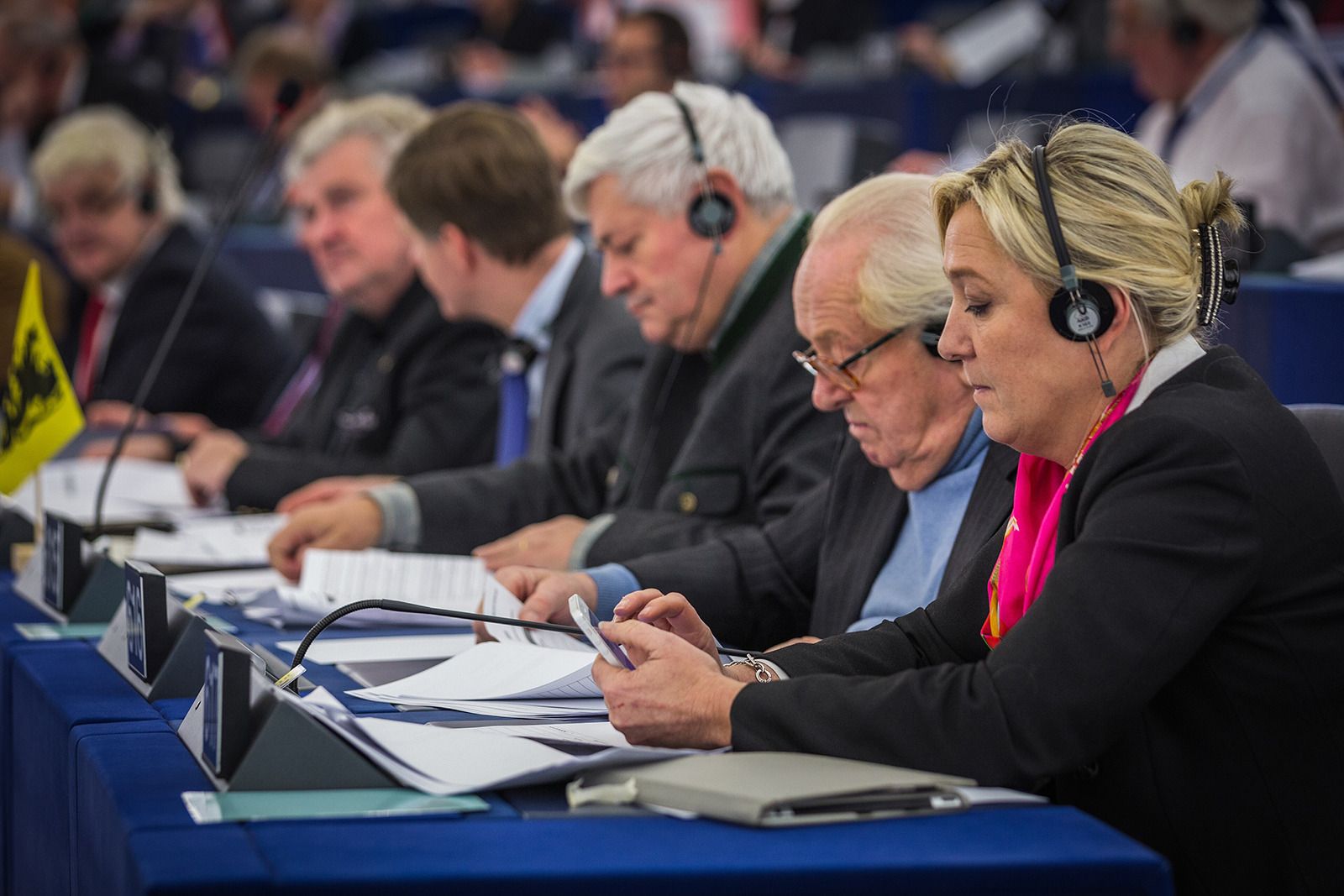
Marine and her father Jean-Marie Le Pen side by side at a European Parliament session, 2013. Photo: Claude Truong-Ngoc / Wikimedia Commons / CC BY-SA-3.0
On July 7, 2026, the appeals court again found Marine Le Pen guilty of embezzling European Parliament funds. Despite the fact that the court verdict was softened compared with the first-instance ruling in March 2025, Le Pen was still sentenced to three years in prison, two of them suspended. Among other things, the court fined her 100,000 euros. But most importantly, the court imposed only forty-five months of ineligibility to run for office, thirty months of which were suspended. Since fifteen months of the unconditional ban on standing for election had already elapsed since her conviction by the first-instance court on March 31, 2025, Marine Le Pen once again has the right to run for elected office.
What remains is the question of one year of actual imprisonment.
A week before the court ruling, on July 1, 2026, Marine Le Pen said: “If the goal is to let me run but actually prevent me from carrying out a completely free election campaign, you understand that that is impossible”. Meanwhile, the court sentenced the politician to one year of actual imprisonment with the possibility of serving it under house arrest, which is a direct obstacle to running a normal presidential campaign. In other words, without full freedom of movement, Marine Le Pen would have to withdraw from the presidential race.
The suspense lasted for several hours — between the announcement of the court’s decision and the evening news on TF1, during which Le Pen was to comment on the sentence and announce her next steps.
After consulting with her allies, lawyers, and her main stand-in Jordan Bardella at the headquarters of the “National Rally”, Le Pen decided to run in the 2027 presidential election after all.
The possibility of appealing to the Court of Cassation, which automatically suspends the appeals court decision until a new ruling — and therefore the year of house arrest — finally strengthened Le Pen’s resolve to enter the presidential race. The legal proceedings will last at least until January 2027, which, despite the risk of a new appeal being dismissed, gives the far-right leader the time needed to run an aggressive campaign.
Now that the most serious and obvious presidential candidates have been determined, French politics faces a short summer pause. But in September, the campaign will resume with renewed force — rallies, alliances and betrayals, and the unveiling of proposals and platforms will return to the front pages. How will the “National Rally” conduct its campaign?
It is obvious that Marine Le Pen’s candidacy has significantly weakened her party’s position. Criticism of “judicial leniency”, demands for harsher punishments, the construction of new prisons, and a more repressive police force, all of which play an important role in the “National Rally’s” program and rhetoric, seem hypocritical when defended by a candidate convicted under criminal law. Not to mention how convenient it will be for the other candidates to attack their rival on the terrain of moral integrity, competence, and transparency.
The difficulties Marine Le Pen will face during the upcoming campaign inevitably raise the following question: could she have acted differently in her place?
After all, since 2022, in view of a possible ban from running in elections, the far-right leader has deliberately cultivated her protégé — young and ambitious.
Jordan Bardella’s triumphant victory in the 2024 European Parliament elections instantly turned Marine Le Pen’s protégé into a potential presidential candidate.
Over the past two years, Jordan and Marine, as their supporters affectionately call them, have diligently worked on their “presidential duo”. She — president, he — prime minister. However, in March 2025, after the first sentence made Le Pen’s disqualification from the presidential race a real threat to the party, the “National Rally” abruptly changed strategy.
The candidacy of 30-year-old Bardella began to seem like only a matter of time. French far-right leaders had finally achieved a kind of “normalization” — their new leader is gradually distancing himself from the untouchable “Le Pen clan”, and the media compare him to a young Chirac and Sarkozy. Bardella became so confident in himself that he even dared to distance himself from Marine Le Pen on certain socio-economic issues.
For a year now, French newspapers have been writing about “two political lines” within the “National Rally”. Bardella’s more liberal line, which does not rule out raising the retirement age, promises lower taxes, and flirts with the French employers’ union (MEDEF), is contrasted with Marine Le Pen’s classic positions — the welfare state, no changes to pensions, and war against destructive globalization.
These disagreements, which both politicians categorically deny, have become obvious even from a stylistic point of view. While Marine Le Pen cultivates the image of a politician close to the people, Jordan Bardella is photographed with his partner Maria Carolina of Bourbon-Two Sicilies in the grandstand at the Monaco Grand Prix.The young “almost-candidate” really did begin to resemble classic French conservatives, unashamed of their belonging to the “system” that Marine Le Pen so fiercely criticizes.
Jordan Bardella’s potential candidacy would change a great deal in the balance of power at the upcoming election. An inexperienced and incompetent young politician, attractive only because of his smile and image, he would be an ideal opponent for the leader of “La France Insoumise”, Jean-Luc Mélenchon, who has long seen himself in the second round of the presidential election. For the right, accustomed to attacking Marine Le Pen for her vision of social and economic policy, in which the state plays no minor role, Bardella, who has chosen Nicolas Sarkozy as his idol, would be a far less convenient opponent. However, those arguments are now in the past: the unlucky candidate will once again have to accept the role of apprentice after several months in the spotlight.
Marine Le Pen’s latest attempt to fight for the presidency is a natural and serious challenge to the French political class. At the same time, the political weakness of her candidacy is striking. Many supporters of the “National Rally” do not fully understand why, instead of the young Bardella, who has so far not been implicated in corruption scandals, the party’s candidate is once again Le Pen, whose reputation and three failed presidential campaigns do not exactly inspire voters.
However, the weakness of the far right does not always reflect the strength of its opponents.
The ten years Emmanuel Macron spent at the Élysée Palace have so disappointed and destabilized French society that many now see voting for the “National Rally” as the only way to express their anger, distrust, and incomprehension.
The center-right candidates Édouard Philippe and Gabriel Attal — both former prime ministers under Macron — are often seen as political heirs of “Macronism”, which severely undermines their chances of convincing voters to unite once again against “right-wing extremism”. Even though both have already made every possible effort to distance themselves from the president’s “toxic” figure, both propose continuing the ineffective socio-economic policy started by Macron.
Meanwhile, the project of united left-wing primaries has collapsed with a crash. Instead of the left-wing alliance that voters still hope for, everyone is running on their own. The Socialist Party has announced internal primaries, the Greens have nominated Marine Tondelier, and the Communists will most likely support their first secretary Fabien Roussel. European Parliament member Raphaël Glucksmann, who wants to unite French social democrats, is still hesitating to formally enter the presidential race.
But the most serious candidate on the left remains Jean-Luc Mélenchon, who has a coherent program and an effective team. To date, he is the only one on the left with a real chance of reaching the second round of the presidential election. However, his confrontational behavior, ambiguity regarding the rise of antisemitism in France, and unusually favorable rhetoric toward Russia and China severely undermine his hope of “standing up to fascism” and defeating Le Pen.
In the absence of a strong and convincing candidate capable of uniting the French against the far right, Marine Le Pen now has a genuine boulevard to victory in the upcoming election.
It seems that many French media outlets, endlessly commissioning and discussing opinion polls in which 35% of French people do not rule out voting for Marine Le Pen, have long since accepted the inevitability of a “National Rally” victory in 2027. The coming triumph is so obvious that today, unlike in 2022, the issue is no longer a broad republican alliance to prevent the far right from being elected. On the contrary, journalists and commentators increasingly speak of the possibility of uniting against the far left.
Marine Le Pen’s decision to run for president of France for the fourth time in a row, despite harsh rulings at first and second instance on corruption charges serious for any politician, fits into the “Trumpist wave” sweeping European politics. The “National Rally” and its leader represent a new and extremely dangerous vision of politics for democracy, one in which demagoguery, populism, and the glorification of popular sovereignty are placed above political ethics and judicial decisions. After all, Marine Le Pen still firmly refuses to acknowledge her guilt in organizing a criminal system for stealing European Parliament funds. Even if her rhetoric has softened in recent months, everyone still remembers the recent statements of various members of the “National Rally”, who shouted about “judicial tyranny”, “political persecution”, and “interference in the democratic process” after the first court decision on March 31, 2025.
In short, as early as next year, the French may elect not just the first woman in the country’s history to the presidency, but also one convicted under criminal law of embezzling public funds.
If you enjoyed this article, consider making a donation — one-time or, even better, monthly. Your support helps us motivate our authors and become better with every article.
Our organization is recognized by the Internal Revenue Service (IRS) as a 501(c)(3) tax-exempt, charitable organization, which means that all contributions made to us are tax-deductible to the fullest extent permitted by U.S. law. Individuals may generally deduct charitable contributions of up to 60% of their Adjusted Gross Income (AGI) for cash donations made to qualifying 501(c)(3) organizations. For donations of appreciated assets (such as stocks or other long-term capital assets), the deduction is typically limited to 30% of AGI, based on the fair market value of the asset. C-corporations may deduct charitable contributions of up to 10% of their taxable income for donations made to eligible charitable organizations.
By submitting a donation, you confirm that you have read and accept the following documents: Privacy Policy and User Agreement, and also give consent to the processing of your personal data.
If you would like to unsubscribe from a monthly donation, please email us at: [email protected]