To celebrate the Night of Ivan Kupala according to the customs of the ancestors, you need to call the phone number listed in one of the thematic Telegram channels in advance. Get instructions. On the appointed day, put on a simple light dress, take the commuter train at Kursky Station, and about two hours later get off at a sparsely populated station in the Vladimir region. Every year on the eve of the Summer Solstice Day, pagan Rodnovers gather here and celebrate their main holiday for a full day, symbolizing the peak of nature’s bloom and fertility. Journalist from “Most.Media” spent this day with them.
Photo: Irina Romashova
The text was prepared by the project team “Blue Capybaras”, where mentors work with novice journalists.
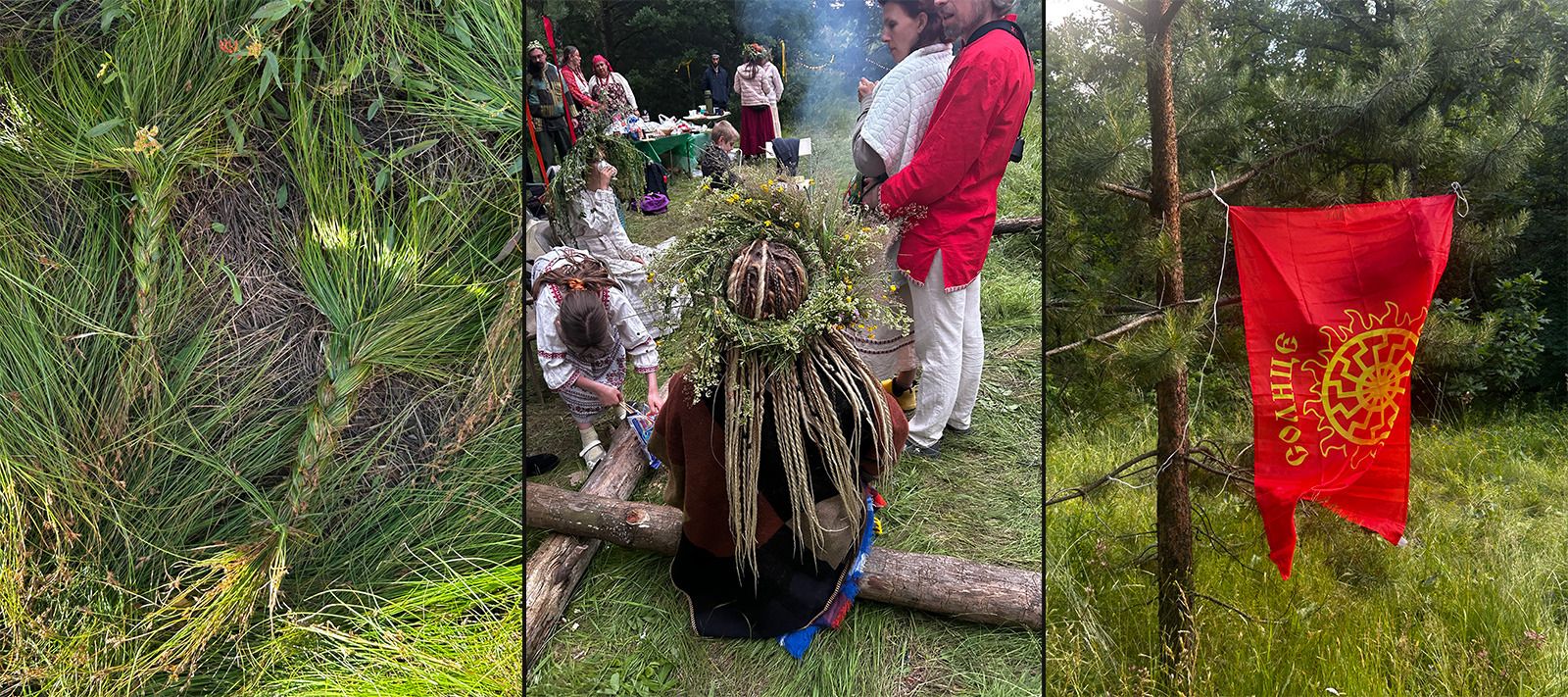
The pagan camp spread out on a forest clearing 20 minutes’ walk from the nearest village. A community flag hangs from one of the trees: a sun with ornaments on a bright red background and the inscription “The Sun Is on Our Side”. About forty people — men in embroidered shirts and women in patterned sarafans — are getting ready for the celebration: setting the table, lighting a cooking fire, weaving wreaths, pouring drinks. On the long table there are boiled potatoes, sausage, cheese, vegetables, fruit, sweets, and kvass: everyone brings something and puts it on the common table.
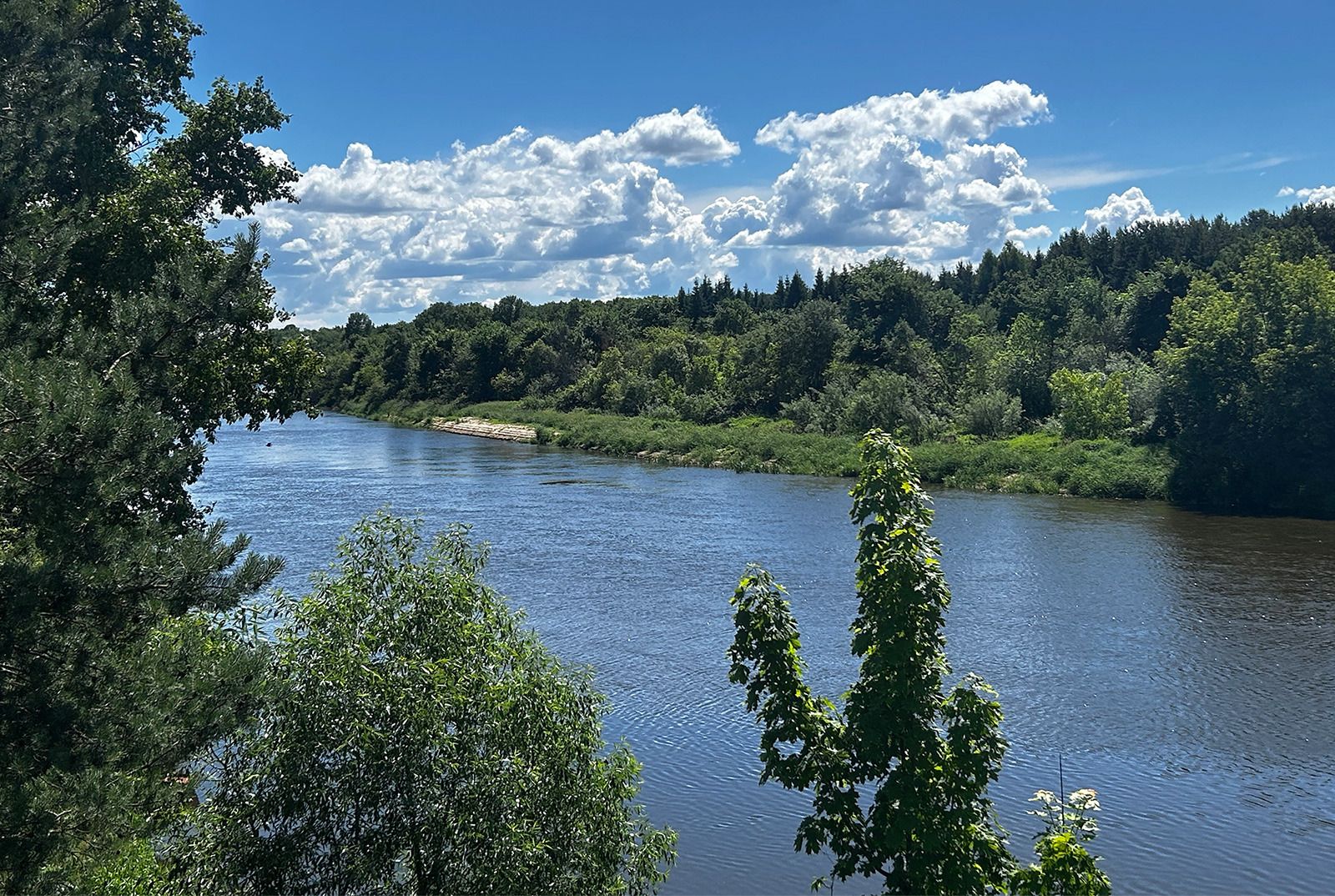
Before the ritual, one should bathe. Women in their 50s and 60s on the small beach insistently recommend doing so and not being squeamish. In response to objections about the lack of swimsuits, they say that one should swim naked, and the men won’t look anyway. However, you can simply wash your feet in the river. First the pagan women bathe en masse in the river, then the pagan men.
“There’s a whole sea of wild strawberries here!” one of the women in a light dress exclaims and starts picking berries with her friend. Nearby is a married couple in their forties in light clothing: the smiling woman in a wreath of wildflowers glances at her husband and takes a selfie with the strawberries. She says that exactly two years ago her husband came to this place to fish and spontaneously joined the Kupala celebration. He liked it very much, and the following year they came together, “because pagans are fun”.
Suddenly several women begin singing in chorus. Forming a line, they walk to the clearing with the ritual bonfire. Everyone follows them to the beat of drums and forms a circle to the drawn-out singing. After a few minutes the song fades, and the community leader Svyatibor — long-haired, about 40, in a white shirt tied with a red patterned belt — steps into the center of the circle with a drum in his hands. The same patterns are also shown on his forehead band.
- Glory to the spirits of this place, we believe in Yarilo, hail Kupala! — the leader exclaims, and the circle repeats everything after him in unison. Then, to the sound of the drum, everyone runs behind the trees. There the leader takes a long pole to drive a three-meter wooden idol into the ground. Svyatibor explains that this is a symbolic union of earth and nature: according to one version, the holiday’s name is related to the word “copulation” — “which is essentially what we are observing”.
Four men with fierce, strained cries of “Aekh, aekh” stamp the ground with their feet and push the trunk into the earth with their hands. Women circle around them singing. After three randomly chosen girls wrap the idol with ribbons, the leader gives the instruction: everyone must sing vowel sounds — a, o, u, e. First very low, and then gradually raise the pitch — it looks like solfeggio lessons at music school.
After “tribute” — grain meant to appease the gods and spirits — is thrown into the ritual fire, Svyatibor announces that on this special day he wants to officially welcome Miroslava into the community. A cheerful girl with dreadlocks in a blue sarafan runs into the center of the clearing. Svyatibor gives Miroslava a carved wooden talisman on a long black cord — he says it was made especially for her. The girl jumps for joy and hugs the community priests.
Now everyone must take a sip of kvass from a three-liter carved linden bowl with two handles, and then praise whoever they deem necessary: the spirits of this place, ancestors, Perun, Yarilo, fire, water, air, earth, the world, parents. After the kvass, they start passing around bread, but it is not meant to be eaten: everyone touches it with their hands and bows. A long-haired brunette in a red headscarf and sarafan explains that the left hand placed on it means wishes of happiness for oneself, the right — for one’s loved ones. Of course, everyone places both hands on it.
“Let’s smash this Yarilo already!”
The men disappear into the bushes to prepare for the next ritual, while the women stay and listen to instructions from Arina — a woman over 60 in a red sarafan with many patterns. She says that now there will be a symbolic meeting of the masculine and feminine principles. According to Arina, in the Slavic tradition, several weeks before Kupala — during the period of sowing and sprouting of crops — women kept away from men and refrained from contact with them. At that time, a woman transferred all her strength to the crops, became the “mother of the earth”, and gained the right to dispose fully of the wealth grown.
- And obscene songs like “Oh dear, loathsome, stiff on the stove, and I’m running around nearby doing nothing”, “here’s some slops for you, wash yourself”, “here’s a mat for you, wipe yourself” were composed because women ritually broke ties with the masculine principle, — Arina adds (the words about slops and a mat are included in the full version of the folk song “A Birch Stood in the Field”).
Then cheerful men run out of the bushes into the clearing. One of them is holding a Yarilo idol made of grass and straw, with a birch-bark head and hands wrapped in ribbons.
- But you can’t even tell it’s Yarilo! — one of the circle participants exclaims. In response, the Rodnover leader tears the white towel from the idol’s waist, and everyone can see the symbol of fertility — a male sexual organ made of grass and red velvet.
The next part of the ritual is choosing Yarilo among the participants: it will be the one who guesses the women’s riddle. It sounds like this: “It rustles, laughs, wants a woman”. After a short thought, a man in a light wide shirt with a white belt shouts: “A sarafan!” The women appoint him Yarilo — though later this choice does not affect the ritual in any way: the winner of the challenge takes part in the action alongside everyone else.
Then the ritual matchmaking begins: men and women stand in two lines facing each other, hold hands, and start talking about marriage in the style of folk ditties — “I’ll go to the city to trade”, “and how much money will you get?”, “a hundred rubles”, “oh, too little, I won’t marry you”. With each phrase, the male and female lines move closer and farther apart. In the finale of the matchmaking, the men, after several attempts, break through the women’s line.
— Let’s smash this Yarilo already! — shouts a six-year-old girl. The adults seem to have been waiting for this: they pull the idol in different directions and tear it to pieces. A woman in her forties snatches the red velvet sexual organ. The leader predicts she will have seven children in the near future. The remains of the idol fly into the fire.
After the ritual burial of the god, the celebration participants rest by the fire in the camp kitchen: some talk, some eat, some stare thoughtfully at the pot in which buckwheat with meat is cooking.
What post-Soviet pagans believe in
The elder of the community, Arina, tells me that she used to be a parishioner of a Christian church, knew Orthodox prayers and the Gospel well. But one day the priest told her that she could not read Russian philosophers, such as Solovyov. Arina was outraged: “How can you forbid development?” In the end, she parted ways with Orthodoxy.
- There are cases in churches when people are answered even more rudely, — agrees red-haired Irina, who came to Rodnoverie from Buddhism.
- Before my baptism I read the Gospel all night and admired the feat of Jesus, who sacrificed himself — not everyone is capable of that. Over time I realized that if I had been in his place, I would have been disappointed in what Christianity ultimately became, because it turned into manipulation, — says a woman in her 50s with a copper forehead ornament and pendants (she does not introduce herself). She says that she first came into contact with Rodnoverie thanks to a meeting with Velimir — one of the founders of modern Rodnoverie. By the time they met, she was already interested in Slavic traditions and was outraged that “Slavs are overlooked in many history books”. For example, in the book “History of the Ancient World” there were “Egypt, Mesopotamia, China, Scandinavia — but no Slavs”.
(“History of the Ancient World” edited by Dmitry Reder - a textbook from the late 1970s, still used by students at Russian pedagogical universities. Slavs are not included in the lists of peoples of the Ancient World because they do not belong there since their ethnic community formed in the early Middle Ages — Most.Media).
- There is a theory that the top leadership of the Soviet Union relied on transformed paganism. Communist ideas were interwoven with the idea of Mother Earth, the Motherland, things like that. They were woven into the ideology, but from a different angle, — our interlocutor says. — They did not try to impose the old ways, people did not feel that they were returning to something ancient and unprogressive. But at the same time they returned the ideas themselves to people. Soviet ideology was permeated with these things — all those “For the Motherland”, “Field, my field”. And in ancient times there were no such texts. This is not imitation, but reinterpretation — an attempt to return to the right ideas, but outside a religious context. It’s usually like this with children: first they just believe, then they ask questions, argue, look for explanations. In the past, people were treated like children — “here is the faith, don’t ask”. During the Soviet period, the people supposedly came to power, and they could not be left stupid. The same ideas were presented not through faith, but through love for the homeland, family, and nature. Rodnoverie is, above all, a worldview: we are part of nature and feel it. And whether to accept it as a religion or not is everyone’s personal business.
- But this comes through practices, through experience, it won’t awaken on its own, — Irina joins the conversation, — During the day at the ritual the girl says: glory to the earth and water. And I whisper: and to fire and wind, and immediately a small breeze blew, I felt it with my hands. You are heard, the spirits respond to you. It is recognition by the forces of nature of you as part of them.
While we are talking, an elderly pagan woman, Larisa, appears nearby with an accordion in her bag. She puts a white scarf on her head, ties a red forehead band over it, takes out the accordion, and begins playing motifs of pagan chants. Some sing along, some just listen.
Near the fire, a student is gathering material for a research paper: she asks Vseslav — a guy about twenty in a shirt with green Slavic patterns — about Rodnover traditions and Slavic magic. It turns out that Vseslav has been in this community since he finished 11th grade, and he started practicing pagan rituals about 10 years ago.
- And how did your parents feel about it? — I ask.
Vseslav bursts into loud laughter:
- I’ll stay silent, I’ll just refuse to answer.
- They didn’t come with a censer to consecrate you, didn’t take you to a psychiatrist?
- Fortunately, neither happened.
- At least they understood?
- No, that too. They just thought it was an age thing and would pass. It didn’t pass.
“Our gods do not demand all of you”
Pagan Rodnovers are followers of a religious movement aimed at reviving pre-Christian beliefs and rituals. This movement arose in the 20th century in the territory of the former USSR and Eastern European countries (the first Rodnover community was founded by Ukrainian Sanskrit scholar Volodymyr Shayan in 1934). Rodnoverie is practiced by many self-regulating communities. There are no unified rules. In some communities, you can only join after an interview and proof of the sincerity of your faith. But the one I ended up in is quite open — anyone who calls the organizers can come to the celebration and take part in the ritual.
In the interval between rituals, leader Svyatibor gives a lecture on the basics of paganism. About twenty people gather around the ritual fire to listen to him.
Svyatibor says little about himself: according to him, he switched from Orthodoxy to Rodnoverie in 2017 and has since studied a lot of literature on the subject; he joined this particular community in 2022.
- The rise in interest in Rodnoverie in Russia is connected with the collapse of the USSR; people began searching for new meanings of life and new ideas: some went into Orthodoxy, some into sects, and some into paganism. With the latter, a problem arises: how do you restore a faith that was lost for many years? There are very, very few sources of information about paganism, and there are no written ones at all. In modern scholarship, the question of whether the Slavs had writing is closed: it is believed they did not, — says Svyatibor.
The community he leads (the leader is an elected position) restores rituals based on historical sources, ethnographic materials, and linguistic research. They creatively rework all the information: they sing songs from different regions during rituals, sometimes compose texts themselves, or introduce actions that help them experience events. In short, these Rodnovers have freedom of self-expression — for Svyatibor as a priest, it is important that he “within the community can unfold as a creator, an artist of a long-standing ritual”.
According to the leader, there are no dogmas in Rodnoverie. But Russian communities do have documents describing the meaning of this faith — these are the Bittsev Agreement and the Agreement to the Slavic Priests.
- These documents say that Rodnoverie is a collective faith, we do not have a clear hierarchy, doctrine, or dogma; each community creates its own calendar, creates holidays in its own time, and performs rituals at its own discretion. Matters important to the movement as a whole are decided collectively, by veche principle. We do not have some main person, a Rodnover patriarch, who would say what is right and what is wrong. If you come to another community, everything will look different there or they will tell you different things, — Svyatibor explains.
The feature of the Slavic worldview, in his observation, is its connection with Christianity. Most people who come to Rodnoverie previously interacted with Christianity, most likely Orthodox Christianity.
- People coming from Orthodoxy often transmit Christian beliefs; it is hard for them to move away from them. The Christian God demands all of you; you must lay your whole life on his altar, align all spheres with him: the times of fasting, prayer, and so on are prescribed. Paganism is very different because our gods do not demand all of you; you interact with pagan gods as with your ancestors: we come to grandma and grandpa in the village for a holiday, but that does not mean we must be with them all our lives and weed the garden. Pagans can regulate the amount of religion in their lives to a comfortable level.
I ask him whether a person of non-Slavic nationality can join the community. Svyatibor thinks yes: in his community there have been precedents when non-Slavs came to the holidays:
- If a person knows, for example, Russian and accepts our cultural and religious norms, then why not. If a person was born Tatar, Jewish, Armenian, Georgian, German…
- And if he’s Black? — the newly converted Miroslava asks half-jokingly.
- Even if I were Black! — one of the grandmothers in a sarafan quotes Mayakovsky ironically.
- I just have a friend, Black, who keeps asking, like, will you take me to Kupala? I say: sorry, of course, but no, — Miroslava explains.
- Why? I would take you! — Svyatibor answers confidently and calmly.
- No, I would take him too, but okay, me and my close ones — people would react normally, but if, for example, there were some, well, slightly Nazi-leaning guests, they wouldn’t understand! — Miroslava reasons.
- Well, in that case those guests have no place at our celebration, — the leader concludes.
- Two years ago at Kupala there was a Korean, and he really stood out to everyone, — reminds a man in his forties in gray clothes named Radomir.
- Do you remember how I invited an Australian woman to Kolyada? — Svyatibor says with a smile.
- We had Germans too! — one of the women says thoughtfully.
- And there was a Mexican too, he sang in the band “White Stone”, spoke Russian well, and was studying at some institute, — Radomir adds.
- As can be seen from the discussion, we have no restrictions on this matter, — Svyatibor turns to me. — I remember, a few years ago I conducted a ritual, and a girl walked with the ceremonial loaf with me, an ethnic Jew, and she was from an Orthodox family observing Shabbat. She feels herself to be part of Russian culture, speaks Russian, and wanted to take part in a Slavic ritual.
I ask how he feels about the fact that people not connected with paganism take part in pagan holidays and festivals
- I believe that any movement, so to speak, the Overton window toward love for native culture is a good thing. Ethnic holidays, clothes, festivals — of course, everything gets commercialized and brings benefits to people, but it does not harm Rodnoverie. Today they came to such a Kupala, sang songs, next time they’ll be more interested in the place where rituals are performed, — the leader answers.
- Well, “Mir Gusley” is holding Kupala today, it’s quite expensive, I think 15 thousand, — Radomir adds. (“Mir Gusley” is a musical instrument store that sometimes organizes celebrations, according to one travel agency, the cost of celebrating Ivan Kupala there is 8200 rubles — Most.Media)
- 500 for a tent, 500 for parking, the whole celebration will come out pretty expensive. — one of the pagan women agrees.
Drumming and “Lyube”
It got dark. Three men stand by the fire and hold their drums over it — warming them so the skin expands and the sound gets better.
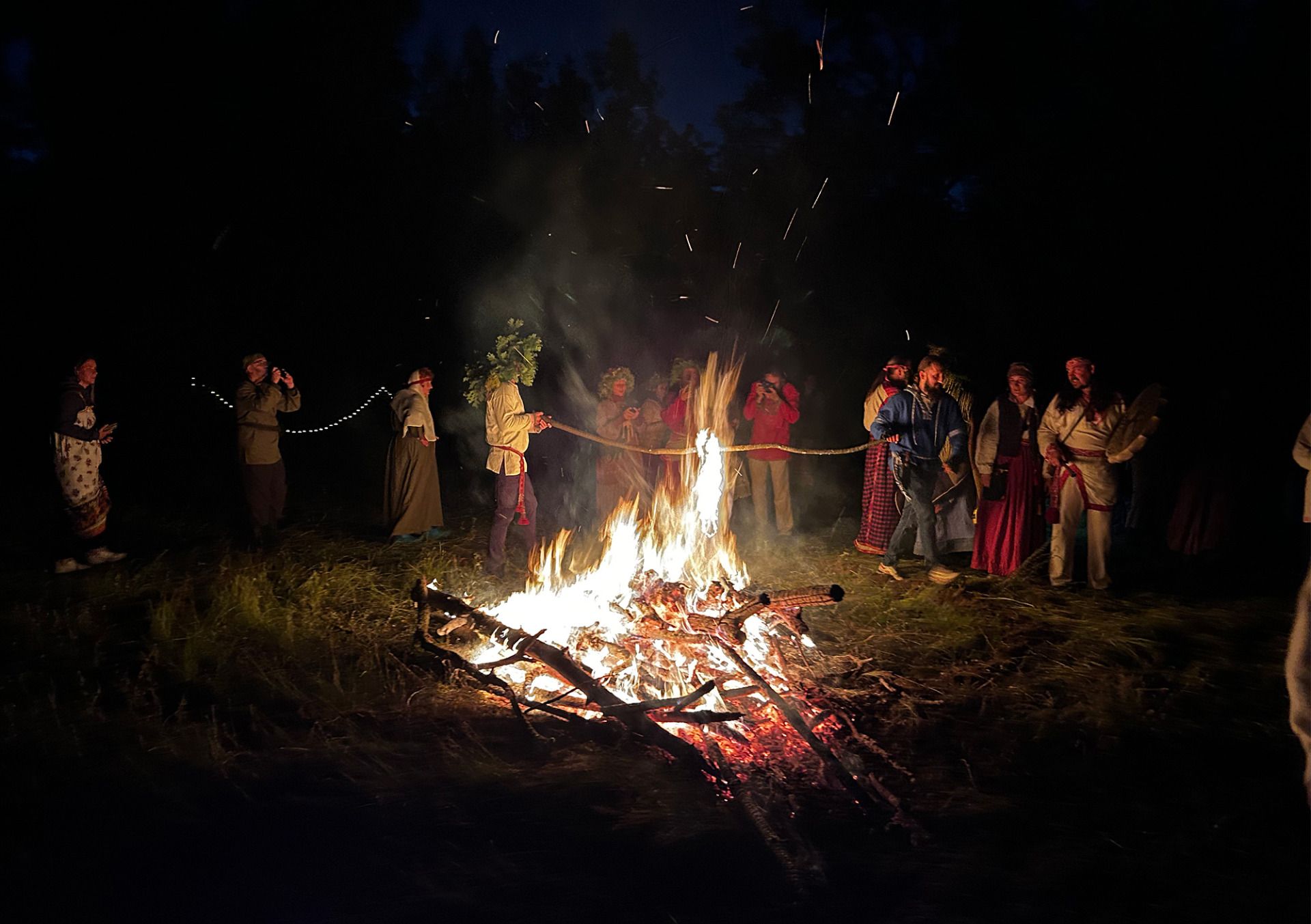
A few minutes later everyone pairs up. To songs and drumbeats, two columns slowly move toward the ritual part of the clearing. They pass through an arch resembling an oversized wreath. Beyond the arch, two people with torches meet them — first they pass fire in front of each person’s face, then draw lines on their cheeks with charcoal from last year’s Kupala night. Many participants film the proceedings on their phones, trying to fit as much of the ritual into the frame as possible.
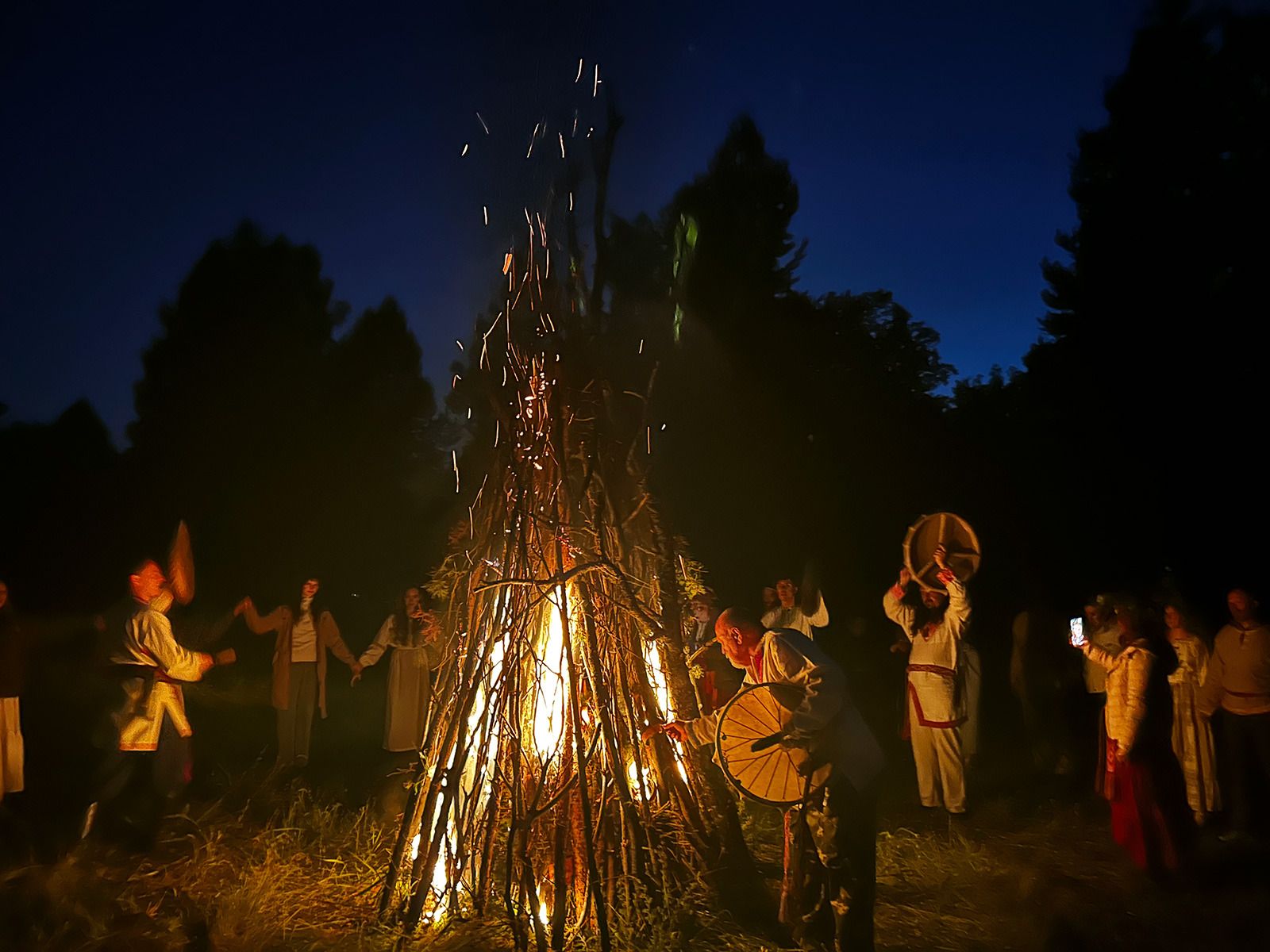
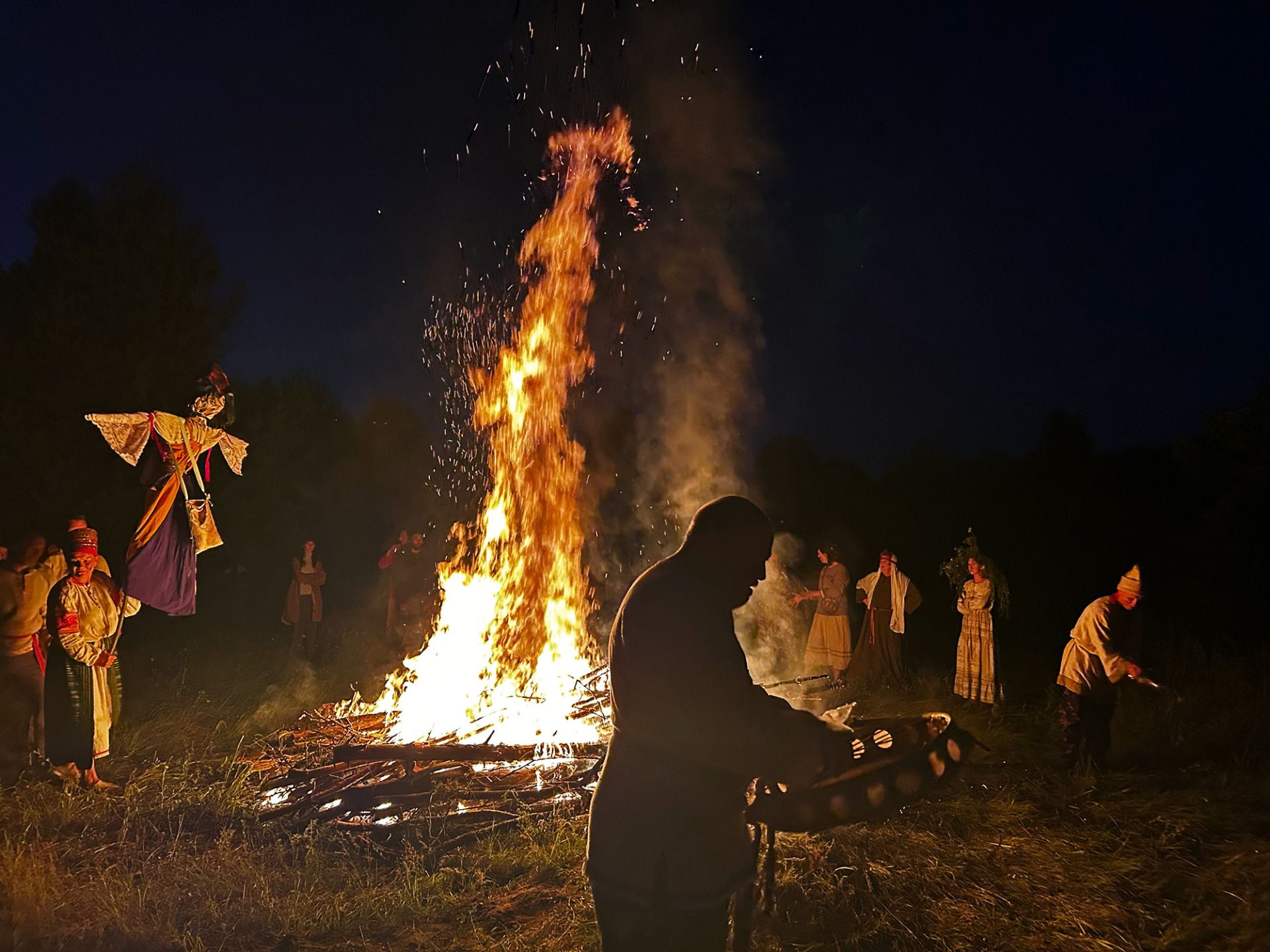
The idol that was driven into the clearing during the day is now covered with long branches for the fire. To the beat of drums and the singing of “burn, burn brightly”, several pagans set them alight. The stronger the fire burns, the more often the priests beat the drums and the livelier the circle dance moves. Sometimes you can hear cries: faster, even faster! People run at the limit of their strength — when someone gets tired and leaves the circle, they have to catch up with the neighbors of the one who left in order to restore the circle. The distance between people increases, and the arms have to be spread wider and wider — sometimes it seems like you are about to be torn apart. The drumbeats become more frequent, the songs louder, the heat from the fire hits the cheeks, and you want to turn away from it so as not to feel its flames on you.
Suddenly the three-meter fire collapses sideways. People get scared and step back, but when they realize no one was hurt, they return to the circle dance. As the flames die down, the running in the circle slows too. Everyone stops and watches the fire, only elder Arina dances and sings along, stretching out the last syllables: “Oh, early, oh, on Kupala”. Then four more women join her, and together they walk around the fire, dance, and sing. Arina brings out a female idol in a yellow sarafan, checkered apron, dark kerchief with red patterns, and lace sleeves — and throws it into the fire.
The next part of the ritual is the burning of the kol, a symbol of the year and the смена of seasons. Two pagans carry a pole about three meters long, with a wooden wheel — a kolo — threaded onto it. It is lit from the fire, and to the beat of drums and the drawn-out chant “Roll, wheel, across the yellow fields..”. it is taken to the river and rolled straight into it.
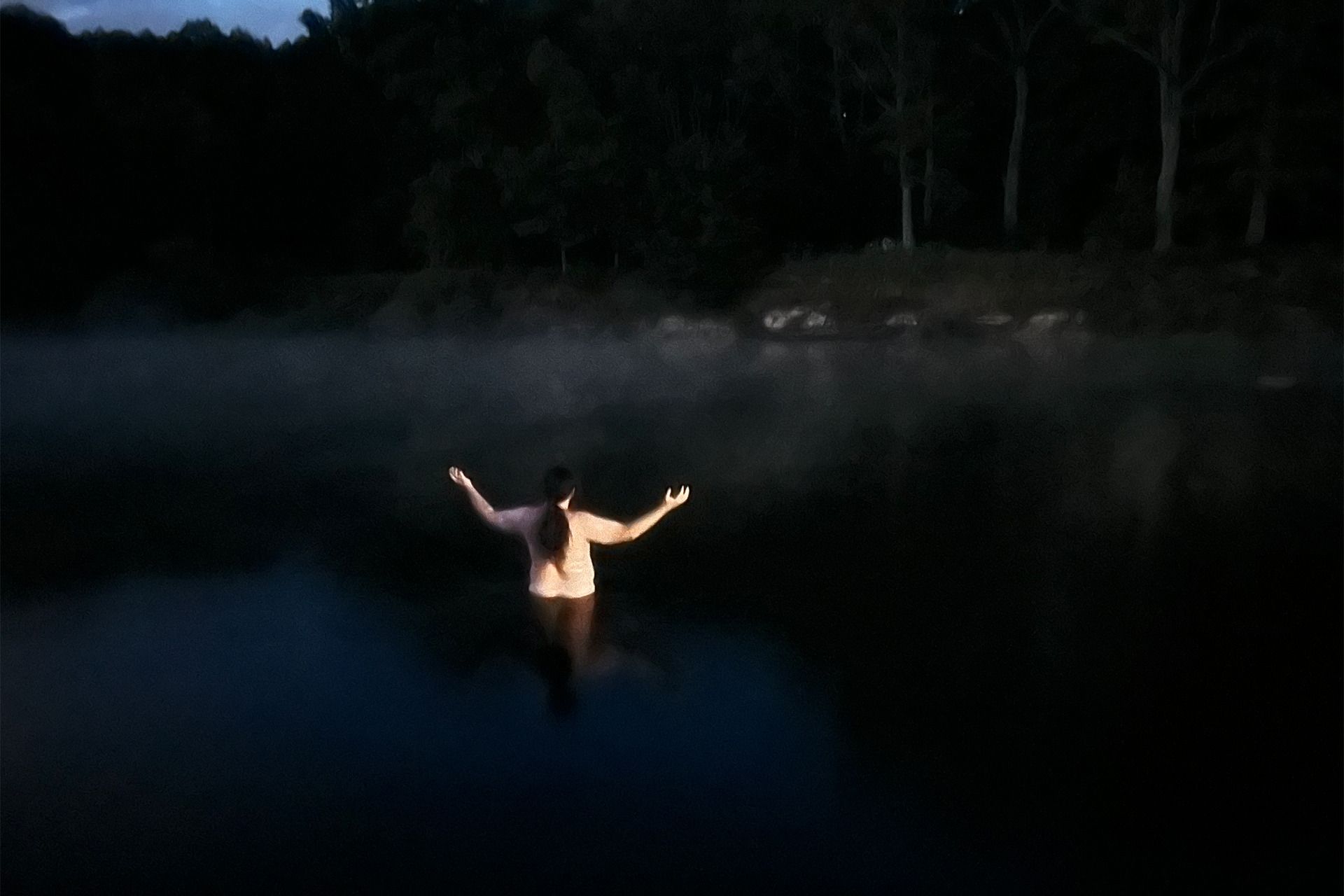
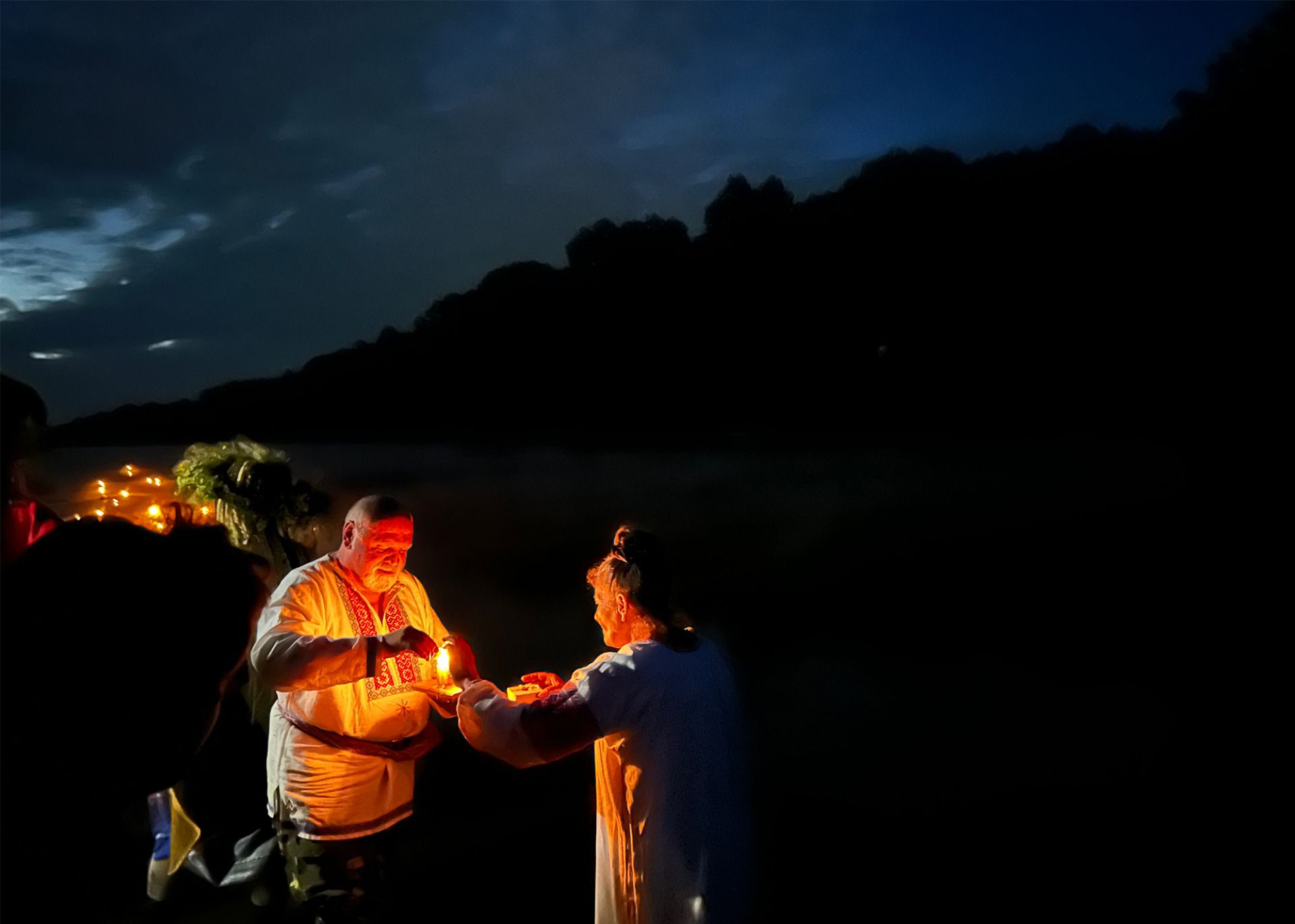
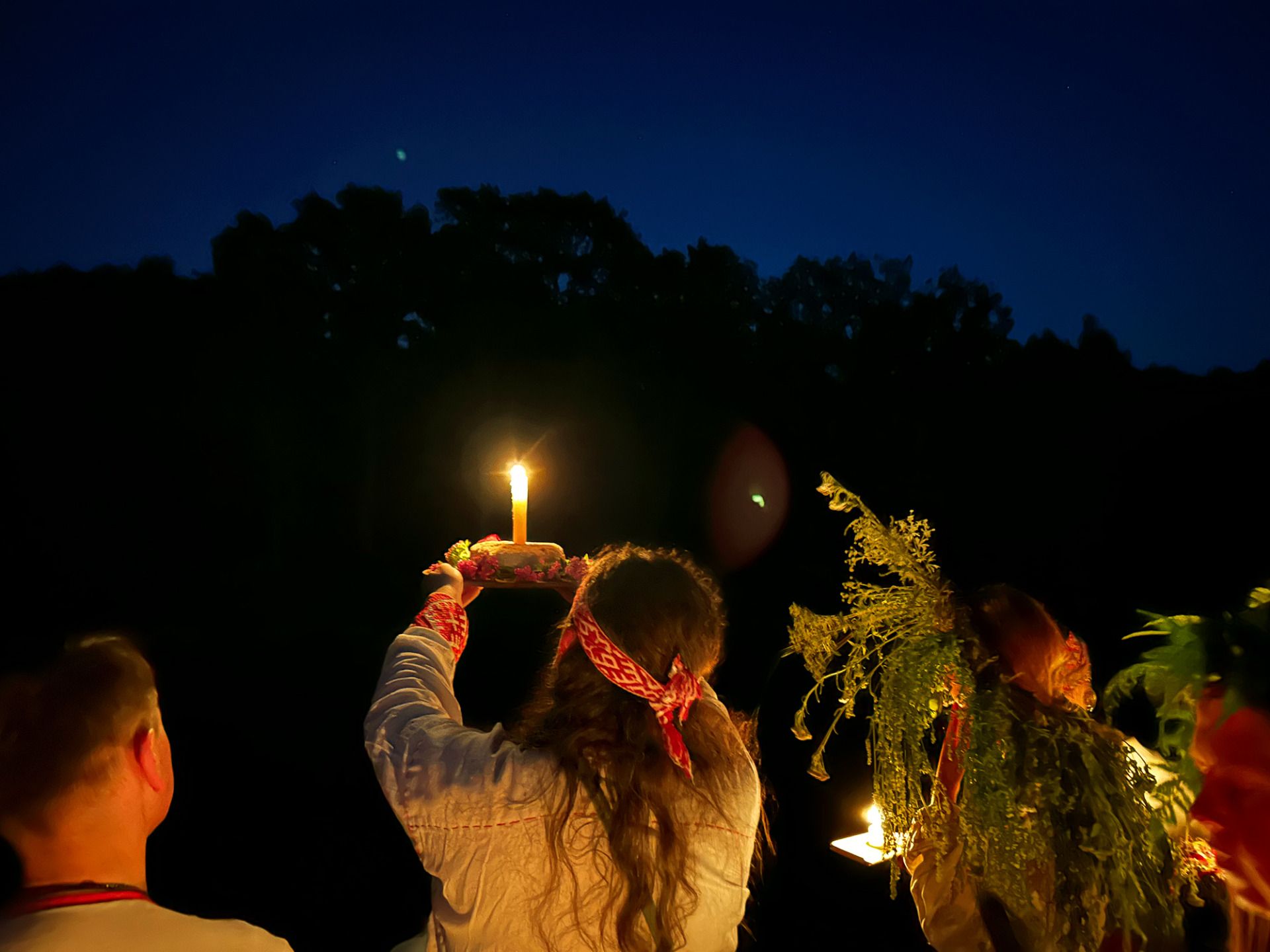
Then everyone goes to the river to release little rafts with candles and wreaths — they must be watched carefully until the current carries them away and they disappear from view. Chaos breaks out: people hurriedly and in the crush search for their little rafts and wreaths, try to keep their balance on the narrow bank and not fall into the river, and a clamor is heard from all sides. Finally the leader steps into the water, glorifies Kupala, and invites everyone to plunge in.
One of the most famous symbols of Ivan Kupala is the fern flower (in Slavic folk beliefs, it is believed that the fern blooms for a moment on the Night of Ivan Kupala — in reality this plant reproduces by spores or vegetatively and cannot bloom — Most.Media). One of the priests explains the rules: search only within the clearing, and if you search as a pair, then the happiness will be shared too. People scatter into the forest. After a few minutes of searching, a woman shouts, “I found it!” — and brings back a glowing LED flashlight in a large bouquet of fern leaves. Everyone takes turns tearing off a small branch from the bouquet as a talisman.
When the fire burns down to about half a meter from the ground, people can jump over it safely. The first ten jumps are accompanied by cries of “Glory to Kupala!”, but then people get tired of shouting constantly and jump in silence: experienced pagans — briskly and easily, newcomers — cautiously. To have good luck all year, one must jump three times. Little Aglaya, who during the day demanded that Yarilo be smashed, boasts that she jumped over the fire about fifteen times — both by herself and together with other children and adults.
Another Kupala talisman is a coal from the fire: it is believed to bring good luck. The pagans sit around the fire and, waiting for the coals, sing songs. First — something about love for the homeland from the repertoire of Lyudmila Zykina, and then — “Only we and the horse walk across the field..”. by the band Lyube.
Miroslava tells how she gave a Kupala coal to her Orthodox friend:
- He has a lot of icons in his apartment, even one in the bathroom. My friend hung the little bag with the coal right above the front door and went to sleep. That same night he had terrible nightmares; he had never seen such horror in dreams before. His first thought upon waking was that he had to throw that coal away immediately!
Miroslava believes this happened because of a conflict between the energies of the icons and the coal.
When only hot coals remain from the fire, some begin to walk on them. First the community leader walked across slowly, then Vseslav proceeded unhurriedly with a proud smile on his face. A girl who was at the Kupala celebration for the first time ran across the coals, and then cried out loudly in pain.
At dawn, the pagans stand facing the rising sun and sing:
Rise, Dazhdbog — the ore of light —
The sun of Yarga-Yar of dawn,
Above the water, above me, above the earth.
Glory to Dazhdbog, we are alive through You!
Mostly older women sing; their voices are tired but content. Sometimes they glance at one another, trying to figure out whether the sun has fully appeared from behind the trees. But then everyone can see it from behind the trees, and the singing falls silent. Some go to sleep in tents, while others stay to dance in a circle to quiet melodies.
Priest from the Ministry of Emergency Situations
In between rituals, Rodnovers gladly talk both with each other and with newcomers like me and my two friends. They practically do not talk about their secular lives — not out of secrecy, just because it is clear that everyone is deeply absorbed in the ritual and in communicating with each other. But in the end I get a chance to talk in detail with a pagan: one of the priests, who had beaten the drum very hard during the rituals, heard that a girl from our group was not feeling well — and offered to drive us to Moscow.
At dawn we get into Ivan’s car (name changed). Nothing in the cabin of this white used foreign car reveals the owner’s religious views — a gray-haired, short-haired man of about 50 in camouflage pants. Before driving to Moscow, he takes off the embroidered white shirt he wore at the celebration and remains in a T-shirt with a fierce valkyrie изображение.
I sit in the front passenger seat, the girls doze in the back. The car rolls along the smooth highway in the rays of the rising sun through pine forests, open fields, and sleeping villages. Although the day before Ivan had beaten the drum and recited praises day and night, he looks energetic. Now and then he complains about the driving style of oncoming drivers and the, in his view, unfortunate placement of road signs.
- I’m actually from Kursk region, from a village, — his South Russian accent gives it away. — Back when I was there, an acquaintance suggested going to a fortune-teller бабка, so I agreed. She told me I had a special gift, and that I myself was special: I feel what others do not feel. I understood that, but I couldn’t get to it. The old woman started teaching me to cast wax, read cards, do curses, the evil eye, and so on.
But now Ivan, according to him, does not practice magical methods.
The Rodnover priest works in the Ministry of Emergency Situations system, but he does not go into much detail about his profession. He is more interested in the differences between paganism and Christianity:
- Our prayers, they [the Christians] copied for themselves, we had glorifications — they appropriated everything. They even took the very name “Orthodoxy” from us! In paganism there are three worlds: Yav — the world of people, Nav — the world of dark gods, and Prav — the world of higher gods. We pagans glorified Prav, but whom do Christians glorify? Can you explain?
I suggest that it is Jesus Christ.
- They don’t glorify him, they pray to him and consider themselves slaves of God, — Ivan objects. And easily shifts into the realm of alternative history:
- As for Christ himself — he really existed. His name was Radomir. He was truly a powerful god, saved the lost, wanted to make the world new, accepted death for it, suffered greatly. He said there would be a new world, new people. Have you ever seen him depicted in garments?
- Well no, his clothes were often torn. And at the Last Supper he washed his disciples’ feet, — I reply.
- There was probably no Last Supper or apostles. They were invented in the 13th century; they did not live at that time, — Ivan says. — But Judas existed, and Christ was indeed sold out. The film “The Master and Margarita” shows everything in detail. In general, Christianity came to Rus’ around the 1400s, or even later.
- And what about Vladimir? He baptized Rus’ in 988, — I try to stick to the school history curriculum.
In response, Ivan says that school teaches nothing and urges me to read “the right literature — for example, Levashov and Trehlebov”.
The books of Nikolai Levashov and Alexey Trehlebov are popular among both Russian neo-pagans and far-right conservatives — both authors were sympathized with, for example, by the popular satirist Mikhail Zadornov. Levashov’s works are built around the idea of racial cosmic struggle between “white” Aryans, among whom he counted Russians, and “gray” Jews, whom the writer considered parasites and the erroneous result of genetic experiments. For this theory, his book “Russia in Crooked Mirrors” was added to the Federal List of Extremist Materials.
Trehlebov is an even more exotic figure: a Cossack-origin yogi who allegedly discovered healing abilities in himself at the age of five, underwent a Buddhist monastic initiation in Tibet in 1990, and in 2001 joined the Old Believers-Inglings under the name Father Vedagor. His most famous book, “The Incantations of Finist”, develops the same racist theory as Levashov’s.
Far from all Rodnovers agree with them: in 2012, three Rodnover associations recognized the theories of several neo-pagan authors, including Trehlebov, as “pseudoscientific and harmful to the Slavic faith”. And in 2013, a criminal case was opened against the writer for inciting ethnic hatred and participating in an extremist organization. It never reached trial, however. In 2014, “The Incantations of Finist” was added to the same Federal List of Extremist Materials.
Levashov died in 2012, Trehlebov in 2024. But their ideas, as the reasoning of priest Ivan shows, are very much alive.
- What names do we have now? — our driver asks rhetorically. — Greek names. Why Greek ones specifically? In Rus’ there was then the Greek cult of Dionysius. There was no baptism. And then someone had to be glorified, so Orthodoxy was invented. “We are Orthodox Christians” is a tautology; there is no point in talking about Orthodoxy, why don’t Catholics say “we are Orthodox Catholics”?
- You were talking about Nav — the world of dark gods, — I remind him. — What gods are those?
- You can’t say “bad gods”. All our gods are good, we glorify everyone equally, there is Belobog and his brother Chernobog. In nature there must always be balance: dark and light. If there were no balance in nature, would we be riding in this car now? No, we wouldn’t; it wouldn’t have been invented, — Ivan reasons. — They make poison, and for it there is an antidote. The same with a computer: there are viruses, and there is some Kaspersky. We are developing! Read the works of Nikola Tesla.
To introduce me to pagan culture, Ivan puts on Russian folk rock — it sings about glorifying the gods, ancient legends, forests, and trees. The girls in the back seat listen to our conversation. Then one of them asks Ivan:
- Right now the special military operation is going on, essentially Slavs are fighting Slavs, that’s barbaric, how do you feel about that?
- You’re right. It’s barbaric. The Jews set us against each other. The people were made slaves, the people are sold for money. Who is fighting there? Of course, there are those who were drafted....
- Well, there are also ideological ones, — I suggest.
Ivan is outraged:
- They’re not ideological, they’re insane! How could you go and fight your own people? How? How? How?
Around 5:30 in the morning we arrive in the capital, lit by the dawn sun. The streets are empty and quiet, there are almost no cars. On the southeastern edge of Moscow, Ivan drops us off at the metro station closest to his home, says goodbye, and leaves. And tomorrow he’ll go to work — responding to emergencies.
Photos by Irina Romashova
The author thanks the project interns Vika and Yulia from “Blue Capybaras” for help organizing the trip to the Rodnovers
If you enjoyed this article, consider making a donation — one-time or, even better, monthly. Your support helps us motivate our authors and become better with every article.
Our organization is recognized by the Internal Revenue Service (IRS) as a 501(c)(3) tax-exempt, charitable organization, which means that all contributions made to us are tax-deductible to the fullest extent permitted by U.S. law. Individuals may generally deduct charitable contributions of up to 60% of their Adjusted Gross Income (AGI) for cash donations made to qualifying 501(c)(3) organizations. For donations of appreciated assets (such as stocks or other long-term capital assets), the deduction is typically limited to 30% of AGI, based on the fair market value of the asset. C-corporations may deduct charitable contributions of up to 10% of their taxable income for donations made to eligible charitable organizations.
By submitting a donation, you confirm that you have read and accept the following documents: Privacy Policy and User Agreement, and also give consent to the processing of your personal data.
If you would like to unsubscribe from a monthly donation, please email us at: [email protected]