The political confrontation in the United States is intensifying. The current president of the country has accused one of his predecessors of treason over the investigation into Russia's interference in the 2016 election (the so-called “Russiagate”).
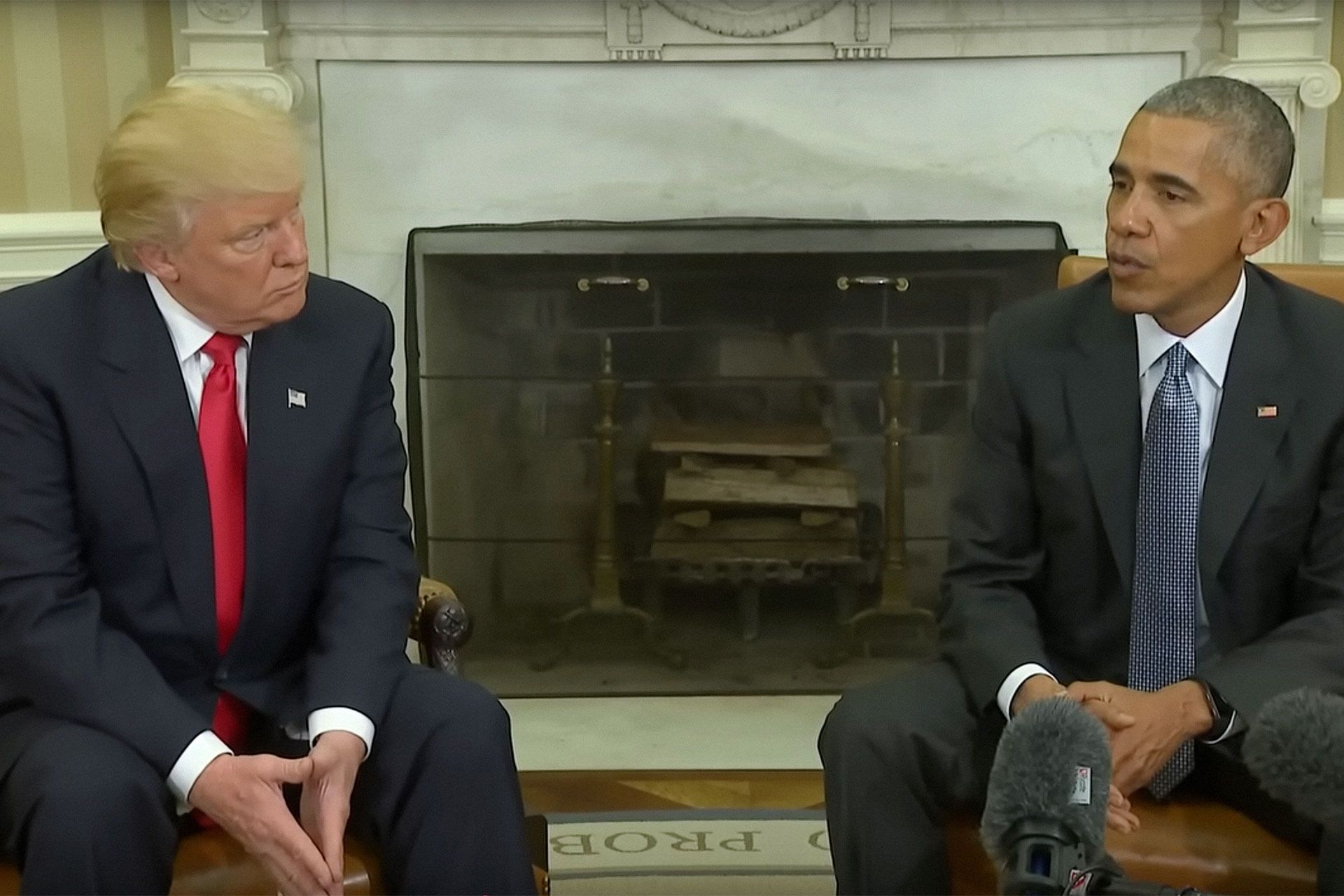
Meeting of President Barack Obama with President-elect Donald Trump at the White House, November 10, 2016. Footage from video: YouTube / @obamawhitehouse
At the end of July Donald Trump accused Barack Obama of treason, citing the head of the intelligence community Tulsi Gabbard. On July 18, Gabbard declassified documents allegedly proving that it was the Obama administration that laid the groundwork for the investigation into Russia's interference in the 2016 presidential election. According to Trump, this was an attempt by his opponents in the first presidential campaign to steal the election by doing what “is unimaginable even in other countries.“
In turn, Obama called Trump's statements “an attempt to distract attention“ from the newly reignited scandal surrounding the Jeffrey Epstein case — the financier who supplied underage girls to the American elite for sexual entertainment. According to Bloomberg, the FBI redacted documents related to the Epstein case, hiding the names of Donald Trump and other well-known individuals, although earlier it was reported that the current president's name was frequently mentioned in the case. The context of these mentions is unknown; however, Democratic senators are insisting on declassifying the documents.
Obama explained Trump's current accusations by Trump’s unwillingness to comply with their demands.
“Nothing in the document released last week refutes the widely accepted conclusion that Russia attempted to influence the 2016 presidential election but failed to change the vote count,” said a statement from Obama's office. — These findings were confirmed in the 2020 report by the bipartisan Senate Intelligence Committee chaired by then-chairman Marco Rubio.”
In any case, in her report, Gabbard declared “egregious use of intelligence for military purposes and politicization of its activities” and recommended initiating criminal prosecution against staff in the Obama administration office. What exactly is this about?
The Mueller Investigation
In May 2017, when Trump had already assumed the office of U.S. president for the first time, his political opponents insisted on appointing a special counsel to investigate alleged Russian interference in the 2016 election. That person was Robert Mueller — former FBI director who seemed acceptable to everyone. Mueller had a good reputation with both parties, was a Republican by conviction, and thus it was hard to suspect him of sympathies toward the “left.”
The first arrests under Mueller’s investigation followed the same year. In early November, former presidential advisor to Donald Trump Paul Manafort and his partner Rick Gates were charged on 12 counts. These included conspiracy against the United States, conspiracy to launder money, acting as an unregistered foreign agent, and failure to report foreign bank accounts.
The indictment mysteriously disappeared from the U.S. Department of Justice website, but quotes from it remain in the American press. According to Newsweek, based in Cyprus, Lucicle Consultants transferred up to $2.5 million to the accused, including to Manafort’s personal accounts. In total, more than $75 million passed through offshore accounts owned by Manafort and Gates.
Then, on February 16, 2018, Mueller charged 13 Russian nationals for interference in the U.S. presidential election. This document is also no longer available on the Department of Justice website. The vanished document detailed the work of a “troll factory” influencing American public opinion. Despite attempts to remove it from public space, a cached copy of the report is still available online.
According to Mueller’s conclusion, the accused Russians conducted campaigns supporting Donald Trump and undermining his rival Hillary Clinton on social media and beyond. They used stolen personal data of American citizens to create accounts and profiles on Instagram, Twitter, YouTube, and Facebook, and also entered the U.S. under false pretenses.
This work was carried out by the St. Petersburg-based “Internet Research Agency,” led by the well-known and now deceased Yevgeny Prigozhin and partly financed by two of his other companies — “Concord Management” and “Concord Catering.”
The Russians worked in two shifts for many months and created hundreds of social media profiles in the names of Americans. Since 2014, they created pages of organizations advocating for immigration, the importance of Black lives (“Blacktivists”), Muslim and Christian groups, and so on, which then pitted Americans against each other.
The project later expanded into a new one with identical goals and strategy — called “Lakhta.” Since 2015, Lakhta employees began buying ads on social media, being most active on Twitter. As of September 2016, the project's monthly budget was $1.25 million. According to Mueller, to hide the sources of funds, Concord transferred money through its subsidiaries.
Lakhta also acquired servers on U.S. soil and created virtual private networks, trying to simulate an internal American network. Email addresses were created in the names of non-existent Americans. These were used to communicate with other activists and send appeals to local media for “publicity.”
In 2016, Lakhta staff began using real social security numbers and authentic birthdates of Americans without their knowledge. Using this information, PayPal wallets were created, driver's licenses obtained, and later, pages of organizations controlled by Lakhta were created in the victims' names, with ads purchased on social media.
Since February 2016, Lakhta organized rallies and demonstrations in honor of Trump. Events supporting Democrats were also held but were actually aimed at discrediting them.
For example, their organizers called for the introduction of Sharia law in the U.S. Lakhta also urged potential Hillary Clinton voters not to participate in the election.
How Did the Russian Interference Case End?
Mueller’s investigation did not find evidence of collusion between Donald Trump and Russia, nor did it present proof that Trump coordinated with Moscow on the troll factory’s actions. The conclusion stated that Russia did not interfere with the election infrastructure to alter vote counts but hacked and distributed documents from the Democratic National Committee to damage Clinton’s campaign.
Nevertheless, the document concluded that the interference was likely limited in scope, and there is no evidence that Russia’s efforts affected the election outcome.
This conclusion — that no broader operation by Russia took place and that Russia did not hack vote counting systems directly — allowed Tulsi Gabbard to conclude there was “political interference in intelligence assessments.”
Notably, insider sources at the time claimed that Moscow in 2016 did not even believe in Trump’s victory, “playing” on his side only to maximally undermine Clinton’s future presidency with scandals and investigations. After Trump’s win, the result was completely reversed: scandals and investigations began aimed at him, preventing him from “making a deal” with Russia on Putin’s terms. Instead of a “new reset,” Trump constantly had to fend off accusations of ties with Moscow.
It seems the American president has now decided to seriously retaliate against his adversaries by denying the very fact of Russian interference — or at least the fact of its interference on his side. Considering that the troll factory’s work has since been described many times in various sources, not just in Mueller’s report, disproving this will be difficult. However, the very fact of such a campaign may give Putin new hope that he and Trump are once again on the same side of the barricades — meaning that the American president’s ultimatums regarding the war in Ukraine should not be taken seriously.
If you enjoyed this article, consider making a donation — one-time or, even better, monthly. Your support helps us motivate our authors and become better with every article.
Our organization is recognized by the Internal Revenue Service (IRS) as a 501(c)(3) tax-exempt, charitable organization, which means that all contributions made to us are tax-deductible to the fullest extent permitted by U.S. law. Individuals may generally deduct charitable contributions of up to 60% of their Adjusted Gross Income (AGI) for cash donations made to qualifying 501(c)(3) organizations. For donations of appreciated assets (such as stocks or other long-term capital assets), the deduction is typically limited to 30% of AGI, based on the fair market value of the asset. C-corporations may deduct charitable contributions of up to 10% of their taxable income for donations made to eligible charitable organizations.
By submitting a donation, you confirm that you have read and accept the following documents: Privacy Policy and User Agreement, and also give consent to the processing of your personal data.
If you would like to unsubscribe from a monthly donation, please email us at: [email protected]