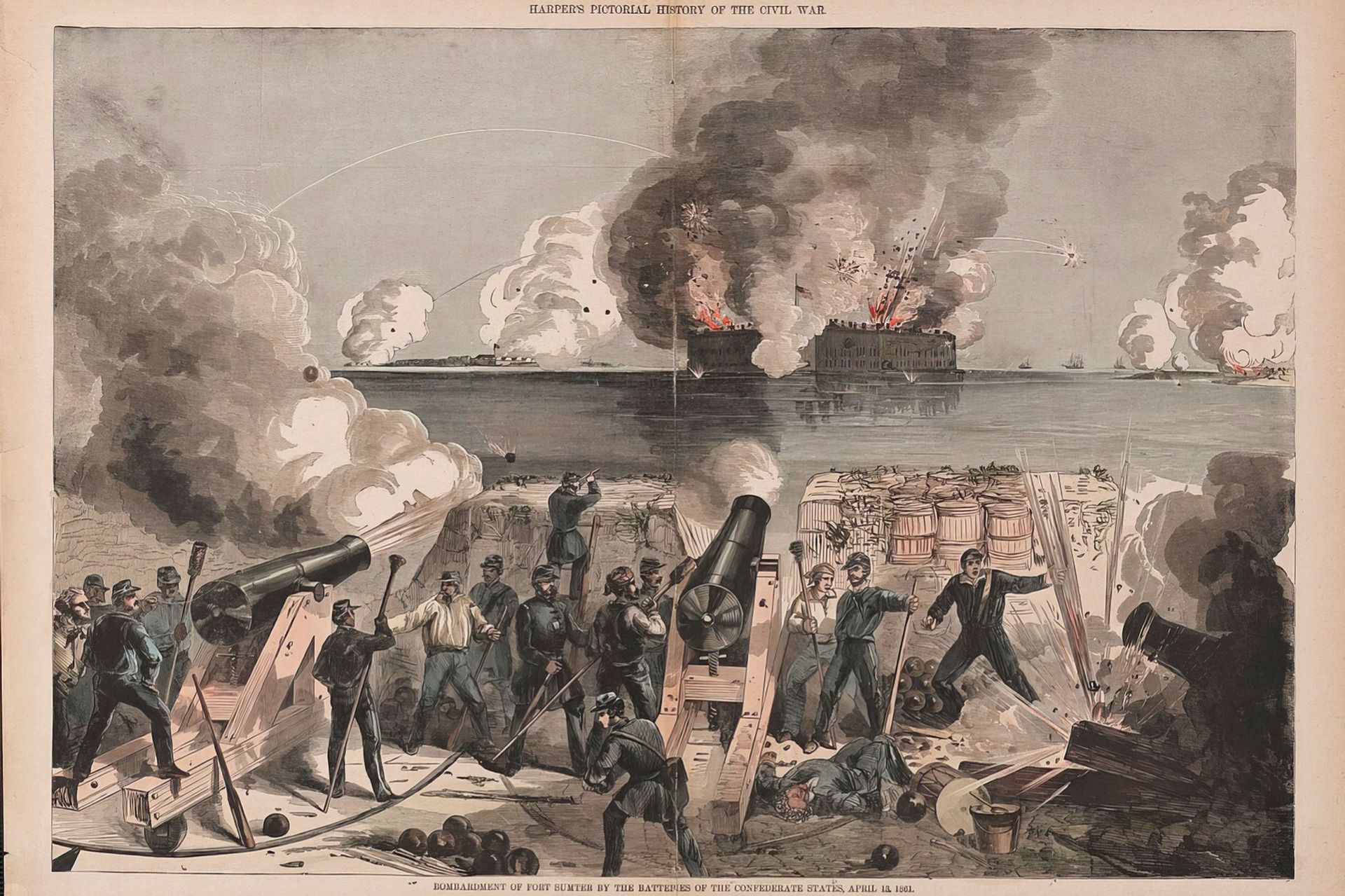
On April 12, 1861, the Civil War began in the United States with Confederate rebels firing on Fort Sumter. Historians still debate its underlying causes even in the 21st century. Both in America and abroad, the legend of the Lost Cause remains popular—a tale of the South’s heroic struggle against the relentless march of heartless Northern capitalism. According to this legend, slavery played little role: the irrepressible romantic Southerners were simply defending their unique culture—balls, beautiful ladies, horseback rides, and everything else “gone with the wind.” But what really happened?
CSA artillerymen shell Fort Sumter in South Carolina, April 12, 1861. In the first battle of the Civil War, only two federal soldiers died—and that was due to an accident during the lowering of the US flag. Image: Wikipedia / Prints and Photographs Division, Library of Congress
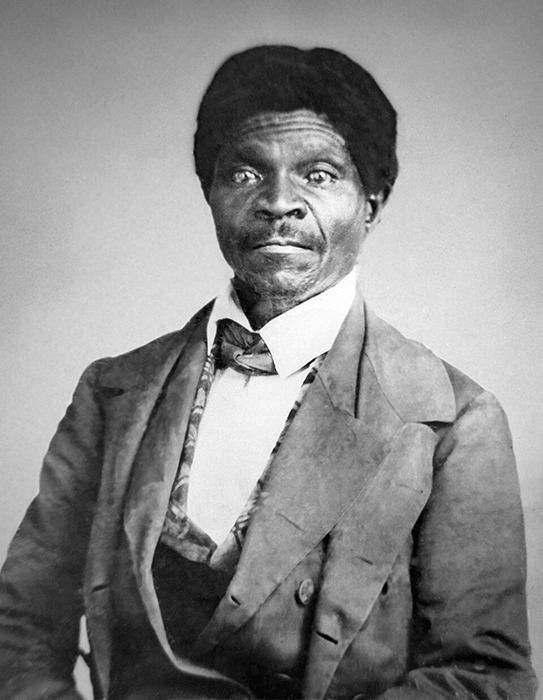
A century and a half ago, there lived a man in the US named Dred Scott. In his youth, nothing suggested that his name would go down in history. Born in 1799, Scott was one of several million enslaved Black people—essentially living property, for whom the laws of that era did not provide basic human rights.
Originally, Dred belonged to the modest Blow family. First, they farmed in Alabama, then moved to Missouri. By the low standards of his fellow sufferers, Scott was relatively lucky: it was better to serve small landowners than to toil 18 hours a day on giant plantations. In the early 1830s, the Blow family fell on hard times and sold their slave to military doctor John Emerson. Again—however cynical it may sound now—Scott was lucky. He became a servant for an educated and fairly good-natured white man, rather than being sent to the hell of cotton or rice fields in Georgia or Alabama.
Dred Scott, 1857. Image: Wikipedia
Scott spent more than ten years with Emerson. Due to his new master's service, Dred lived for a long time in Northern states where slavery was prohibited. In Wisconsin, the officer even allowed his servant to marry the woman he loved—a rare privilege for African Americans at the time, as Southern laws explicitly forbade Black people from officially registering marriages.
In 1843, Emerson died, and the slave was inherited by the doctor's widow, Irene, née Sanford. For several years, she rented out Scott and his wife as hired servants in Missouri. The conflict between them flared up in 1846, when Dred, having saved some money, offered his mistress $300 (about $11,000 in today's money) to buy freedom for himself, his wife, and their two daughters. Irene deemed the sum insufficient and refused. Scott then went to court, demanding his freedom and citizenship on the grounds that he had lived for several years in free territories and had even married there legally.
Scott's lawsuit did not seem hopeless. By then, Missouri had established the precedent of once free, always free—Black people who could prove they had lived in the North for a significant time were indeed granted freedom. Moreover, Scott remained on good terms with his first owners, the Blow family, received financial support from them, and could afford lawyers. However, Irene and her brother John Sanford stubbornly insisted that Dred had been their family's property for 15 years.
The legal battle dragged on for 11 years. Both sides had alternating successes, filed appeals, and the case kept restarting. Eventually, Scott v. Sanford reached the US Supreme Court. By that time, the case had become a major political issue. In the late 1850s, the country was torn by debates over slavery and its future. Scott’s struggle with his former owners—since 1848 he had lived apart from the Sanfords—attracted nationwide attention.
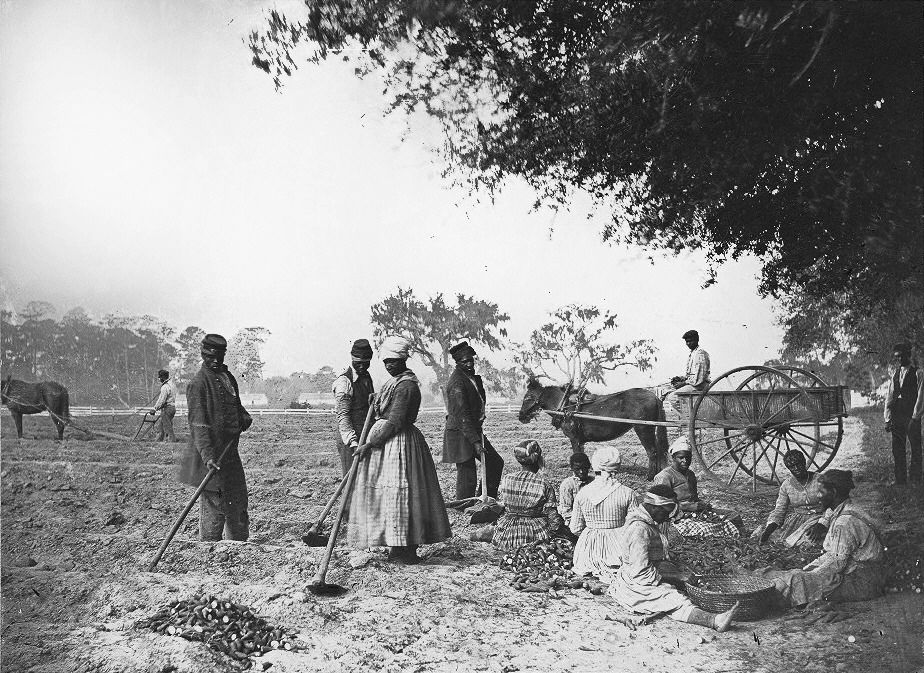
Slaves on a plantation in South Carolina planting sweet potatoes, 1862. Image: Wikipedia / Henry P. Moore
Supporters of slavery in the US saw Scott v. Sanford as the perfect precedent to cement the disgraceful institution at the federal level. Unfortunately for Dred, Chief Justice Roger Taney himself belonged to this camp. On March 6, 1857, Taney, a descendant of a planter family, delivered what historians consider the most shameful verdict in US legal history: Scott was a slave simply by virtue of belonging to the African race.
We think ... that they [Black people] are not included under the word 'citizens' in the Constitution, and were not intended to be included. Therefore, they can claim none of the rights and privileges which that instrument provides and secures to citizens of the United States. On the contrary, at the time [when the US was founded] they were considered a subordinate and inferior class of beings, held in bondage by the dominant race
- from Taney's final decision
In the summer of 1857, Scott's ordeal finally bore fruit. It suddenly emerged that Irene's second husband was Republican congressman Calvin Chaffee. For eight years, he had publicly opposed slavery while ignoring the fact that his own wife was contesting the rights to the most famous slave in America. Chaffee was publicly shamed, and the embarrassed politician was forced to help resolve the situation so that the Sanfords would leave Scott alone. In 1857, the African American finally gained his freedom—but due to tuberculosis, he lived just over a year as a free man.
During that time, many white Northerners who had previously been indifferent to the suffering of Black slaves became aware of the issue of slavery. Scott’s case made it clear that the US could not remain half-slave, half-free: Southern planters were determined to impose their ways on all states, seeking laws, courts, and precedents solely in their favor, with no regard for their neighbors’ interests. Big changes were brewing in America.
They agreed to agree
Today, it seems natural that the North American states, freed from British rule at the end of the 18th century, became a single federation. In reality, things were more complicated: during the war of 1776–1783 and in the first years of independence, the States were a situational and rather loose confederation. Only in May 1787, at the Constitutional Convention in Philadelphia, did representatives of the 13 former British colonies, after much debate, agree to unite into the world’s first federal state.
Even then, slavery was one of the main issues dividing the thirteen states.
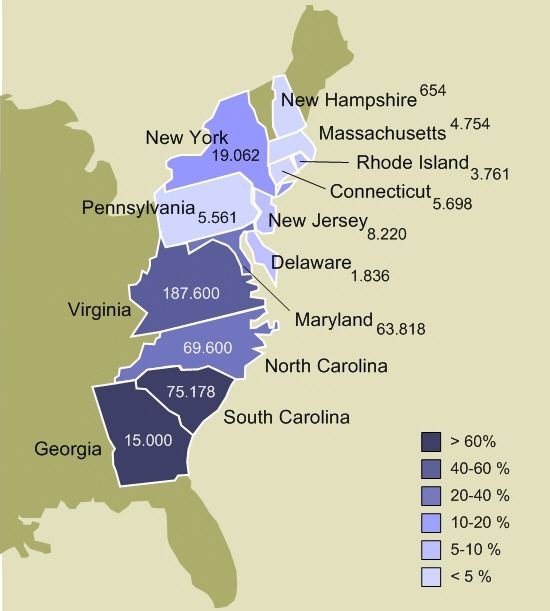
In the seven Northern founders of the US (Massachusetts, Connecticut, Pennsylvania, Rhode Island, New York, New Jersey, and New Hampshire) slavery was abolished in the first 30 years of independence, while in the Southern six (Virginia, Delaware, Georgia, Maryland, North and South Carolina) it continued to exist until the 1860s.
This was not because Northerners were more humane or cared about Black rights—racism was sadly the norm in America at that time.
Number of slaves in the first thirteen US states at the time of independence: a clear disparity between North and South. Infographic: Wikipedia / Stilfehler
Due to climate and tradition, plantation agriculture developed better in the South, which by default required slaves. In the North, white colonists preferred activities that did not require enslaved labor: farming, weaving, metallurgy, or manufacturing. The two ways of life were implicitly at odds. A large planter—with hundreds of acres and thousands of slaves and overseers—by his very business deprived dozens of potential farmers of land and limited the labor pool for, say, a watchmaker, carriage builder, or mine owner.
At first, Americans decided that an uneasy peace was better than a good quarrel. After all, they hadn’t fought the British for seven years just to fight each other afterward. In 1787, delegates from North and South reached the Connecticut Compromise, named after its author, lawyer Roger Sherman. His plan omitted mention of slavery and slaves in the federal Constitution, set a 20-year moratorium on banning the transatlantic slave trade, and established that, for representation in the House, slaves would be counted as 3/5 of a white person.
By the 1810s, the Connecticut Compromise had run its course regarding slavery. The US was expanding westward, new states were constantly being created, and the question arose: would they be slave states or free? In 1820, Congress passed the Missouri Compromise. The agreement required the federal government to admit new states in pairs: one slave, one free. Slavery was forbidden only in territories north of 36°30′ latitude and west of the Mississippi River, except for Missouri itself, which was admitted as a slave state by special exception.
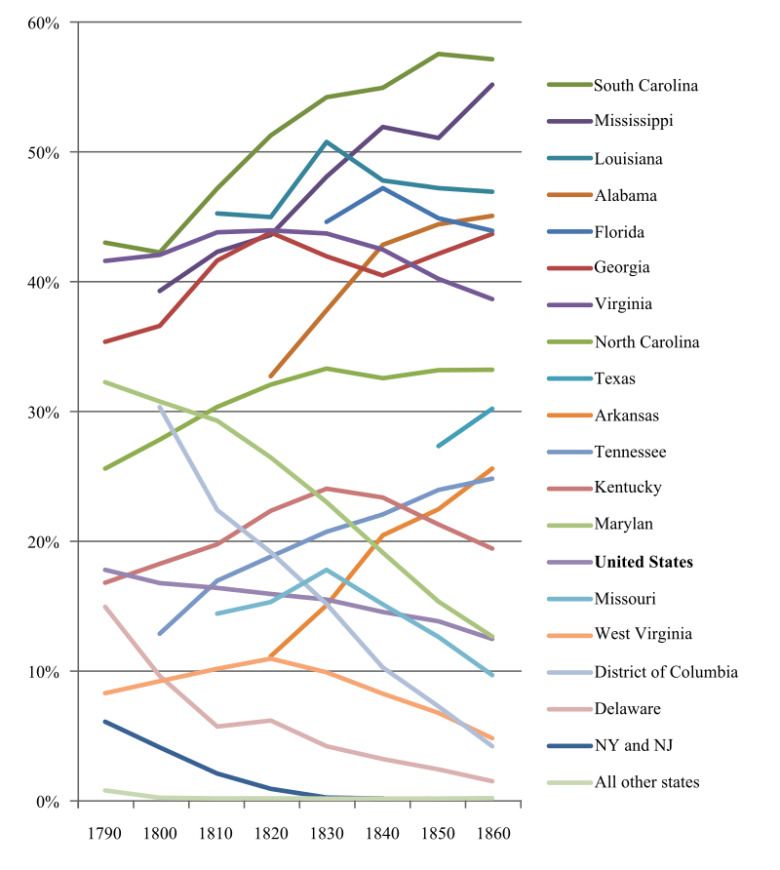
Share of slaves in the population of different states up to 1861. As shown, in key Southern states this share kept growing—slavery would hardly have disappeared there without outside intervention. Infographic: Wikipedia / MHz`as
As can be seen, the 1820 “compromise” was so only in name—planters actually won twice. First, they secured the subtropical zone of the US, and second, they achieved parity in the number of “their” and “other” states. Politically, this meant equal numbers of Southerners and Northerners in the Senate, allowing the former to block any anti-slavery initiatives. But, as often happens in history, “always” turned out to be temporary.
Folks, let’s live Southern
In the second quarter of the 19th century, the development of the United States was highly contradictory. On one hand, the North clearly chose an industrial path. Urbanization grew, factories and railroads were built. As a result, more European immigrants came to the North—there were more jobs and opportunities for private enterprise. By 1861, the North outstripped the South tenfold in industry, threefold in railroad mileage, and 3.5 times in the number of full citizens.
The future Confederate states took a different path. An extractive system based on plantation agriculture developed there. Only 3–4% of white Southerners owned twenty or more Black slaves, who grew cotton, tobacco, rice, sugar, or hemp. But families like the Heywards of South Carolina, the Randolphs of Virginia, or the Davises of Mississippi controlled the local economy and politics. Thousands of poor whites worked as overseers, gamekeepers, or artisans on their plantations, and hundreds of lawyers, officials, and journalists served their interests.
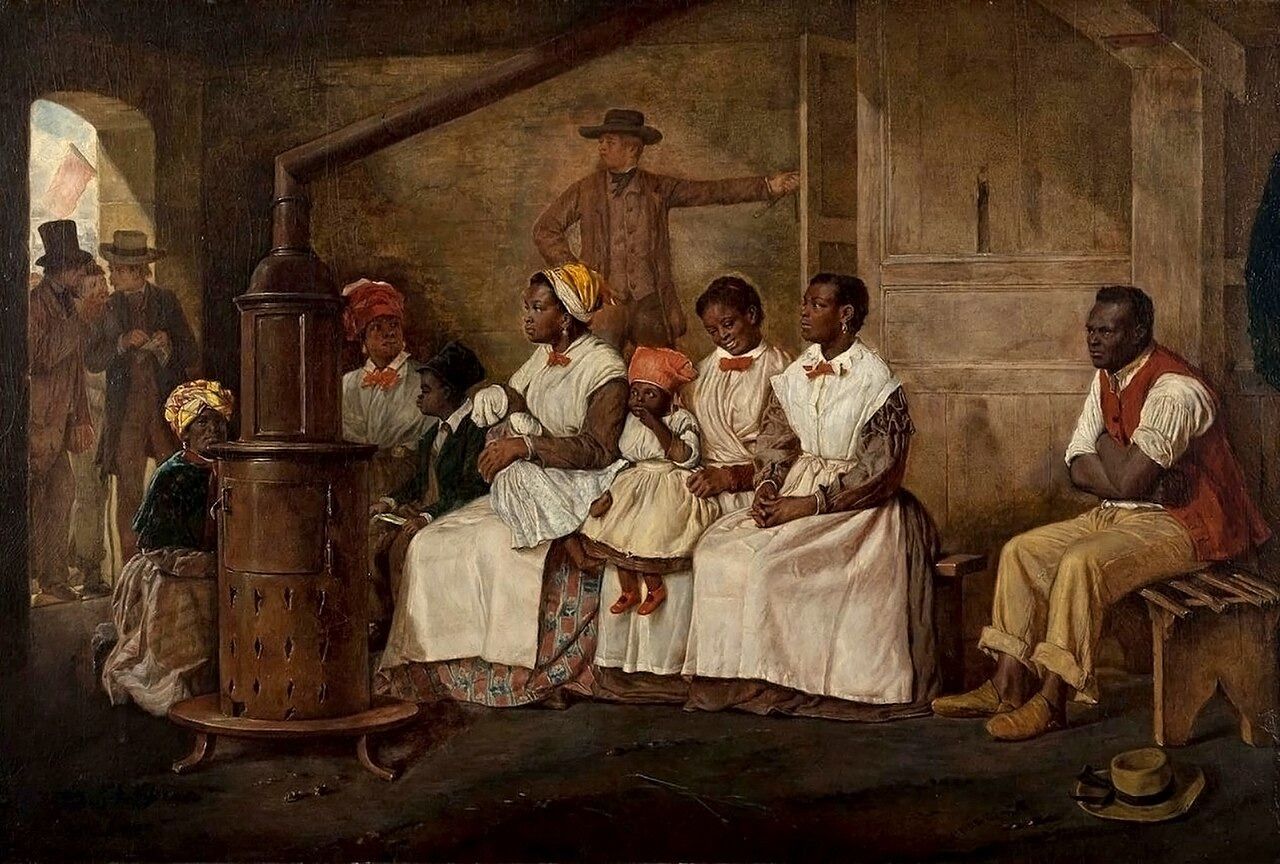
“Slaves Waiting for Sale,” painting by Eyre Crowe, 1861. Image: Wikipedia
Most importantly, in the 1830s–1850s, plantation raw materials were highly valued. By 1861, cotton and tobacco exports to Europe made up about 70% of US exports. Huge profits fueled the planters’ arrogance. While the “scrawny Yankees” tinkered up North, Southern gentlemen made real money. And if the losers from the North tried to infringe upon their rights, the answer would be secession of the Southern states.
Before God, I swear to this chamber and this country, that if you, by your laws, seek to drive us from California and New Mexico, thereby bringing the Union states to ruin, then I am for disunion. And I will stake myself and all I have on earth to achieve it
- from a speech in Congress by Georgia Representative Robert Toombs, December 1849
But until the late 1850s, the issue of Southern secession—also called Dixieland after the old border line—was not taken seriously. Planters enjoyed life in the unified federation. Since the 1820s, they had controlled the Democratic Party, the key political force of the era. Northerners’ interests were represented by several weak parties, and the Democrats easily outmaneuvered them.
By the 1850s, the White House and Capitol had essentially become branches of the planters’ drawing rooms. Each administration obediently resolved issues in the interests of slaveholders. Unsurprisingly, the three presidents before Abraham Lincoln—Millard Fillmore, Franklin Pierce, and James Buchanan—are still regularly ranked among the worst US leaders. Descendants remember them as men who used their power to blindly serve the ambitions of the Dixie elite.
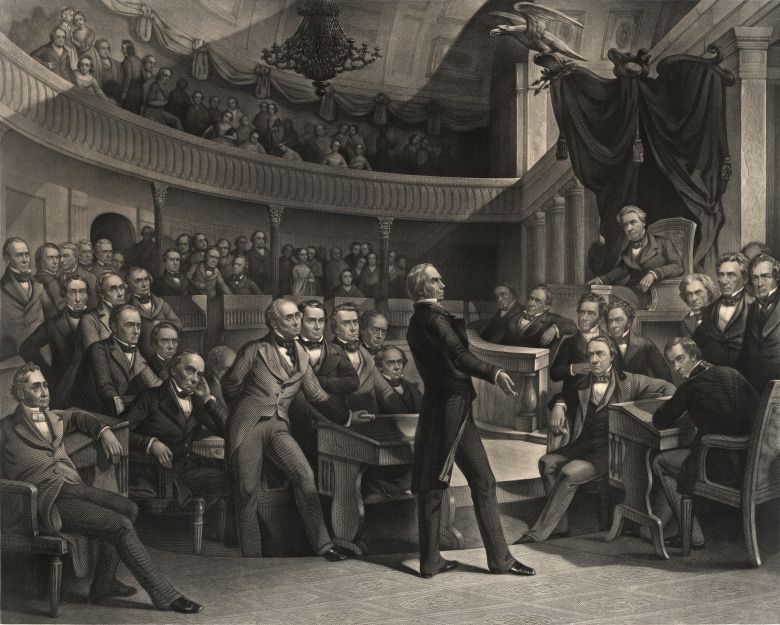
In 1850, with Washington’s support, the planters won another victory. Congress passed yet another questionable compromise, proposed by Virginian Henry Clay. He suggested admitting California, taken from Mexico, as a free state without a slaveholding pair. In exchange, Clay asked Northerners for mere trifles: to return escaped Southern slaves and to accept the so-called “doctrine of popular sovereignty,” under which the legality of slavery in a territory would be decided by its residents, bypassing the 1820 agreements.
Henry Clay (standing center) presents his “compromise” plan to the US Senate, 1850. Image: Wikipedia / Peter F. Rothermel
The Southern lobby was strong enough for Congress to pass Clay’s plan in five separate acts. But the silent majority of Northerners began to feel they were losing their country. Even whites indifferent to the plight of plantation slaves were outraged that their states were now required to return the few brave escapees to their owners. “I cannot believe that this filthy law was passed in the nineteenth century by people who can read and write. I swear to Heaven, I will not obey it!“ wrote Massachusetts publicist Ralph Emerson.
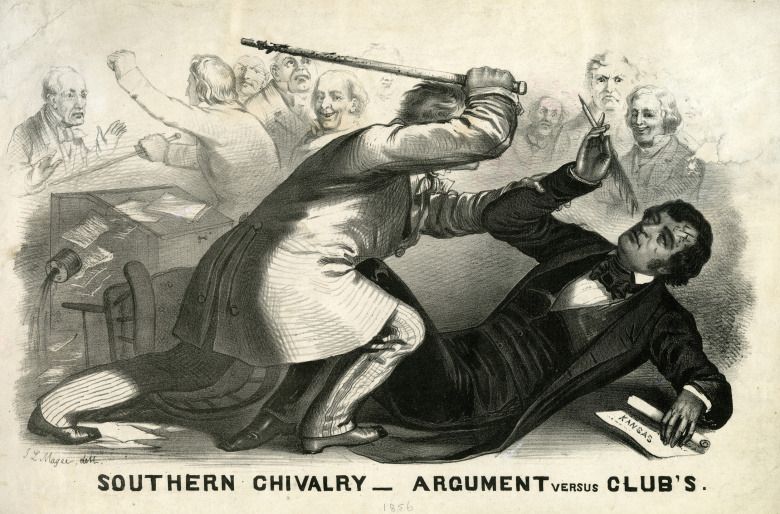
A turning point in the American crisis came with another conflict. In the spring of 1854, Congress passed a new law favoring slaveholders, the “Kansas-Nebraska Act.” The law again violated previous agreements: Southerners gained territory north of the agreed 36°30′ parallel. Moreover, thousands of Northerners had already settled in Kansas, starting farms and building railroads. After the law passed, arriving slaveholders issued an ultimatum: accept their rules or go home.
South Carolina Congressman Preston Brooks beats Massachusetts Senator Charles Sumner for harshly criticizing slaveholder actions in Kansas. May 20, 1856. Image: Wikipedia / John L. Magee
Northerners responded with armed resistance, which escalated into a mini–civil war. In 1857, Southerners, with federal army support, suppressed their opponents’ detachments, but two years later, anti-slavery forces won a referendum on the constitution—surprisingly, the anti-slavery project prevailed.
“One Southerner will easily defeat a dozen Yankees”
By the time of the Kansas fighting, abolitionists (as anti-slavery Americans were called) had finally created a serious political force. On March 20, 1854, in Wisconsin, veterans of several unsuccessful movements and disenchanted Democrats founded the new Republican Party. Its core platform was the slogan of preventing the spread of slavery beyond the historic South.
It’s important to note: the party rarely spoke about abolishing slavery entirely or full emancipation for Black people. The most famous early Republican, future president Abraham Lincoln, positioned himself as a pragmatist—someone who would find a real compromise with Southerners and not trouble them with sermons about the sinfulness of slavery or the vileness of racism.
I am not, nor ever have been, in favor of bringing about in any way the social and political equality of the white and Black races [...] of making voters or jurors of Negroes, nor of qualifying them to hold office, nor to intermarry with white people.
- from Lincoln’s speech at the Illinois debates, 1858
But the Southerners sought no half-measures. Their extensive economy could yield super-profits only in the system they had built: with the constant expansion of slavery westward and minimal tariffs on European goods. Any change threatened to destroy this order and ruin the cotton kings. So the new party was initially seen in Dixie as a “ band of dirty mechanics, small farmers, and crazed philosophers,“ as a Georgia newspaper wrote. And Lincoln, despite his moderation, was considered as much a “Negro lover” as his more radical party colleagues.
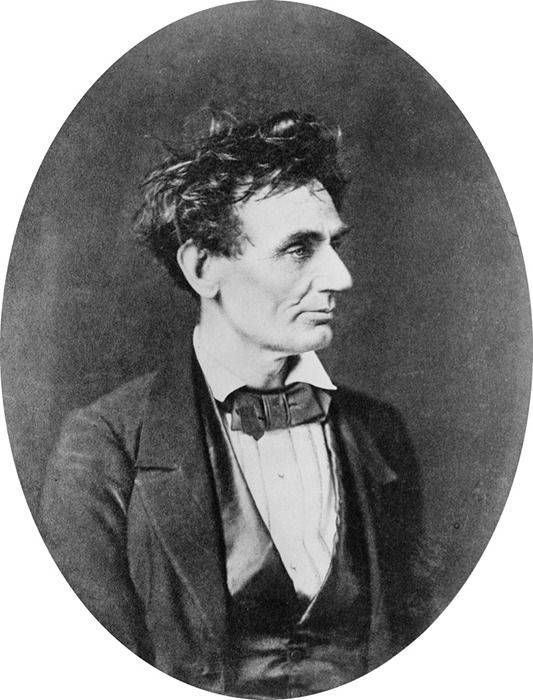
Abraham Lincoln in 1857. Photo: Wikipedia / Hesler, Alexander
In the late 1850s, Southerners’ hatred for Republicans only grew. The upstarts quickly swept away the old Northern parties, won Congressional elections in several states, and became the second political force in the US. The country itself was losing unity. Almost every significant social event further split the federation. Take, for example, the publication of two very different books: Uncle Tom’s Cabin by Harriet Beecher Stowe (1852) and The Impending Crisis of the South by Hinton Helper (1857).
Committed humanist Beecher Stowe and staunch racist Helper produced two very similar works. The first, in a world-famous novel, denounced slavery from a Christian moral perspective, while the author of “Crisis” attacked the archaic institution in purely utilitarian terms. Helper argued that plantations exhausted Southern soil and prevented poor whites from freely engaging in farming, crafts, and trade. Thus, slavery entrenched Dixie’s industrial backwardness, which was only temporarily offset by Europe’s high demand for American cotton.
Both books provoked a torrent of impotent rage and hack writing among Southerners. Dozens of authors of dubious literary and political-economic works tried to refute Beecher Stowe and Helper’s conclusions. They failed, and in the end, slaveholding states’ authorities could think of nothing better than to ban both hated books. But by then, the battles between the two camps were inexorably turning violent.
“Husbands, wives, and families, sold indiscriminately to different buyers, violently separated, will probably never meet again.” Lithograph by American anti-slavery activists, 1843. Image: Wikipedia / Armistead, Wilson
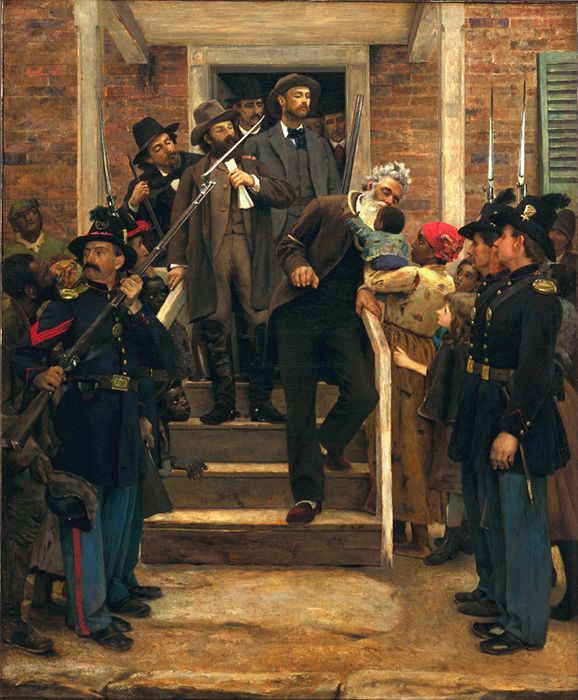
From October 16–18, 1859, just after the Kansas conflict had subsided, the US was shaken by new violence. A group of 21 radical abolitionists led by bankrupt farmer John Brown attacked the Harpers Ferry arsenal in slaveholding Virginia: the rebels wanted to seize weapons and distribute them to Black people, inciting a mass uprising. The desperate venture failed as expected. Brown’s group was quickly defeated by local militia and the Marines.
At any other time, Brown’s raid might have been dismissed as the act of a lone madman. But given the background, the Harpers Ferry incident was seen as a battle of good versus evil. For Northern abolitionists, the hero was the brave Brown (he survived, was arrested, and hanged a month and a half later); for Southerners, the heroes were Virginia militiamen and soldiers. Symbolically, Brown’s captors were two future Confederate generals, Robert E. Lee and Jeb Stuart.
The last moments of John Brown’s life, painting from 1884. Image: Wikipedia / Thomas Hovenden
Dixieland was especially outraged by the results of the brief investigation into Brown. It turned out the rebel was not acting entirely alone—he was financed by a group of like-minded businessmen from the North. The militant Southerners saw this as an invitation to war. “The people of the South are direct descendants of the Norman barons of William the Conqueror, an elite distinguished from ancient times by their warlike and fearless character. [...] Therefore, if it comes to battle, one Norman Southerner, without a doubt, will defeat a dozen vile Saxon Yankees,“ wrote the Virginia newspaper Southern Literary Messenger in 1860.
The parade of sovereignties
Of course, the conflicts described above are just a small part of the storms that shook the US in the 1850s. Consider just the Scott v. Sanford case mentioned at the beginning. Planters and their supporters tried to make slavery legally unassailable, but suffered a significant reputational defeat. Paradoxically, the racist judge Roger Taney handed abolitionists an invaluable gift.
Taney, among other things, declared the Missouri Compromise of 1820 unconstitutional, including the custom of admitting new states in pairs. The judge clearly had Southern interests in mind, but Northerners acted faster. From 1858 to 1861, with Republican support, the territories of Minnesota, Oregon, and Kansas gained statehood as free states. The balance within the federation shifted toward abolitionism: only 15 slave states versus 19 free. Separatist sentiment in Dixie rose sharply, as the federal Senate no longer served as a perfect brake against Northern politicians.
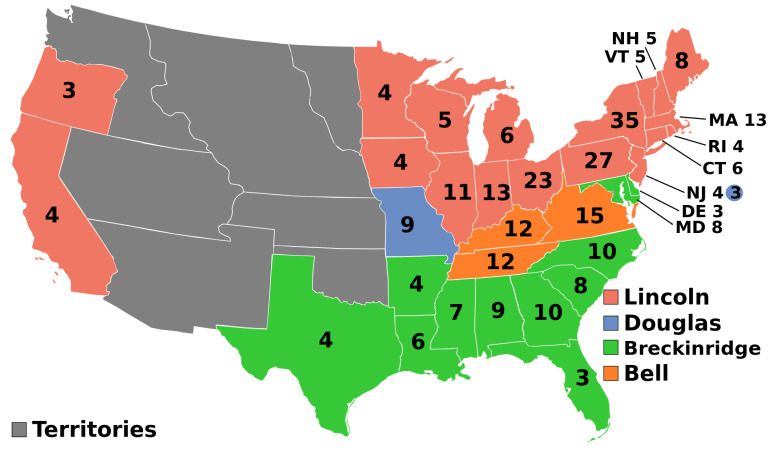
State voting in the 1860 election. Red shows states won by Lincoln, blue—Northern Democrat Stephen Douglas, green—Southern Democrat John Breckinridge, orange—John Bell, candidate from the fourth force, the “Constitutional Union.” Gray—federal territories not yet states and not voting. Infographic: Wikipedia
Given all this, the presidential election of November 6, 1860 became the “final battle for Washington.” Defenders of slavery made another strategic mistake. Due to infighting, the Democrats fielded not one, but three candidates, while abolitionists united behind Lincoln. In any case, “Honest Abe” was backed by the most populous states and would have likely won even against a united Southern candidate—Lincoln received 180 electoral votes, while his opponents together got only 123.
The planter elite faced an unpleasant reality. For the first time in US history, the people had elected a president they did not control, and the key political lever of the slaveholders—the Democratic Party—had broken into warring factions. The North had put the South in a bind: either the Southerners would moderate their zeal and negotiate new terms of coexistence with Lincoln, or they would carry out their old threat of secession. The South chose the latter.
Initially, only six of the 15 slave states were involved, the so-called “Deep South”: South Carolina, Mississippi, Florida, Alabama, Georgia, and Louisiana. This region had accumulated too much racism, fervent belief in the sanctity of slavery, and hatred of Republicans for local politicians to choose peace with the Yankees. In December 1860–January 1861, a parade of sovereignties swept Dixie, and on February 8, the rebellious six declared themselves a new union, the Confederate States of America.
In early March 1861, Texas joined the Confederacy. But the remaining slave states could not decide which was the lesser evil—Republicans in the White House or outright conflict with the North? Especially since Lincoln was winking at the wavering states: no one in the White House wanted to abolish slavery, and everything could still be negotiated.
I declare that I have no intention, directly or indirectly, to interfere with the institution of slavery in the states where it exists. I believe I have no lawful right to do so, and I have no inclination to do so
- Abraham Lincoln, from his inaugural address, March 4, 1861
***
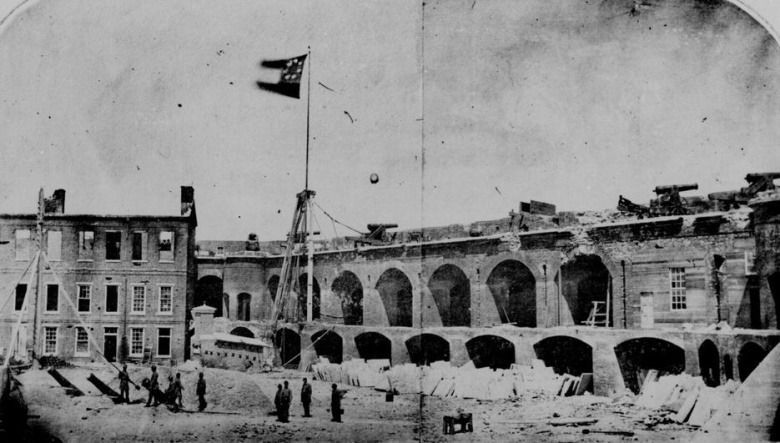
In the spring of 1861, the Confederates decided to escalate. On April 12, in South Carolina, the secessionists shelled the federal Fort Sumter. The reason was the refusal of the fort's commander, Colonel Robert Anderson, to join the CSA. This militarily insignificant event—Anderson surrendered after a few shots—marks the start of the Civil War.
Fort Sumter after being taken by the rebels. The three-striped CSA flag is visible on the flagpole, raised in place of the former federal one. April 15, 1861. Photo: Wikipedia / Alma A. Pelot
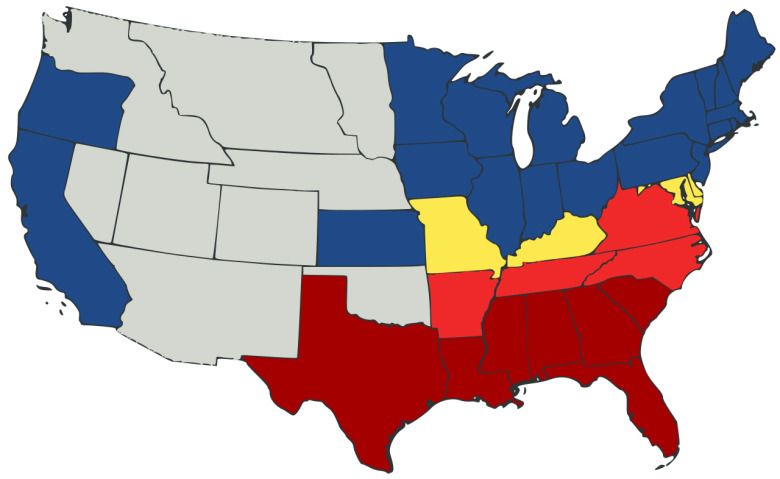
Patient Lincoln only declared the seven seceded states rebellious and called on Americans to join the army after the shelling of Sumter. The eight undecided slave states had to choose. Four (Virginia, Arkansas, North Carolina, and Tennessee) joined the CSA, and the other four (Missouri, Kentucky, Maryland, and Delaware) either remained in the Union voluntarily or were preemptively occupied by federal troops.
Even after the war began, Washington left the door open for its wayward territories. The country's leaders, including Lincoln himself, repeatedly stated that they were fighting to restore the Union, not to abolish slavery. Even the Emancipation Proclamation of January 1, 1863, explicitly granted virtual freedom only to slaves in rebellious lands. In loyal states, slaveholders’ rights were untouched until 1865.
The division of North America in 1861: blue—free US states, brown—founding slave states of the CSA, red—slave states that joined the CSA after the fall of Fort Sumter, yellow—slave states that remained in the US. Infographic: Wikipedia
So what’s the bottom line? On close examination, the legend of the Lost Cause doesn’t stand up to scrutiny. In reality, there was no expansion of Yankee merchants against noble Southerners. On the contrary, Northerners tolerated countless “compromises” at their own expense for far too long. And when they finally achieved the necessary political unity, Dixie became convinced of its own exceptionalism and infallibility.
Economically, this belief rested solely on a temporary anomaly—high export prices for cotton, which would inevitably have fallen. The South’s extensive economy made real development impossible (not to mention the absolute immorality of slavery). Moreover, in a crisis, Southerners could not provide themselves with manufactured goods or even food. They would experience all this fully during the brutal war of 1861–1865—a war they largely started themselves in the name of toxic ideological chimeras.
Main sources for this article:
Latov, Yu. New Economic History of the US Civil War and the Elimination of Economic Slavery;
McPherson, J. Battle Cry of Freedom: The Civil War Era;
Maltz, K. The Civil War in the United States;
Popov, A. Freedom Granted by Necessity: How the US Abandoned Slavery;
Rimini, R. A Short History of the United States;
Tippot, S. USA. A Complete History of the Country.
If you enjoyed this article, consider making a donation — one-time or, even better, monthly. Your support helps us motivate our authors and become better with every article.
Our organization is recognized by the Internal Revenue Service (IRS) as a 501(c)(3) tax-exempt, charitable organization, which means that all contributions made to us are tax-deductible to the fullest extent permitted by U.S. law. Individuals may generally deduct charitable contributions of up to 60% of their Adjusted Gross Income (AGI) for cash donations made to qualifying 501(c)(3) organizations. For donations of appreciated assets (such as stocks or other long-term capital assets), the deduction is typically limited to 30% of AGI, based on the fair market value of the asset. C-corporations may deduct charitable contributions of up to 10% of their taxable income for donations made to eligible charitable organizations.
By submitting a donation, you confirm that you have read and accept the following documents: Privacy Policy and User Agreement, and also give consent to the processing of your personal data.
If you would like to unsubscribe from a monthly donation, please email us at: [email protected]