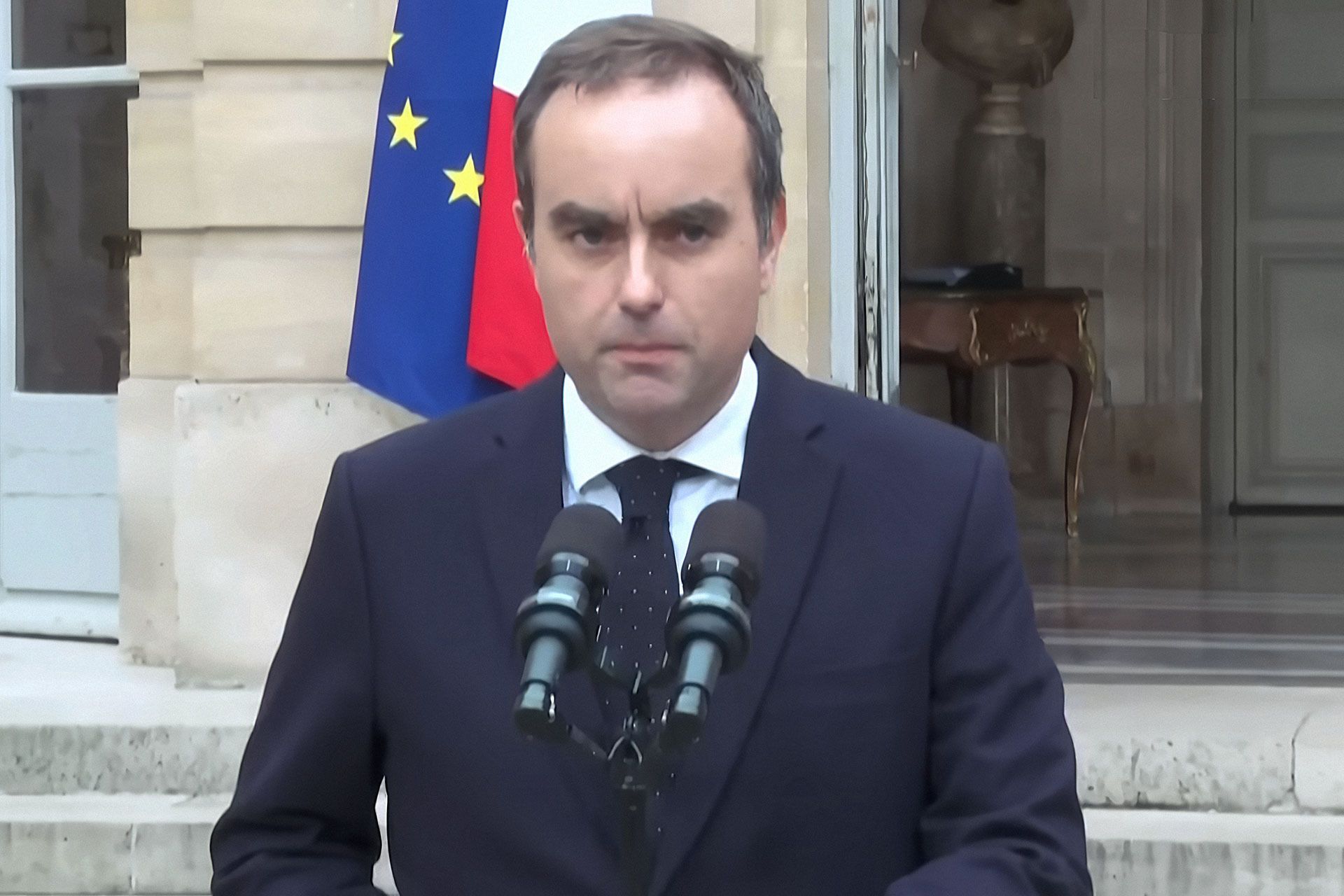
The new prime minister of the country, appointed by President Emmanuel Macron, suddenly turned out to be the very same person who resigned from the same position three days before the appointment.
Frame from video: RFI / YouTube
Former Defense Minister Sébastien Lecornu, one of Macron’s most trusted and closest people, spent almost a whole month since the resignation of the previous government of François Bayrou consulting with leaders of various political forces in the National Assembly. It seemed he managed to agree on the composition of the new cabinet, but at the last moment the agreements collapsed, and on October 6, a desperate Lecornu went to the Élysée Palace to refuse the hopeless mission.
But the conversation with Macron turned out so that the president asked his ally to continue consultations with representatives of the leading political forces — and Lecornu became prime minister again, announcing the new government composition. However, his fate was again hanging by a thread, as the cabinet could not rely on a majority of votes in the National Assembly. On the morning of October 16, 271 deputies voted for a vote of no confidence against the required 289, and the government held on literally at the last line.
The current parliament was formed following early elections announced by President Macron on the evening of June 9, 2024, immediately after the European Parliament election results, where Marine Le Pen’s RN party won a convincing victory. The post-election balance of power turned out to be very unusual for French political life, with no absolute majority of 289 seats in the National Assembly, but three poles roughly equal in representation. These are the left-wing NFP bloc, the centrist block of the presidential coalition, and Marine Le Pen’s National Rally (RN) party with allies. Considering that each of the first two blocs includes several parties, each with its own interests and voter relations, as well as individual ambitions of leaders, a very colorful picture emerges, not conducive to compromise.
Both the left-wing NFP bloc and RN with right-wing allies built their election campaigns on a complete rejection of “Macronism,” i.e., President Macron’s policies over the past seven to eight years. This approach cannot be considered any special discovery, as the president’s rating has steadily declined since his victory in 2017 and now fluctuates somewhere between 15% and 20%.
It is not surprising that the composition of the National Assembly reflects public sentiment, and about two-thirds of deputies demanded a revision, particularly of the pension reform, which corresponded well with the wishes of the majority of French people. As a result of this uncompromising position, a political deadlock arose: Macron appointed prime ministers from his circle, but the opposition dismissed them.
Few now remember that Emmanuel Macron won convincingly in 2017 with a project of quick and effective reforms. During the election campaign, his book was published with the characteristic title “Révolution,” where the future president promised to end the political customs of the old parties, attract new people from civil society, and pave the way for a renewed, dynamic, and modern France.
Voters tired of the same faces in power representing traditional parties gave a vote of confidence to the young and energetic candidate, giving him their votes not only in the presidential elections but also supporting his political movement in the National Assembly elections, where Macron’s supporters now had an absolute majority. Thus, the new president had all the necessary tools and a five-year planning horizon to begin the promised revolutionary transformations.
Indeed, Macron’s first year in office was marked by the implementation of several reforms, among which the long-overdue reform of the railways stood out. There was no shortage of vivid speeches with visionary views on the future of France and Europe. But by the end of 2018, the whole country was gripped by the “yellow vests” protests.
The government had to freeze the pension reform that was next in line but caused predictable disagreement among many French citizens. Macron decided not to escalate the situation, to refine certain provisions of the project, and buy time.
However, at the beginning of 2020, a new crisis arrived, this time a health one related to the COVID epidemic. Another emergency situation arose, and all forces were thrown into fighting the new threat.
Thus, Macron’s first presidential term flew by unnoticed: new elections were scheduled for spring 2022. The usual scenario of the election campaign would be the president defending the results of his time in the Élysée Palace and presenting a list of his achievements, while his opponents would focus on shortcomings and omissions. But in February 2022, Russia invaded Ukraine, and Macron abandoned domestic affairs to devote himself fully to attempts to resolve the new crisis.
He won the presidential election somewhat by inertia, without a real campaign, again defeating Marine Le Pen in the second round, although with a smaller margin. But voters were left with a strange feeling: five years had passed, the president was exceptionally active, constantly fighting difficulties, but it was not very clear what had actually been accomplished. And as a warning, citizens did not give the president an absolute majority in the National Assembly, where deputies from a diverse opposition could now play a more significant role.
Probably, Macron should have interpreted this circumstance as a warning bell, signaling that the French neither understood his intentions nor his actions. Perhaps he needed to adjust his management style, create some coalition in parliament based on a reform project for the next five years. But he preferred to behave as if he still had the same vote of confidence as in 2017.
This time, the pension reform met very strong resistance both in parliament and society — and was passed by a special law without a vote, which left the French feeling injustice and strengthened the opposition’s position. Macron’s decision to hold early elections in the National Assembly in June 2024 was probably made in an emotional impulse — but as a result, he lost the relative majority, got an even more hostile composition of deputies, and lost the remnants of his positive rating in society. Contrary to expectations, the once promising young president turned into a classic example of a “lame duck,” barely limping to the end of his term.
The difficulties of compromise
The constitutional powers of the president of the Fifth Republic are so great that they allowed him to maintain influence even in such a difficult situation; in particular, he retained the right to appoint the prime minister at his discretion. Nevertheless, Macron had no good moves left. He did not want to hand the government over to the right or left radical opposition; however, even if he had, that government would not have secured majority support in the National Assembly. He could again dissolve parliament and call early elections — but, according to polls, the new composition would be even more problematic.
Essentially, the only option left for Macron was to shuffle prime minister candidates from his circle, hoping that one of them could avoid a vote of no confidence in the National Assembly, at least temporarily, by persuading part of the opposition to compromise in exchange for some concessions.
Why did Sébastien Lecornu succeed where his predecessors failed?
Two significant reasons can be highlighted. First, polls predicted failure not only for the presidential bloc parties but for all moderate opposition representatives — while radical forces would emerge victorious. In this situation, many uncompromising critics of “Macronism” from traditional parties, socialists, or republicans understood well the cost of their intransigence. Their choice was roughly this: to make a partial agreement with the president’s camp, forgetting their merciless exposures of “Macronism” for a while, or face voters after the dissolution of the National Assembly, risking the loss of some deputy mandates. It turned out that the first option was preferable.
Second, France’s difficult economic situation, with a budget deficit of 5.8% and public debt at 113% of GDP by the end of 2024, left little room for political maneuvering. The main question today is the revenues and expenditures for 2026, the balance of which would include measures to correct the current situation. But to prepare the budget, a government is needed, and to approve it, a parliament. Therefore, all scenarios with early elections or a new prime minister candidacy would exacerbate the crisis, delaying the budget adoption indefinitely. In the end, deputies’ sense of responsibility had to assert itself, and some of them, reluctantly, agreed to seek compromise with the hated “Macronism.”
It remains to understand what chances Sébastien Lecornu has for successfully passing the budget through the National Assembly in the remaining two-plus months, and what sacrifices this will require.
The price of the agreement
Sébastien Lecornu managed to reach an agreement with the socialists, splitting the left-wing NFP bloc, whose most radical members did not abandon the usual “all or nothing” position — and this agreement made it possible to avoid a vote of no confidence in parliament. From the prime minister’s speech, we can outline the concessions that had to be made.
First, the pension reform is frozen, which is perhaps the most painful point of the compromise. After all, the pension reform, though imperfect and poorly implemented, remained Macron’s main achievement, and abandoning it symbolizes recognition of the overall failure of his presidency. And that’s not even considering the state of the government’s revenue and expenditure balance, which requires tightening fiscal policy rather than introducing more leniency.
Second, a refusal to use the special law allowing the budget to bypass a vote in the National Assembly was proclaimed, complicating the government’s task.
Third, the budget deficit target for 2026 was set at 5%, unlike the plans of François Bayrou, Lecornu’s unsuccessful predecessor, who aimed for 4.6%. Accordingly, Bayrou planned savings of 44 billion euros, while Lecornu agreed to limit it to 31 billion euros in 2026. This is far from the EU norm of 3%. France continues to spend more than it earns and is in no hurry to fix the situation.
The real test of the reached compromise will be during the budget discussion. Deputies from all parties will try to avoid strict austerity measures, which are necessary but not fully understood by voters. When these measures are seriously discussed, the rule “let someone else pay, but not me” comes into effect.
The devil in the financial world is even more prone to hiding in details than other kinds of evil. All moderate deputies, from socialists to republicans, who today prevented the vote of no confidence, may tomorrow recall their criticism of “Macronism.” The 2027 presidential elections are approaching, where the main political prize of the Fifth Republic will be contested, and in budget discussions, all party leaders will have to consider this fact. It is very likely that the acute political crisis in France has only quieted down for a while and will soon flare up again with new strength.
If you enjoyed this article, consider making a donation — one-time or, even better, monthly. Your support helps us motivate our authors and become better with every article.
Our organization is recognized by the Internal Revenue Service (IRS) as a 501(c)(3) tax-exempt, charitable organization, which means that all contributions made to us are tax-deductible to the fullest extent permitted by U.S. law. Individuals may generally deduct charitable contributions of up to 60% of their Adjusted Gross Income (AGI) for cash donations made to qualifying 501(c)(3) organizations. For donations of appreciated assets (such as stocks or other long-term capital assets), the deduction is typically limited to 30% of AGI, based on the fair market value of the asset. C-corporations may deduct charitable contributions of up to 10% of their taxable income for donations made to eligible charitable organizations.
By submitting a donation, you confirm that you have read and accept the following documents: Privacy Policy and User Agreement, and also give consent to the processing of your personal data.
If you would like to unsubscribe from a monthly donation, please email us at: [email protected]