The loud “Freedom Flotilla for Gaza 2025” action last week was accompanied by many sympathetic comments, despite the senselessness and provocativeness of its content combined with the obvious promotional agenda of its participants. Using France as an example, one can see what European pro-Palestinian support forces rely on.
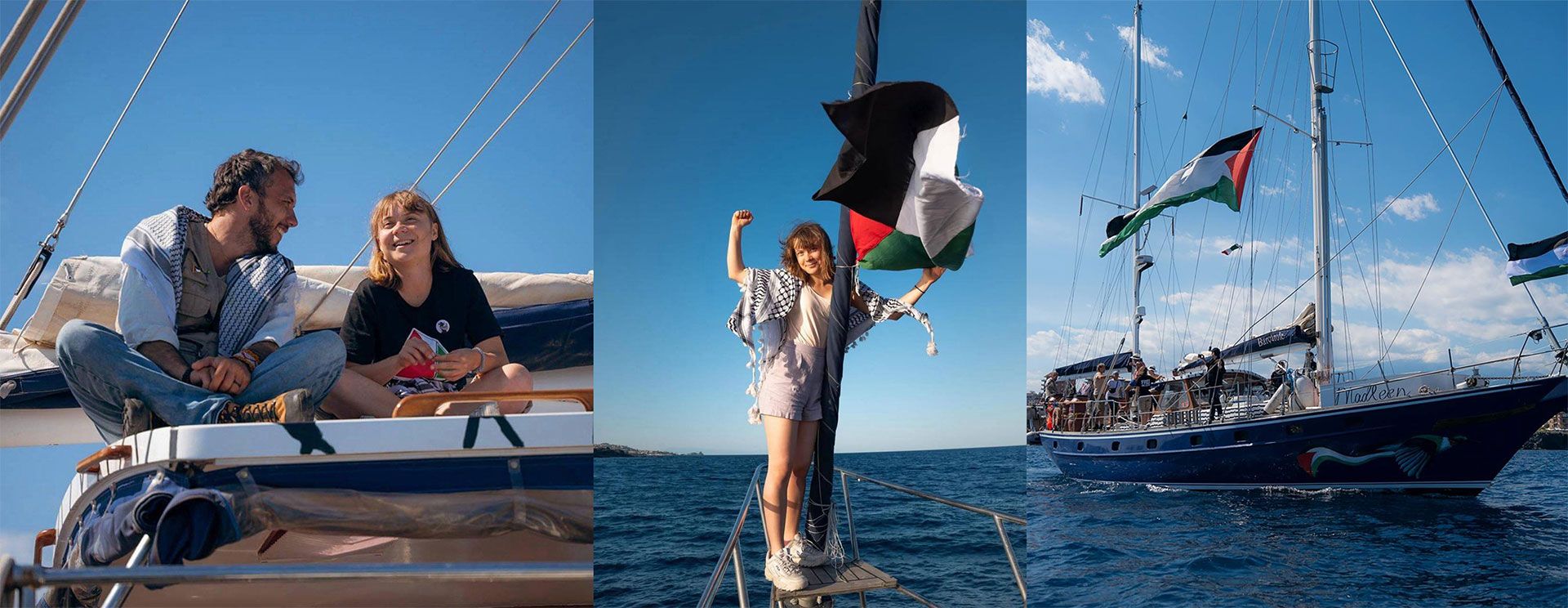
On the night of June 8 to 9, the sailing ship Madeleine, which alone formed the entire “Freedom Flotilla for Gaza 2025,” was detained in international waters by Israeli military forces. On board were 12 pro-Palestinian activists, including the well-known Greta Thunberg and Rima Hassan—a Member of the European Parliament from France representing the “Unsubmissive France” party (LFI). Of the 12 expedition participants, six held French citizenship. As their mission, the brave sailors declared breaking the blockade of the Gaza Strip imposed by Israel and delivering humanitarian cargo. During their brief sea voyage, the travelers posed with Palestinian flags, smiled a lot, and even played guitar, not forgetting to post photo and video reports on social media.
Photo: Greta Thunberg’s Instagram
This action was organized against the backdrop of a strong diplomatic offensive by some European countries against Israel under the banner of the idea of coexistence of two states, Jewish and Arab. In May 2024, Spain, Ireland, and Norway jointly officially recognized Palestine as an independent state. At the same time, Europeans clearly supported Israel after the terrorist attack on October 7, 2023, organized by Hamas from the Gaza Strip. However, when Tel Aviv launched a military operation against Hamas, the level of support began to decline, giving way to cautious criticism.
Two main criticisms of Israel can be highlighted: excessive use of force and the humanitarian catastrophe in Gaza. According to reports from international and human rights organizations, all this has led to suffering among the civilian population. From the European perspective, it is time to pressure Tel Aviv and convince it to move toward more selective use of military force and seek a political resolution of the crisis relying on moderate Palestinians, if any can be found. Netanyahu’s government, however, had its own arguments for continuing the operation in Gaza by methods it considered best suited to combating Hamas.
These disagreements led politicians in Europe to make increasingly sharp statements against Israel. In particular, French President Emmanuel Macron, in turn, also promised to officially recognize Palestine as an independent state, which did not improve his understanding with Netanyahu. However, Macron set forth conditions for this recognition, including a reform of Palestinian power structures that would ensure the disappearance of Hamas not only as a military but also as a political organization. It cannot be ruled out that the transition from words to action by the French president might be delayed somewhat, since practical implementation of the announced conditions is not expected soon, especially after Israel’s strikes on Iran.
Meanwhile, only a year ago, the Israeli Defense Minister thanked France for helping repel a missile attack from Iran, and European support for Israel’s actions against Hamas and demands for the unconditional release of all hostages seemed obvious and unwavering. Israel’s military operation against Iran aimed at destroying its nuclear project, which began on June 13, also did not provoke condemnation. It is worth recalling that the elimination of Hezbollah leadership and its military potential in Lebanon was also received quite favorably in Europe. It creates the impression that when Israel attacks Iran and its allies in Lebanon, Syria, or Yemen, its actions are judged by a somewhat different standard than in the case of Gaza.
The loud Freedom Flotilla action was accompanied in Europe by many sympathetic comments despite the senselessness and provocativeness of its content combined with the obvious promotional agenda of the participants. Using France as an example, one can try to understand what the pro-Palestinian support forces in Europe rely on.
That sweet word blockade
The reasons why providing Gaza residents with humanitarian cargo appeared, at least, problematic over many recent years are well known. The fact is that these supplies ended up with Hamas, were distributed by its representatives, and served the purposes of the “holy war” against Israel.
Tel Aviv, not denying in principle the need to provide Gaza’s civilian population with a basic set of food and medicines even during a military operation, did not want any resources to fall into Hamas’s hands. It should also be added that fighting in dense urban areas generally complicates any assistance programs for civilians, regardless of the goodwill of the parties. So the delivery of humanitarian cargo to Gaza was indeed interrupted, which naturally caused outrage among those sympathetic to the Palestinians.
If the Freedom Flotilla had set out during one of those moments, its mission would have been somewhat clearer—although the modest amount of aid on board intended for Gaza’s population was significantly outweighed by the impact of social media posts. But the fact is that the supply mechanism is now established, even if it continues to draw criticism. There is no need to deliver humanitarian cargo by roundabout routes—they are gathered, in particular, at the Israeli port of Ashdod, from where they go directly to Gaza. The sailing ship Madeleine could have headed there if its main goal was to provide humanitarian aid.
Greta Thunberg after detention by Israeli military. Photo: social media
Here we encounter the second contradiction in the activities of the 12 pro-Palestinian activists. Their action was planned on the assumption that no one wants to delve into the term “Gaza Strip blockade.” Meanwhile, there is a land blockade—from Egypt and periodically from Israel (which is linked to problems with delivering humanitarian aid). And there is a naval blockade imposed by Israel in 2007 after Hamas came to power in Gaza, aimed at preventing arms supplies to it. This naval blockade is illegal under international law, but a UN commission report, known as the Palmer Report, recognized Israel’s right to impose such measures under certain conditions and for security purposes. One way or another, supplying Gaza with humanitarian cargo does not depend on the naval blockade, since no ship with food or medicine has arrived in Gaza in recent years. There is no doubt that Hamas would be very pleased with easing the naval blockade imposed by Israel and would probably use this opportunity not for humanitarian purposes.
One of the main organizers of the Madeleine sailing ship mission was Zaher Birawi—a wealthy pro-Palestinian activist living in London who supports actions to break the naval blockade of Gaza. There are many joint photos of him with Hamas leaders, although he denies accusations of sympathy for terrorism. In any case, his entire set of statements leaves no doubt about his adherence to the idea of Palestine “from the river to the sea.”
In light of these circumstances, the Freedom Flotilla voyage appears not only as a promotional action by the participants, which would generally be excusable. Politically, there is a substitution of meanings when pro-Palestinian activists from Europe try to break a humanitarian blockade that does not exist but attack another blockade that prevents arms supplies to Hamas. These manipulations appear well prepared.
How it works
Greta Thunberg is well known to Russian-speaking audiences and has even become something of a household name (though she is unlikely aware of this). Therefore, it is better to take a closer look at other expedition participants, in particular, Rima Hassan, a Member of the European Parliament from France on the LFI party list. She was born in a Palestinian refugee camp but moved to France at the age of ten with her family, obtained citizenship, studied at the Sorbonne, and went into politics.
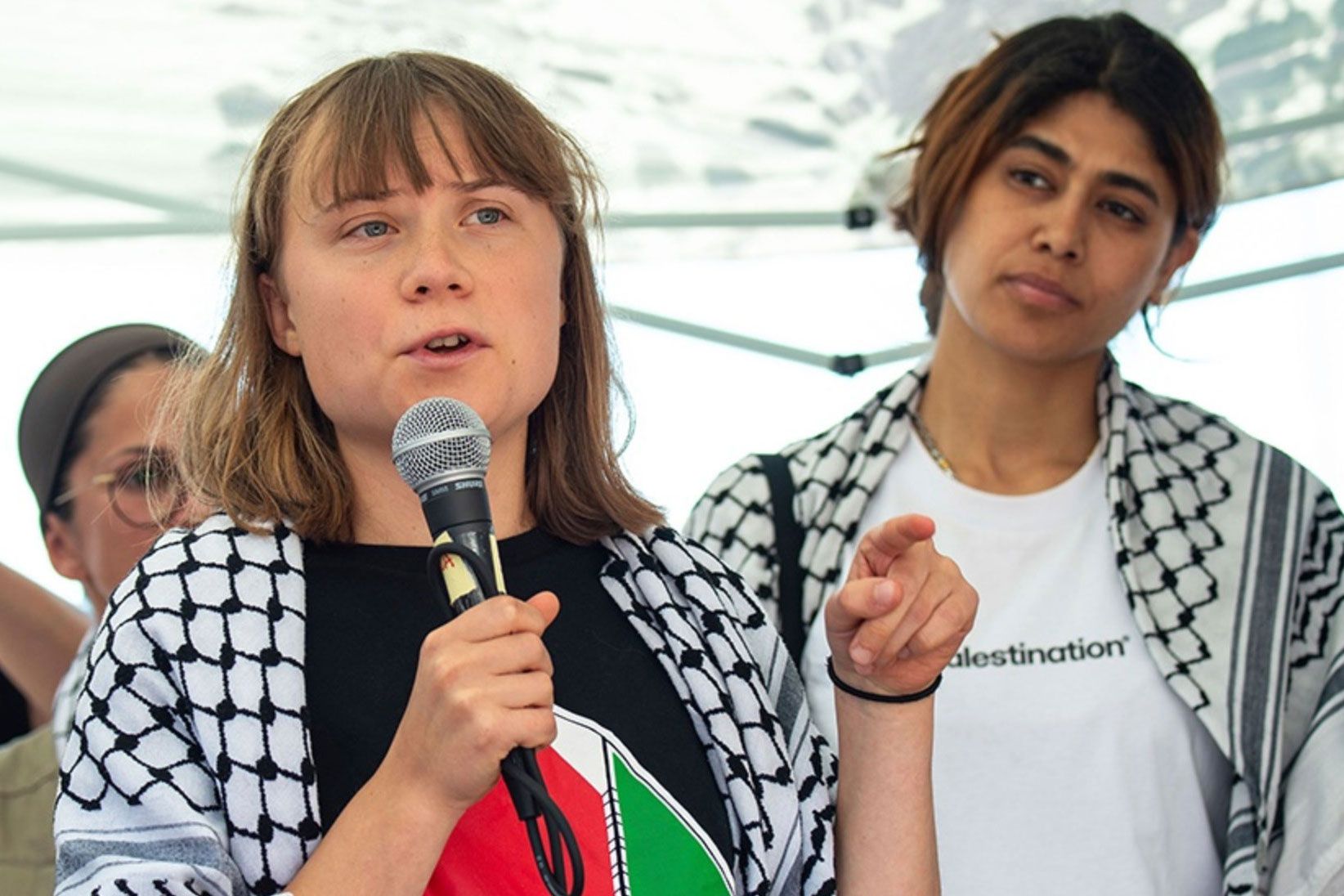
Press conference before the flotilla’s departure, right — Rima Hassan. Photo: Salvatore Cavalli/AP Photo/picture alliance
After the Hamas terrorist attack on Israel on October 7, 2023, Rima Hassan repeatedly used the slogan From the river to the sea Palestine will be free, called Hamas’s actions “resistance,” and was even summoned to the police in connection with “apology for terrorism.” All her speeches carefully avoided the hostage problem. Surprisingly, although a French politician and a prominent representative of a French political party, she focused exclusively on Palestinian issues, showing little interest in what was happening in France. Her statements were often scandalous and of openly antisemitic nature. She repeatedly characterized Israel’s actions as “genocide.”
Is this stance socially approved in France? More no than yes. Protests after the Israeli detention of the Freedom Flotilla gathered 50,000 demonstrators, according to organizers, and 8,000, according to police, which is very few for a country with such a tradition of protest movements as France. Rima Hassan is by no means a dominant voice, and the LFI party scares off most voters with its left-radical agenda and cannot claim significant influence.
So why does the Freedom Flotilla voyage, despite its obvious manipulativeness, receive mostly sympathetic comments? To answer this, it is useful to look at the assessments given by the President of Brazil regarding events in Gaza.
Strangely, Lula da Silva says roughly the same as Rima Hassan: about genocide, humanitarian catastrophe, and the need for coexistence of two states according to the original UN plan. And along with Lula da Silva, the entire “global South” speaks about this. It is primarily the global South that distinguishes between Israeli military interventions against Iran, Syria, Yemen, and so on—since these are sovereign states with which many global South countries have complicated relations—and Palestinians, who are perceived as victims of neocolonial policies in the worst traditions of the 19th century.
These sentiments are well read not only by Rima Hassan and Greta Thunberg but also by the entire French political class led by Emmanuel Macron. It is not just a matter of fighting for the sympathies of part of the French electorate, which (thanks to origin but not only) increasingly thinks about global South issues. As of May 2024, 147 countries have recognized Palestine as an independent state. This state of affairs cannot be ignored in European politics, creating a somewhat ambiguous situation where the right hand supports Israel while the left makes welcoming gestures to Palestinians.
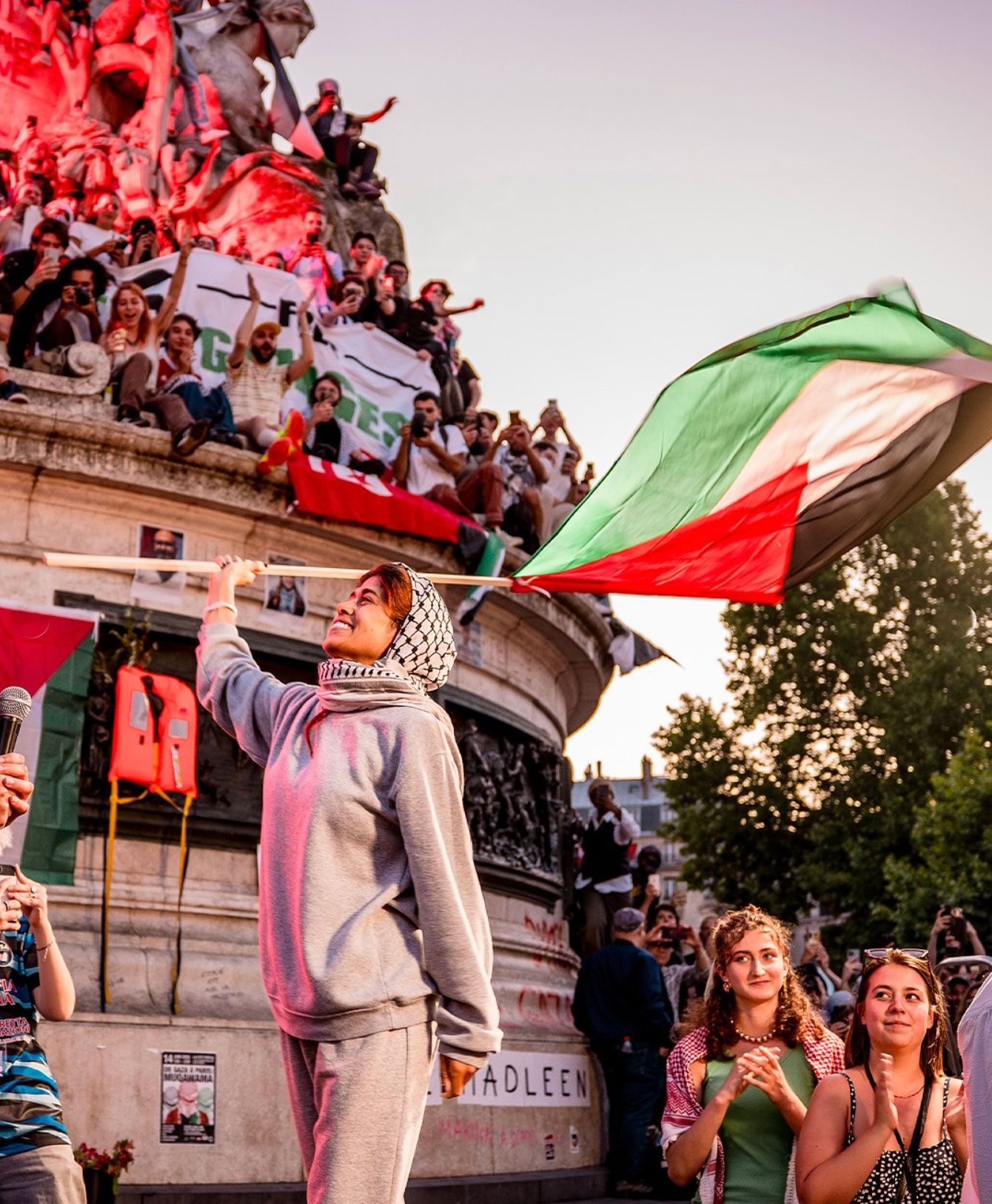
Rima Hassan at the rally celebrating the return of the Freedom Flotilla crew. Place de la République, Paris, June 12, 2025. Photo: Claire Jacquin via Instagram
Political strategy of “Unsubmissive France”
LFI leader Jean-Luc Mélenchon predictably described the detention of the Madeleine sailing ship as an “act of piracy.” He also condemned Israel’s strikes on Iran, but in a calmer tone. LFI is preparing for possible early elections to the National Assembly and, of course, for the 2027 presidential campaign, which suggests a calculated political reason behind the party’s pro-Palestinian sympathies. It seems that this stance has two important foundations.
On the one hand, Mélenchon’s electorate is mainly concentrated in disadvantaged areas of large cities, whose residents are more receptive to left-radical rhetoric. Many of them, personally or through one or two generations, come from former French colonies in North Africa or countries south of the Sahara, where Islam is the main religion. It is not surprising that in the conflict between Israel and the Palestinians and, more broadly, the Arab world, they predominantly side with the latter. Sympathy for Iran is much less, as they do not share the Shiite interpretation of Islam. Thus, a pragmatic electoral view inclines LFI to full support primarily for Palestine, as its example successfully combines the fight for the rights of the oppressed and dispossessed, condemnation of imperialism and Zionism, and decolonial rhetoric.
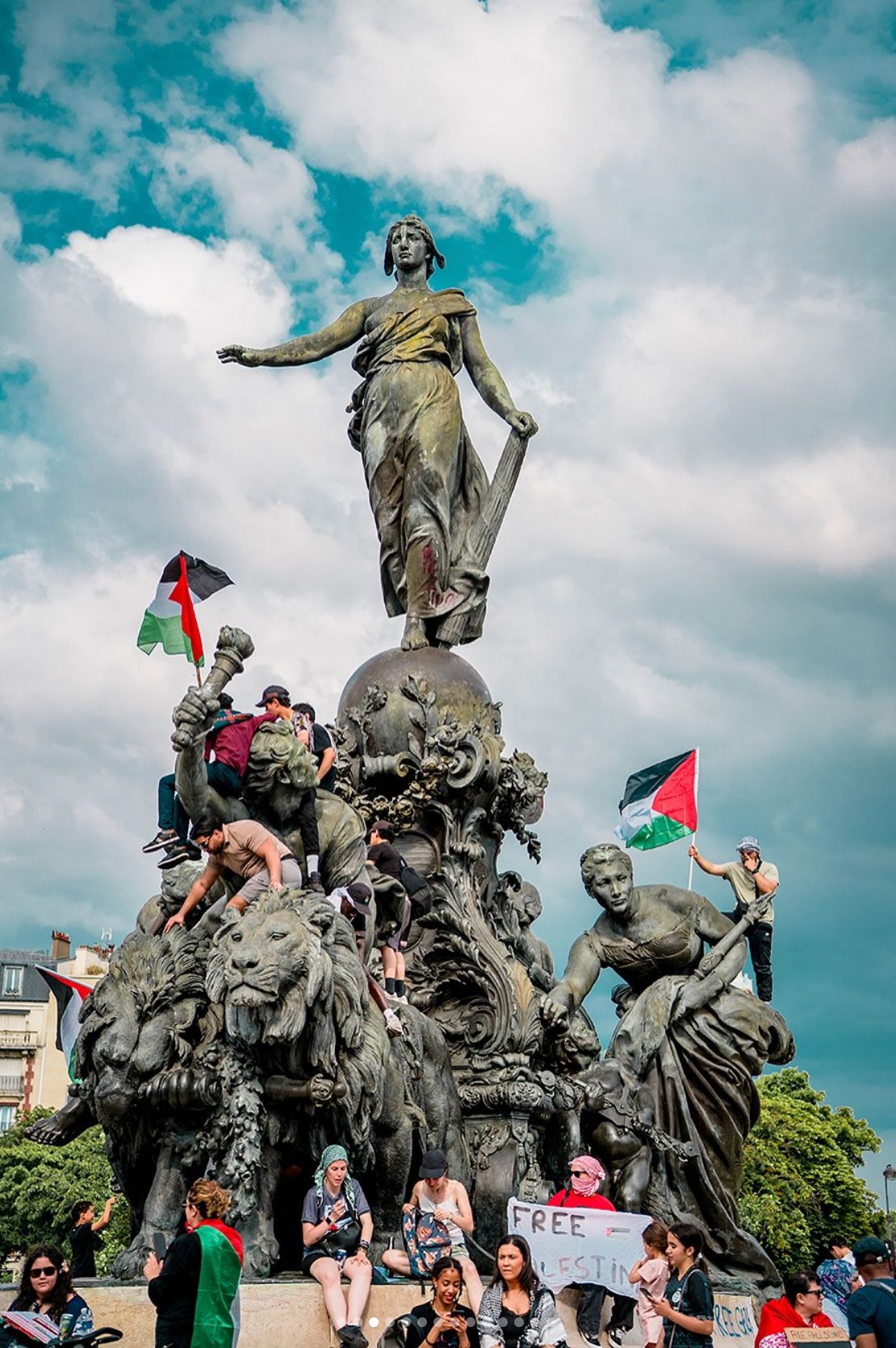
Demonstration against genocide in Gaza. Place de la République, Paris, June 14, 2025. Photo: Claire Jacquin via Instagram
But there are other considerations. It is commonly thought that a politician in a democratic system should try to unite as many people as possible around their program and become a center of attraction for the majority of voters. However, another strategy is possible, and we are witnessing its relative success. A political leader may consciously work to split voters and even provoke it, deliberately targeting those segments of the population that are unlikely ever to vote for them. This is exactly what Mélenchon does, excluding from LFI’s program not only French Jews but also all those sympathetic to Israel and who believe that Hamas is not a “resistance movement.” In this sense, Rima Hassan embodies division, and the Freedom Flotilla action gives it a “human face.”
One might ask: does Mélenchon really expect to win elections with such a strategy? Under normal conditions—of course not, but if chaos, crisis, and mutual distrust arise in society—perhaps yes.
In the main photo — Rima Hassan waving the Palestinian flag at a rally celebrating the return of the Freedom Flotilla crew. Place de la République, Paris, June 12, 2025. Photo: Claire Jacquin via Instagram
If you enjoyed this article, consider making a donation — one-time or, even better, monthly. Your support helps us motivate our authors and become better with every article.
Our organization is recognized by the Internal Revenue Service (IRS) as a 501(c)(3) tax-exempt, charitable organization, which means that all contributions made to us are tax-deductible to the fullest extent permitted by U.S. law. Individuals may generally deduct charitable contributions of up to 60% of their Adjusted Gross Income (AGI) for cash donations made to qualifying 501(c)(3) organizations. For donations of appreciated assets (such as stocks or other long-term capital assets), the deduction is typically limited to 30% of AGI, based on the fair market value of the asset. C-corporations may deduct charitable contributions of up to 10% of their taxable income for donations made to eligible charitable organizations.
By submitting a donation, you confirm that you have read and accept the following documents: Privacy Policy and User Agreement, and also give consent to the processing of your personal data.
If you would like to unsubscribe from a monthly donation, please email us at: [email protected]