«I laughed at a police officer — and they rushed at me». A conversation with a 16-year-old lycée student who went to a demonstration for the first time
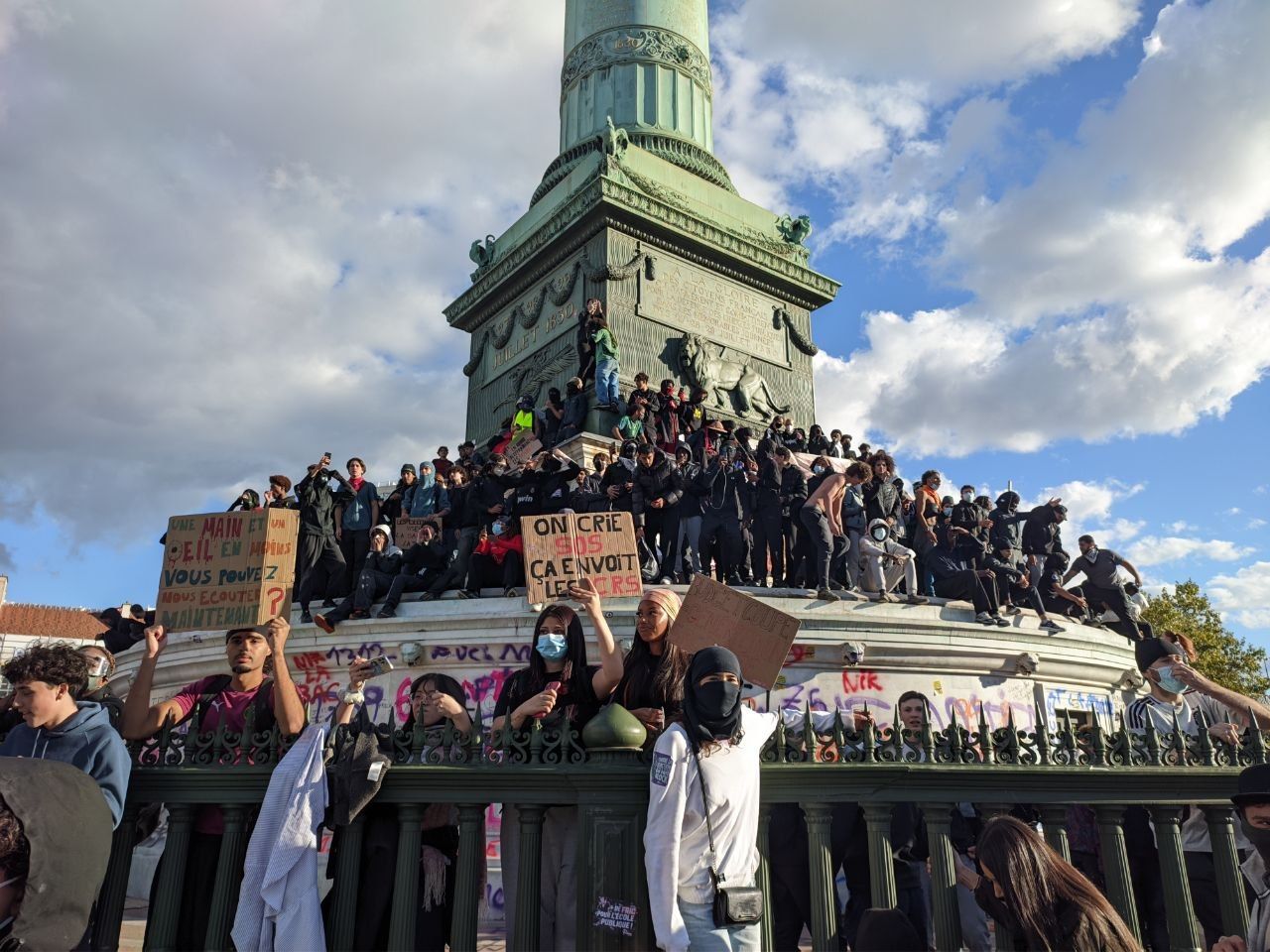
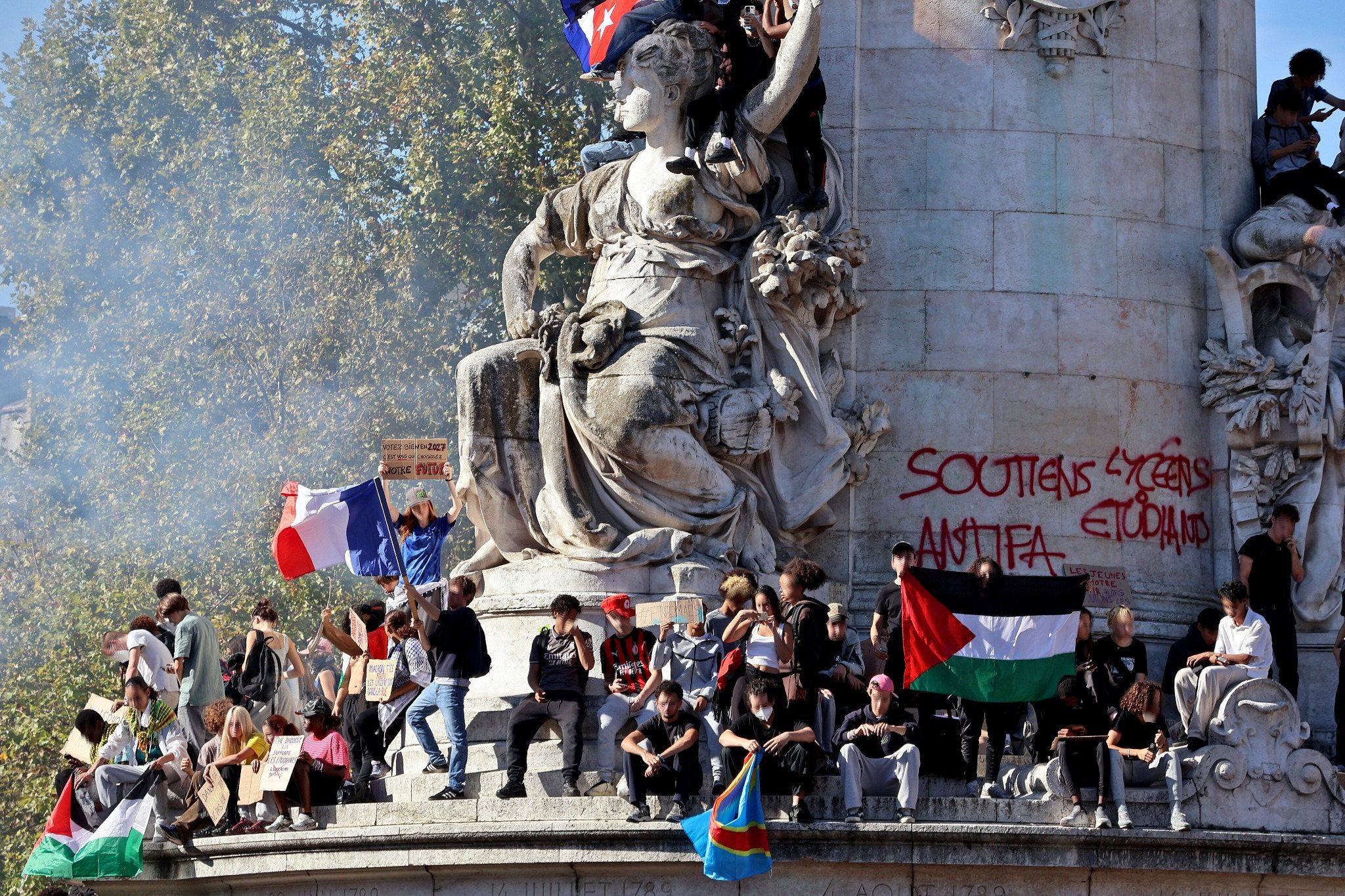
I recorded this interview anonymously a week after the large demonstration by lycée students on October 8 at Place de la Bastille in Paris. The scene at the event was picturesque: crowds of young people climbed onto the huge pedestal of the monument, amid clouds of black smoke from burning trash bins and white (tear) gas, dozens of fully equipped riot police “cosmonauts” with transparent shields and batons at the ready, face to face with fragile girls and boys clutching cardboard signs with witty handwritten slogans, bright scarves and black masks worn by participants, shouts and songs rolling from one corner of the square to the other, the booming blasts of stun grenades and the crackle of firecrackers. A sense of a risky celebration. This is almost how the big media portrayed the “revolutionary” lycée mobilization. Saturday, October 17 added to it — once again in recent years — smashed shop windows and burned cars. Terror in the streets of Paris! Meanwhile, in the French press, not to mention the Russian-language one, there were — once again — very few pieces offering a view of the events from the inside, through the eyes of participants.
Police gas attack during a protest action at Place de la Bastille, October 8, 2026
- I go to a private Catholic school. The parents of the students are mostly rich and very rich people. My father works in culture; he has left-wing views. My mother quit her job and now does charity work. The situation at school is simply unbearable for me.
- Do you blockSchool and university blockades (called blocus among French lycée students) are a protest tactic in which pupils and students close off access to an institution by barricading doors or setting up pickets, partially or fully suspending its operation. your school?
- No, not at all. We’re not allowed to. The administration simply told us: anyone who tries to set up a blockade will be expelled, because the school is private. Even if there is authorization from the Ministry of Education.
- So you went to the protest in town on your own?
- Not alone. I was at Place de la Bastille with a friend. You know, LecornuFrench Prime Minister Sébastien Lecornu announced that after lunch you didn’t have to go to school. You heard that, right? But in the morning you still had to come in. And at our school they banned it altogether, because it’s private.
- And you still skipped school with your friend to go to the rally. Are her parents left-wing?
- She’s the daughter of a history teacher who agrees with all thisthe protest. But he doesn’t take part himself because he’s afraid of big crowds. So her parents are basically totally okay.
- So in your circle, those whose parents are okay broke the school administration’s ban. And most parents are probably against it?
- I think most students themselves just don’t care. When they talked about blocking our school, the ones who were “for” it mostly just wanted to skip classes. Like they didn’t want to take tests. And we’d say: that’s not why we’re doing it. Well, kids often think like their parents. There are a few lefties at school, but many are still very right-wing. When I dyed my hair, they said I looked like a Russian prostitute. I honestly don’t even know what that means. To me — nothing. But they repeated that joke every day. Still, okay, I have a pretty face anyway, so I took it almost as a compliment.
- And why did you go to the protest? Is ParcoursupParcoursup is an algorithmic platform, mandatory since 2018 for enrolling school graduates in universities. Since its launch and to this day, it has remained the target of the harshest criticism from students, parents, and experts, because it does not make choosing institutions easier or more transparent, but instead makes the procedure unnecessarily complicated, excludes more and more applicants, and stretches decision deadlines. relevant to you?
- Yes, it is relevant, even in private schools. But I still have two years left until graduation. Overall, we don’t have those problemslike in public schools. Well, I mean, there are problems at school. But not material ones or a shortage of teachers. So there’s really no reason to blockade our school. Although some private schools do it. For example, at one private school they blockaded in solidarity with schools in deprived suburbs. And I went there too, I took part as well. So, for others.
- Did you and your friend try to talk to your school administration about taking part in the protest? Or did the administration warn you in advance: “No one goes anywhere, otherwise there will be punishment”? And was it immediately clear to you that there was nothing to discuss?
- No, we didn’t even try. The next day they came and said: “If you have any problems, come to us and we’ll discuss them; don’t try to provoke the police and start a blockade”. And once they let us out of school early because there was supposed to be a demonstration everywhere. They said: for your safety, you’re going home now. Everyone left — and everyone was warnedat the exit: like, you don’t talk to anyone, you go straight home, and you don’t tell anyone what’s going on at school.
- All that’s missing is sirens in the hallway!
- In some Catholic schools it’s much worse. For example, during the pedophilia scandalSince spring 2025, Paris has seen a growing scandal over sexualized violence against children during after-school care and extracurricular activities. The first major case involved the Alphonse-Baudin kindergarten in the 11th arrondissement: an employee was suspended after accusations of sexual assault against five minors and an adult woman. It turned out that the first warning signs had already come in autumn 2024, but no proper response followed. Then reports began coming from other schools. In 2025, Paris authorities suspended 19 activity leaders after reports of sexual misconduct, and the prosecutor’s office opened 15 investigations on suspicion of sexualized violence against children under five in kindergartens., which was in all the newspapers, one well-known school said: “The first person who gives a comment about this on TV will be thrown out of the school”. They’re outright fascists there. What they say about abortion, women, and sexuality is simply impossible. Once I told my friend that I like girls too. The teacher heard me and said: “You’ll go straight to hell”. Even basic sex education is a huge problem. If you’re pregnant, you can’t have an abortion because you’ll go to hell. I asked: “What if you were raped and got pregnant?” They say: “If you were raped, that’s awful. But you probably were dressed wrong, and you probably said something wrong”. Or something like: “It’s not the man’s fault; he has those impulses”. And if you’re pregnant, it’s God giving you a gift for surviving. It’s a child, a holy life. And the phrase, “Your clothes provoke the rapist”, was repeated everywhere, just everywhere.
- That’s impressive and frightening. I remember that in 2012, during the legalization of same-sex marriage, one very famous Catholic school sent parents an invitation to attend traditionalist demonstrations.
- Our teachers are generally in favor of protests. They say: “Well, of course you’re not going anywhere, but I agree with those who are out there”. It’s the principal who is firmlyagainst it. He says it’s illegal, like because of it a lot of police officers get injured, like students attack them a lot. Even though it’s exactly the opposite.
- In these bans, is there also the idea that the administration is afraid of losing wealthy sponsors for the school?
- They’ll always have sponsors. A friend of mine was depressed and it was very hard for her to go to class. And at school they said they would expel her. But her parents paid, and she just stayed on for the next year. I don’t know how much, but I know they paid. And that happened many times. So I think the school will never lose sponsors. Because there are enough Catholicswealthy living in Paris.
“Generation 6/7 is making the revolution of ’68”
- Let’s go back to the latest events. Did you just skip class with your friend and go to Bastille?
- When I was walking to school on Thursday morning that week and saw blockades everywhere, I just said: “How I wish I could be there!” I know that this is very important, that right now all of France is taking part, and I’m so sorry that I go to a Catholic school. I used to be sorry about it before, and now especially. And then I heard someone say in the street: “See you at 3 p.m. at Place de la Bastille”. And I told myself: “That’s it, at 3 I’m going to Bastille”. I decided I’d call my mom and, even if she said no, I’d go anyway. I wrote something like a manifesto to my family, explaining why this was so important to me. She said: “You can miss two classes. Once, and that’s it”. And then I can too, but not on weekdays.
- And why is it so important to you?
- In general, I think that right now this is much bigger than just a student protest. Now there are lots of other people there too, even elderly people. I saw a lot of boomers and others. Everyone together, like one huge family. And even if nothing changes for me personally, it’s so cool! And everyone was so kind. I’ve never been to a demonstration where everyone was so kind. There wasn’t a single clash between demonstrators. Everyone helped each other. When the police, for example, used gas, everyone ran around asking: do you need help? When the police attacked me, someone pushed them off me, picked me up right away, and led me away. He didn’t know me. I myself went to the school that was blockaded in solidarity with the suburbs: I did it to support everyone else.
- And how did you manage to leave school? At 2 or 2:30 you just packed up and left class?
- Well, I had lunch, and I leave for lunch every day. So it was easy. I just went out during the break and didn’t come back to school. And my mom wrote to the administration that I had a headache and stayed home.
- And you and your friend went to the protest not knowing anyone else?
- Yes. We wrote slogans on pieces of cardboard — the ones we especially liked. Mine said “Les lycéennes visent le bac et la BAC vise la tête“Lycée girls aim for the baccalauréat, and the BAC aims for the head” — a pun in the French original, as in the following slogans“. It was my favorite slogan of all the ones I saw. And also: ”Très fâchée, jamais facho“Very angry, but never fascist”“. And my friend wrote: ”Lacrymocratie de merde“Shitty tearocracy”“ and ”Génération 6/7 fait mai 68“Generation six-seven is making May ’68”. Six-seven (“6–7”) is a popular internet meme among teenagers with no fixed meaning. It came from a line in a song by American rapper Skrilla, Doot Doot (6 7), and in 2025 spread on TikTok and Instagram, in particular thanks to basketball clips featuring NBA player LaMelo Ball, whose height is 6 feet 7 inches. Teenagers say “six-seven” as an absurd remark or inside joke“.
So, we got there, first just walked around and looked. We were given lots of different stickers. I took a flyer inviting people to a meeting somewhere else, but I didn’t go. And then people started climbing onto the pedestal of the monument in the middle of the square. And I told my friend: come on, let’s climb up. It was very hard because it’s very high. And everyone helped each other, because nobody is three meters tall. Everyone just held out their hands to one another. And everyone supported people when someone was going down or climbing up. In short, I did the same: people just came up and helped. I think nobody got hurt at all. And we were up there, shouting every time “ACAB”an abbreviation of “All cops are bastards”, “La jeunesse emmerde le Front national““Youth pisses off the National Front” — the former name of Marine Le Pen’s party, now known as the National Rally (Rassemblement national, RN)“ — different slogans, and sang ”La Marseillaise“ many times. Everyone was so happy.
We saw a lot of people. MélenchonLeader of the far-left party La France insoumise (LFI), presidential candidate in the 2027 election came, but I didn’t really want to see him. We saw BallyBally Bagayoko, a representative of the far-left La France insoumise (LFI). Since March 2026, he has been mayor of Saint-Denis, one of the largest municipalities in the Paris region of Île-de-France, and everyone was so happy to see him, they treated him almost like a god. He gave a speech, everyone was very happy. There were a lot of communists. Most of all there were people from La France insoumise, with flags that they were just putting up everywhere. And then the police started moving in, more and more. It was already around four or five. And my friend climbed down and said: “Shall we go?” But I didn’t want to climb down because they hadn’t advanced far. When they advanced a little bit, people also stepped back a little and stayed in place. Then they started throwing tear gas canisters at everyone.
- Toward the monument?
- No, to the side. The monument is in the middle of the square, and they were throwing from the edge. And I don’t understand why. The demonstration was legal, there were no problems from the demonstrators. I really don’t understand why they were trying to disperse everyone.
- When I was there around half past five, the police announced that the march should move along one of the boulevards and invited everyone to join. It sounded as if everyone was supposed to leave the square behind the march.
- Yes, yes, exactly! The plan was to leave Bastille and go somewhere else. But then people decided to stay and not go anywhere.
Protesters at Place de la Bastille
- That was exactly the kind of formal pretext the police could use to start a “clearance”. On the other hand, from time to time shop windows were smashed from the Rue de Rivoli side, right where the police were periodically blasting gas.
- Yes. But they were firing gas in all directions, not just there.
- Right, they were releasing gas in a much wider fan, as in many demonstrations before. In addition, as usual, they blocked all exits from the square except one boulevard. And of course they didn’t announce how to leave the demonstration. So everyone was let into the square, but almost no one was let out.
- Yes, everyone was let in. And then they say, like, leave, but they didn’t let people out!
- When I was already leaving, I saw that the police had regrouped and started moving toward the monument. Were you staying on it the whole time?
- Yes. I saw them every time they came closer. From the pedestal we shouted: “Run at the police, don’t let them get any closer!” And then, when everyone had already started leaving, there were about 20 people left on the monument. Everyone started saying: “Come down and, if anything, run that way, there’s no police there”. I climbed down, but only to go where people were blocking the police so that the others could stay in the square. There people were holding three huge wooden boards. They were banging on them, shouting “ACAB” and all that. And that started only after the police had brought in the water cannon.
Police water cannon vehicle in the depths of the boulevard
- I saw the water cannon vehicle on one of the boulevards, but I didn’t know they had put it into action.
- They did, and there’s a video showing that the jet is so strong that five people are holding a board like that and barely staying on their feet. And when that started, I said we had to go there, to be there. My friend just wanted to leave because she thought it was unsafe. I understood that, but I don’t know, I really wanted to get even closer to the police. We were standing right in front of them, and they said: “Disperse! This is your last warning”. And they said it about five times: “This is the last, the last..”. And it was so funny — “last” five times. And then they just ran at us. And people started running away, while some were holding slogans and saying: “Stay where you are, we can hold them off”. But then too many of us left, and only three of us were left.
I was holding one of the banners, my friend ran off to the side, I couldn’t hold the slogan and it fell. And I just stood there and watched one of the police officers slip on the water they themselves had sprayed and fall. I started laughing, very loudly, because he just fell flat on his own in an empty spot. And he looked at me like, who’s laughing here, called his friends — and they all rushed at me. I tried to run away, but they all attacked me. I fell. No, he slipped again and fell, this time on top of me. And kept hitting me. A few more police officers ran up. I was hit several times. I had bruises everywhere here [shows arms] — now they’re almost gone. And the worst was on my head — I was hit very hard on the head, right here [at the back of the head, closer to the neck]. And they also partially broke my tooth.
And then they attacked someone else too and ran over there. I got up and walked in the direction of the monument. And then they threw three grenadesstun grenades. One landed a meter from me. It was so loud! I was just deafened for about 30 seconds. When I opened my eyes, everything was white, there was gas all around. I couldn’t see anything at all. And then I almost suffocated because the gas was so concentrated. And I started coughing and crying. Tears were streaming down my face, I was just standing there with my eyes closed and not even moving. And some kind person just took me by the shoulders and said: “Don’t open your eyes, don’t open your eyes”. I had a scarf, but it didn’t help. He had a real gas mask. He said: “Let’s go that way”. And he just led me in another direction. In short, we moved away, stopped, and he asked: “Can you see me, can you hear everything?” I answered: “Yes”. And he started pouring saline into my eyes. Another girl grabbed my hand and said: “Don’t stand there, let’s run, they’re coming at us again!” And we ran the other way, all the way to the Bastille Opera building.
And then I feel my friend calling me, I take my phone, and the screen is just broken in half. I try to answer the call, but I can’t. Oh yes, when I was walking, I was crying because I couldn’t find my friend and my phone was broken. And then someone stopped me and said: “I remember you, you were on the monument! I saw the police attack you. Are you okay? Everyone saw you, you did great!” It was so cool that they all recognized me! I was just wearing a memorable “Siamo tutti antifascisti”“We are all antifascists” T-shirt.
So then my friend called again, I managed to answer, and we found each other. And she started crying: “I just saw you fall. I was so scared!” And then, when we were walking, she says: “My back hurts so much!” I said: “What happened, they didn’t beat you up, did they?” And she herself, while looking for me for 20 minutes, was crying everywhere, shouting my name. And she got to the line of riot police. And they just saw a crying girl, hit her hard, and said: “Go back there!” Just like that, for no reason.
- Was it only the police officer who fell on you who hit you, or were the others just standing nearby or also beating you?
- No... I didn’t really understand. I’m sure only that when he fell on me, he was beating me. And then...
- So it wasn’t really an attempt to subdue you. Just anger, revenge for your laughter?
- Well, I was also shouting “Bande de petites putes!“Bunch of little whores!”“, but yes.
- In situations like that, they’re trained to stay impassive.
- They did stay impassive, and then they didn’t. There were moments when they started moving, and someone [among them] from behind would say: no, not yet. And then they all stopped. And then I saw, when we were leaving, I noticed, you know, they had those shields — they were all broken. I don’t know what the shields are made of if they can be broken without weapons. Either they were hitting people with those shields, or they were hitting each other... I don’t understand, they were all just white and cracked. It’s so strange. Or maybe they have a budget for making grenades that, like, tear off handsIn October 2026, two cases were recorded in which protesters in France lost a hand after the explosion of a police grenade.
The first occurred on October 5 in Lens during the blockade of the Béhal lycée. A 15-year-old lycée student had his hand torn off after the explosion of an EF-SON stun grenade. After that, on October 7 the Interior Ministry temporarily suspended the use of EF-SON, and an investigation began into the police officer who used the grenade under the article on violence causing mutilation or permanent disability. Le Monde.fr
The second case occurred on October 17 in Saint-Étienne during nationwide protests. A 17-year-old participant lost his right hand after a grenade thrown by law enforcement exploded. According to the initial medical testimony, the young man picked up the grenade from the ground, after which it exploded in his hand. The grenade model has not yet been officially identified., and rifles with plastic bullets, but they don’t have money for shields.
- Hmm, interesting! And you left right after that? You came to your senses more or less when you got home?
- Well, I went home. I did come to my senses, but as soon as I started talking or lifted my eyes, I’d get a sharp pain in the back of my head right away; I had a huge bump there. There was no blood, but it hurt a lot. And then we got home. And the only thing my mom said to me was, like, I shouldn’t have provoked them. So that was pretty sad, because both my mom and my sister said, “It wasn’t your fault, but you could have left earlier”.
- To show good sense?
- Yes.
- And did you try to explain to them that this was so important to you?
- Well yes, I tried.
- Of course they were worried about you. That’s understandable. Sometimes, out of fear for you, loved ones can even shout at you instead of sympathizing.
- Well, yes, they were worried. And I think they really minimized it. When my mom was telling her friend everything, I was nearby, showed them photos, like, look, that’s me at Bastille. And she said: her daughter got a few blows. But there was more than just that. Of course I was lucky not to be badly hurt, that everything stayed in place — eyes, hands, and so on. But, I don’t know... It shows that I’m not afraid of them. I hate them much more. Of course, I already hated them a lot before because of everything I constantly hear and see. They’ve killed so many people killed According to the independent media outlet Basta!, in 2024 in France 66 people died in connection with law enforcement intervention, and in 2025 — 49.- even before all this.
Why the police deny their guilt
- When you came to school the next day, there were no visible signs that you had been beaten. You didn’t have to explain anything to anyone?
- I told everyonemy friends that I had been at Place de la Bastille and that I had been beaten. I showed the bruises. everyone was very worried, yes. But everyone was very happy. I even appeared in one press photo where you can see me with the girls. But at schoolthe teachers and administration they still don’t know... I think even if they find out, they won’t do much. Of course they say it’s illegal. And if you shout loudly at school or in front of the school about something like that, of course they’ll stop you.
Although I always try to speak openly about what I think. I feel like when I go to school, I spend 30% of the time learning and 70% just trying to make teachers give the full version of every story. For example, you know, when the teacher was talking about RimbaudArthur Rimbaud (1854–1891) was a French poet, one of the key figures of 19th-century European poetry and a precursor of symbolism and literary modernism. He wrote most of his famous texts as a teenager and left literature at 20., she didn’t say anything about Verlaine. I asked: “Why don’t you want to mention the fact that they were together? Because they were both men, and that makes you uncomfortable?” She replied: “Well yes, I think that would shock some people”. Come on, we’re 16! We know everything, we talk about everything...
Or, for example, when the Pope was in Paris and you could skip classes to go see him. I didn’t think of saying I wanted to go see him and then not actually go. I mean, I didn’t ask to be excused from class. And everyone wrote a note saying who was going and who wasn’t. Seeing the replies, the French teacher said: “What is this? Everyone should ask to be excused, go see him, he’s the Pope!” And I said quietly to the girl next to me: “Well, if you’re not Catholic, it doesn’t really matter whether he’s the Pope or not. Just a person like any other”. And the teacher demanded: “What did you say? Say it out loud”. And I said: “That’s not how it works. I don’t really care who the Pope is; I don’t believe in God”. And she answered: “It matters to you”. Can you imagine? It’s great that so many people love him. But I don’t care at all about seeing him drive down the street.
- Will you have the chance to take part in the next demonstrations, to leave school? Will you go?
- I would really like to be at the demonstration on Saturday. But I’m going to my father’s. I’m so sorry! So many people will come. There will be lycée students, and the yellow vests too — everyone. There will be even more riot police, and they’ll crack down hard.
- And how do you think things will develop?
- Well, I read about the yellow vests: they went out, and not much came of it.
- When the police beat the yellow vests, shot rubber bullets straight into their faces, and trampled them underfoot, the explanation was that it was an attempt to restore order among troublemakers. In the case of lycée students, police violence is masked. Do you remember what the interior minister said a week ago? He claimed that in the overwhelming majority of cases, 215 lycée students were injured by accident, simply because someone slipped while climbing a gate, protest signs fell on someone, or someone was injured by a firecracker thrown by other demonstrators. Behind this implausible, ridiculous description lies a simple idea: we had nothing to do with it at all.
- Yes, that’s true. The way the protest is portrayed in the media — that’s a big problem. One teenager went viral on social media, ElwanElwan Benoît is a 17-year-old final-year student at the Paris lycée Jacques-Decour in the 9th arrondissement, who became one of the most visible media faces of the lycée protests in autumn 2026. He gained fame thanks to a viral video with the far-right blogger Vincent Lapierre, in which Elwan spoke about social inequality and the lack of resources in suburban schools. After that, he was invited onto television and interviewed by major French media.. You saw him, right? Well, basically, he just speaks very well, without using crude words. It’s not that he has genius ideas; I think there are people smarter than him. But he speaks well. And everyone was like: “Ah, he’ll be our spokesperson!” They did an interview with him, it went on TikTok, and he became wildly popular.
The speech that made 17-year-old Elwan Benoît a media symbol of the lycée protests
And then he was invited onto TV, onto one of the main programs. And he was the only teenager there; everyone else was an adult, very right-wing, except for two teachers on the left, whom nobody listened to at all. And there was a police officer there saying exactly what you just explained: “No, it’s not our fault”. They ask him: “How can you explain that a person lost a hand or an eye in a grenade explosion?” And he answered: “The grenades we are using now have not been tested. We haven’t trained to use them”. He also added: if people no longer respect the police, it’s not our fault. So the government, the bosses, told them: now use these grenades. And they say: we haven’t trained with them, and if someone is injured, it’s not our fault. Then why are you using them at all?! It’s like giving a child a gun and, when he kills someone, saying: “Well, he doesn’t know how to shoot”.
- By the way, did you notice whether the police officers who beat you had personal numbers on their uniforms?
- No, I didn’t notice. I don’t think there were any. But I can’t say for sure.
- I understand, that’s not the first thing you look at while being beaten. At the yellow vest demonstrations I regularly saw police officers without personal badges and asked them to show them. How to put it mildly — I often didn’t get an answer. The thing is, police officers are simply required to wear an individual number so it’s possible to tell which one of them is overstepping their authority. But officially police violence has supposedly not existed since 2018. The Interior Ministry denies it.
- Maybe the numbers were there, just very, very small. I only remember that none of their faces were visible. I’ll look at my videos later, but it’s hard to make out.
- That’s precisely why personal numbers matter. Not the unit number, which is written in large letters on the back and sleeve: 2A, 3B, and so on. In fact, the Council of State ordered the Interior Ministry by the end of 2026, first, to equip all police officers with personal numbers, and second, to increase their size by 88%. Imagine, almost 9 times! This is a real problem: how to demand accountability for a police officer’s misconduct in a targeted way. Everyone in uniform and in protective gear, faces covered... And in 2021 there was also an attempt to push through parliament a law banning filming police officers while on duty. So if the bill had passed, you basically would not have had the right to take out your phone and start filming them beating you. But the bill met very strong resistance, was sent back for review, and was ultimately rejected. Today filming is allowed, but you need to know who to file a complaint against in a case like the beating you went through. In general, this is like in Russia: the less civilian oversight there is from our side, the greater the risk that police will use violence more and more broadly and arbitrarily.
- Yes, exactly. There were a lot of slogans about that. Like “Gazez les voleurs, pas les mineurs!“Gas the thieves, not the minors!”“ and others.
“We often talk about billionaires — that nobody needs that much money”
- How much do you feel that your classmates and peers see the situation at school and the protests the same way you do? Do you talk to anyone else who has similar views?
- Yes, I do. I don’t have a single friend who disagrees with me politically.
- They’re not at your school, but somewhere else?
- Well, some are, yes. But even at my school they’re all very left-wing. Though no, some are right-wing, of course. But there isn’t a single fascist. I just can’t talk to them. For example, my 14-year-old friend, she was always going to blockades, and the police also sprayed her with gas many times. My friends from the lycée also go to blockades all the time. Another girl, who is already 18, will be voting this time. She also goes to blockades all the time. And of course we talk about it, yes. I have very political friends.
- And do you all share views, for example, on Palestine? Is Palestine what unites your views today, what remains at the center?
- Yes.
- And those who, say, have relatives in Israel, see the situation differently?
- Well, that doesn’t determine their views. You can be from Russia and still not be pro-Russia at all. Yes, Palestine is a shared solidarity. But besides Palestine there’s also Congo, Sudan, Afghanistan, all of that. Though few people really try to do anything serious.
Once my phone got hacked and, for some reason, a photo of Elon Musk was sent from my account on social media. I don’t even know what the point was for the hackers, but okay. And they sent it to my old class group, where there were only fascists. And they all started reacting — “so cool, so cool!” My phone was off, I didn’t see any of it. I went into the group in the evening and saw that they had already started posting stickers. But you know, stickers are usually made to be funny. And these were just, like, Palestinians crying because they’re all being bombed. Or something about Israel, that it will one day be the strongest nation. Or a defense of Benjamin Netanyahu. And nobody objected to anything. I just left the group because there was no point in discussing anything with them.
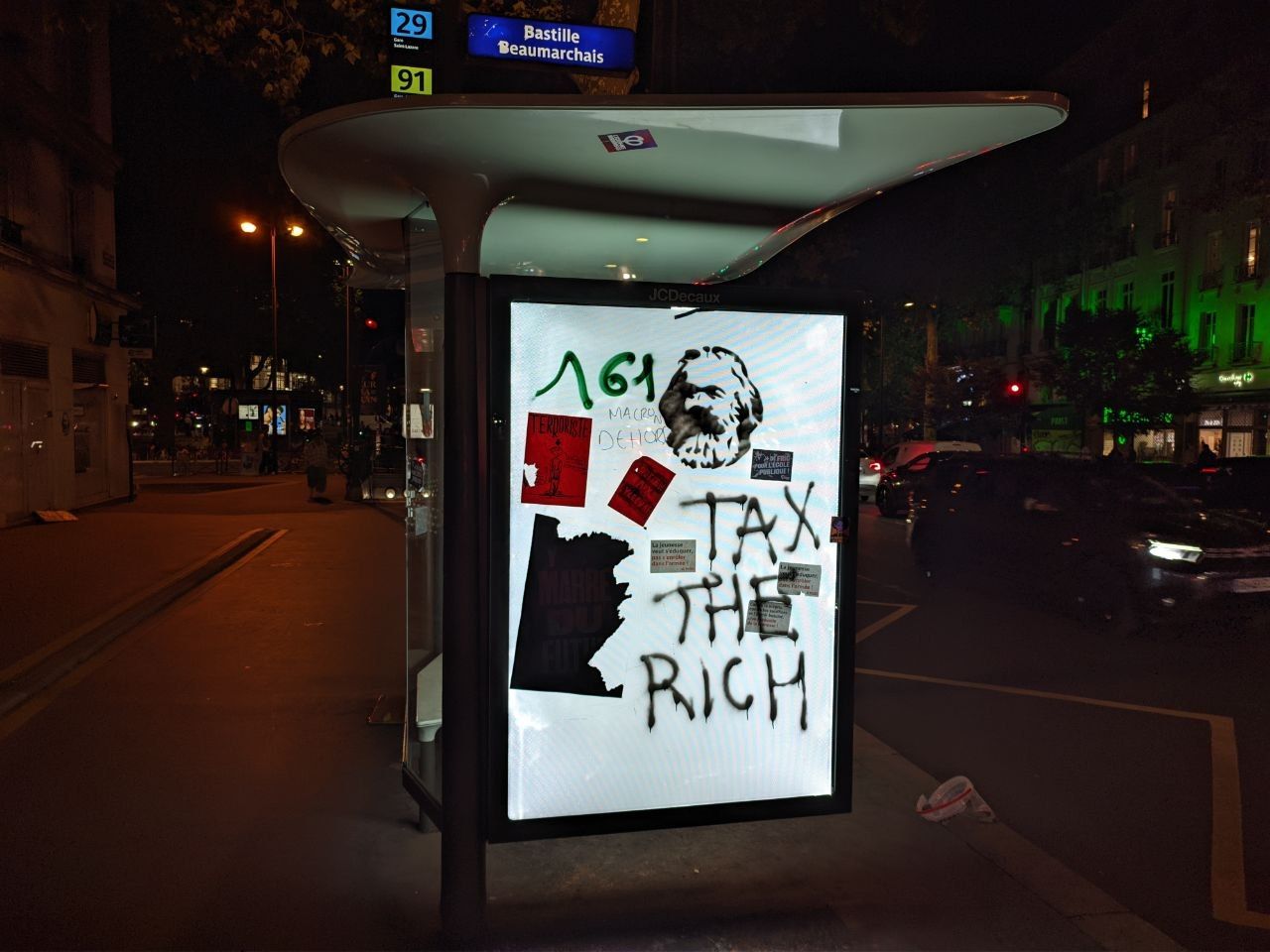
Traces of the demonstration in the evening city
- And do you discuss social issues with your friends? Healthcare, unemployment benefits, universal basic income?
- All my friends are fairly rich or very rich. In fact, just like me. So we can afford everything. And every time our parents buy expensive things, we talk about it — it’s so weird to buy something so expensive, it’s such a shame! We often talk about billionaires — that nobody needs that much money. And when the war in Lebanon started, one of my friends had family there. Everyone went to her, everyone asked how she was doing. And yes, we feel sorry for people without jobs, without homes. For example, when we’re walking down the street and there’s a homeless person there, even if we can’t give them money, we always try to help somehow. If someone looks at them badly, we publicly stand up for them. When we see fascist stickers on the street, we just tear them down together. For example, queer people or just women — they feel uncomfortable, and it’s important that they don’t feel afraid.
I’ve experienced sexual aggression. We talked about it a lot, and everyone was supportive. And nobody tried to say that I was wrong in that situationthe one who provoked the aggressor. Or even about teenage depression, we talk about that a lot because I have friends like that. Two of my best friends I met in the hospital. They all have some kind of problem.
- Queer, homosexuality — is that a topic of discussion in your circle, or just a matter of course? I’ve spoken with teenagers who see themselves as a new generation for whom this doesn’t even need to be discussed anymore because it’s so normal. In their groups, half the people are queer, they identify as queer themselves...
- I don’t know. I think for us it’s normal, of course, if someone comes and says, for example: “My name is now such-and-such. I was born a girl, but I’m a boy”, nobody will say anything. I think your generation already had no problems with transgender people, with homosexuals. On the other hand, even I myself have problems with fully understanding it: I don’t completely understand some sexualities. I mean, I say: good that you identify that way, and I do my best to respect it. But I don’t fully understand them.
- What type of sexuality don’t you understand?
- For example, therians: I think they feel they have a very strong connection with animals. They don’t have a sexual relationship with animals, but they identify with them, dress like them, wear tails. I don’t understand — is that just dressing like an animal or considering yourself half-animal? Or I know a polyamorous person. I don’t see myself that way, but if it works for them... I don’t know all the new types, names, and flags of sexuality: I can’t memorize them all. I try to remember: non-binary — that’s clear, and some others. But when combinations of different types start, it gets complicated.
- So in a sense you keep learning, getting used to each new piece of knowledge or acquaintance. I’m curious how much, looking back at previous generations, you feel their abnormality? Earlier generations that grew up when there were many prohibitions, rigid norms — do you ever feel something like, “You’re the abnormal ones yourselves?”
- I don’t think so. In ancient Greece there were so many homosexuals. And in all other eras too. Oscar Wilde and others. If it’s hard for me to figure out some topics, of course it’s hard for you too. But I try to explain if someone asks a question. I’m very happy when people older than me try to understand something about our generation; I’m happy to explain it to them. I don’t think it’s impossible to change people. Well, maybe fascists will always be fascists. But everyone else, I think, does try to understand. I hope they do.
“You can’t vote just against someone — only for what you truly believe in”
- What, in your opinion, distinguishes your generation? Do you have a sense of what makes you special?
- Well, of course, phones. Phones are what speed everything up. If something starts on TikTok, next week everyone will have forgotten it. Just millions of likes today, and next week nobody will remember. I was once punished and went, I don’t know, two months without my phone — a hundred million things. And I realized it didn’t matter that much to me.
I think my generation — they say a lot of what they think, but I don’t know whether they really think what they say. The best example is La France insoumise. Everyone [in my circle] says you have to vote for them. You don’t ask why, because you know it’s so as not to vote for the National RallyThe National Rally (Rassemblement national, RN) is a French far-right party, called the National Front until 2018. It was founded in 1972 with the participation of Jean-Marie Le Pen. His daughter Marine Le Pen took over the party in 2011 and pursued a course of “normalization”, including the name change. Since 2022, the RN chair has been Jordan Bardella, while Marine Le Pen heads the party’s group in the National Assembly.. But voting shouldn’t be against someone — it should be for something you truly believe in. Even if you vote for anarchists or anti-capitalists and know they won’t make it to the second round, then you just don’t vote for anyone else if you don’t fully agree with the others. And La France insoumise uses this very actively. In its leaflets, in its speeches. When my friend climbed down from the monument at Bastille, she was a meter away from Mélenchon, who had passed by there. And even though people don’t like him as much as BallySaint-Denis mayor Bally Bagayoko, representing La France insoumise, they were still like: yeah, cool!
As for the generation before us, it created a lot of things that, I don’t know, don’t kill us, but something like that. They created artificial intelligence, and then complain that we use it at school. I will never use AI at school, and I constantly get zeros just because I don’t understand the questions or don’t know the answers. Or they create TikTok — and then they’re like: strange, teenagers are all depressed... If algorithms are made so that everyone keeps scrolling [and getting views], if everyone likes sad videos, I’ll be shown sad videos.
Just even take how the school curriculum is set up. For example, I think we really lack lessons on how to pay taxes. Because when it’s time to do it, you don’t know how: what, just hand over a check? And why?
- Tell me, do you have more girlfriends or boyfriends? I mean the gender balance in your circle.
- 99% of my friends are girls. In my school, boys are not very left-wing. I don’t know how that happened. Someone said that among girls there are generally many more left-wing people. Because it’s hard not to be a feminist if you’re a woman. Let me put it that way. My only boy friends live outside France. One friend is in Eastern Europe, another in Germany, after a school exchange. And in Germany everyone is so left-wing. You just see, when you get to school there, how everyone dresses, how they walk, say what they want, kiss whom they want. I want to live like that and be in a school like that! I actually wanted to be in a public school, but my mother has stereotypes in her head that there are only stupid people there who won’t go anywhere afterward. And my specialization is art, and with that I won’t go anywhere at all. Like, what am I going to do after a public school with an art specialization?
- And how does that affect your plans for the future? Are you planning to go study in Germany after you finish school?
- I don’t know. No, I could probably study in France, but definitely not at a private university. Never private again: not work, not study — nothing. I’d like to, but I think it’s expensive to study in another country. Though yes, Germany looks cool. Especially since I’ve been learning German for several years now.
I’m trying not to think about it at all. Because I just don’t understand where people get their money from. When you see how much you can earn yourself, and then [you see] — people have such expensive apartments. How, where do you get so much money? Leave some for us, would you!
I think I’ll live with my friend, with some friends, or with other people. Because it’s so fun to live with other people who aren’t your family. In general, I think all my friends are like my family. Well, I do have a family too. But I agree more with my friends than with my family. Of course they love me; they raised me. But I don’t know... I think my friends have always helped me a lot, and I help them too whenever I can. I just don’t think about it; I go to school every week.
- Overall, do you already have some sense of perspective, of where you’ll go to study next?
- I know some universities, I know their names. I know where I don’t want to go. For example, metal art or digital art. I don’t really know much about that. I could figure it out, but I like drawing more.
- When you get into university, do you think you’ll keep going to demonstrations, staying interested in politics?
- Yes, the same! I’ll go to demonstrations even more. I hope there won’t be any more demonstrations, because there will be less and less that people disagree with. It would be good if everyone were happy. But there will still be important events, like Pride, Women’s Day, or May 1. In general, when we go somewhere with my dad (he taught me), I learn a lot of new things. And if I can help, of course I’ll be glad. When there was an event for political prisoners, I sold books for my dad, helped out. And that was a lot of fun. My mom once signed me up for volunteering — at a store collecting food. You know, when people come out and give you something from their shopping. I did that, and that was fun too. I’d like more of that.
- It sounds like you want to help and be part of some community, right?
- Yes! I once thought I’d like to become a psychologist. But then I realized that’s a very heavy burden after all. Since I’ve dealt with psychologists, I wouldn’t want to be the person sitting across from me. Or work in a hospital. Things like that happen there every day: pain, blood, people trying to kill themselves. Theyhospital psychologists are so cool! And they just aren’t paid. Money goes everywhere else: to the army and to the riot police — just not to that. Or when Macron comes, they spend a million euros on dinner.
Anyway, I just love doing everything with my own hands, trying everything myself. I cut my own hair, dye my own hair. It’s fun. And I don’t want to spend 100 euros just to have my hair dyed when it’s not that hard to do myself. I gave myself a tattoo with a pen and a needle. It hurt a lot. But I did it — it’s not that pretty, but it’s me doing it myself.
- That sounds great, really. You seem to have a sense of perspective, of direction. It may not be very specific yet, but the framework is already there.
- Yeah. A lot of what shapes me comes from my family. A left-wing dad, a mom involved in aid associations, a sister who helped Ukrainians. I can’t be any other way. I just don’t know how it could be different at my school. When my sister was younger, she was like that too. Now she’s a little less radical, a little closer to the center than I am. I hope I stay as I am now.
If you enjoyed this article, consider making a donation — one-time or, even better, monthly. Your support helps us motivate our authors and become better with every article.
Our organization is recognized by the Internal Revenue Service (IRS) as a 501(c)(3) tax-exempt, charitable organization, which means that all contributions made to us are tax-deductible to the fullest extent permitted by U.S. law. Individuals may generally deduct charitable contributions of up to 60% of their Adjusted Gross Income (AGI) for cash donations made to qualifying 501(c)(3) organizations. For donations of appreciated assets (such as stocks or other long-term capital assets), the deduction is typically limited to 30% of AGI, based on the fair market value of the asset. C-corporations may deduct charitable contributions of up to 10% of their taxable income for donations made to eligible charitable organizations.
By submitting a donation, you confirm that you have read and accept the following documents: Privacy Policy and User Agreement, and also give consent to the processing of your personal data.
If you would like to unsubscribe from a monthly donation, please email us at: [email protected]