Exactly 35 years ago, the central authorities allowed Sverdlovsk enthusiasts to print their own francs. Today, the history of this exotic currency is linked to the Ural Republic — a project that seriously influenced all of Russian politics in the 1990s.
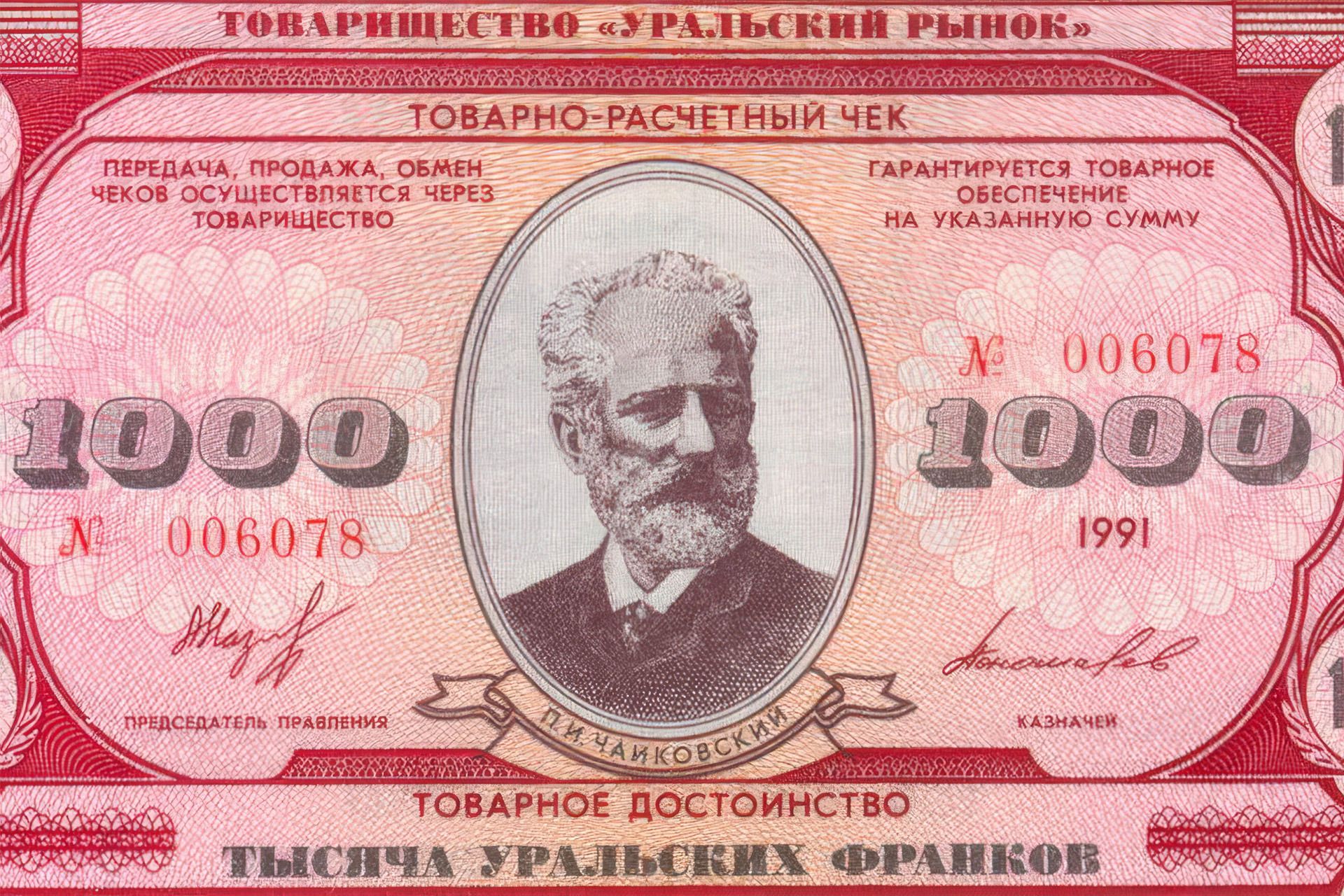
Banknote (fragment) of 1,000 Ural francs with a portrait of P. I. Tchaikovsky. Photo: Wikipedia
In 2010, the book “Russia at a Turning Point. Frank Notes of the First Minister of Economy”was published — the memoirs of Andrei Nechaev, a major statesman of the early 1990s. Nechaev’s recollections contain many interesting things, but in the context of this story we are interested in one factual blunder that is as crude as it is remarkable.
“A number of regions even went down the path of issuing all sorts of local quasi-money... The Sverdlovsk governor Eduard Rossel went furthest in this direction. He found Ural francs in local storage facilities, issued back in the Civil War years by the White Guard government, and tried to officially put them into circulation. The president had to cut Rossel’s initiative off at the root”
There are several mistakes here. First, the White Guards in the Urals printed no francs at all — the whole saga with the new money began only at the very end of the USSR. Second, the head of the region, Rossel, not only did not support the Ural franc, but twice obstructed its circulation. Third, the unadopted constitution of the would-be republic explicitly stated that, apart from the all-Russian ruble, it had no official currency.
However, the Ural francs themselves did really exist in the 1990s. In retrospect, they became the main brand of the “non-state” that Rossel tried to create at the junction of the Soviet and Russian eras. Over time, the Ural Republic turned into a bogeyman for turbo-patriots: supposedly, if Moscow showed weakness, outside forces would tear the country apart, turn its inhabitants into separatists, and force them to switch from rubles to francs. In reality, things were far more complicated: it is enough to note that the leaders of the Ural “rebellion” capitulated at the first summons from the Kremlin, and then integrated without problems into the vertical of the new power.
The struggle for symmetry
To begin, let us rewind not 35 years, but only three and a half years back. In January 2023, at the Ural branch of RANEPA, that same Eduard Rossel — an honorary veteran of Russian politics, former governor of Sverdlovsk Oblast (1995–2009) and former Federation Council senator (2009–2022) — met with students.
Rossel could not escape the spirit of the times. For a significant part of the conversation, he praised the country’s current leadership and approved the invasion of Ukraine. But when questions from the audience turned to the 1990s and specifically to the Ural Republic, the former governor visibly perked up and, it seems, candidly told of those half-forgotten events.
In particular, Rossel said what motivated him to raise the status of his region from an oblast to a republic:
“I met with the Minister of Finance [of the RSFSR; apparently this was in the autumn of 1991]. I’m sitting there, my turn comes. The Minister of Finance of Tatarstan walks in. ‘Oh, the Minister of Finance of Tatarstan! Eduard Ergartovich, please wait.’ That really hit me, it hurt. We are two and a half times stronger than they are. This is the national principle, there is some kind of pandering going on. Then I came back and said: come on, guys, let’s fulfill the relevant clause of the constitution and create the Ural Republic”.
Perhaps the anecdote about the queue to the finance minister was entirely invented by the author. But it recalls a real collective trauma of the regional leadership in the RSFSR — the inequality of the subjects of that quasi-federation. Leaders of “Russian” territories and oblasts like Rossel had to put up with the fact that their counterparts in “national” autonomous republics (ASSRs) had higher status and more powers.
Eduard Rossel (right) with Tatarstan President Mintimer Shaimiev, 2003. Photo: Wikipedia / Tatarstan.ru
In the 1978 RSFSR constitution, autonomous republics were explicitly called “Soviet socialist states”. Articles 82–85 listed a fairly broad range of their rights, which the territories and oblasts did not have:
an independent budget;
their own constitution;
the right to resolve on their own issues not assigned to the union and republican center;
the right to appeal directly to union bodies on specific issues;
a veto over any changes to their borders.
In “classic” the USSR, any protest against such an order would have meant political suicide. For the Soviet system, the asymmetry of territorial organization was a matter of principle. This arrangement reminded everyone that under the tsars Russia was a “prison of nations”, whereas after the October Revolution all the ethnic groups formerly subjugated by the Russians received statehood from the Bolsheviks, albeit within the framework of a common Union.
Of course, one could not overestimate the degree of real autonomy of Tatarstan or other ASSRs. Separate federal mechanisms could not compensate for the rigidly centralized system of party structures. But by the early 1990s, for Rossel and leaders like him, equality of the subjects of the RSFSR / RF had become the most important goal. All the more so because, as Perestroika progressed, many former taboos ended up on the dustbin of history.
Let’s make the Urals great again
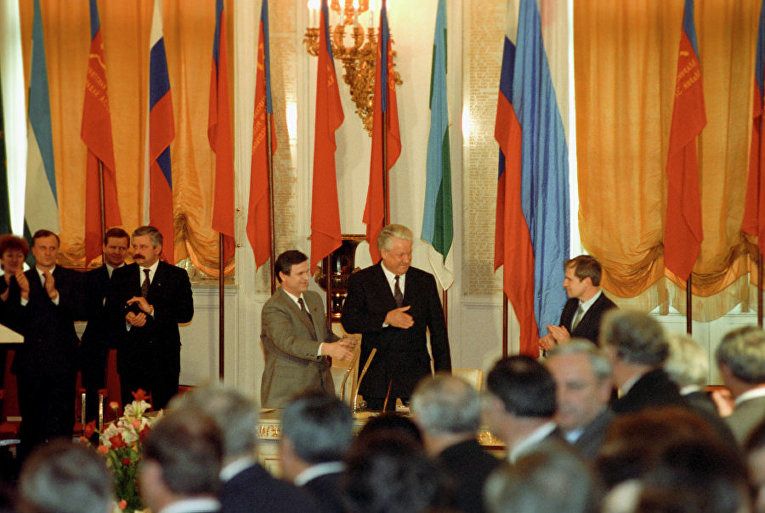
On March 31, 1992, dissatisfaction among the heads of territories and oblasts was only fueled by the signing in Moscow of the Federative Treaty. The document confirmed the previous principle of asymmetry and at the same time elevated a number of “national”, not “Russian”, regions to republic status: Adygea, Gorny Altai, Karachay-Cherkessia, and Khakassia.
Boris Yeltsin and Chairman of the Supreme Soviet Ruslan Khasbulatov at the signing of the Federative Treaty, March 31, 1992. Photo: RIA Novosti / Yuri Abramochkin
After this event, in Yekaterinburg (the city’s historical name was restored in September 1991), talk gradually began that Sverdlovsk Oblast was no worse than the former autonomous districts and could also raise its status. The laws in force did not explicitly forbid “Russian” regions from becoming republics. Soviet history knew no precedents for such a boost, but a formal mechanism was provided: a decision by the oblast / territorial council of deputies — a regional referendum — approval by the federal center.
The decisive role in making Sverdlovsk Oblast, rather than say Krasnodar Krai or Krasnoyarsk Krai, the pioneer in this marathon was played by Rossel, who had led the region since April 1990. He was a relatively young (in 1992 he turned 55), bright, and energetic leader. Eduard Ergartovich enjoyed a reputation as a solid manager and, as Americans would say, a self-made man. Coming from a repressed family of Volga Germans, he first built a career in construction and then achieved success in politics as well.
“I myself worked for many years in Sverdlovsk Oblast and was often present at Rossel’s public speeches. He knew how to hold an audience, was not afraid to answer difficult questions, loved talking with journalists, and was an excellent storyteller. People are drawn to such figures. It is no coincidence that Rossel won open competitive elections several times”
Judging by Kozev’s stories and those of other Sverdlovsk residents, appeals to local identity were not merely a political tool for Rossel. The politician believed in the special role of his region and shared the concept of “The Urals — the backbone of the state”. At the same time, according to his own admissions, Rossel was fiercely jealous of Moscow’s neighbors in the Volga region, who had republic status (above all, Tatarstan and Bashkortostan).
Of course, the region itself, and especially its capital, matched its leader’s ambitions. Yekaterinburg was among the five largest cities in Russia, and was considered one of the least “red” and most pro-Yeltsin megacities. Strong universities with a solid intellectual elite had long existed here, and by the late 1980s the first successful businessmen had appeared as well. It was from the professoriate and the business milieu, respectively, that two figures important to the movement for the Ural Republic emerged: law professor Anatoly Gayda and the adventurous “new Russian” Anton Bakov.
And finally, an important factor was the most high-ranking Ural native in Russia — the first president, Boris Yeltsin, at that time an exceptionally popular figure. The American biographer of the politician, Timothy Colton, later claimed that Yeltsin — while heading the Sverdlovsk regional party committee in the late 1970s — developed an even more radical plan than Rossel’s. Allegedly, the future president wanted to unite all the territories and oblasts of the RSFSR into seven or eight “super-republics”, one of which would be “Greater Urals”, that is, Sverdlovsk Oblast united with neighboring regions.
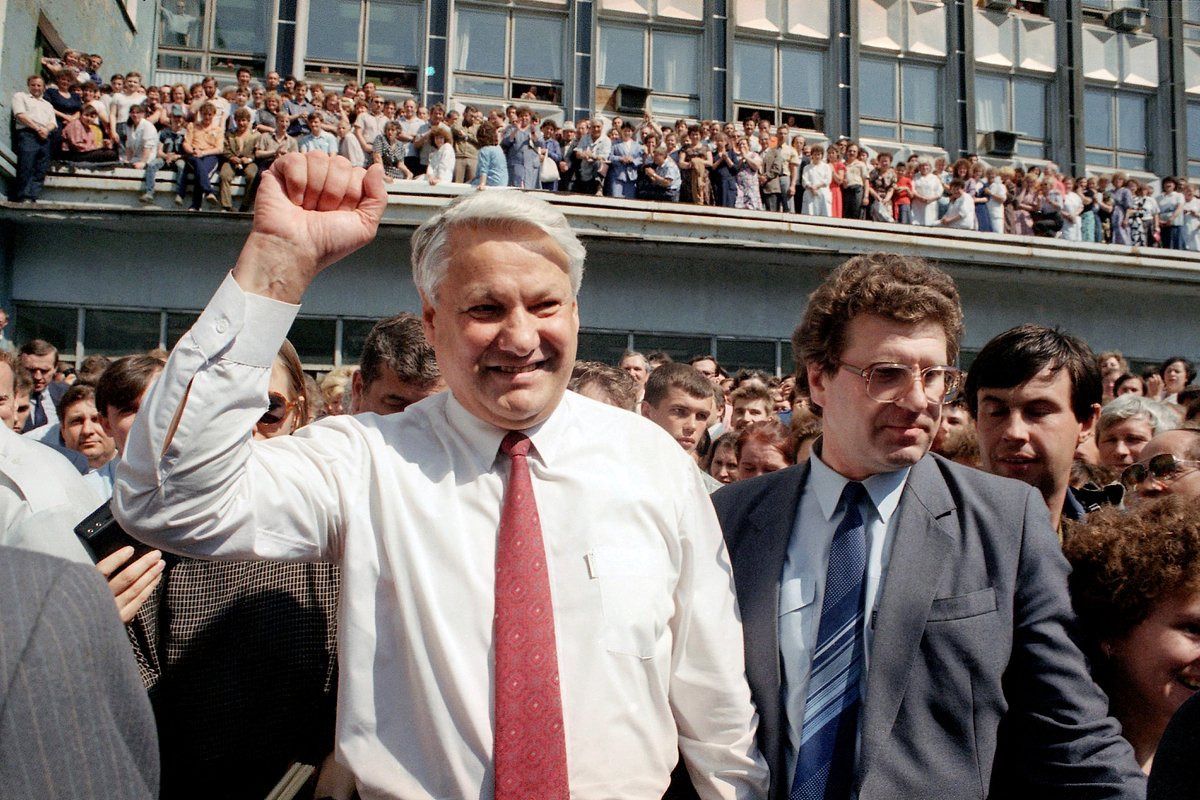
Boris Yeltsin meeting with residents of Perm, June 5, 1991. Photo: Sergei Karpukhin / AP
It is now hard to say whether such a project really existed. But in the early 1990s Yeltsin certainly looked like an ally for Ural regionalists. First, Boris Nikolayevich never forgot his native oblast; for example, during the days of the GKChP coup he sent his reserve government specifically to Sverdlovsk. Second, he openly sympathized with all movements for the real federalization of the former RSFSR — one need only recall his immortal line: “Take as much sovereignty as you can swallow”. And Rossel, who had known the head of state personally since the 1970s, decided to act.
A republic to grow into
On April 25, 1993, against the backdrop of the confrontation between Yeltsin and the opposition Supreme Soviet, a referendum on confidence in the president was held across Russia. At that time, people had to answer four questions at once; in mass memory, the procedure remained thanks to the pro-Yeltsin combination of answers from the persistent TV ad: “Yes-yes-no-yes”.
The authorities of Sverdlovsk Oblast timed their informal poll to coincide with the referendum. There was only one question here, and it was phrased rather slyly: “Do you agree that Sverdlovsk Oblast should have equal powers with the republics within the Russian Federation?” An absolute majority of Sverdlovsk residents agreed with this innocent formulation: more than 83% of those who came to the polls, with a solid turnout of 67%.
Single-person picket in Yekaterinburg, early 1990s. Photo: Anatoly Semehin / TASS
Rossel achieved his first public success on the road to a republic and clearly began to believe in himself. On June 12, 1993, at a meeting of the Constitutional Conference in Moscow, the Sverdlovsk leader made a bold proposal — to abandon the national-territorial system and switch entirely to territorial division. Despite his 25 years in the CPSU, Rossel condemned the Bolsheviks’ experiment with an asymmetric federation and national autonomies, and then referred to the experience of the Russian Empire. Supposedly, there were equal provinces there, so now there should be equal republics too.
The initiative predictably failed. The other participants in the conference did not dare abandon the principles of territorial organization that had been established for 70 years. But in a certain sense Rossel won again: he was the first to say aloud what many oblasts were whispering about under their breath — and became a kind of chief regionalist in Russia.
“Throughout the 1990s, Sverdlovsk Oblast was a kind of troublemaker. It was a period when we, the people of Sverdlovsk, were always generating something interesting, something large-scale. Eduard Rossel, the head of Sverdlovsk Oblast, was known in every subject of the federation. And when in those years I had to communicate with someone from other regions, I was always asked: ‘So, how is your Rossel doing?’”
On July 1, 1993, the Sverdlovsk Oblast Council announced the proclamation of the Ural Republic and the start of work on its constitution. In Yekaterinburg, this task was taken seriously. For several months, a group of legal scholars led by Professor Anatoly Gayda worked on the basic law.
Anatoly Gayda, 1990s. Photo: magister.urfu.ru
The emphatically intellectual Gayda seemed at first glance to have little in common with the loud, charismatic Rossel. But at least their biographies had one thing in common: if Rossel came from a repressed family of Volga Germans, Gayda came from Ukrainian Poles exiled to Kazakhstan. Both, despite relatives rejected by the system, managed to build successful careers within that very system. And both, at a moment of political turbulence, decided to use some laws of the half-collapsed empire to rewrite others — to turn Sverdlovsk Oblast into a new Ural Republic.
Gayda and his team pursued two strategic goals. First and foremost, they закрепляли the favorite Rossel thesis that the new republic should become an equal subject within a future symmetrical federation. The Yekaterinburg lawyers also emphasized that their region renounced any claims to independence. The head of the republic was to be styled not president, but only governor. The 1993 Ural constitution explicitly закреплял the rejection of many attributes of a sovereign state: armed forces, state borders, customs, and its own currency.
Yes, and the rejection of its own currency too. Paradoxically, the notorious Ural francs, which over time became the main brand of the failed republic, had no direct relation to it.
Hayek, francs, and Mansi
The initiator of the issue of Ural francs was the young businessman Anton Bakov (at the time of the events described, he was not yet 30). Bakov was close to the Sverdlovsk political class and actively supported regionalist ideas, but he had no connection to the Soviet system and held no official positions. This gave the activist freedom of creativity in matters that more serious figures preferred not to touch.
Anton Bakov, 1990s. Photo: kommersant.ru
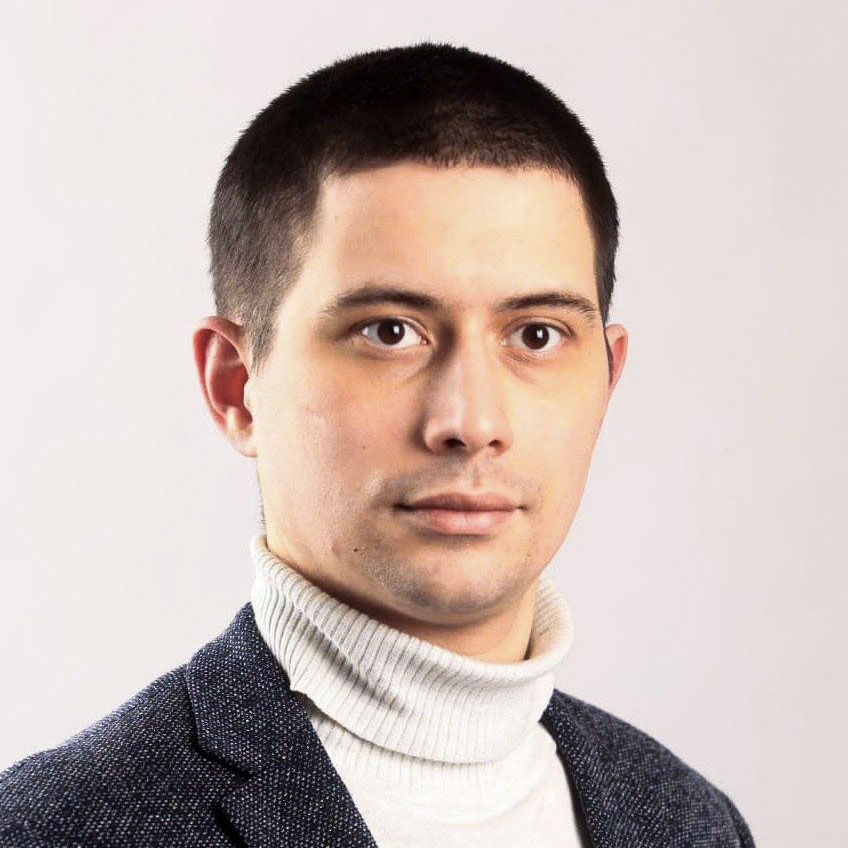
As early as the beginning of 1991, Bakov actively lobbied the idea of a separate currency in the Urals. Supposedly, after all the financial shocks, people no longer trusted the Soviet ruble, so the region needed its own money. Nobel laureate Friedrich von Hayek had already advocated the concept of private money, so let’s put it into practice.
“We thought for a long time about the name [of the currency]. We could not call it the Ural ruble, because the word ‘ruble’ had been discredited; people called it nothing but wooden. Besides, it would have been a contrast to the non-Ural ruble, basically a conflictual name. It could not be called the dollar, because Russia always had anti-Americanism. Among currencies with a common name, we chose the franc: at that time there were not only Swiss francs, but also French and Belgian francs”
According to Bakov, in Moscow he managed to obtain support from then Finance Minister Yegor Gaidar personally. On September 4, 1991, the Finance Ministry officially gave the Uralians permission to print their own currency.
The design for the Ural banknotes was developed by architect Sofya Demidova. She created a truly striking series of banknotes with denominations from 1 to 1,000 francs. On the reverse side they were decorated with sights of Ural cities (such as the Ipatiev House in Yekaterinburg, the Nevyansk Tower, or the Zlatoust Arsenal), and on the front with portraits of outstanding Uralians: composer Pyotr Tchaikovsky, chemist Dmitri Mendeleev, theater figure Sergei Diaghilev, or even the 15th-century Tyumen khan Ibak.
The thing is that in Sverdlovsk / Yekaterinburg no one was willing to support the franc adventure. For system figures like Rossel and Gayda, their own currency clearly looked like overkill. When in 1992 the Perm Goznak printed banknotes with a total face value of 56 million francs, they lay dead weight in storage facilities. Only years later did Bakov come up with a way to use his creation.
In 1997, the banknotes began to be used at a metallurgical plant in the city of Serov owned by the businessman — for some time workers paid with francs in factory canteens and shops. But soon Bakov, after a conflict with Governor Rossel, lost this asset, and the banknotes with Tchaikovsky and Mendeleev finally turned into purely numismatic value. Such irony: in the 21st century Rossel is often remembered as the initiator of the Ural francs, but in fact he was precisely the one who twice stopped this currency from circulating.
Front page of the newspaper “Mansi Maa”, which urged the small people to break with the Khanty and join Sverdlovsk Oblast. Photo: 66.ru / Dmitry Antonenkov
In the early 1990s, Bakov was obsessed with another dubious idea. Taking advantage of constitutional chaos, the activist wanted to attach the western part of the neighboring Khanty-Mansi Autonomous Okrug, within Tyumen Oblast, to Sverdlovsk Oblast. Bakov justified the claim by saying that the small Mansi people live there. Supposedly, in the same district as the more numerous Khanty their culture was declining, the Mansi had already been part of Sverdlovsk Oblast in the 1930s, and in general transport in KhMAO was developed in such a way that its western areas found it more convenient to communicate with Yekaterinburg.
In 1992, Bakov organized the printing of a pro-Sverdlovsk newspaper for the Mansi and held something like a liberation congress among them. But the end of this initiative was inglorious. In Tyumen and Khanty-Mansiysk, Bakov’s decolonization caused fury, the local authorities lodged a protest with Rossel, and he rebuked Bakov. As the adventurer himself admitted decades later, he really did not care about the interests of the Mansi — he simply wanted to cut the oil-rich neighboring lands onto his native region.
During the Mansi saga, Bakov even invented an original black-white-green flag for them. The northern ethnic group remained indifferent to the emblem, but regionalists in Yekaterinburg itself embraced it as their own. The tricolor did not receive official status, but it quite took root among Sverdlovsk residents. Some associated the colors of the banner with the coat of arms of the Demidov family, others with the Siberian regionalism close in spirit, and still others with the unity of the geographic parts of “Greater Urals”: north, center, and south.
Eduard Ergartovich, it’s canceled!
In the summer of 1993, the chances of Rossel’s team in their march toward republic status looked promising. Many thought that Sverdlovsk Oblast could become not just a republic within the Russian Federation, but also the core of a larger formation — in the spirit of Yeltsin’s phantom project of seven or eight “big republics”.
On September 14, 1993, in Yekaterinburg, an event took place under the ornate title: seminar “The Ural Republic and the Integrity of the Russian State”. As a result, the heads of four neighboring oblasts — Kurgan, Orenburg, Perm, and Chelyabinsk — declared that they were ready to take part in developing an economic model together with Yekaterinburg. “Greater Urals” was taking on ever clearer outlines.
Residents of Yekaterinburg with the flag of the Ural Republic at protests in defense of the square on Oktyabrskaya Square, spring 2019. Photo: X.com
On October 27, the Sverdlovsk Oblast Council approved the constitution of the Ural Republic developed by Gayda. On November 2 in Moscow, Rossel took part in an expanded meeting of the Russian government. In his presence, Yeltsin said that the desire of the oblasts to raise their status was a natural and legitimate process. It seemed victory was already within reach. On November 8, upon returning home, an elated Rossel announced a constitutional referendum for December 12 together with elections to the region’s new bicameral legislative assembly.
And then came a cold splash of water. On November 9–10, Yeltsin issued decrees dissolving the Sverdlovsk Oblast Council and dismissing the regional head. At the same time, the president declared all decisions on transforming Sverdlovsk Oblast into the Ural Republic illegal.
“In connection with repeated violations by the Sverdlovsk Oblast Council of People’s Deputies of the Constitution of the Russian Federation and the laws of the Russian Federation, expressed in the proclamation of Sverdlovsk Oblast as the Ural Republic and the adoption of the Constitution of the Ural Republic […] I decree: To consider the decisions of the Sverdlovsk Oblast Council of People’s Deputies of July 1, 1993, ‘On the Status of Sverdlovsk Oblast within the Russian Federation’ and of October 27, 1993, ‘On the Constitution of the Ural Republic’ to have no legal force from the moment of their adoption“
The case of the failed “non-state” had, in essence, already been lost. Unlike classic regionalists, who rely on living tradition and active support from fellow locals, Rossel and his team initially relied on the letter of the law and informal ties with the head of state. Therefore, the presidential cancellation of the Ural Republic could not be offset by anything its supporters had. In the end, Rossel and the deputies of the oblast council submitted to the Kremlin’s decisions.
In Yekaterinburg, the president’s abrupt change of heart on the issue of his small homeland was later blamed on his entourage. Supposedly, Yeltsin was turned against Rossel by administration head Sergei Filatov and Sergei Shakhrai, who was responsible for regional policy. But in retrospect, the change in Yeltsin’s course looks natural. After defeating the Supreme Soviet in October 1993, the politician no longer needed allies among local elites, but rather the restoration of the vertical of power. In addition, by that time the Sverdlovsk example was tempting far too many Russian regions.
By the autumn of 1993, people in Vladivostok, Irkutsk, Krasnoyarsk, Tomsk, Chelyabinsk, and some other oblast and territorial centers were talking about their own republics. And such a mass boost for “Russian” regions clearly promised the Kremlin new problems in relations with the existing “national” republics — relations that were already quite tense at the time.
***
So, did the Ural Republic vanish without a trace? In Yekaterinburg itself, they never thought so.
The main initiators of the project, Eduard Rossel and Anatoly Gayda, remained in politics. Within a couple of years both restored their lost positions and then repeatedly reminded everyone that their rejected constitution, after stylistic edits, was nevertheless adopted as the Charter of Sverdlovsk Oblast. And from it, similar documents were copied in other oblasts and territories. Rossel also claimed that it was precisely after the Yekaterinburg events of 1993 that a provision on the equality of all subjects of the federation was added to the Constitution of the Russian Federation; in early versions of the basic law it really was not there.
“Rossel built up political capital thanks to this project. But, what is more important from the point of view of the historical process, the Ural Republic as an idea and as a symbol will undoubtedly outlive its initiators”.
More than 30 years after the story of the failed “non-state”, one can say this in Yekaterinburg: different people have retained their own image of the Ural Republic in memory. For some, it is no more than a characteristic venture from the wild era of crimson jackets and brick-sized mobile phones; for others, it is a monument to lost freedom and genuine federalism; and for still others, a chthonic symbol of the collapse of a great power. Very recently, on January 14, 2025, the Supreme Court of Russia recognized as terrorist the nonexistent movement “Ural Republic” — in a perverse sense, it really outlived its time.
If you enjoyed this article, consider making a donation — one-time or, even better, monthly. Your support helps us motivate our authors and become better with every article.
Our organization is recognized by the Internal Revenue Service (IRS) as a 501(c)(3) tax-exempt, charitable organization, which means that all contributions made to us are tax-deductible to the fullest extent permitted by U.S. law. Individuals may generally deduct charitable contributions of up to 60% of their Adjusted Gross Income (AGI) for cash donations made to qualifying 501(c)(3) organizations. For donations of appreciated assets (such as stocks or other long-term capital assets), the deduction is typically limited to 30% of AGI, based on the fair market value of the asset. C-corporations may deduct charitable contributions of up to 10% of their taxable income for donations made to eligible charitable organizations.
By submitting a donation, you confirm that you have read and accept the following documents: Privacy Policy and User Agreement, and also give consent to the processing of your personal data.
If you would like to unsubscribe from a monthly donation, please email us at: [email protected]