It is clear that the main strategic direction of the EU (in alliance with the United Kingdom) today must primarily focus on achieving autonomy in the field of security. This means arms production, training capable armies, and creating new command centers, either within NATO or alongside it – while simultaneously maintaining political and economic stability in Europe. Altogether, this represents a complex challenge, as European citizens wish to continue living peacefully, enjoying numerous social guarantees without giving up their accustomed way of life.
Among the main political events of the past month, two summits stand out: the G7 and NATO, as well as Israel’s swift and effective strike against Iran’s nuclear program, to which the US joined at the crucial moment to deliver a decisive blow. There is debate about the extent of the damage; some experts believe that Iran could resume work on its nuclear project soon. Nevertheless, the military power demonstrated by Israel and the US made a strong impression.
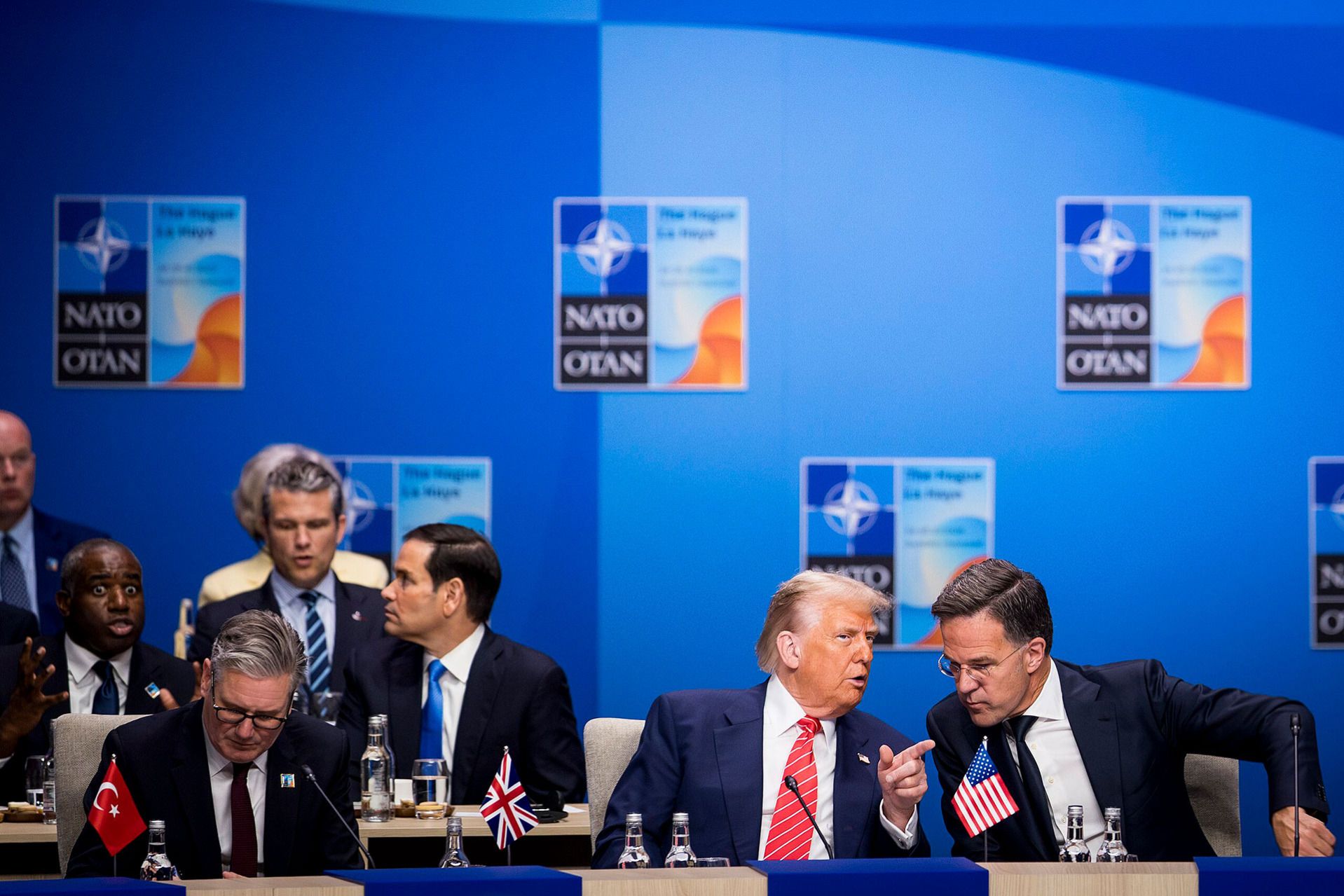
Against this backdrop, European leaders appeared rather unconvincing. The G7 summit in Canada was tense and chaotic, as Donald Trump left early to attend to more important matters. Trying to avoid a similar scenario at the NATO summit in The Hague, NATO Secretary General Mark Rutte offered several flattering messages in honor of the American president, praising his decisiveness and wisdom. Perhaps these efforts paid off and influenced Trump’s good mood during his stay in The Hague, but the European press did not spare criticism of their political leaders, who agreed to dubious secondary roles in the show centered on the main star from Washington.
If it were only about protocol mishaps and unfortunate remarks, these misunderstandings would not deserve much attention. The worse issue is:
it might have seemed that Europeans once again immersed themselves in internal disagreements – and signs of diverging positions caused more concern than individual strange statements.
For example, Emmanuel Macron constantly called for a ceasefire and truce in the Middle East and specifically linked the sudden departure of the American president from the G7 summit to preparations for negotiations – for which he received a mocking label from Donald Trump as a confused person who “always gets it wrong.” At the same time, German Chancellor Friedrich Merz welcomed Israel’s strikes against Iran, calling them “dirty work” done “on behalf of all of us.” At the NATO summit, all participants congratulated each other on the intention to raise defense spending to 5% (including 1.5% for infrastructure), but Spanish Prime Minister Pedro Sánchez considered such extravagance impossible, which immediately provoked Trump’s anger and threats directed at him.
All these circumstances allowed renewed talk of a new “sunset of Europe,” which cannot convert its economic, human, and historical potential into political power – and is therefore doomed to lose to more purposeful and decisive players in a changing world. This view is well-known, but perhaps it overlooks some important factors.
Trade War
The impression from the G7 and NATO summits was indeed unfavorable to Europeans. The former can be considered a failure, if not a fiasco, as Trump openly showed both a lack of interest in discussing the agenda and his usual disregard for allies, expressed by his premature departure. That is why NATO Secretary General Mark Rutte decided to do everything possible to avoid a similar scenario in The Hague.
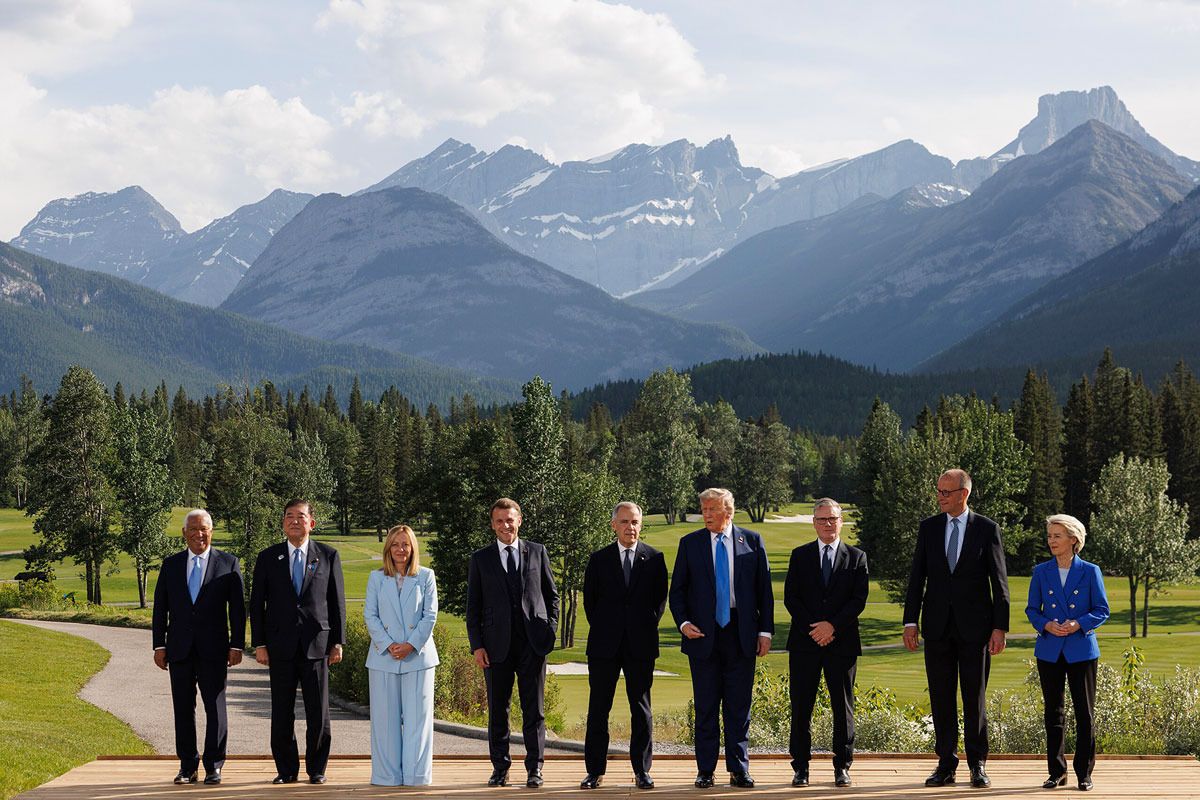
Group photo of participants of the 51st “G7” summit, Kananaskis, Alberta province, Canada, June 16, 2025. Photo: Simon Dawson / No 10 Downing Street / CC BY 4.0
The difficult knowledge of the peculiarities of the current American president allowed expectations of any declarations from him depending on his mood, including denial of Article 5 of the Charter and revision of the US role in the Alliance. Meanwhile, now, as the war continues in Ukraine, military tensions with Russia persist in Europe, and European countries begin rearmament and strengthening their armies, a NATO scandal would be highly undesirable. Not only in terms of image loss or bad encouragement in the Kremlin – but primarily because of the need to restructure the Alliance on the fly and urgently. Too much in NATO depends on Americans simply on a technical and organizational level.
On the other hand, it was very important for Europeans to bring the issue of the war in Ukraine back to Trump’s attention, which could be achieved through a personal meeting of the presidents. In Canada, at the G7 summit, it did not happen; in The Hague, the arrival of Zelensky and his short dialogue with Trump was arranged, which could be considered a relative tactical success.
Meeting of Alliance leaders with Volodymyr Zelensky behind the scenes of the summit, June 25, 2025. Photo: Simon Dawson / No 10 Downing Street / CC BY 4.0
One way or another, the final communiqué includes a point on the parties’ commitment to Article 5 of the NATO Charter(8), and the behavior of the American president, aside from outbursts against rebellious Spain, seemed quite peaceful. But a few days later, Washington announced a suspension of military aid to Ukraine, and this decision once again confirmed the futility of efforts aimed at reaching solid agreements with the current American administration.
However, beyond the two summits, there was another issue far more significant than the protocol smiles of political leaders. It concerns negotiations on a new trade agreement between the EU and the US.
As is known, President Trump is a strong advocate of imposing high tariffs on goods imported into the US. He views the trade deficit as daylight robbery and makes no distinction between allies and less friendly countries. It is no surprise that within just a few months, he announced tariffs on EU goods, then canceled some of them, and later froze most of them until July 9, when the conclusion of new trade agreement negotiations is expected. That deadline is approaching, but it is known that contradictions between the parties remain very significant.
The situation is complicated by the fact that only the EU and China in the modern world, with economies comparable in size to the US, could, if they wished, escalate tariffs with Washington – but prefer to negotiate with Trump while possible to avoid worse scenarios.
It is obvious that no one in the EU wants a trade war with the US, but Brussels understands well both the advantages of its position, including a unique market of 450 million solvent consumers, and its weaknesses.
The problem with the EU’s negotiating position is that the interests of various European countries in the American market do not coincide.
For example, Germany exports its cars to the US, while France exports cognac and champagne, and if Washington imposes high tariffs on one group of goods, leaving another in a more privileged position, it could provoke a split among Europeans. The EU is an economically strong subject only because of its unity, which is well understood in European capitals. That is why too much importance should not be attached to summit images, which do not signify either European agreement with American dominance or renunciation of protecting their own interests. It is merely a tactical maneuver, the appropriateness of which, of course, can be debated.
Iran and Ukraine
Some passivity of Europe in Middle Eastern affairs, as well as discord among European leaders regarding Israel’s actions, can be interpreted as a kind of “withdrawal from history,” a concession of former positions to new, younger, and more assertive contenders. Meanwhile, a more pragmatic view is possible: Europe understands that this is “not its war.” Everyone agrees that Iran cannot claim to possess nuclear weapons and must adhere to the non-proliferation treaty provisions and cooperate with the IAEA. Otherwise, some, like Macron, may call for negotiations and fear the consequences of escalation, while others, like Merz, may congratulate Israel on a job well done – which only matters as a local position of individual countries in their bilateral relations with Israel, the Arab world, or Iran.
But Ukraine is a completely different matter. Many circumstances determine a different attitude toward this war, which is happening in Europe, in close proximity to the EU borders. The aggressor is Russia, historically seen in Eastern Europe as a direct threat, and there are solid grounds for these fears. Hundreds of billions of euros have already been allocated from the EU budget(10) and individual member states’ budgets to support Ukraine and assist refugees. The US is trying to distance itself from the problems of the Old Continent in general and aid to Kyiv in particular, shifting these responsibilities onto Europeans, which does not cause substantive objections but forces a rapid restructuring of the European economy toward a more military footing.
The defeat of Ukraine would mean not only the appearance on Europe’s borders of a well-armed army with fresh combat experience and a taste for victory but also the urgent need to build a new security system, taking into account both the Russian threat and the unreliability of American allies.
In these conditions, it is no surprise that Europeans were reluctant to intervene in the conflict around Iran, preferring to focus efforts on the complex tangle of negotiations with the US and on continuing support for Ukraine amid uncertainty about the American position.
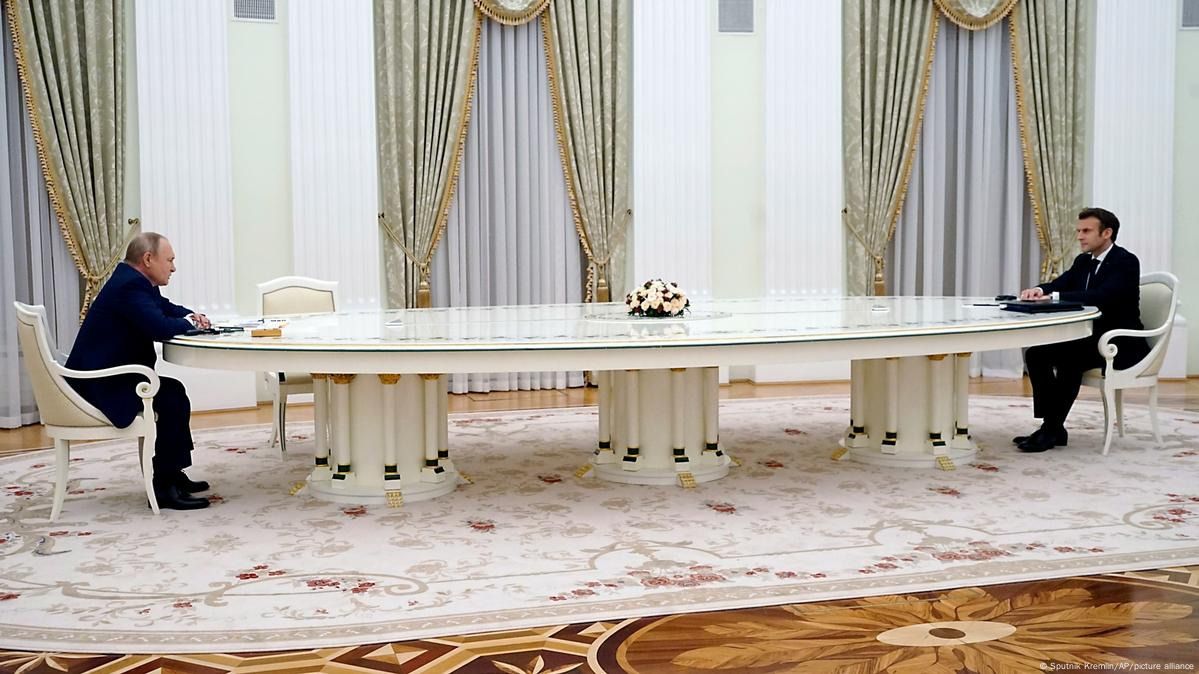
It is worth noting separately an unexpected phone call between Presidents Macron and Putin, who had not spoken for almost three years. According to sparse official reports, the parties discussed Iran and Ukraine but only reiterated their known previous positions. In this case, it is unclear why the conversation lasted a full two hours – and moreover, why the Russian president, who so often spoke condescendingly about Europeans, denying them subjectivity compared to the US, even picked up the phone.
Vladimir Putin and Emmanuel Macron during a meeting at the Kremlin, February 7, 2022. Photo: kremlin.ru
In reality, much depends on Europe’s position; without its opinion, Trump will not make any deal with Putin on Ukraine, which the Russian side understands well. Talking with Macron or Merz will be necessary anyway; perhaps now some new prerequisites for this have emerged.
Strategy and Tactics
It is clear that the main strategic direction of the EU (in alliance with the United Kingdom) today must primarily focus on achieving autonomy in the field of security. This means arms production, training capable armies, and creating new command centers, either within NATO or alongside it – while simultaneously maintaining political and economic stability in Europe. All of this represents a complex challenge, as European citizens wish to continue living peacefully, enjoying numerous social guarantees without giving up their accustomed way of life.
It can be assumed that as a tactical approach, Europeans have chosen a line of continuously easing contradictions with the US to buy time.
Within this line, concessions and image losses must be made, but perhaps history will confirm the correctness of this approach. Especially since Europe’s position as arguably the last guardian of international law principles is not as outdated as supporters of forceful methods might think. In the modern world, not everyone shares Trump’s or Putin’s methods. For example, in the Global South, no one in South America attacks each other, and development is recognized as the main problem. The same can be said for many countries in Africa or Southeast Asia – each, of course, has its concerns, but the EU market is attractive to all, as is playing by the rules when protecting national interests. In the long term, the calm tone of Europeans and their adherence to international law principles (if these qualities can be preserved) may earn wide recognition.
Group photo of NATO summit participants 2025. The Hague, Netherlands, June 25, 2025. Photo: Ministerie van Buitenlandse Zaken / Bart Maat / CC BY-SA 4.0
Nevertheless, all these dances of European leaders around Trump, whatever their tactical justifications, are alarming for two reasons. First, at some point, a series of clever maneuvers must give way to a firm and principled position – otherwise, the habit of constant maneuvering will only reinforce the skill of intrigue but not bring closer the achievement of strategic goals. Second, one should not forget European voters, who do not want to delve into the nuances of communication with the American president but hope for the effectiveness of their own politicians. When it comes to the rise of populists in Europe, one of the main reasons is considered the European political class’s unwillingness to make difficult decisions, a tendency toward compromises and hesitation, and a fascination with tactical moves at the expense of strategic firmness. Disappointed voters may then call for new forces to govern, which, in turn, will review current European security programs. In that case, Mark Rutte’s crafty praise of Donald Trump will remain in history as an example of useless and inglorious efforts that could have been better spent.
In the main photo – Donald Trump talks with NATO Secretary General Mark Rutte at the summit in The Hague, June 25, 2025. Source: Ministerie van Buitenlandse Zaken / Bart Maat / CC BY-SA 4.0
If you enjoyed this article, consider making a donation — one-time or, even better, monthly. Your support helps us motivate our authors and become better with every article.
Our organization is recognized by the Internal Revenue Service (IRS) as a 501(c)(3) tax-exempt, charitable organization, which means that all contributions made to us are tax-deductible to the fullest extent permitted by U.S. law. Individuals may generally deduct charitable contributions of up to 60% of their Adjusted Gross Income (AGI) for cash donations made to qualifying 501(c)(3) organizations. For donations of appreciated assets (such as stocks or other long-term capital assets), the deduction is typically limited to 30% of AGI, based on the fair market value of the asset. C-corporations may deduct charitable contributions of up to 10% of their taxable income for donations made to eligible charitable organizations.
By submitting a donation, you confirm that you have read and accept the following documents: Privacy Policy and User Agreement, and also give consent to the processing of your personal data.
If you would like to unsubscribe from a monthly donation, please email us at: [email protected]