The fewer economic, cultural, and simply human ties between Russia and European countries, the more conflict stories there are, the easier it will be to turn toward a possible military clash. No one in Europe wants such a development, but a peaceful Russian-Ukrainian agreement as imposed by the American administration looks like a respite for the aggressor. Therefore, Europe and Ukraine need to build a new structure to deter Russia together, without wasting time.
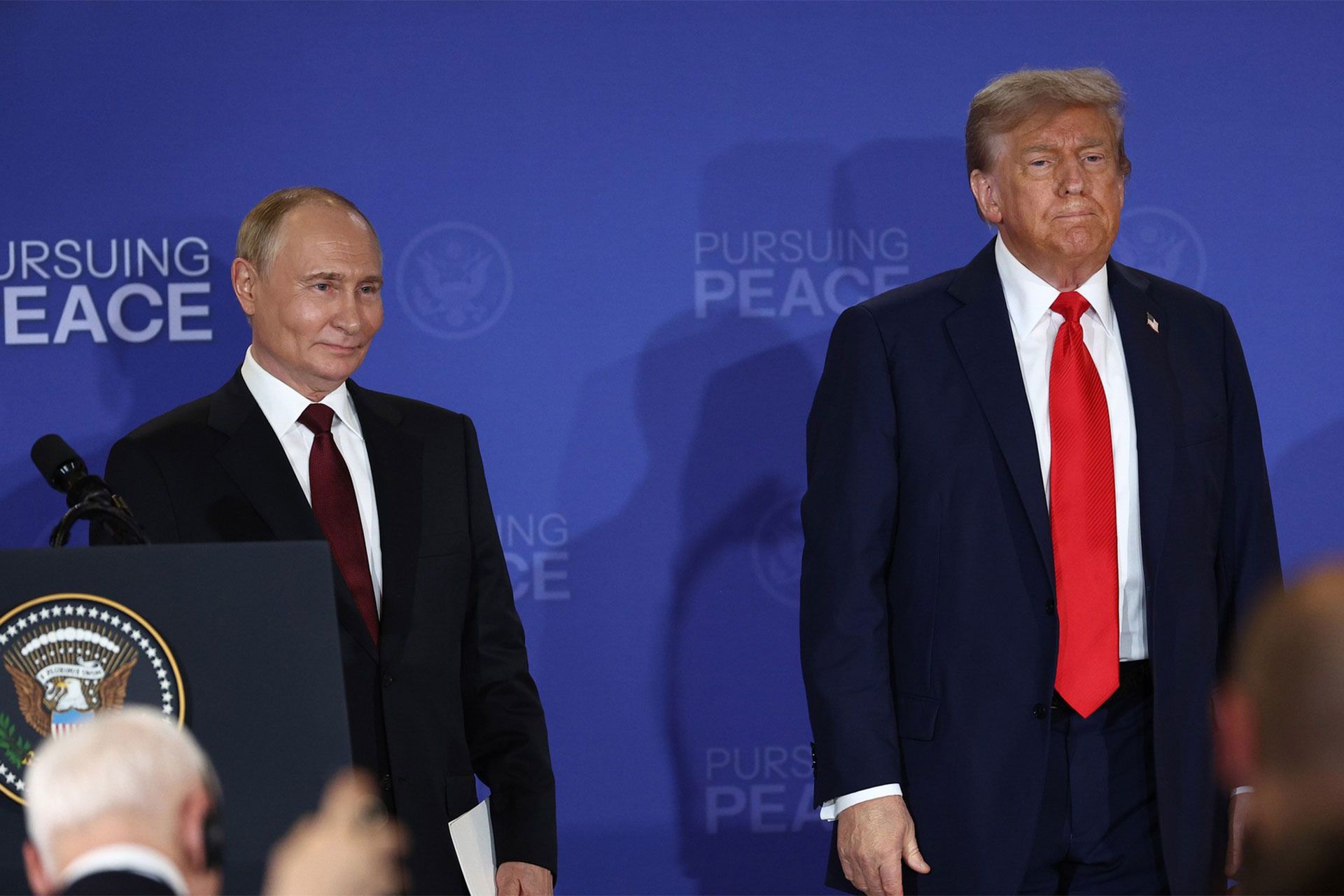
Vladimir Putin and Donald Trump at a joint press conference in Anchorage, August 16, 2025. Photo: kremlin.ru
Over the past few weeks, the main focus has been on a new peace plan to end the war in Ukraine, which has undergone remarkable transformations and been accompanied by loud scandals. As could have been expected, in the end the parties parted ways without agreeing on anything, except perhaps to continue consultations. Nevertheless, publications in the world press first of the 28 points of the original plan, and then of various revised versions, have made it possible to get an idea of the issues under discussion and the main points of disagreement. And President Trump has not given up trying, by any means necessary, to insist on a peace agreement based on his own ideas.
EU leaders did not participate in the negotiations, but closely followed their progress and maintained contact with both President Zelensky and representatives of the American administration. Obviously, implementation of a number of provisions of the peace plan, such as unfreezing Russian assets in Brussels or lifting European sanctions, requires the consent of the Europeans themselves. But at the initial stage, when the approximate outlines of a possible truce theoretically acceptable to both Russia and Ukraine are being discussed, without specifying details, the presence of Europeans did not seem necessary, especially given the total crisis of trust between Moscow and Brussels and growing tensions between Washington and European capitals.
Nevertheless, there is one significant factor that explains Europe's heightened interest in the latest discussions around the new peace plan. For the first time, there is a relatively coherent concept of a truce with fundamental provisions that are unlikely to change in the course of further negotiations. Of course, no one can now predict either the timing of the war's end or the exact parameters of a peace agreement. But it seems that today it is already possible to outline several fundamental theses on which such an agreement may be reached.
First, the cessation of hostilities will occur along the current front line. This does not preclude individual territorial concessions, but creates a post-war situation in which, on the one hand, Ukraine will continue to exist as an independent state, but on the other, will lose control over a substantial part of its territory for a long time. Meanwhile, the legal status of the occupied territories will remain unclear for an indefinite period. The temporary nature of the truce, in which no one achieves a decisive victory, as well as the aggressive nature of Putin's regime, make a resumption of the war in the near future highly likely. Both Ukraine and Russia could always find a pretext for this.
Second, the global West is unlikely to be able to provide Ukraine with firm security guarantees, whatever promises are written into the agreement. The US is determined to withdraw from European affairs, and the European idea of deploying peacekeeping forces in Ukraine from a “coalition of the willing” faces strong resistance in Moscow on the one hand, and lacks necessary support in Washington on the other. Thus, the only security guarantee for Kyiv can be a strong army of its own.
Third, Ukraine's reconstruction should become a pan-European task, as there is no alternative scheme available. From the perspective of Kyiv's European allies, the natural source of funding for Ukraine's recovery after the horrors of war is frozen Russian assets. But this idea provokes outrage in Moscow. It can be expected that tensions between Russia and the EU will increase even further in the near future due to disagreements in this area as well. In essence, Europe, which is experiencing economic difficulties, has neither extra money nor room to maneuver. European governments, as well as taxpayers, generally agree that the costs of rebuilding Ukraine should be covered at the expense of frozen Russian assets. The only thing left is to find a technical solution that will not scare off other investors and will not be an easy target in court for Russian lawyers. What Moscow will call theft, Brussels will consider fair compensation for the destruction caused. But this is a direct path to a new level of escalation between Europe and Russia, for which one must be prepared.
Europe will have to comprehend this news in the near future.
Security Issues
The events of recent years have dispelled several dangerous illusions in Europe.
First, it has become clear that the main threat is in the East and the tranquil, peaceful life is a thing of the past. At the same time, Russia has long been waging a hybrid war, even if Russian troops have not yet crossed the EU borders and no one is shooting. Constant sabotage, cut cables in the Baltic Sea, strange launches of anonymous drones and balloons, as well as information attacks, clearly show that Europe today lacks arguments to deter the enemy on its eastern borders, in the spirit of peaceful coexistence during the Cold War. Hence, such arguments must be created and demonstrated.
Second, confidence in transatlantic solidarity has evaporated, and Article Five of the NATO Charter no longer promises reliable protection. Moreover, the US has not only lost its status as an ally of Europeans, but has become an actor seeking to make its own “deals” at Europe's expense. The new US National Security Strategy, which devoted two and a half pages out of 33 to Europe, claims that the old continent is in deep decline and needs reforming along American lines. Otherwise, collapse is inevitable. It is unlikely that President Trump and his entourage could have drafted a better document to convince Europeans that from now on they will have to rely only on themselves, and NATO is destined for the archives of history.
Third, there is a war on the doorstep for which no one was prepared. Ukraine's example shows that entire areas of modern military affairs, in particular the mass production and use of drones, are virtually nonexistent in Europe, and previous doctrines require urgent revision.
It is clear that all these concerns are, in one way or another, related to the changing format of previous relations with the US, which Europeans would like to avoid. In this regard, throughout 2025, from the moment Donald Trump's administration appeared in the White House, European leaders chose a strategy of appeasing the American president. They hoped that a combination of certain concessions and moderate (or immoderate) flattery would preserve the appearance of the old allied relationship and delay the unpleasant moment of rupture. Today, this approach does not seem successful. Europe has had to sacrifice a lot, from accepting US tariffs without retaliatory measures to agreeing to American leadership in negotiations with Russia and Ukraine, even though the parameters of the future peace agreement directly affect European security interests. At the same time, it is unclear what has been gained—except perhaps time, but even that is uncertain.
Experience shows that American pressure on Europe is increasing and will continue to grow.
The fine imposed on the X information network for violating the pan-European DSA law(10) not only provoked outrage from the owner, Elon Musk, who in response suggested dissolving the EU, but also criticism from President Trump. One might wonder why they care what kind of union European countries have formed among themselves and what laws they pass? But the problem is that, within the current worldview of the American administration, Europe has no choice but to follow instructions from Washington, pay for their implementation, and not show excessive independence. President Trump and his entourage do not hide their hostility to the EU and continue their efforts to weaken it.
All this would be the subject of abstract discussions—especially since European diplomacy has historically been able to reduce confrontation with the US to the level of everyday disputes between allies who quarrel only to amuse themselves—but this time, the issue is genuinely about security.
How will NATO act in the event of a Russian attack? And if NATO spends weeks deliberating, what is the point of its existence? And at the same time: if we recognize a deep crisis in NATO, is it a good idea to massively procure American weapons (NATO is the primary market for US military exports)? Wouldn't it be better to invest these resources in organizing production in Europe, instead of remaining dependent on external supplies?
The European rearmament program, as well as strengthening defense at the national level in individual countries, primarily Germany and Poland, show a shift from words to action. But Europe still has a long way to go to achieve strategic autonomy from the US, which will require political will, significant investment, and the restoration of lost manufacturing skills.
Ukraine's European Future
Ukraine's possible accession to the European Union is the subject of much debate. On the one hand, Ukraine does not meet many EU membership criteria and the country is shaken by corruption scandals. On the other hand, the country has already paid a very high price for its European choice, which makes it possible to speak of exceptional circumstances.
But a separate issue remains the future of the Ukrainian army, the largest in Europe and possessing invaluable experience in modern warfare. There is no doubt that Moscow sees one of its main tasks as creating a postwar configuration in which Ukraine's ability to resist is significantly reduced. Therefore, the peace plan projects that Trump's emissaries are discussing in the Kremlin always include points about reducing the size of the Ukrainian army and depriving it of long-range weapons. Obviously, Europe's interests are directly opposed.
It is not just a somewhat cynical consideration about a fighting Ukraine, which allows Europeans to gain time and strengthen their own defense potential. Such a presentation of Brussels' position is an inadmissible simplification.
It is truly important for Europe that, after a truce is concluded, Russia does not have a chance to disarm and subjugate Ukraine. Conquerors always incorporate the soldiers of the defeated army into their own ranks. Europe cannot allow such a scenario for Ukraine.
In this regard, there is already strengthening of military cooperation between Kyiv and European capitals in the production of components for the Ukrainian army, in the study of combat experience (in particular, drone warfare) by European specialists, and in other areas. Clearly, Ukrainians would like allies to be more decisive, but these new forms of cooperation are important in themselves, strengthening mutual security and providing new arguments for Ukraine's swift integration into EU structures.
Confrontation with Russia
The Kremlin's efforts to sow discord in the ranks of the united West have not been fruitless, although it is hard to say how much of the discord is due to Moscow's efforts or to objective reasons. In any case, NATO's fate hangs by a thread, Donald Trump is increasingly irritated by European leaders, and there is no complete unity within the EU either.
Nevertheless, the flip side of the crisis in transatlantic solidarity has been an increasingly clear realization among Europeans of the need to turn the page on dependence on the US and take responsibility for their own security. As often happens, a common threat has greatly helped spread this idea.
Nothing unites people like a potential enemy on the horizon. The invasion of Ukraine has shown that Putin's regime is constrained neither by international obligations voluntarily undertaken nor by considerations of law, and acts solely on the basis of the balance of power.
The EU's border states have long understood this, especially those that experienced Soviet occupation. But Moscow has launched a hybrid war across Europe—and if before 2022 France and Germany tried to take a restrained position and not burn bridges in relations with Russia, now there are no grounds for such moderation.
Thus, tension between Moscow and Brussels will only increase in the near future. The EU is preparing a reparations loan for Ukraine at the expense of Russian assets and a complete ban on Russian gas imports by 2027, as well as further restrictions on Russian oil. The fewer economic, cultural, and simply human ties between Russia and European countries, the more conflict stories there are, the easier it will be to turn toward a possible military clash. No one in Europe wants such a development, but a peace agreement as imposed by the American administration looks like a respite for the aggressor. Therefore, Europe and Ukraine need to build a new structure to deter Russia together, without wasting time.
If you enjoyed this article, consider making a donation — one-time or, even better, monthly. Your support helps us motivate our authors and become better with every article.
Our organization is recognized by the Internal Revenue Service (IRS) as a 501(c)(3) tax-exempt, charitable organization, which means that all contributions made to us are tax-deductible to the fullest extent permitted by U.S. law. Individuals may generally deduct charitable contributions of up to 60% of their Adjusted Gross Income (AGI) for cash donations made to qualifying 501(c)(3) organizations. For donations of appreciated assets (such as stocks or other long-term capital assets), the deduction is typically limited to 30% of AGI, based on the fair market value of the asset. C-corporations may deduct charitable contributions of up to 10% of their taxable income for donations made to eligible charitable organizations.
By submitting a donation, you confirm that you have read and accept the following documents: Privacy Policy and User Agreement, and also give consent to the processing of your personal data.
If you would like to unsubscribe from a monthly donation, please email us at: [email protected]