By creating a cult around the image of the past, tries to justify his own authoritarian rule, great-power chauvinism, and external aggression. However, at some point, the reincarnation of Stalinism began to turn against its creators, taking on an oppositional tone.
One of the “spiritual bonds” of modern Putinism is the undisputed cult of the Soviet dictator Joseph Stalin. Monuments to him are erected all over Russia, his name is glorified in history textbooks, his terror against his own citizens is given “rational explanations,” and Khrushchev’s report exposing Stalin’s cult of personality is labeled by modern communists as “mistaken and biased.” However, the dictator, pulled from the grave, periodically “shows his character,” and the Kremlin has to deal with the consequences of the cult they created—most often through new escalations or war.
There is nothing surprising about the glorification of Stalin in modern Russia. By creating a cult around the image of the past, tries to justify his own authoritarian rule, great-power chauvinism, and external aggression. This rehabilitation began even before the annexation of Crimea. At first, however, it was not so much the Kremlin itself as the Communist Party of the Russian Federation and the “new ideologists” of the left connected to and controlled by the authorities, such as Sergey Kurginyan and Nikolai Starikov, who were engaged in this.
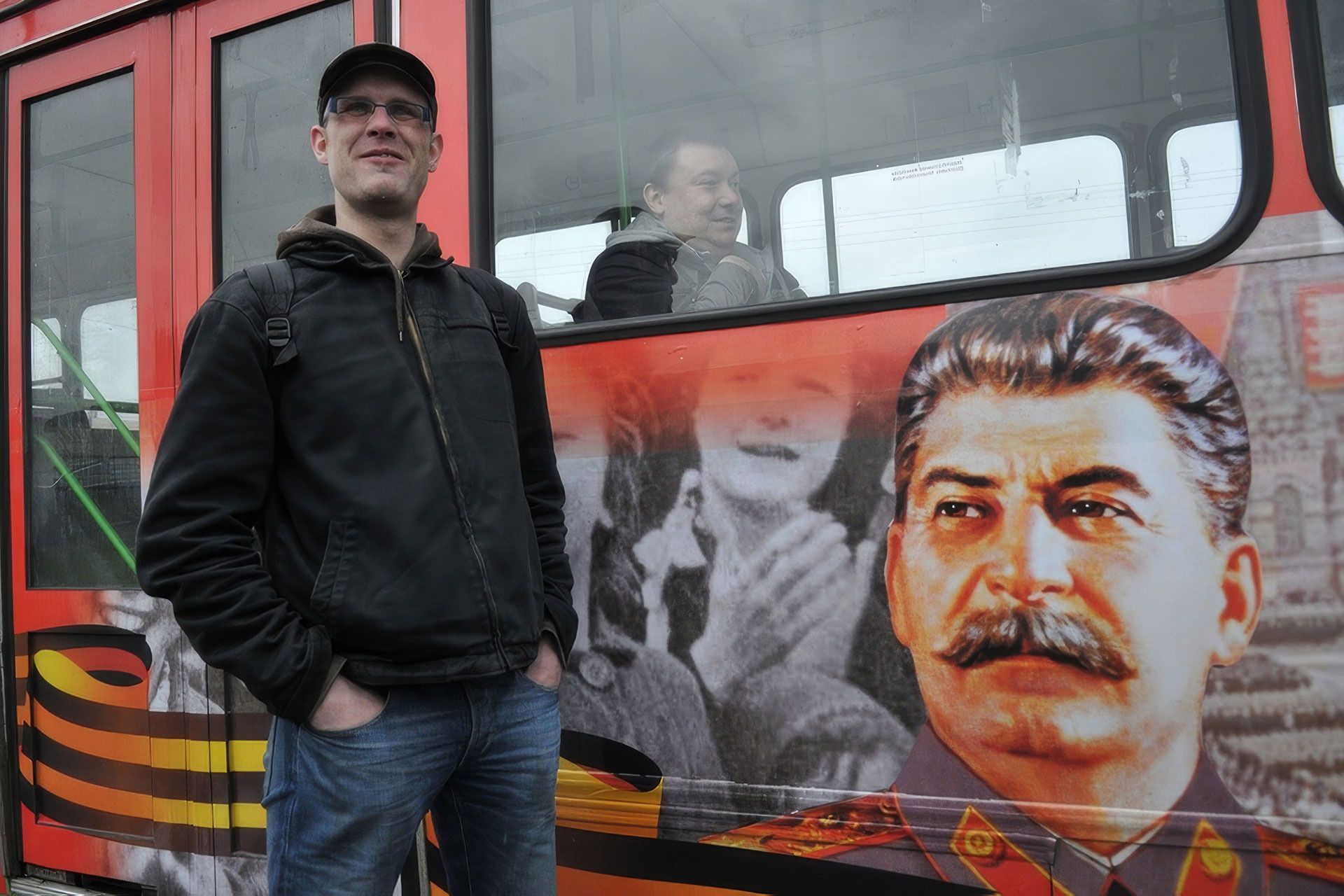
As early as 2012, as if testing public consciousness, the “Kurginyan followers” launched so-called “Stalin buses” with the leader’s portrait through the streets of Russian cities, laid flowers at Stalin’s grave, and held the annual “Antipilorama” forum. At the same time, right-wing radicals called for the dawn of an era of “enlightened Stalinism.” Parallel to this, Stalin’s rehabilitation began in official propaganda. However, at some point, the revival of the cult of personality from the past began to turn against the sponsors of its “resurrection,” taking on an oppositional hue.
The fact is that even in its oppositional form, the sentiments of the “deep people,” honed for years by propaganda, are most often not connected with support for liberal reforms. On the contrary, they can be described as conditionally Stalinist.
According to surveys conducted by the Levada Center*, in 2019, 51% of Russians viewed Stalin’s figure with admiration, respect, or sympathy. On the eve of the full-scale war, this record was broken again: as of summer 2021, 60% of Russians, including youth, had a positive attitude toward Stalin, and only 11% viewed him negatively.
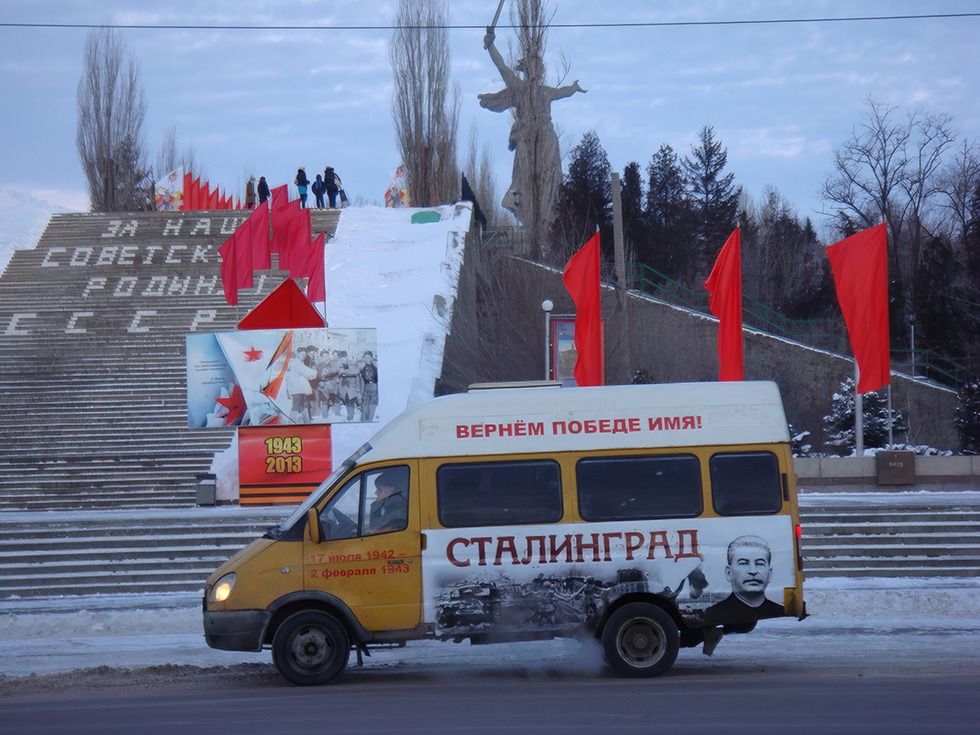
A marshrutka with Stalin’s portrait on board, Volgograd, 2013. Source: stalinobus.info / web.archive.org
It is important to note that the image of Stalin in the eyes of the Russian majority embodies not so much a specific historical figure responsible for the deaths of millions of innocent people, but a set of qualities and actions that Russians expect from today's authorities. According to a survey conducted in August 2021, respondents named Stalin’s virtues as “restoring order,” “lifting the country from its knees,” and “victory in the war.” Sociologists also noted a strong demand for social justice, which finds no practical expression nowadays.
Three qualities stand out that appeal to most Stalin supporters in his image: a victor and defender against the “external threats” fueled by propaganda; a symbol of social justice; an image of an incorruptible, “strong hand” mercilessly fighting corruption. However, the Kremlin itself has not always matched this image in the public consciousness.
Moreover, the more distrust toward Putin grew in the country, the greater the sympathy for the dictator from the past.
For example, at the end of May 2019, the Russian leader’s rating hit a historic low, falling to 31.7%, and in July 2020, his rating dropped to 23%. In the 2021 elections, despite all the falsifications, the communists gained a large number of votes. All these figures correlate with the rise in sympathy for Stalin.
This trend was even acknowledged by the well-known pro-Kremlin website close to the Russian Ministry of Defense, “Military Review.”
“The sharp rise in Stalin’s popularity is nothing other than a veiled, so far internalized protest of society against the actions of our authorities and those who currently embody them... This, if you will, is that very 'internal opposition' that philosophers sometimes talk about and comedians sometimes joke about. Now it has become a reality for 51% of Russians. And however anyone truly feels about Stalin’s personality, such a percentage of potential oppositionists should somehow convince the Kremlin that it is losing control of the situation and stands on the threshold of significant changes,“ noted one of the site’s authors, Viktor Kuzovkov.
Indeed, according to ordinary people, Stalin “would have long ago dealt with” all the high-ranking “crooks and thieves.” The luxurious palaces of Putin and his circle certainly do not correspond to the image of an incorruptible man, and the constant reduction of social spending negates the very notion of social justice. The pension reform combined with the continual decline in living standards became the final nail in the coffin of the myth of the “social state.”
The image of “defender of Russia” against “external enemies” was no better. The regime’s inability to exist without a constant sense of external threat played a cruel joke on the Kremlin. It turned out that Putin “held back” the external threat, but all these years he could not overcome it or eliminate the “danger from Ukraine and NATO.” Gradually, his electorate began to feel this too, increasingly doubting his role as defender and victor.
The full-scale war against Ukraine largely became a reaction to these doubts and an attempt to boost the government’s shaken rating. With its start, Putin again began to be associated in the eyes of his electorate with the image of a “new Stalin”—a defender against external threat.
These people saw the capture of new territories as a long-awaited victory, which simultaneously resonated with their imperial aspirations and the image of “resisting the hateful West.” In June 2025, respondents from the Levada Center* named Stalin the most outstanding person of all times and peoples (42% of those surveyed). Putin came in second (31%).
Talks about “nationalizing the elites” and fighting the “sixth column in power” became a kind of surrogate satisfaction of the sense of social justice. Anti-oligarchic sentiments were strong in Russia long before the war began, and the introduction of Western sanctions against oligarchs found a peculiar echo in the eyes of Russians, as, in the view of ordinary people, it “deprives them of the opportunity to rob the country.” Promises to “deal with traitorous liberals in power” even seem to many like the fulfillment of their old dream of “cleansing the elites” and bringing them closer to the “common people.”
“Stalinobus,” which ran through the streets of Saint Petersburg in May 2010. Source: https://viklamist.livejournal.com / CC-BY-SA
However, as these promises fail to be fulfilled, the cult of the “strong hand” may again turn against, if not the entire government, then at least some of its clans. Radicals are already demanding serious reforms at the state level, including abandoning digital development; granting additional powers to the Russian Orthodox Church; measures against migrants and even Russian citizens of non-Russian nationality; banning mandatory vaccinations; and nationalizing the economy. Even if some of these measures are implemented, it will deprive Russia of the “safety cushion” in the form of remnants of a market economy that allow Putin to wage war without serious harm to the electorate’s welfare.
So far, the authorities have managed to keep radicals under control by maintaining the required level of “external threat” and staging “demonstrative punishments” in the form of intra-elite repressions. However, to meet popular expectations, largely shaped by the propagandists themselves, these intra-elite repressions will inevitably have to be intensified. It is quite possible that in this case more and more people in the elites will begin to understand that their survival depends on whether they can get rid of the aging leader. And this is not only about Stalin.
Further reading about the deep people and Stalinism
The unbearable Joseph. It’s not enough to remove Stalin from the mausoleum; the country must be removed from Stalin
Stalin in the metro. Moscow, 2025: a monument to the dictator installed at the Taganskaya-Koltsevaya station
Main photo – initiator of the “Victory Bus” campaign Viktor Loginov in front of a bus with a portrait of Joseph Stalin, Saint Petersburg, May 5, 2010 Wikipedia.org / https://viklamist.livejournal.com / CC BY-SA 3.0
If you enjoyed this article, consider making a donation — one-time or, even better, monthly. Your support helps us motivate our authors and become better with every article.
Our organization is recognized by the Internal Revenue Service (IRS) as a 501(c)(3) tax-exempt, charitable organization, which means that all contributions made to us are tax-deductible to the fullest extent permitted by U.S. law. Individuals may generally deduct charitable contributions of up to 60% of their Adjusted Gross Income (AGI) for cash donations made to qualifying 501(c)(3) organizations. For donations of appreciated assets (such as stocks or other long-term capital assets), the deduction is typically limited to 30% of AGI, based on the fair market value of the asset. C-corporations may deduct charitable contributions of up to 10% of their taxable income for donations made to eligible charitable organizations.
By submitting a donation, you confirm that you have read and accept the following documents: Privacy Policy and User Agreement, and also give consent to the processing of your personal data.
If you would like to unsubscribe from a monthly donation, please email us at: [email protected]