Team Zelensky still hopes that as soon as Russian citizens realize the state is unable to protect them, an uprising will begin in the country. However, these expectations fit poorly with how modern Russia is organized. Putin’s main vulnerability lies elsewhere.
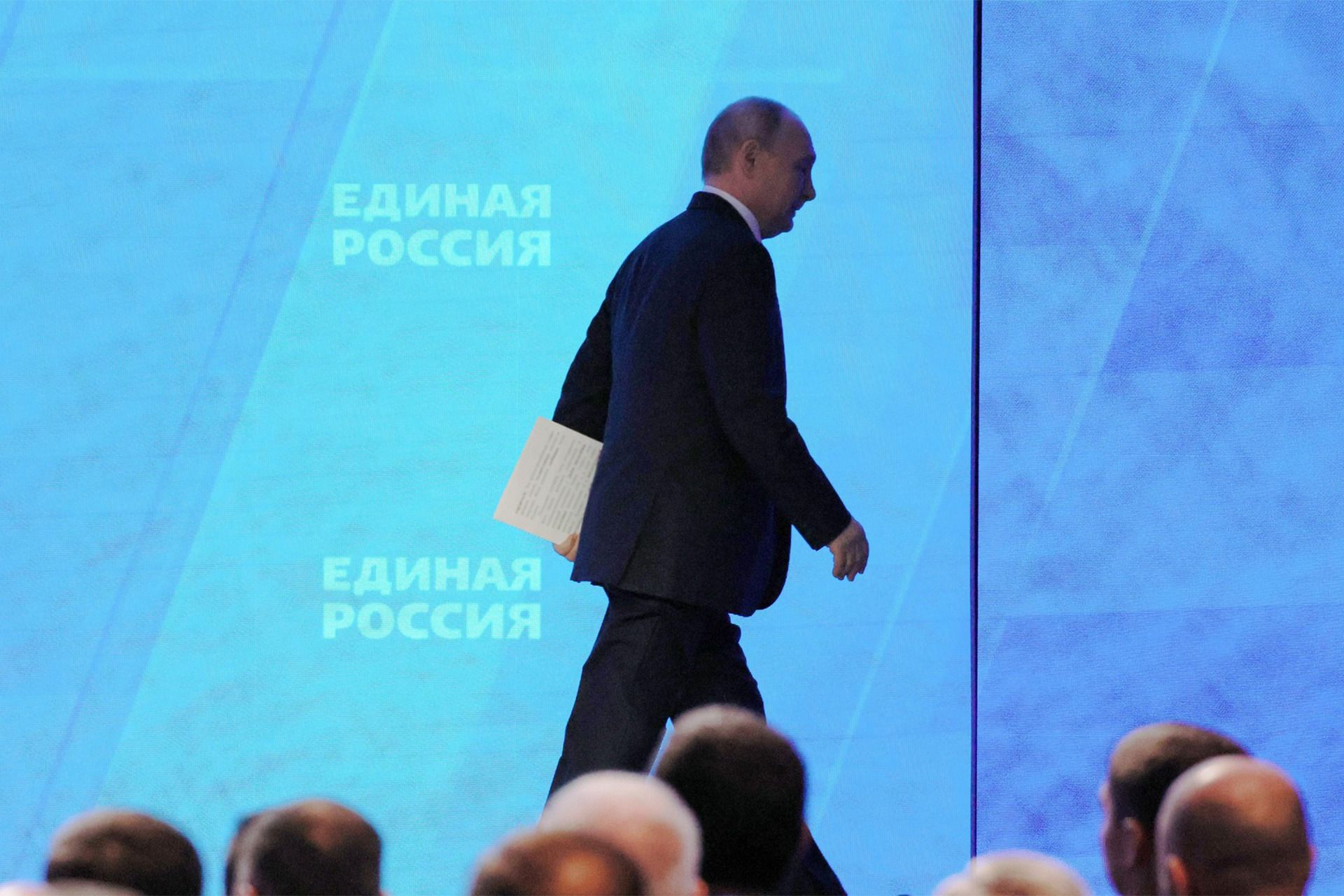
United Russia party congress, June 28, 2026. Photo: kremlin.ru
In recent weeks, observers of the Russian-Ukrainian war may have experienced what modern psychology calls cognitive dissonance.
On the one hand, Putin almost daily says that Russian troops are “advancing on all fronts”. He last made this statement over the weekend and at the congress of the ruling party, United Russia, saying that “the Kyiv regime is retreating along the entire line of contact”.
On the other hand, at the same time, photos and videos are being published of large-scale Ukrainian strikes on Russian oil refineries and military plants, as well as on the highway linking occupied Crimea with the territory of Donbas controlled by Moscow and Russia’s Rostov region.
According to the American Institute for the Study of War (ISW), in the Sumy, Kharkiv, and Donetsk regions over the past three days the Russians tried to attack, but failed to advance. In the Zaporizhzhia region, meanwhile, the AFU made progress.
Among the latest news on this topic, notable is an interview of Polish Foreign Minister Radosław Sikorski with CBS, where he notes:
“Ukraine has certainly won in the Black Sea. Russia definitely does not dominate Ukraine’s airspace. It can launch missiles and drones, but it cannot freely use aviation over the territory of Ukraine. On the ground, the war has reached a deadlock, and it appears that Ukraine has gained fire control over the strategically important highway connecting Donbas with Crimea”.
And that’s not even mentioning Sikorski, known for his steadfast support of Ukraine — U.S. President Donald Trump recently noted that things for Zelensky (in this war) are “going pretty well”. In the mouth of the Western politician closest to Putin, who together with his vice president Vance not so long ago was assuring the president of Ukraine that he “has no cards”, this sounds like a compliment. And after a personal meeting at the G7 summit in the French city of Evian, Trump, impressed by Ukraine’s successes, called Zelensky courageous and admitted that he was “doing pretty well“.
However, a spoonful of realism should be added to this barrel of optimism.
Putin’s statements that his army is advancing on all fronts, alas, are partly confirmed on some fronts. First and foremost in the still unoccupied part of Donbas.
Kramatorsk, the official temporary capital of Donetsk region, and Sloviansk are already being shelled by Russian tube artillery. Ukrainian media acknowledge that the front is drawing ever closer to them. Civilians are being actively evacuated from these cities.
Bloomberg recently reported that “the Russian army has sharply intensified strikes on Kramatorsk, actively using guided aerial bombs, artillery and drones. The Russian Federationis turning Kramatorsk into ruins, trying to make the city uninhabitable“.
And what is happening in Crimea? Ukrainian strikes on the “road of life” from Crimea to Donbas make a strong impression. A mass exodus of vacationers and local residents from the peninsula has begun along the only, for now relatively safe, road connecting Crimea with Russian territory and passing over the Crimean Bridge. Thousands of cars are now stuck near Kerch at the entrance to this bridge from the Crimean side.
However, fully isolating the peninsula with drone and missile strikes is unlikely under current unmanned technologies. Let us not forget that the Russian Federation still has a kind of navy in the Black Sea, including submarines.
Putin and his propaganda twist the sharp deterioration in the lives of Crimeans under these conditions to their advantage: they compare what is happening to the siege of Leningrad. For them, this is another argument in favor of the version that the Russian Federation is fighting the “Ukrainian Nazis” and that this war was not started by Moscow in vain.
Hope for Ukrainian “long-range sanctions” is also excessive. By mid-2026, Ukrainian strikes had knocked out Russian refineries whose combined capacity, according to Reuters, accounted for about a quarter of the country’s entire oil refining capacity. However, even if another quarter of Russian refinery capacity is taken out of service and the country faces an even greater gasoline shortage, Russians will switch to scooters, bicycles, and public transport, tighten their belts, and, as usual, rally around the flag.
Team Zelensky still hopes that as soon as Russian citizens realize that the state is unable to protect them and provide them with a certain standard of living, an uprising will begin in the country.
Well-known Ukrainian military analyst and adviser to Ukraine’s Minister of Defense, Serhii Flash (Beskrestnov), recently wrote in his Telegram channel:
“It is the fifth year of a war nobody needs. Neither the common people of Ukraine nor the common people of Russia. The front-line, positional war has now shifted into the format of attacks on rear-area territories (infrastructure, business) with missiles and UAVs. No one will win in this format. Russia’s leaders do not hear us, which is understandable, but I hope the people of Russia, who do not want to fight, hear us: ‘Let’s end this madness already.’ We offer peace; if you do not want your loved ones and relatives to die, rise up against the war“.
The thing is, Russian citizens have never massively made demands on their state to ensure security and prosperity. In the mass consciousness of Russians, it is not the state that owes citizens, but citizens that owe the state. Russian propaganda also works toward this idea.
Note that Zelensky’s plan and that of his current Minister of Defense Mykhailo Fedorov to disable 50,000 occupiers a month, on which the Ukrainian leadership also placed great hopes, is not being fulfilled. NATO Secretary General Mark Rutte recently confirmed that Russia loses 30,000 to 35,000 people per month on the battlefield — killed and wounded. And he reminded that
the monthly number of Russian losses in Ukraine exceeds the USSR’s total losses over 10 years of war in Afghanistan. But the problem is that for Putin this is quite acceptable.
He balances the “debits and credits” in this sphere like a calculating accountant. Russia’s mobilization reserve is five times larger than Ukraine’s: 150 million people in Russia together with the occupied territories versus 30 million Ukrainians in Ukraine. Therefore, even a potential doubling of losses on the front does not concern him. If they were to increase fivefold, then yes, perhaps he would think about it; otherwise, no.
Putin can be forced to make peace only through what really matters to him. And what matters to him is preventing defeat. For a dictator raised on militarist propaganda in the USSR, defeat is perceived not as human losses (they can be anything), but as the loss of territory and the army’s retreat.
This conclusion is also confirmed by Russian history.
It is worth remembering that all three Russian revolutions happened not because of public dissatisfaction with the government, but after Russia’s defeats in war.
The First Russian Revolution (1905) happened after the defeat of the army and navy in the Russo-Japanese War.
The February Revolution of 1917 was largely a consequence of the defeat of the army of the Russian Empire during the First World War and specifically the huge losses during the so-called Brusilov (Lutsk) breakthrough — the failed offensive of the Russian army in June–September 1916.
The October Revolution of 1917, in turn, was largely the result of yet another unsuccessful attempt by the Russian army to defeat Germany and Austria-Hungary in June–July 1917. This offensive, undertaken by the Provisional Government, like the Brusilov breakthrough, ended in a severe defeat and a large-scale retreat of the Russian army.
How the Ukrainian military-political leadership can solve this problem is another matter. But there should be no illusions here. Apart from serious defeats, nothing else will force Putin to stop the hostilities.
If you enjoyed this article, consider making a donation — one-time or, even better, monthly. Your support helps us motivate our authors and become better with every article.
Our organization is recognized by the Internal Revenue Service (IRS) as a 501(c)(3) tax-exempt, charitable organization, which means that all contributions made to us are tax-deductible to the fullest extent permitted by U.S. law. Individuals may generally deduct charitable contributions of up to 60% of their Adjusted Gross Income (AGI) for cash donations made to qualifying 501(c)(3) organizations. For donations of appreciated assets (such as stocks or other long-term capital assets), the deduction is typically limited to 30% of AGI, based on the fair market value of the asset. C-corporations may deduct charitable contributions of up to 10% of their taxable income for donations made to eligible charitable organizations.
By submitting a donation, you confirm that you have read and accept the following documents: Privacy Policy and User Agreement, and also give consent to the processing of your personal data.
If you would like to unsubscribe from a monthly donation, please email us at: [email protected]