While ordinary Russians are being denied the opportunity to obtain visas to the EU, sanctions are being lifted from two emblematic figures of Putin’s Russia. The negative consequences of this decision are clear. But are there any positive ones?
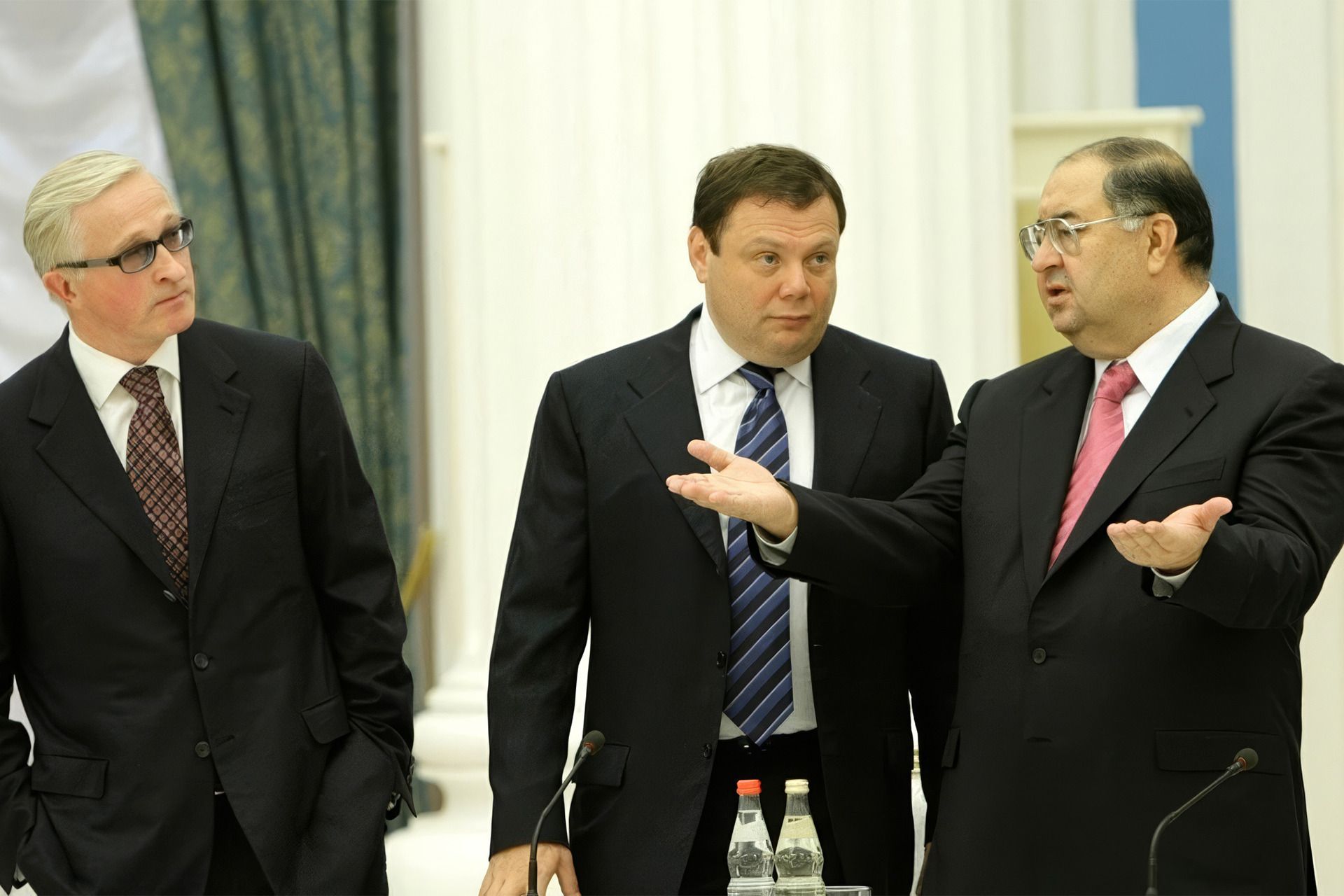
From left to right: head of the RSPP Alexander Shokhin, head of Alfa Group Mikhail Fridman, and head of Metalloinvest Alisher Usmanov. 2009. Photo: kremlin.ru
Last Monday, the Council of Europe published a decision to remove two Russian oligarchs from the sanctions lists: USM Holdings founder Alisher Usmanov and Alfa Group co-founder Mikhail Fridman. At the same time, sanctions against the other 3,000 individuals, legal entities, and companies whom the European authorities consider responsible for the Russian invasion of Ukraine were extended for another three years. But Fridman and Usmanov have done nothing since the start of the war that would justify removing them from sanctions. And before that, both spent decades contributing to the creation and strengthening of the Putin regime.
Suspicious figures
Mikhail Fridman is a participant in the notorious “semibankirshchina”, whose interference in politics in the second half of the 1990s led to Vladimir Putin’s appearance in the Kremlin. In the Alfa Group he created with partners, the ideologue of the Putin regime Vladislav Surkov began his career (in the 1990s he headed the PR department of Alfa-Bank, and later became deputy head of the presidential administration), as did Alexander Abramov (another former Alfa Group PR man, who before Surkov’s resignation served as deputy head of the Presidential Directorate for Domestic Policy and oversaw regional policy).
After Russia’s invasion of Ukraine, Fridman took a cautious position — for example, he was absent from the famous meeting of big business with Putin on February 24, 2022. But Alfa Group was represented there by Pyotr Aven, simply because Fridman himself was in London at the time.
In 2023, Fridman still had to return from London to Moscow: he publicly complained that because of EU and UK sanctions he could not even pay for the household staff in his mansion, and the SBU accused him of financing Russian military factories. It seems that after an attempt by several Russian opposition figures in exile to lobby for concessions for Fridman ended in a public scandal, he resigned himself to the fact that there would be no easy way out. However, as can be seen, he did not stop looking for other paths. By the way, Leonid Volkov, one of those who signed the letter asking for sanctions against Fridman to be lifted, is now criticizing the EU decision: in 2022, he says, the idea was that sanctions would be lifted from Fridman in the event of unequivocal support for Ukraine, including financially. Now, according to the former head of the FBK, the oligarch has not been caught doing anything of the sort.
Alisher Usmanov, known to the general public for the meme “Piss off, Navalny”, is an even more odious figure. In 2000–2014, he headed Gazprom-Holding, a subsidiary of Gazprom, and returned strategic metallurgical and industrial assets that had ended up in private hands thanks to the privatization of the 1990s under state control. In addition, in coordination with the authorities, Usmanov invested in areas sensitive to the Kremlin. For example, in media and social networks — from the publishing house Kommersant to VKontakte, taken from its founder Pavel Durov. And the notorious meme appeared after the FBK investigation “He Is Not Dimon to You”, which told how Usmanov paid for the luxurious life of the former president of the Russian Federation (and, in essence, Putin’s viceroy) Dmitry Medvedev.
In 2014, after the first wave of Western sanctions in response to Russia’s annexation of Crimea, Usmanov was among the first to respond to Putin’s call for the “deoffshorization” of the economy — and moved his Metalloinvest holding and mobile operator MegaFon into Russian jurisdiction. Usmanov’s repeated awarding with Russia’s highest orders clearly indicates his complete loyalty to Putin.
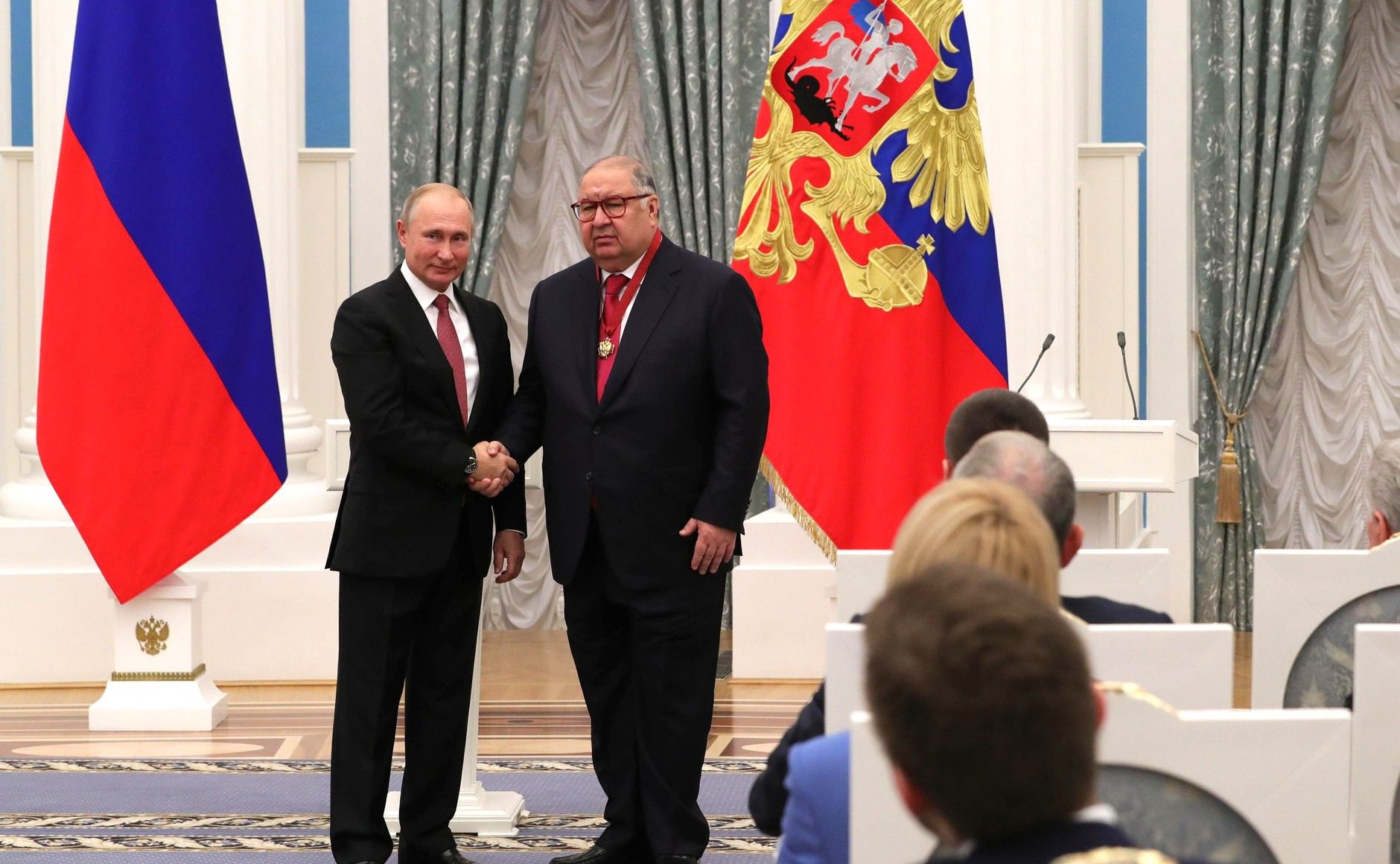
Awarding Alisher Usmanov the Order “For Merit to the Fatherland”, 3rd class, November 27, 2018. Photo: kremlin.ru
Questionable grounds
And so the EU is lifting sanctions on such people. “It turns out that for Europe it doesn’t matter whether you support the war or not, whether you are friendly with Putin or oppose him. Apparently, what matters much more is how much money is sitting in your bank accounts”, Yulia Navalnaya wrote in anger. In reality, things are much worse.
The thing is that Usmanov’s sanctions were lifted at France’s insistence: he secretly promised to get a French citizen accused of espionage out of an Azerbaijani prison. And Luxembourg made its consent to lifting sanctions on Usmanov dependent on lifting sanctions on Fridman, who filed a $16 billion lawsuit against the country, claiming that his assets there were frozen solely on the basis of his Russian citizenship. Under these conditions, Latvia’s objections, which was categorically opposed to lifting sanctions on Fridman (as, incidentally, on his friend and partner, Latvian citizen Aven), were not taken into account. So far, only Lithuania has demonstratively banned Usmanov and Fridman from entering for five years.
In short, sanctions were lifted from Usmanov because he unlawfully influenced the release of a French hostage (whether he was actually a spy is not so important in this situation). And Fridman was hitched on because the Luxembourg authorities were afraid of losing to the oligarch in court (or for some other, unknown to me, reasons).
This is not even about Usmanov and Fridman themselves: there is every reason to fear that other people on the sanctions list have received an inspiring example of how to act — and there is already information that they are very inspired.
It turns out that all you need is to strike a deal with one of the dictators to take a citizen of a sufficiently influential European country hostage, or to file a multibillion-dollar lawsuit against a country that is not very influential but very timid when it comes to foreign investment — and success can be expected.
And now it is not only Putin and his propaganda who speak of Europe’s “double standards” policy. Especially against the backdrop of statements by some European politicians that Russian emigrants in the EU are not helping to overthrow the regime in Russia.
In short, the negative consequences are clear. But are there any positive ones?
Strangely enough, yes.
Is his example a lesson to others?
First of all, the Fridman case shows that the sanctions imposed on oligarchs in 2022 need a radical overhaul — they do not have very strong legal grounds. General statements about closeness to Putin and financing the regime must either be backed up by specific facts — and often these facts are not hard to find — or replaced or supplemented by stronger formulations.
There is no point in criticizing the authors of the sanctions lists. These lists were adopted in haste and in complete confidence that the war would be short-lived, and that Russian oligarchs, for the sake of their yachts and palaces, would betray Putin — remember the arguments that no one would use a nuclear bomb against their own assets in the West?
Despite the regular verbal threats from Russia, it has not come to a nuclear bomb yet, but the expectation of Putin’s betrayal was definitely a mistake. The fear of falling out of a window or dying some other sudden death, as has happened more than once with representatives of the Putin elite, turned out to be stronger than the longing for yachts and villas on the Côte d’Azur: between life and their wallets, the oligarchs quite reasonably chose life. But now the situation is changing.
It should be noted that in 2022 almost everyone agreed that the war would be short-term — though with different predictions of its outcome. The oligarchs were no exception. Today the situation is different. The war has clearly reached a dead end, and Putin, wanting to turn things around, is increasingly dipping into the pockets not only of the population but also of big business — the latest decision to levy an excess profits tax now also on mining companies, as well as the increase in the personal income tax rate to 22% on passive income, including dividends (which are precisely the basis of big business’s real income), is an example of this. At the same time, the force bloc is being strengthened, accompanied by an even more unrestrained redistribution of business: the grounds for seizure are becoming more and more ephemeral, and even ostentatious loyalty and integration into the system do not protect against robbery.
Under these conditions, in addition to fear of Putin, large Russian capital acquires another fear — the fear of losing much more than is possible now.
In principle, people, many of whom in the 1990s went to business meetings wearing bulletproof vests and accompanied by automatic rifles, know how to take risks, even if age and time have made them appreciate caution. But they want to understand what exactly they are risking for.
In fact, it has been repeatedly said, including by Russian opposition figures, that Russian capital needs a clear exit strategy from the West. And over the four-plus years of war, one could have thought about such a strategy more constructively rather than simply arguing about its morality. But the question of morality really does arise here.
How can forgiveness be prevented from becoming justification? How can the responsibility of the Russian oligarchy for the fact that the system created with their direct participation led to military aggression be preserved? And here it is worth returning to the current EU decision. The trouble is not only that it is unjust. This decision is, in effect, the sale of an indulgence to Fridman and Usmanov, “resetting” their sins. In other words, it is immoral in essence.
The positive aspect of the current situation is only that the issue of the effectiveness of sanctions against the Russian oligarchy is once again on the agenda.
Perhaps right now a “window of opportunity” has opened to deprive Putin of support from big capital. And even to get that capital to support Ukrainian resistance.
It seems to me that the Russian opposition has reason to take part in this work and try to develop some recommendations. Yes, that would be a compromise between supporters of the moral path and supporters of actions “in relation to baseness”. But without this compromise, Western countries are unlikely to be able to build a more effective system of sanctions “carrot and stick” that will deprive Putin of at least a significant part of the money for the war. And at most — lead to an “elite conspiracy” against him.
If you enjoyed this article, consider making a donation — one-time or, even better, monthly. Your support helps us motivate our authors and become better with every article.
Our organization is recognized by the Internal Revenue Service (IRS) as a 501(c)(3) tax-exempt, charitable organization, which means that all contributions made to us are tax-deductible to the fullest extent permitted by U.S. law. Individuals may generally deduct charitable contributions of up to 60% of their Adjusted Gross Income (AGI) for cash donations made to qualifying 501(c)(3) organizations. For donations of appreciated assets (such as stocks or other long-term capital assets), the deduction is typically limited to 30% of AGI, based on the fair market value of the asset. C-corporations may deduct charitable contributions of up to 10% of their taxable income for donations made to eligible charitable organizations.
By submitting a donation, you confirm that you have read and accept the following documents: Privacy Policy and User Agreement, and also give consent to the processing of your personal data.
If you would like to unsubscribe from a monthly donation, please email us at: [email protected]