Moscow's persistent attempts to demonstrate the unshakable nature of its partnership with Astana are the best evidence that, in reality, many things are changing there.
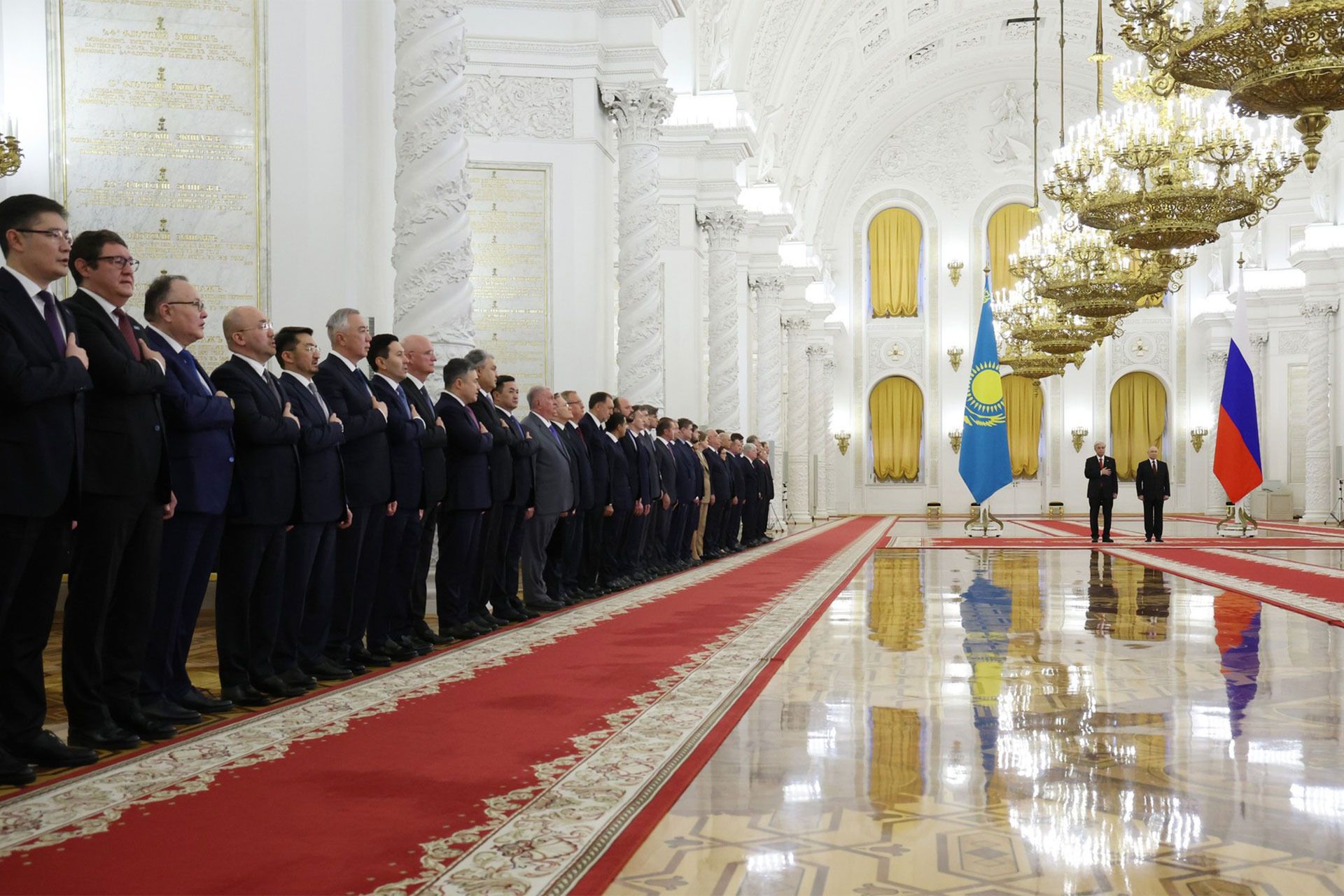
The official meeting ceremony between Vladimir Putin and the President of Kazakhstan Kassym-Jomart Tokayev, November 12, 2025. Photo: kremlin.ru
Last week, the global agenda was shaken by the President of Kazakhstan, Kassym-Jomart Tokayev. Immediately following his historic visit to the United States, the Kazakh leader made an equally striking trip to Moscow. Two productive visits to two rival world capitals, each with two not-so-easygoing presidents, within five days (plus another round of Russian-American tensions) — this is undoubtedly an achievement.
More precisely, it’s two separate and qualitatively different achievements. In the case of the USA, everything is clear: mutual praise with Donald Trump, multibillion-dollar contracts, other Central Asian leaders sitting nearby. But the situation with Russia turned out to be much more interesting. Paradoxically, the main breakthrough here is that on the surface there seems to be no breakthrough: between the two neighbors, everything appears to remain as before. But the phrase “appears to” is the key here.
The Screen Will Show Ours
Russian independent media covered Tokayev’s Moscow visit on November 11-12 in somewhat bleak tones. For example, “Important Stories” wrote that the heads of Russia and Kazakhstan “forgot all disagreements”, while “Dozhd” explicitly stated in one of its news broadcasts’ headlines that “Tokayev is getting closer to Putin”.
A clear and consistent narrative emerged: the Kremlin welcomes the geopolitically wayward son who had wandered and harbored secrets but ultimately realized everything and returned. But is that really the case?
At the Moscow summit, Tokayev did not hint at revising his original positions on the war in Ukraine. Therefore, Astana’s stance remains the same: no military assistance to the northern neighbor, recognition of Ukraine’s 1991 borders, and a desire for a swift end to hostilities (the echoes of which periodically reach even Kazakhstan).
The protocol of Tokayev’s meeting in Moscow did not resemble that of a vassal repenting his defiance. On the contrary, the Russian capital received the president at an unprecedentedly high level. There were Su-35 fighter jets escorting the foreign plane No. 1, huge LED screens displaying the president’s photo with greetings in Kazakh, and a talk on the same screens with MGIMO students (an institution Tokayev himself once graduated from). Finally, although Putin did not personally meet the guest at the airport (sending Deputy Prime Minister Denis Manturov instead), he later received him at his Kremlin apartment — a rare honor for foreign visitors.
There is no need to list mutual assurances of friendship, good neighborliness, and cooperation voiced over the two days of the summit — these are well reflected in the official statements of both states. More important are the few details that differ. Kazakh media highlighted the mention of the giant LED images of Tokayev along his motorcade’s route through Moscow — a detail overlooked by their Russian counterparts. Meanwhile, pro-Kremlin media appreciated how Tokayev referred to Putin as the “senior comrade”, which, in turn, was lost in Kazakh sources.
Tokayev’s policy is balanced, confident, and wise. He understands his place in the world, between Russia, China, and the United States. What else can be done? As long as such centers of power and nuclear states exist, countries in between will always be tools to shift the balance among these powers. This process is ongoing; Kazakhstan is strengthening and gaining what is important to it.
- Arkady Dubnov, Russian political scientist, Central Asia expert
Seemingly minor differences point to a fundamental issue: Moscow and Astana have different views of the November 11-12 meeting. The Russian leadership wants to show that nothing has changed between it and its Central Asian partner — he remains a reliable ally as before. Meanwhile, Kazakh authorities subtly emphasize that the balance of power between the sides is gradually leveling — they are gradually obtaining a new attitude from their northern neighbor.
Propaganda, Tigers, and Metal
It is appropriate here to recall how bilateral relations developed after February 24, 2022. On a protocol level, things remained serene — the same words about the world’s friendliest good neighborliness, heard again last week. Yes, there were occasional annoyances: Tokayev under Putin defended Ukraine’s territorial integrity on camera, and the Russian president couldn’t pronounce the Kazakh colleague’s not-so-complex name.
Such seemingly trivial incidents concealed a consistent Kremlin campaign to “educate” the Central Asian neighbor. Many interesting things happened. Sometimes, individual Russian politicians and propagandists allowed themselves, to put it mildly, inappropriateremarkstoward Kazakhstan. At times, trade wars flared up: on the “fronts” of oil exports, food markets, and large freight transport (the latter literally as recently as last month).
In 2025, it can be stated: Kazakhstan refrained from harsh responses but simultaneously did not change its course of multi-vector diplomacy; this seems to be the favorite term among local political analysts when asked about their country’s foreign policy.
The best way to understand how this principle works is to look at the structure of Astana’s foreign trade turnover. Over the past 3.5 years, China has surpassed Russia in gross figures, and the shares of the USA, Turkey, South Korea, and EU members look increasingly impressive year after year.
In short, Kazakhstan is becoming increasingly attractive to foreign investors: both as a resource-rich country (about 40% of the world’s chromium reserves, 15% uranium, 6.5% zinc, 2% oil, and more) and as a relatively convenient place for business with pragmatically minded leadership.
The summer and fall of 2025 were a continuous diplomatic showcase for President Tokayev. First, two productive meetings with Xi Jinping, then a striking speech at the UN General Assembly, followed by the historic rendezvous with Donald Trump. This rendezvous was truly historic for all Central Asia: for the first time, all five leaders sat at one table with the US president. Specifically, the Kazakh leader also secured deals worth $17 billion, announcing his intention to sign the Abraham Accords with Israel — in other words, cementing his status as a US partner in his region.
Against this backdrop, Tokayev’s trip to Russia appears more as a nod to the aforementioned multi-vector approach than a truly qualitative leap. Yes, the host side worked hard to present the visit as pompous as possible. The Declaration on the Transition of Kazakhstan-Russia Relations to a Level of Comprehensive Strategic Partnership and Alliance, signed by the two presidents, is worth noting. However, as rightly noted in Kazakh media, “what is happening is less about opening prospects and more about consolidating the past.”
Of the 14 documents signed [in Moscow], only two agreements seem truly new — on cooperation in AI implementation and on importing Ussuri tigers to Kazakhstan. Everything else agreed upon by the delegations of the two countries has been voiced before: increasing trade turnover to $30 billion […], Rosatom’s construction of the first [Kazakh] nuclear power plant, inter-university cooperation, and workforce training
- Maksat Nurpeisov, exclusive.kz
Who Needs Whom?
In Russian pro-government media, of course, different assessments prevail. The overall tone was skillfully set — with marked politeness toward Astana — by the maestro himself, Vladimir Solovyov: attempts were made to drive a wedge between us, Kazakhstan did not give in, its authorities have their own interests, but also wisdom and respect.
Indeed, the Central Asian country remains in all respects too closely tied to Russia for now. And for the local elites — despite their efforts to diversify external ties — it is often easier to act in the manner of their northern neighbor. Incidentally, this happened literally during Tokayev’s visit to Moscow. The Mazhilis (lower house of parliament) adopted a law similar to Russia’s banning “LGBT and pedophilia propaganda” in their republic.
From the outside, this act looks like a clear wink to the Kremlin, but in reality, its background is somewhat more complex. The ban on “LGBT propaganda” had been discussed in Kazakhstan for about a year and a half. However, apparently, Kazakh politicians were spurred on by a sharp speech by Kazakh feminist activist Janar Serkenbayeva living in Lithuania — criticizing homophobia in her homeland. After that, the initiative group in the Mazhilis seemed to become zealous and achieved the bill’s adoption in less than a month (theoretically, it could still be rejected by the Senate or president).
However, this is already a strictly domestic Kazakh agenda issue, and for Russian citizens, it is much more important to understand: what do all these tigers, LED screens, and the friendly Solovyov mean for Russia’s foreign policy?
Here, one cannot help but come to a strange hypothesis: it seems that a time of reflection has come in the Kremlin and on Smolenskaya Square. It appears that the tsar’s men have realized that diplomacy cannot be built on blackmail, lies, distilled rudeness, and demonstrative contempt for partners. That following Ukraine and the South Caucasus countries, Russia might lose another long-time friend and neighbor — in the person of Kazakhstan. But it might also be that the Russian leadership is worried not about the long-term agenda.
The aforementioned Arkady Dubnov does not rule out that the Kremlin urgently needs any connection with Donald Trump and Marco Rubio right now. Especially after Sergey Lavrov’s diplomacy in this communication failed spectacularly, and another former Soviet Foreign Ministry official, Kassym-Jomart Tokayev, immediately earned from Trump the status of “an outstanding president”. However, experts in Kazakhstan are skeptical about this hypothesis — in their opinion, behind closed doors in the Russian capital, they discussed rather a banal sanctions circumvention.
But agree: the very framing of the question — that Moscow now needs Astana more than Astana needs Moscow — is notable in itself. Such is the somewhat unexpected outcome of the “special operation,” which, as is known, is proceeding strictly according to plan.
If you enjoyed this article, consider making a donation — one-time or, even better, monthly. Your support helps us motivate our authors and become better with every article.
Our organization is recognized by the Internal Revenue Service (IRS) as a 501(c)(3) tax-exempt, charitable organization, which means that all contributions made to us are tax-deductible to the fullest extent permitted by U.S. law. Individuals may generally deduct charitable contributions of up to 60% of their Adjusted Gross Income (AGI) for cash donations made to qualifying 501(c)(3) organizations. For donations of appreciated assets (such as stocks or other long-term capital assets), the deduction is typically limited to 30% of AGI, based on the fair market value of the asset. C-corporations may deduct charitable contributions of up to 10% of their taxable income for donations made to eligible charitable organizations.
By submitting a donation, you confirm that you have read and accept the following documents: Privacy Policy and User Agreement, and also give consent to the processing of your personal data.
If you would like to unsubscribe from a monthly donation, please email us at: [email protected]