US President Donald Trump imposed sanctions on Russia for the first time since the beginning of his second term. Following him, the EU approved the 19th package of sanctions. This is not yet a full embargo, but already a joint policy of “coercion to peace.”
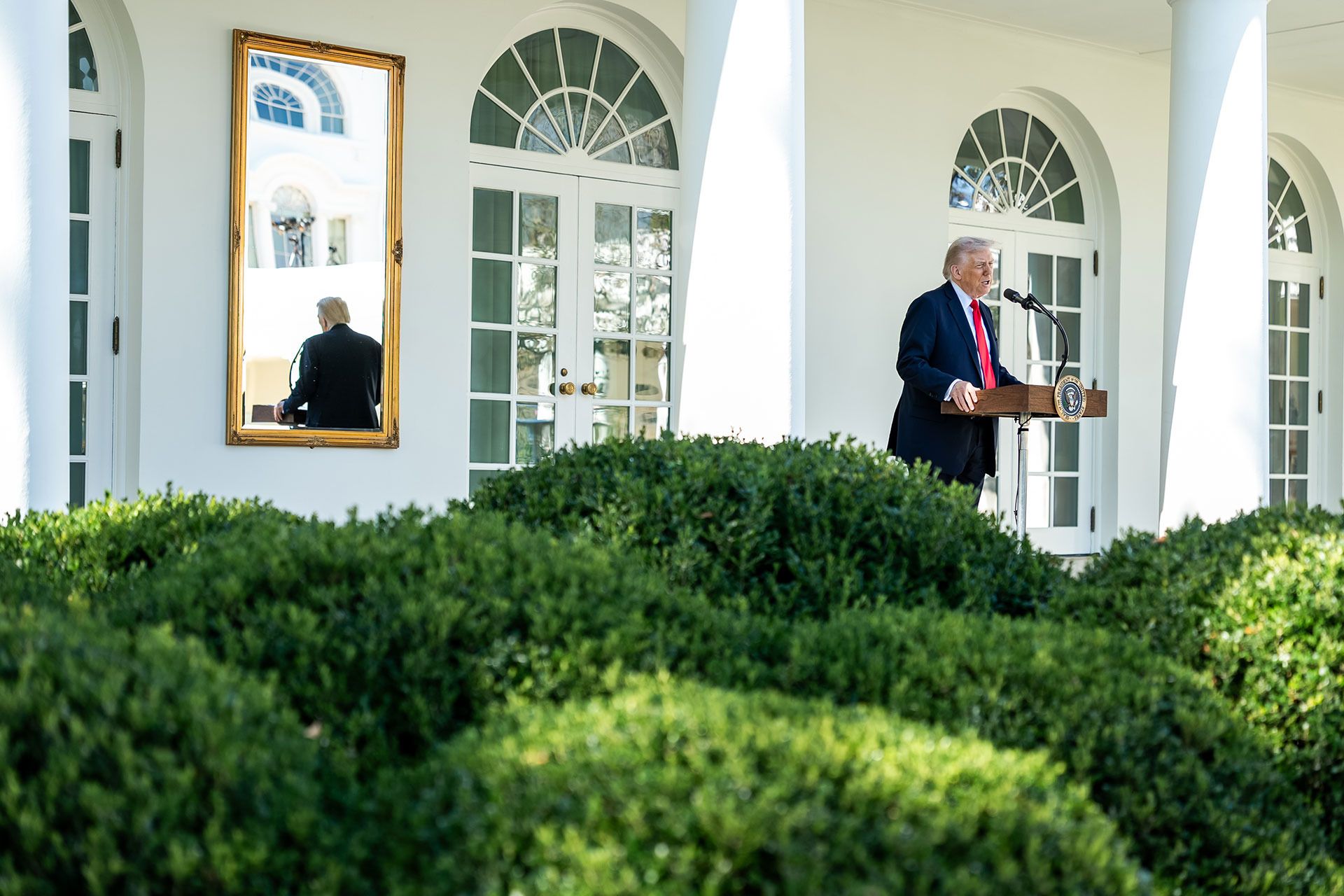
Photo: White House website
“I thought the time has come. We have waited a long time,” said Donald Trump in response to a journalist’s question about why the US Treasury issued an order to impose sanctions simultaneously with the president’s own announcement of canceling the meeting with Vladimir Putin in Budapest. It is symptomatic that he said this sitting next to NATO Secretary General Mark Rutte. It seems Trump has stopped playing the “good investigator” and is moving to the role of the “bad one” – repeatedly stating that everything will change once the fighting stops.
The US imposed sanctions while it was night in Europe. And in the morning, the EU published its 19th package. Before listing the sanctioned organizations and individuals, a few general observations.
The American list is short, but the sanctions themselves are heavier. They are blocking – meaning no one can deal with the organizations or individuals listed if they want to maintain financial relations with the US.
Effectively, this means a ban on any transactions with sanctioned entities, even intermediaries. And on any operations in US dollars. By the way, oil worldwide, except in Russia, is sold in US dollars. US citizens face criminal liability for violating the new sanctions. Overall, the ban is strict. However, the Treasury order can be fairly easily revoked if desired, unlike sanctions passed by Congress.
But Congress is not sleeping either – the US Senate Foreign Relations Committee approved an initiative to recognize Russia as a state sponsor of terrorism. If the US Senate approves the document, Russia will become the fourth country with this status, alongside Cuba, Iran, North Korea, and Syria. This already entails a full embargo on any financial and business relations. Moreover, to remove this “title,” a new parliamentary discussion will be required. As practice shows, this can last for years regardless of the president’s wishes.
For now, this senators' initiative is undoubtedly a “scare tactic” intended to push Russia to change its position, but if that does not happen, it could very well become a reality. US Treasury Secretary Scott Bessent promised that the US will soon announce a new package of sanctions against Russia.
The difference between the American and European approaches is also that the EU, like the Biden administration, tried to limit Russia’s oil revenues without banning the supplies themselves to avoid an oil crisis. Trump takes a different approach: to prohibit dealing with Russian oil. And to avoid rising oil prices, he prefers to negotiate with Saudi Arabia.
The Kingdom of Saudi Arabia has already shifted from limiting production to support prices to pushing out competitors. On November 18, the Saudi Crown Prince Mohammed bin Salman Al Saud, the country’s prime minister, will visit the US for the first time in seven years. So far, oil prices jumped 4% after the sanctions announcement.
European sanctions are broader, though softer. Their effectiveness depends on the degree of control, which the EU is currently not very good at. On the other hand, lifting European sanctions will be as difficult as lifting US Congress sanctions. Moreover, the EU has already stated that the ban on Russian gas, which will be fully enforced from 2027, will remain indefinitely – even if Russia ends the war.
So, here is what is included in the lists of American and European sanctions.
US: sanctions against Lukoil and Rosneft, as well as their subsidiaries (34 in total on the list). At the same time, the US gave a month to complete operations with Rosneft and Lukoil – the US Treasury’s Office of Foreign Assets Control (OFAC) issued three general licenses establishing a transition period until November 21, 2025, during which banks and companies can finalize deals related to these organizations without violating sanctions. Bloomberg reports that India will reduce purchases of Russian oil for its refineries to nearly zero. Apparently, the Indian refinery Nayara Energy, in which Rosneft owns 49% of shares, will have to not only give up Russian oil but also consider changing its shareholder structure. China also announced a suspension of Russian oil purchases.
EU: ban on imports of Russian LNG under short-term contracts from April 25, 2026, and long-term contracts from January 1, 2027. Ban on transactions with Alfa-Bank, MTS Bank, Absolut Bank, branches of VTB and Sberbank in Belarus, branches of VTB in Kazakhstan and Shanghai, Alfa Bank Belarus, Belarusian banks BelVEB and Belgazprombank. For Kyrgyz banks Tolubay and Eurasian Savings Bank, and Tajik banks Dushanbe City Bank, Spitamen, and Commercial Bank of Tajikistan, restrictions come into force on November 12.
From November 25, sanctions will apply to the payment service Payeer, which is used to transfer money from Russia via crypto. The crypto exchange Grinex is also on the list. The Russian stablecoin A7A5, recently widely used by Russian importers, was also sanctioned. This is bad news: the Ministry of Finance and the Central Bank have just agreed to prepare proposals for international settlements in cryptocurrency. Of course, payments can be made in the USDT stablecoin and other stablecoins, but the transparency of transactions and the unconditional loyalty of most stablecoin issuers and crypto exchanges to US regulators make such operations risky.
Moreover, as part of the 19th package of EU sanctions, restrictions on crypto transactions for Russian citizens and residents (both individuals and legal entities) were introduced. This effectively means that any crypto exchange must by default refuse to provide services to them already at the user registration verification stage.
Also, from January 25, 2026, the EU will ban operations through the Mir payment system of the National Payment Card System (NSPK) and the Fast Payment System (FPS).
Transactions with Rosneft, Transneft, Gazpromneft, Rostec, Almaz-Antey, Sovcomflot, Uralvagonzavod, KAMAZ, PO Sevmash, United Aircraft Corporation (UAC), United Shipbuilding Corporation (USC), and Oboronprom are prohibited. Auto manufacturers Sollers and AvtoVAZ are also on the blacklist. Also on the list are the metallurgical holding Evraz plc, gold mining company Polyus, transport group FESCO (multimodal transportation), Lukoil’s trading division in Dubai Litasco Middle East, the Zvezda shipbuilding complex, and others.
Almost all companies on the European list are already under blocking sanctions by the US – some even since 2014.
The EU list also includes 117 “shadow fleet” vessels. European tour companies are banned from organizing tourist trips to Russia. Personal sanctions were imposed on 20 Russians, including AvtoVAZ president Maxim Sokolov, Medvedev’s aide Oleg Osipov, Higher School of Economics rector Nikita Anisimov, director of the Historical Memory Foundation Alexander Dyukov, chief of the Yunarmiya headquarters Vladislav Golovin, regional ministers and ombudsmen, heads of several enterprises included in the EU blacklists. The updated list also includes Lieutenant General of the Korean People’s Army Tsa Yon Bom.
Overall, the blow was significant and, importantly, coordinated. Of course, Russia’s economy will not collapse because of this, but problems will increase considerably – for the government, companies, and ordinary citizens alike.
In particular, the draft budget for next year, recently presented by the Ministry of Finance, can already be sent to the archive. Most importantly, with Trump’s determination, the sanctions are likely to be more blocking than restrictive, designed for the long term, unlike before.
It is also possible that new bans will soon follow from the US side. The EU has already announced the preparation of the 20th package – and it may be adopted much faster than previous ones since Trump has already influenced the positions of Hungary and Slovakia, the main opponents of energy sanctions.
Of course, even North Korea and Cuba, despite being under blockade, somehow survive. But it is really just “somehow.”
If you enjoyed this article, consider making a donation — one-time or, even better, monthly. Your support helps us motivate our authors and become better with every article.
Our organization is recognized by the Internal Revenue Service (IRS) as a 501(c)(3) tax-exempt, charitable organization, which means that all contributions made to us are tax-deductible to the fullest extent permitted by U.S. law. Individuals may generally deduct charitable contributions of up to 60% of their Adjusted Gross Income (AGI) for cash donations made to qualifying 501(c)(3) organizations. For donations of appreciated assets (such as stocks or other long-term capital assets), the deduction is typically limited to 30% of AGI, based on the fair market value of the asset. C-corporations may deduct charitable contributions of up to 10% of their taxable income for donations made to eligible charitable organizations.
By submitting a donation, you confirm that you have read and accept the following documents: Privacy Policy and User Agreement, and also give consent to the processing of your personal data.
If you would like to unsubscribe from a monthly donation, please email us at: [email protected]