At the highest level of Russian power, there is almost no renewal. Many elite members have been waiting for a major reshuffle for over 10 years, but it still hasn’t happened.
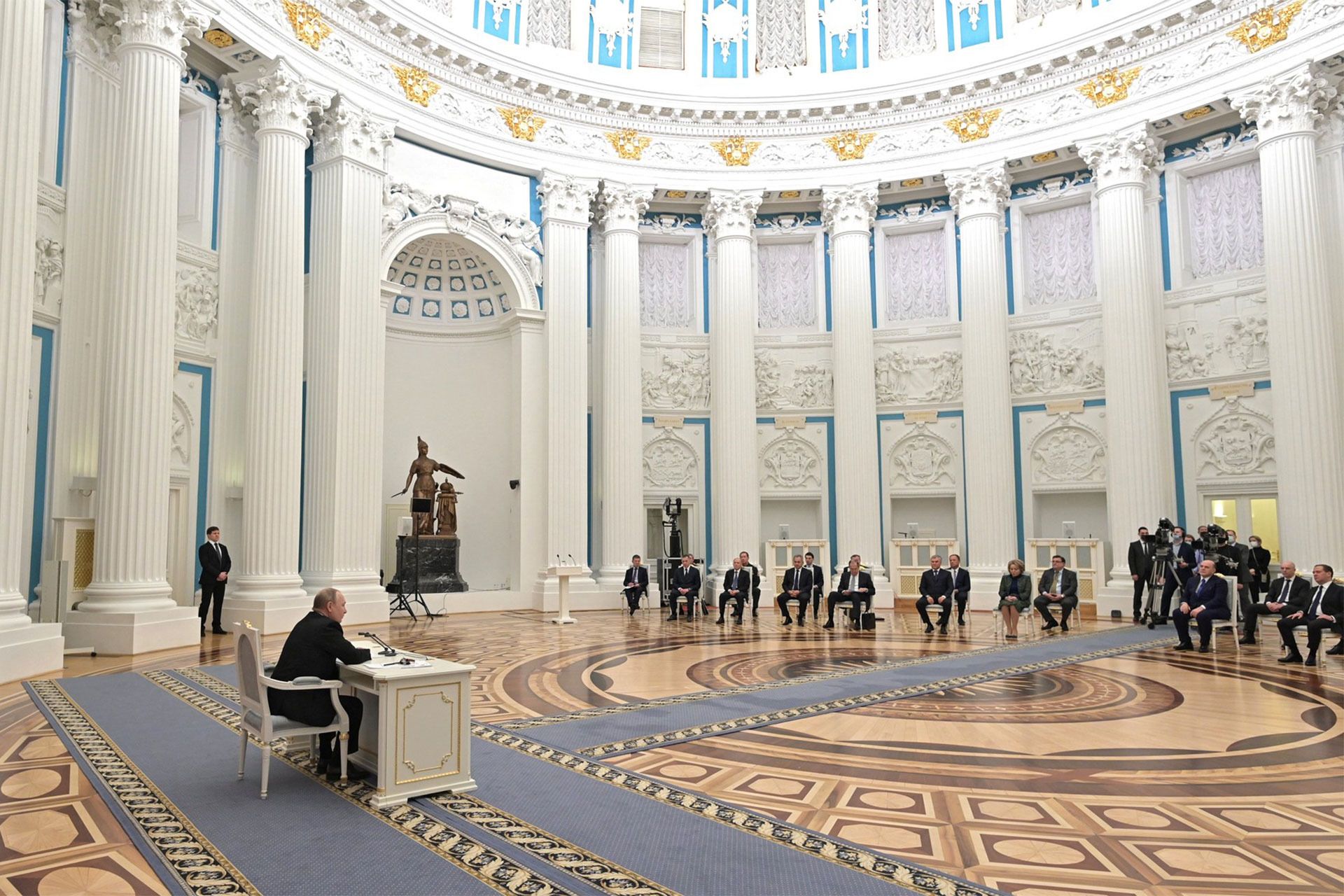
Meeting of the Russian Security Council, February 21, 2022. Photo: kremlin.ru
This publication was prepared by the media project “Country and World — SakharovReview” (project Telegram channel — “Country and World”) based on the discussion “How to Get to the Top? Conversations about Elites in the Special Military Operation Era.”
The personnel stalemate is becoming increasingly palpable and at some point could lead to an explosion. A sign of dissatisfaction with this situation was, for example, an article in Kommersant in spring 2024 about Boris Kovalchuk leaving Inter RAO and considering whether to head Rosneft or Gazprom, become Deputy Prime Minister for the Fuel and Energy Complex, or governor of Saint Petersburg. These are all high-ranking positions.
Such a publication is a sign that the Kovalchuks apparently failed to secure appointments and had to publicly state their desired positions. Yet these were never achieved. As a result, the son of the “Putin consigliere“ received a rather insignificant post as deputy head of the Kremlin’s control department and moved to the Accounts Chamber. Previously, this was considered an honorable place where one could wait out some time or prepare for retirement. It’s not a position for an ambitious person.
Dissatisfaction with the personnel stalemate was growing even before the war. Igor Sechin has headed Rosneft since 2012, Alexey Miller has led Gazprom since 2001. Heads of Sberbank and VTB have also held their positions for a long time, which are very attractive to many. Heads of state companies and state banks are more autonomous and can spend large sums more freely than federal officials.
Leadership of security agencies is also very stable. This may be related to Putin’s or the system’s unwillingness to change. Various positions were predicted for Alexey Dyumin, Putin’s former bodyguard! Viktor Zolotov (head of the National Guard, former deputy head of the Federal Protective Service) placed his people as deputies in security agencies hoping for their quick promotion. However, in 2016 Dyumin was pushed out of the Ministry of Defense to become governor of Tula Oblast, and Dmitry Mironov moved from the Ministry of Internal Affairs to Yaroslavl Oblast. It was expected they would gain civil administrative skills and return to Moscow for higher posts. But this did not happen, although Dyumin was promised the post of Defense Minister or Deputy Prime Minister for defense. In the end, both became Putin’s aides.
People get stuck, and negative energy from the personnel stagnation accumulates and spreads.
At one time, a pool of ambitious deputy ministers believed in Kirienko’s project, which promised to turn young technocrats into governors and provide further career advancement. Those hopes were not fulfilled. In Arkhangelsk Oblast, former Deputy Minister of Economy Alexander Tsybulsky is serving his second term as governor. The same can be said about Stanislav Voskresensky, his colleague from the Ministry of Economy, who heads Ivanovo Oblast, and Gleb Nikitin, now in his second term governing Nizhny Novgorod Oblast.
Putin hands out advances, but then people go through second or third rounds, and it’s unclear what can be given to those who were promised something earlier. Disappointment grows within the professional bureaucracy. And attractive positions are becoming fewer.
Governor posts remain attractive only in regions with large populations and developed industry, so I hear about an increasing number of refusals to head certain regions.
Anton Koltsov, former head of the government of Vologda Oblast, was once considered a promising manager. He studied at the “School of Governors.” After the war began, he went to work in Zaporizhzhia Oblast. As I heard, in 2025 he was offered a depressed region in the Northwest but refused after seeing the budget situation and what was happening with governors there. This displeased the top, and now he works as mayor of Mariupol. This is a problem: on one hand, there are big ambitions, but on the other, many posts are losing their appeal.
This leads to a phenomenon of leaving regions as inheritances, when after a governor leaves, the position passes to their former deputy. This happened in Tula, Kursk, Novgorod Oblasts, and the Jewish Autonomous Region. When high-profile ambitious candidates refuse in casting situations, the bench of willing candidates shrinks. Deputies must be promoted. The increase in such cases indicates something is wrong in the system: influential positions are devalued and reluctantly taken. After Roman Starovoit’s suicide, questions also arose about the ministerial position: there are serious doubts whether it remains attractive and interesting.
Many expect an intense promotion of successors to begin soon. There are examples: Putin’s niece Anna Tsivilyova became Deputy Minister of Defense, her husband Sergey Tsivilyov is Minister of Energy, Fradkov’s younger son is Deputy Minister of Defense. But these are not very high levels yet. The rise of Tsivilyov’s husband can be explained not only by family ties but also lobbying by Gennady Timchenko, in whose structures he worked. Dmitry Patrushev rose high, but he is more of a lone figure than a representative of a generation.
Overall, the children move upward with much friction and not as actively as in the late 2000s when the careers of Patrushev’s, Fradkov’s, and Sergey Ivanov’s children were booming.
Work in “new territories” is often presented as a personnel elevator. Irina Gekht, after working in Zaporizhzhia, received the post of governor of the Nenets Autonomous Okrug — sparsely populated but with good hydrocarbon revenues. But now oil is not doing well, and the governor of Nenets AO is subordinate to the governor of Arkhangelsk Oblast. So it’s a prize, but a weak one. Yevgeny Solntsev headed Orenburg Oblast after working in the Donetsk People’s Republic. But such examples are not very common.
War veterans have not yet received significant posts in the executive branch. As an exception, Yevgeny Pervyshov, the new governor of Tambov Oblast, is mentioned. But he is not exactly military — a former mayor of Krasnodar, a very dynamic city that surpasses the depressed Tambov region in population and economic scale. Senator Alexey Kondratyev is presented as a military man. But he was mayor of Tambov.
There is a “deputy battalion” where some officials supposedly serve. But no serious official or deputy has died in the war (except for the Vice Governor of Primorsky Krai Sergey Efremov, who led a local volunteer battalion).
About 70% of former military personnel entering management schools want to work with youth and engage in patriotic education. It’s hard to make serious mistakes in this area — for example, misusing budget funds; there is little money in this field.
In the 2010s, there was a “Crimean consensus,” when governor posts were given to representatives of the systemic opposition, and governors in regions were advised to nominate local communists, Socialist Revolutionaries, and LDPR members. The latter were placed as heads of youth affairs committees. This is also patriotic education, where there is nothing to steal and it’s impossible to make serious mistakes. Former military personnel are now promoted in a similar way. It is interesting, however, how military men will work as municipal officials since they currently earn significantly more than municipal employees.
Personnel stagnation has become a characteristic feature of Putin’s power system. It is also one of the regime’s main problems. The system does not renew itself; even representatives of influential clans experience difficulties with promotion. All this leads to demotivation among vertical participants and, after some time, may result in open conflicts over positions and powers. In principle, such conflicts are already happening — the head of the Presidential Administration’s political bloc, Sergey Kirienko, stripped Dmitry Kozak of his powers to such an extent that Kozak resigned from the Kremlin.
If you enjoyed this article, consider making a donation — one-time or, even better, monthly. Your support helps us motivate our authors and become better with every article.
Our organization is recognized by the Internal Revenue Service (IRS) as a 501(c)(3) tax-exempt, charitable organization, which means that all contributions made to us are tax-deductible to the fullest extent permitted by U.S. law. Individuals may generally deduct charitable contributions of up to 60% of their Adjusted Gross Income (AGI) for cash donations made to qualifying 501(c)(3) organizations. For donations of appreciated assets (such as stocks or other long-term capital assets), the deduction is typically limited to 30% of AGI, based on the fair market value of the asset. C-corporations may deduct charitable contributions of up to 10% of their taxable income for donations made to eligible charitable organizations.
By submitting a donation, you confirm that you have read and accept the following documents: Privacy Policy and User Agreement, and also give consent to the processing of your personal data.
If you would like to unsubscribe from a monthly donation, please email us at: [email protected]