Let me remind you how the events of the past two weeks unfolded.
On May 28, Putin announced that Russia would declare a three-day ceasefire starting at midnight on May 8 until the night of May 10 to 11.
Zelenskyy responded with a counterproposal: why wait until May 8? Let’s stop hostilities before the May holidays, and not for three, but for 30 days. Putin’s press secretary said his boss was considering the proposal. But, as it turned out later, he never came up with anything.
The three-day “ceasefire” was needed by Putin only to safely conduct his main propaganda event of the last decade—the celebration of the 80th anniversary of the USSR’s victory over Hitler’s fascism.
Meanwhile, Russian troops did not observe the ceasefire. On the evening of May 8, Ukraine’s Foreign Minister Andriy Sybiha reported that “despite Putin’s statements, Russian forces continue to advance along the entire front line. From midnight to noon, Russia committed 734 ceasefire violations and 63 assault operations, 23 of which are still ongoing; 586 shellings of our troops’ positions, 464 of them with heavy weapons; 176 FPV drone strikes; and 10 airstrikes using 16 guided bombs.”
According to DeepState data, on May 8, 9, and 10, Russian troops conducted 193, 196, and 161 assaults on the front, respectively. For comparison: the average daily assault activity of Russian forces in April, which was one of their bloodiest months of the war, was 155 attacks per day.
But Putin’s offensive did not end there, neither on the military nor diplomatic front. On the night of May 10 to 11, he unexpectedly held a press conference at the Kremlin and announced his readiness to start direct talks with Ukrainians in Istanbul on May 15. He emphasized that these would be “without preconditions.”
Previously, the Russian side had constantly demanded “denazification” of Ukraine, the transfer to Russia of Ukrainian regions not yet captured, and so on. And suddenly such progress: talks “without preconditions,” not a word about the “Nazi regime in Kyiv” or the “illegitimacy” of Zelenskyy.
The only concern was that Putin proposed such a meeting literally in four days. And in Turkey, despite his own words that he had not yet discussed this with Turkish authorities.
Such high-level talks are prepared in advance. Not to mention that Turkey, with its second-largest army in NATO, is not a country you can exclude from the loop about important meetings planned on its territory without informing its leadership, promising only to negotiate with them retroactively.
It soon became clear: Putin’s statements at the nighttime press conference were just another PR move to again accuse the Ukrainian leadership of being unwilling to negotiate, while furiously assaulting Ukrainian fortifications in hopes of improving his negotiating position.
This tactic is not new for Putin. He cannot win his war but does not want to appear defeated. The “Russian world” simply won’t understand that. For this reason, the Russian leader is now trying to do what he did in 2015 during the Minsk negotiations (Minsk II), which he calls “coercion to peace.”
Ten years ago, this trick worked for him. Then, “peace talks” were also accompanied by attacks by Russian tanks near Debaltseve, where Ukrainian units were encircled. Ultimately, Putin forced former Ukrainian President Petro Poroshenko to sign the Minsk agreements, which were disadvantageous for Kyiv.
Then-German Chancellor Angela Merkel and French President François Hollande, driven by purely humanitarian and pacifist considerations, objectively and subjectively sided with the aggressor and persuaded Poroshenko “for the sake of peace” to sign the agreement with Putin, which caused Ukraine to lose a third of Donbas.
What came of that became clear on February 24, 2022.
However, today the situation is completely different. At Ukraine’s helm is the unyielding Zelenskyy. Leading European countries stand shoulder to shoulder with Ukraine, as once again demonstrated by the May 10 visit to Kyiv of UK Prime Minister Keir Starmer, French President Emmanuel Macron, German Chancellor Friedrich Merz, and Polish Prime Minister Donald Tusk.
In response to Putin’s May 11 announcement of “talks without preconditions” in Istanbul, Zelenskyy replied almost immediately: “We expect a full and long-term ceasefire starting tomorrow to provide the necessary foundation for diplomacy. There is no point in prolonging the killings,” Zelenskyy said.
“And I will be waiting for Putin on Thursday (May 15) in Turkey. Personally,” added the Ukrainian leader.
It was a powerful blow. In boxing terms, Putin was knocked down. For a while, the Kremlin was stunned, pondering how to respond to such a bold proposal from Kyiv.
Almost all Russian opposition observers this time were right in saying that Putin certainly would not come face to face with Zelenskyy.
By inviting Ukrainian leaders to come to Istanbul on May 15 and start talks “without preconditions,” Putin hoped to seize the diplomatic initiative but ultimately found himself in an extremely difficult position.
His predicament was further complicated by Donald Trump’s support for the “coalition of the willing” from Europe’s largest countries, which issued an ultimatum to Putin: cease fire in the coming days. “The boundaries have been set. It’s clear. Either Russia is serious and wants peace, or it isn’t, and we must impose more sanctions,” French President Emmanuel Macron told Le Figaro. Sanctions, despite their limitations, do work. The Economist magazine recently reported, citing Goldman Sachs and Russia’s VEB data, that Russia’s economic growth, nearly 5% in 2024, dropped to about 0% in the first four months of 2025.
The fleeting hope that Putin would suddenly show some backbone, come to Istanbul, and speak face to face with the president of the country he has tormented for more than three years vanished yesterday after the announcement of the Russian delegation’s composition. Putin put his advisor on historical distortion Vladimir Medinsky at its head. All other participants are even lower—at best deputy ministers. Such a delegation cannot make decisions. And this despite the fact that Zelenskyy was ready to lead the Ukrainian delegation himself, which was supposed to include the head of the Ukrainian presidential office Yermak and foreign minister Sybiha.
Such a move by Putin indicates that he has no intention of ending the war.
The Russian president not only disregarded Ukrainians and Russians who will die in the coming weeks or months because of him, as hundreds of thousands have already died. It was also an insult to Trump, who was ready to guarantee his safety at the talks in Turkey with his authority. And also to Europe and BRICS partners, who persistently urged him to negotiate.
This situation looked especially humiliating for Brazilian President Lula da Silva. On Wednesday, May 14, he flew specially from Beijing to Moscow to meet Putin and persuade him to negotiate with Zelenskyy. “It costs me nothing to say to him: ‘Comrade Putin, for God’s sake, go to Istanbul for talks,’” the Brazilian leader said during his visit to China. In response, Putin kept the 79-year-old president of the largest Latin American country waiting at Vnukovo airport but did not receive him—in the Kremlin press service’s words, they only spoke by phone.
Even the French president, whom Putin detests, was not humiliated like this in Moscow. When Macron flew to Moscow in early 2022 to persuade Putin not to attack Ukraine, he was “only” denied a car, forcing the French leader to walk from the plane to the airport building and then travel to the Kremlin in the French embassy’s car.
It is highly likely to assume how Putin intends to act in the near future. Through secondary officials, he will conduct meaningless negotiations while simultaneously trying to carve out additional pieces of Ukrainian territory on the front. This may continue until the autumn thaw or even winter. Or until the Russian army suffers a serious defeat in Ukraine.
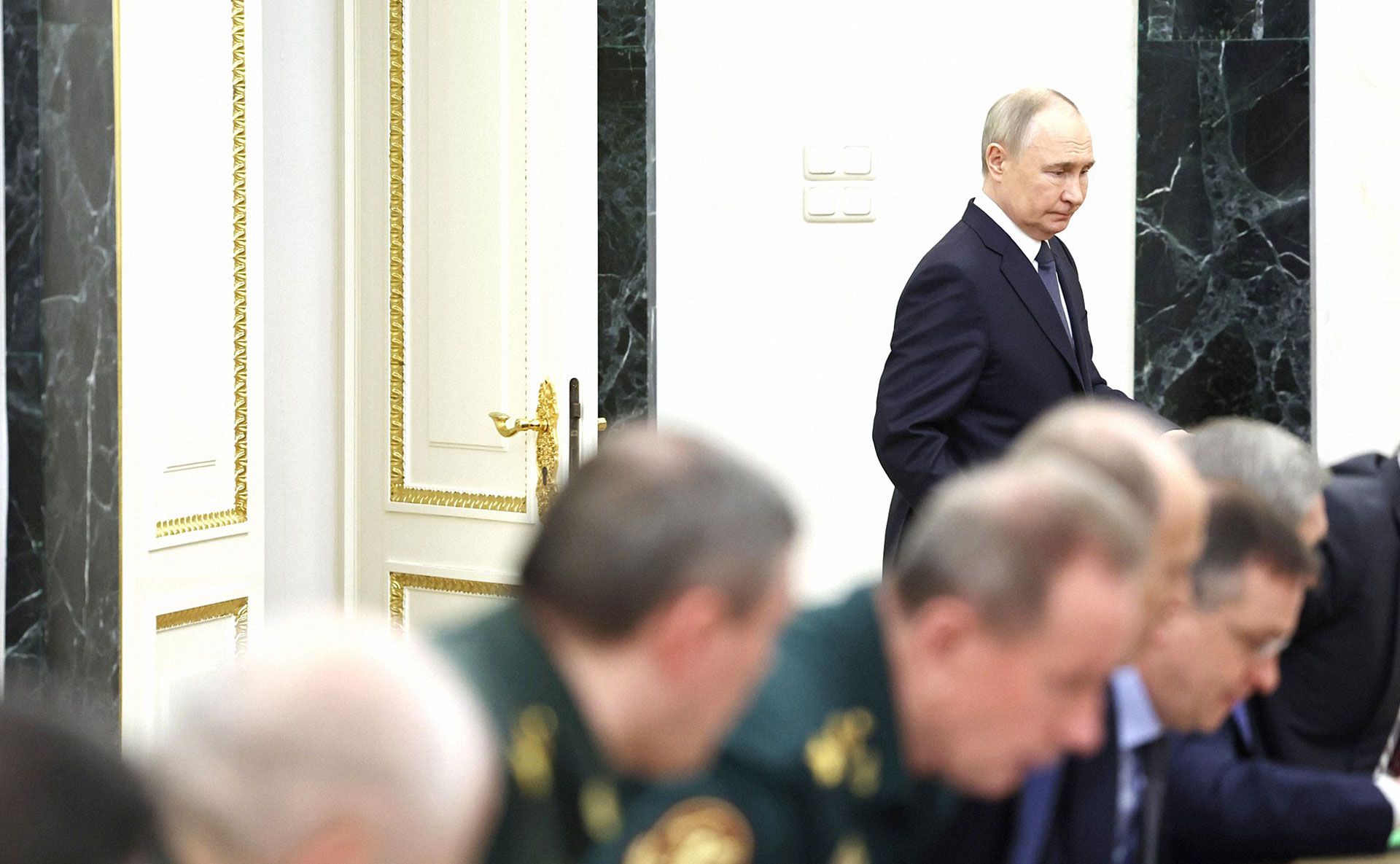
Main photo – Vladimir Putin before the meeting to prepare for the upcoming talks with the Ukrainian side. Source: kremlin.ru