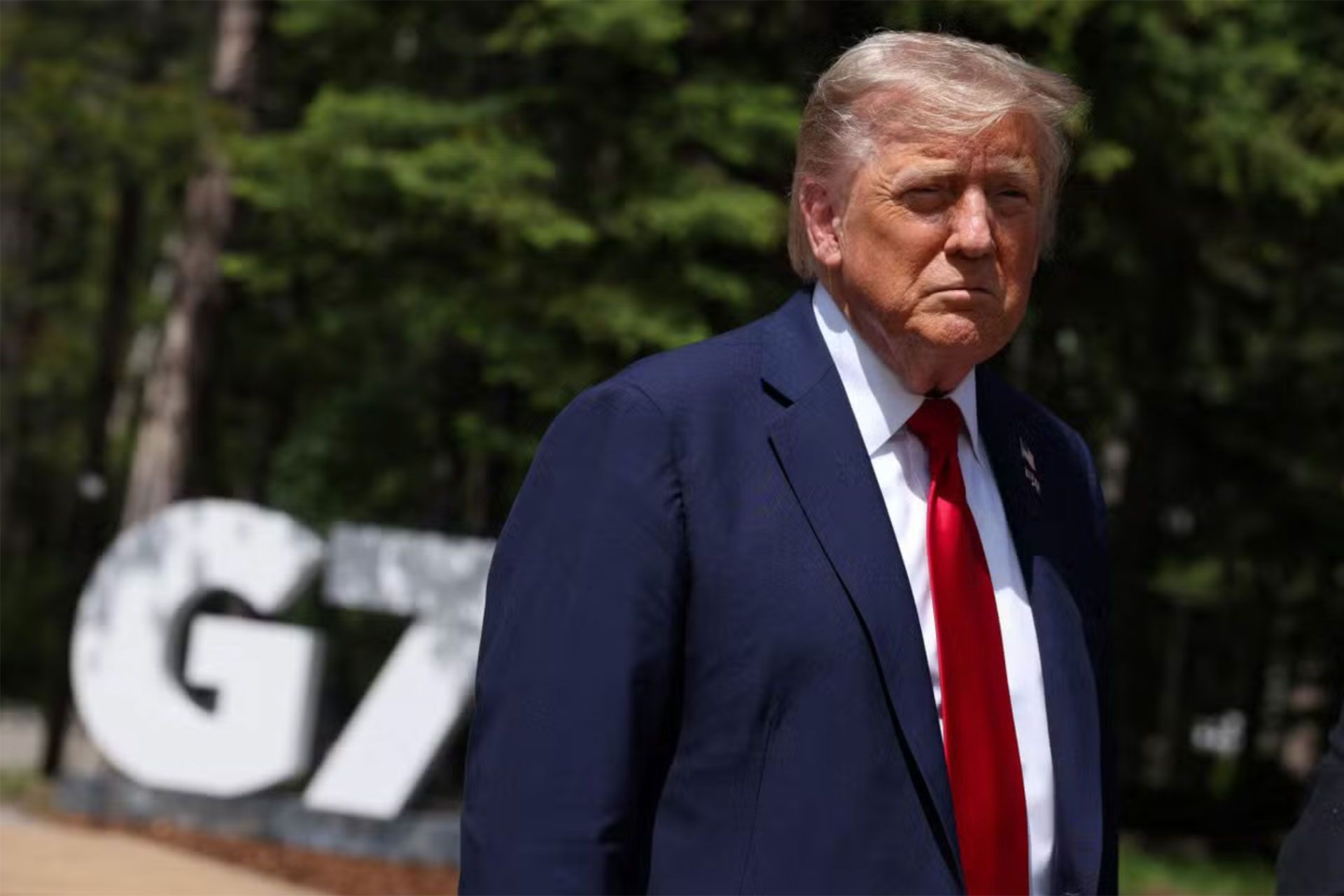
According to American media, the US president is considering participating in Israel’s military operation against Iran and striking the Islamic Republic’s nuclear facilities. The same hope was expressed by Israeli media as well. Due to the escalation in the Middle East, Trump even cut short his participation in the G7 summit. Before leaving Canada, he promised journalists “to take some action,” but after the June 17 National Security Council meeting, no decision has yet been made regarding US strikes on Iran.
ABC News, citing American officials, reported yesterday that the US will decide within the next 24-48 hours whether the Iran-Israel war can be resolved diplomatically or if it should join IDF strikes. US Secretary of Defense Pete Hegseth refused to answer this question, saying only that “the US is currently providing maximum protection for its forces in the Middle East.” Meanwhile, Iran’s Supreme Leader Ali Khamenei , threatened the Americans that “any military intervention against Iran will undoubtedly cause them irreparable damage.”
Meanwhile, military analysts close to the Russian Ministry of Defense openly state that the war benefits the Kremlin. They note that the Middle East conflict “drives up oil prices, increasing Russia’s budget revenues” and “helps divert Western and US attention from the military conflict in Ukraine.” The Russians are counting on Americans focusing on aiding Israel rather than Ukraine, and that the war “opens a window of opportunity for Russia to act as a mediator in negotiations between the US and Iran.”
The last point is the most interesting. The fact is that even before the full-scale invasion of Ukraine, Russian experts asserted that the rise of new players on the world stage would inevitably lead to a new division of the world, which, as a century ago, could be accompanied by world wars and other global upheavals. In fact, the Kremlin was betting on such a bloody reshuffle, hoping to justify its invasion of the neighboring country.
That calculation did not come true at the time, but
Moscow clearly has not abandoned attempts to destabilize the world, against which its own actions would appear natural behavior “in a new balance of power.”
Trying to make aggression and “the right of the strong” the new normal, the Kremlin simultaneously tries to position itself as an exporter of international security, and participating in negotiations between Iran and Israel supports this image.
Independent analysts note that recognizing Russia’s special role in de-escalating the Iran-Israel conflict is a giant step for Putin, “who, with Trump’s help, not only sheds the image of an untouchable aggressor but even returns to the top league of global realpolitik.”
In their opinion, Trump’s desire to secure Putin’s mediating neutrality in the conflict explains his reluctance to pressure the Russian leader on the Ukrainian issue or tighten sanctions against Moscow in recent months. Indeed, by politically supporting Israel, Moscow does not provide it with any military aid, which suits the US perfectly.
Besides this, Kremlin-affiliated analysts openly admit they hope to benefit from a possible Iranian closure of the Strait of Hormuz, through which about 25% of the world’s oil and liquefied gas exports pass to destination ports. Then, according to them, Europe would have to recall the Northern Sea Route to obtain gas. Nevertheless, analysts point out that the impact of the Iran-Israel conflict on oil prices will likely be limited and will not affect the global downward trend. Moreover, after the conflict ends, the US will have more leverage over Moscow.
At first glance, it seems that prolonging the Israel-Iran war and dragging the US into it benefits Russia. Apart from general destabilization and distraction, it would allow Putin to continue manipulating Trump, bargaining for concessions in exchange for neutrality.
Russian war correspondents with ties to intelligence agencies consider the most likely scenario to be limited in time and scale strikes involving bombers from Diego Garcia and US Central Command aviation—without engaging in a prolonged operation. At the same time, even pro-Kremlin political scientists admit that in such a case Moscow will have to choose between the US and Iran.
For example, political scientist Andrey Serenko acknowledges that Russia’s current priority is not to disrupt the reset of relations with the US, and therefore Moscow will not be ready for real military support of Iran. On the other hand, Iran, which has diligently supplied Russia with “Shaheds” and other military equipment, clearly expects more from its ally.
The longer the conflict lasts, the harder it will be for Moscow to avoid the difficult choice: to spoil relations with Trump or support Iran’s backing.
Additionally, in a war situation, Iran is unlikely to continue supplying drones to Russia, while Russian enterprises are already working at full capacity but still cannot meet front-line needs. As early as the year before last, independent journalists published data showing that defense factories in Russia increasingly fail deliveries due to shortages of components, corruption, and other problems. As of September 2023, at least 419 workshop and factory managers failed to meet Ministry of Defense tasks and were fined. Journalists emphasize they only considered appeals by employees to the Federal Antimonopoly Service decisions, while the real number of order failures may be much higher.
This situation persists despite most defense enterprises, according to Security Council Deputy Chairman Dmitry Medvedev, operating in three shifts. Some have even switched to round-the-clock operations and work on holidays. In this context, deliveries from allied countries are very important for Moscow, especially in light of the summer offensive on the Ukrainian front.
Thus, destabilization of the world somewhat plays into Russia’s hands, but at the same time deprives it of support from its few allies and forces it to make a choice the Kremlin would desperately like to avoid.
Main photo – Donald Trump at the G7 summit in Cananskis, Canada. Photo: White House website