«As a Ukrainian, I identified with what is happening to the population of Palestine». Interview with a Ukrainian participant in the «Sumud» flotilla — before and after detention by Israeli authorities
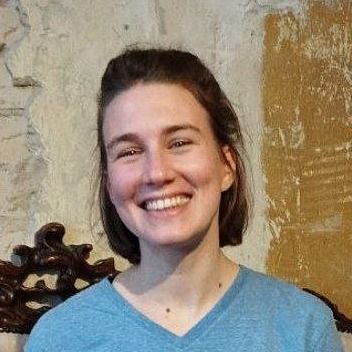
Nina Potarska is a Ukrainian sociologist and researcher in feminist political economy. She heads the Ukrainian Center for Social and Labor Research and is involved in the Global Women’s Alliance for Leadership in Security (WASL). Nina spent her childhood in Murmansk Oblast, from where Russian Air Force fighter jets now take off to carry out airstrikes on Kyiv. But Potarska does not agree with the widespread comparison between Ukraine after February 24 and Israel after October 7: she is in solidarity with Palestinians and criticizes Israel’s actions in Gaza. This spring, Nina joined the humanitarian flotilla “Sumud” — an international maritime initiative launched last year with the aim of breaking Israel’s blockade of the Gaza Strip. She gave the first part of the interview at the beginning of the flotilla’s voyage, and the second part after she, along with other pro-Palestinian activists, was detained by Israeli security forces.
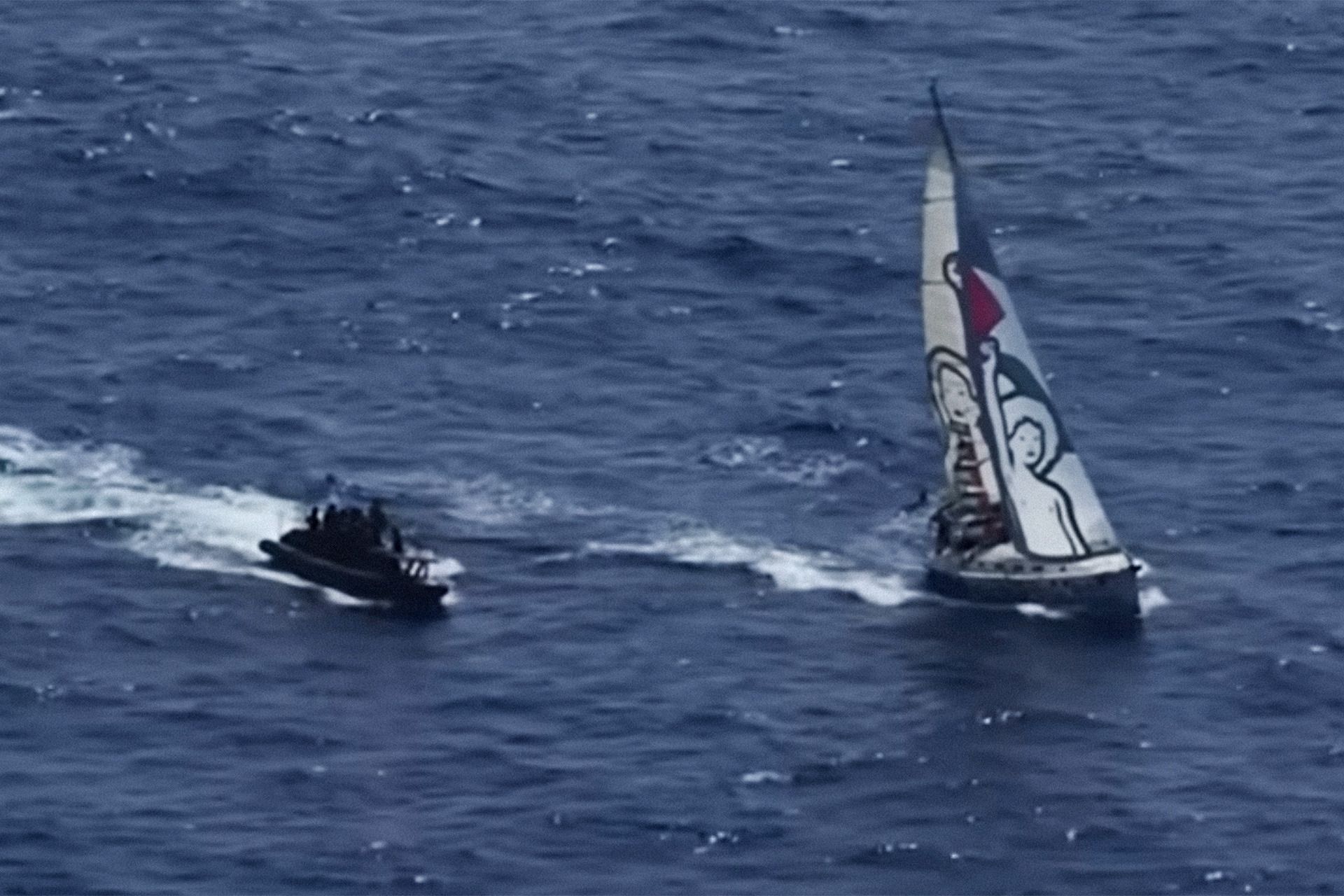
Still from video: YouTube / @dwrussian
The first part of the conversation between Maria Bunina and Nina Potarska was recorded on April 27, the second on May 10, 2026.
- Please tell us how you ended up on the flotilla?
- I can’t say it was by chance, because back in August and September we were already holding solidarity actions in Kyiv near the Holodomor Museum for the people who are now in Gaza.
I worked at an organization that focuses on the Middle East, women’s rights, and situations in conflict zones. So I often end up with first-hand information about what is really happening with the humanitarian situation. As a mediator and facilitator of dialogues, I stay in contact with both Israeli and Palestinian groups. And everything that happened on and after October 7 was very hard for me, because there was talk of “revenge”, but it was hard to imagine the scale of it.
- And how do you view the events of October 7 themselves? Critics of the pro-Palestinian movement insist that Israel suffered an unprecedented terrorist attack, comparable to September 11, 2001, and launched a campaign of revenge. Their opponents, by contrast, date the start of the war long before October 7. What do you think about this?
- We can endlessly rewind history and each time find an explanation for why one side believed it was in the right. But I think that right now it’s important to recognize that everything that happened to us is horrible. And what is happening now is inhumane. There are no excuses for it. We have already gone too deep into this situation. But it is hard for me to move forward with my head constantly turned back. So I would like the focus of attention to shift from searching for the guilty to searching for a way out. To how we can find the strength, the words, and the means to hear one another again. How to overcome fear, mistrust, hurt, hatred, and move forward. Because it is impossible to move forward while constantly looking back.
Many draw parallels with 9/11 and the fact that after those events Iraq was punished. Here one can indeed speak of a similarity in the sense that one event led to the wiping out of a people, a nation, the total destruction of a country. And no, of course, that cannot be justified.
October 7 is often used as an argument in response to criticism of the war in Gaza: “why didn’t you write or speak earlier”, “where were your voices”? And that is understandable from the point of view of a demand for justice. But October 7 ended, and what is happening in Gaza has not. How many more victims will it take for October 7 to stop hurting so much, for society to be able to move forward rather than only look back?
- How do you feel about the fact that after October 7 Israelis sometimes compare their experience to that of Ukrainians? Who do Ukrainians more often identify with? And how is your political position received by other Ukrainians?
- As a Ukrainian, I identified with what is happening to the people of Palestine. At the level of rhetoric, there is a similarity between the way the Israeli authorities speak about Palestinians and the way the Russian authorities speak about Ukrainians. Of course, these are different contexts, but I hear very similar formulations: that “you do not exist”, “there are only fascists there”. This rhetorical connection is very noticeable and painful for me. And at the same time, despite my Polish-Jewish roots, I completely cannot understand how such a thing could happen at all, that people who have suffered to earn their right to “be” became so absorbed in “revenge” that now it is very difficult to understand how to stop it.
How is my position received by others? There is a great deal of support, and I am very grateful for it. There is also a lot of misunderstanding. But we are here, among other things, so as not to shut ourselves off from these people, but to try to explain our position. I often see from the way people formulate their messages that fears lie behind the criticism and aggression.
I think the Ukrainian audience simply lacks information. We are very deeply immersed in our own tragedy. Many people feel that I am distracting attention from Ukraine, but in fact I am, on the contrary, drawing attention to Ukraine. There is a clear connection between the idea that our government and any government is not the whole people, and that people’s needs very often do not coincide with the interests of states and government officials. I am a very great patriot of my people, my land, and my country, but I have many questions about my state and my government. And I think many people here, in this flotilla, have a similar position.
And there is also an important point about the selective application of international law. It seems to me that Ukraine, Palestine, and in fact any country that finds itself in a war or crisis become hostages of an international relations system in which double standards are effectively part of it. So one of the theses we tried to promote is that
if international law does not work for everyone, then it does not work for anyone. And we see confirmation of this practically every day.
My experience, my knowledge, and the way I grew up led me here. I grew up on a Soviet military naval base in Murmansk Oblast. I was born into a military family: my great-grandfather was a military pilot, my father was a submariner, and my first husband was a military signalman. And I am a black sheep even within my own family.
Nina Potarska
It is hard for me to read news that fighter jets are flying from the Olenya base to bomb Kyiv when I am there. Because for me this place is tied to childhood. There was a lot of freedom there: there was no police, children walked around as long as they wanted, there was lots of snow, sleds, winter games, hikes into the hills, mushrooms, friends. I have many bright and warm memories of that place. I still have classmates who live there. And it hurts me very much that I cannot stay in touch with them, because it is unsafe for them and for me. Many of them serve in the military. One of my classmates, with whom I sat at the same desk, later served in Iraq. And I still have very strange feelings about that, because today my close friends from Iraq are helping me on this trip.
And I cannot format myself so that I fit perfectly into any one context. It seems to me that it is precisely through connectedness and wholeness that I feel more alive, healthier, and more real. And war destroys not only my life, it destroys my identity. And that, probably, is my main motivation. I am as if a hostage of this situation. But it is very important for me to maintain a connection with all these parts of myself. Because these are all parts of me that I need to learn to live with in peace. I cannot simply turn off or delete any of them.
- Yes, I understand. So, you decided to become a participant in the flotilla.
- When I was invited to join the flotilla, I hesitated until the very last moment, because I currently have a lot of projects in Ukraine. But in a rather random way I found myself with free time, and the people around me, when they learned that I wanted to go, helped me get here: they took on some of my duties and partially paid for the trip. So my arrival happened mainly thanks to the community I work with and my friends.
The question of the cost of participation comes up very often. It is always funny to hear all these “how much were you paid”. I spent about a thousand dollars just preparing for the trip. Several European organizations paid for my tickets — mostly trade unions, some Spanish political groups, and a support group for Ukraine. Another thousand dollars or so went to a sleeping bag and other camping gear. Over the past four years of constant movement, I lost or gave away many things; refugee life teaches you to live with at most one suitcase. I arrived with a suitcase of clothes, cosmetics, and medicines for a month-long business trip, and immediately afterward I was supposed to go to Turkey, Poland, and Ukraine.
Participation in the flotilla is entirely voluntary. People and organizations that are invited or nominated generally have to seek funding themselves. Some necessary items were provided centrally. For example, if I remember correctly, we were given motion sickness tablets through the central coordination headquarters. Food for the mission, some of the most essential items.
The question of funding often sounds like an accusation, although we all understand that for something to function, someone has to pay for it. Of course, the yachts, food, and humanitarian aid were paid for by someone. But the coordination of the flotilla itself and the coordination of the aid delivered through it is also a huge amount of work. Some participants are on board, while others provide support from shore.
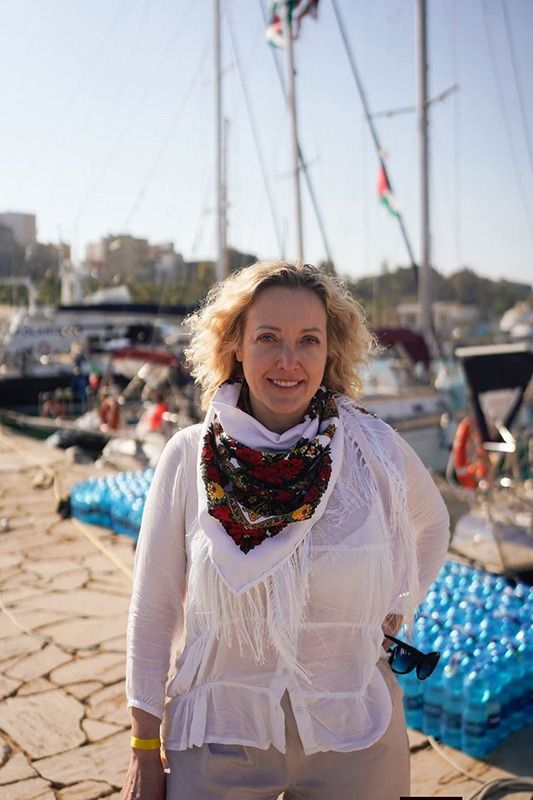
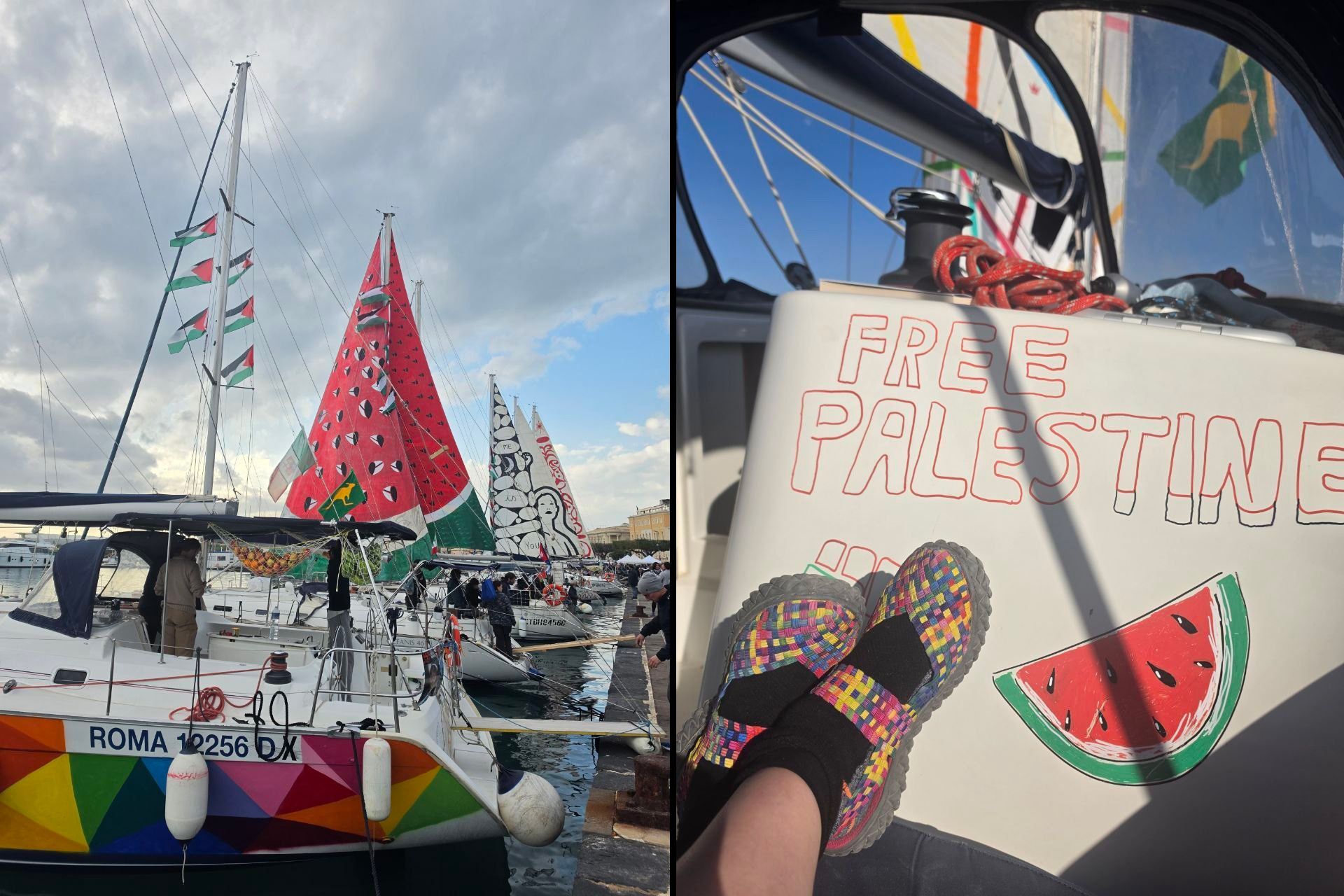
Photos provided by Nina Potarska
Returning to the question of why I decided to participate: I have been involved in high-level advocacy for many years and often meet with people who make decisions. Very bad decisions. Cruel decisions. And I do not understand how to bring them back to a logic of creation and to the idea that it is impossible to build paradise in one place on Earth by making the rest of the world hell. There is neither balance nor justice in that. In part, I decided to join the flotilla because of this: it is impossible to pretend that it does not concern you, because it concerns all of us.
I wanted both to be part of this experience and at the same time study it, to understand how we might self-organize through nonviolence and, roughly speaking, outsmart the political debate and the power system. It is both a tactical and strategic experience — a chance to think about whether we even have a chance at nonviolent resistance to violence.
- And who actually becomes a participant in the flotilla? Who are these people?
- It’s hard for me to say, because I applied simply through the website. There are many people here who volunteer in Ukraine, travel as doctors to help, and send humanitarian convoys. Many help not only Ukrainians and Palestinians, but also people in other countries.
On our ship we have a great team: people from Australia, America, Slovakia, Ukraine, Italy, Colombia, and Britain. We come from very different fields: teachers, doctors, journalists, human rights defenders, cultural workers… It is a very pleasant and professional team of honest people who sincerely want to help and are consciously taking risks. And the risks are obvious now: for example, detention in neutral waters while trying to create a corridor. There are also risks that are hard to predict, because last year the situation in the region was calmer. And this year every week brings a new shock, a new wave of escalation and destruction.
- There are many different nonviolent practices and communities. What new thing does the flotilla bring?
- Last year one or several boats from the flotilla reached the twenty-kilometer zone. And then it became clear that Israel’s ability to fully control the coast was limited. This year there are many more boats. And that is precisely why there is hope: that it simply will not be physically possible to stop all the ships, and that some boats will still be able to reach the area and create a corridor, a kind of “human shield”, so that a barge with humanitarian aid can pass between them and deliver food and medicine to Gaza.
A popular image comes to mind for me: many small fish trying to resist a big one, as opposed to the way a big fish swallows the small ones. Any system has its vulnerabilities, and it is important to find the brick that needs to be removed so that the whole wall collapses.
- One of the biggest objections to the flotilla, even among supporters of nonviolent resistance, is that it is a very expensive project. What do you think about that?
- On the one hand, yes, a great many resources are indeed involved here. But not all of them are measured in money or can be reduced to currency. I think this is more about the time and effort people put in. Although, yes, we do travel on ships that cost money. We carry food that costs money.
One of my research topics is what is happening in the social sphere. In particular, in Bosnia, Iraq, and Haiti during reconstruction and recovery. If you compare these sums, the cost of the flotilla is a drop in the ocean. Because the humanitarian system has largely become a machine for laundering money. A great many dissertations and articles have already been written on this topic, and people working in the sector have understood this for a long time.
I don’t have an internal dilemma about how expensive and resource-intensive it is. War is even more resource-intensive. And reconstruction after war... I don’t even know how many hundreds of years it will take to eliminate the environmental consequences of all the war debris that now lies on the land of Ukraine and the countries of the Middle East.
Iraq, for example, has still not recovered from the war. Despite the presence of American bases, no one has truly invested in rebuilding the country so that it could become a full participant in the global world and economy. The world is full of double standards, and against that backdrop the Sumud flotilla is a rather honest project. Everything is financed from private funds, and financial reporting is publicly available on the website.
EDITOR’S NOTE FROM MOST.MEDIA: On the Global Sumud Flotilla website, the Financial Transparency section does not publish financial reports, audit opinions, or detailed information on how funds are spent. The movement justifies its accountability by pointing to a registered Spanish foundation, the use of a European maritime company to purchase the vessels, and the involvement of legal observers. At the same time, a significant portion of financial information is not disclosed under the pretext of protecting donors and ensuring mission security. The names of the foundation and the maritime company are also not disclosed. On the flotilla website, in the Donate section, as of June 7, information was available that 8,713 donors had raised €661,766 of the €1 million needed for the project.
The project’s legal structure was reconstructed from open Spanish registries. In the Catalan foundation registry, the Fundación Global Sumud Flotilla GSF foundation was found, registered on January 22, 2026, and in the commercial registries — the company Cyber Neptune SL, which established the foundation. Comparing the registration data showed that both structures are linked through a common address in Barcelona and the project leadership. In particular, the president of Fundación Global Sumud Flotilla GSF, Saif Abukeshek, has been listed since August 31, 2025, as an administrator of Cyber Neptune SL.
In September 2025, Israel’s Foreign Ministry claimed that documents found in Gaza prove Hamas’s involvement in financing and organizing the flotilla through the “Popular Conference for Palestinians Abroad” (PCPA) and Saif Abukeshek — the organization’s secretary general. The U.S. Treasury imposed sanctions on him on May 19, 2026. According to the department’s press release, the PCPA acts as a front organization for Hamas, and Hamas helped finance the PCPA’s first meeting with $100,000.
At the same time, Euronews did not find confirmation of the authenticity of the documents published by Israel, nor that Cyber Neptune owns the flotilla’s ships. Global Sumud Flotilla spokesperson Maria Elena Delia called these accusations “Israeli propaganda” in a comment to Euronews and said that the published papers do not prove Hamas financing or control over the flotilla.
On the other hand, there will now be a lot of media attention, and that is also a reason to wake up a little those who try to live only their own lives and follow the path of conformism. Personally, I think fear and conformism, especially in conditions of war, double standards, and constant moral choice, are the biggest sins, if I may put it that way. When people are afraid of losing security, well-being, or status, it is easier for them not to notice that somewhere in the world, or even next to them, someone has fewer rights and is not considered human. So that is how I would probably answer the question about money.
If you look at the people here on the flotilla, they are mostly people who are not focused on material values. They are anarchists, people who respect their own freedom and recognize the freedom of others. We spent more than a week in the port, where everything was built on self-organization, caring for one another, and constant meetings to hear feedback from everyone and make participation safe for all members of the delegation, both physically and psychologically.
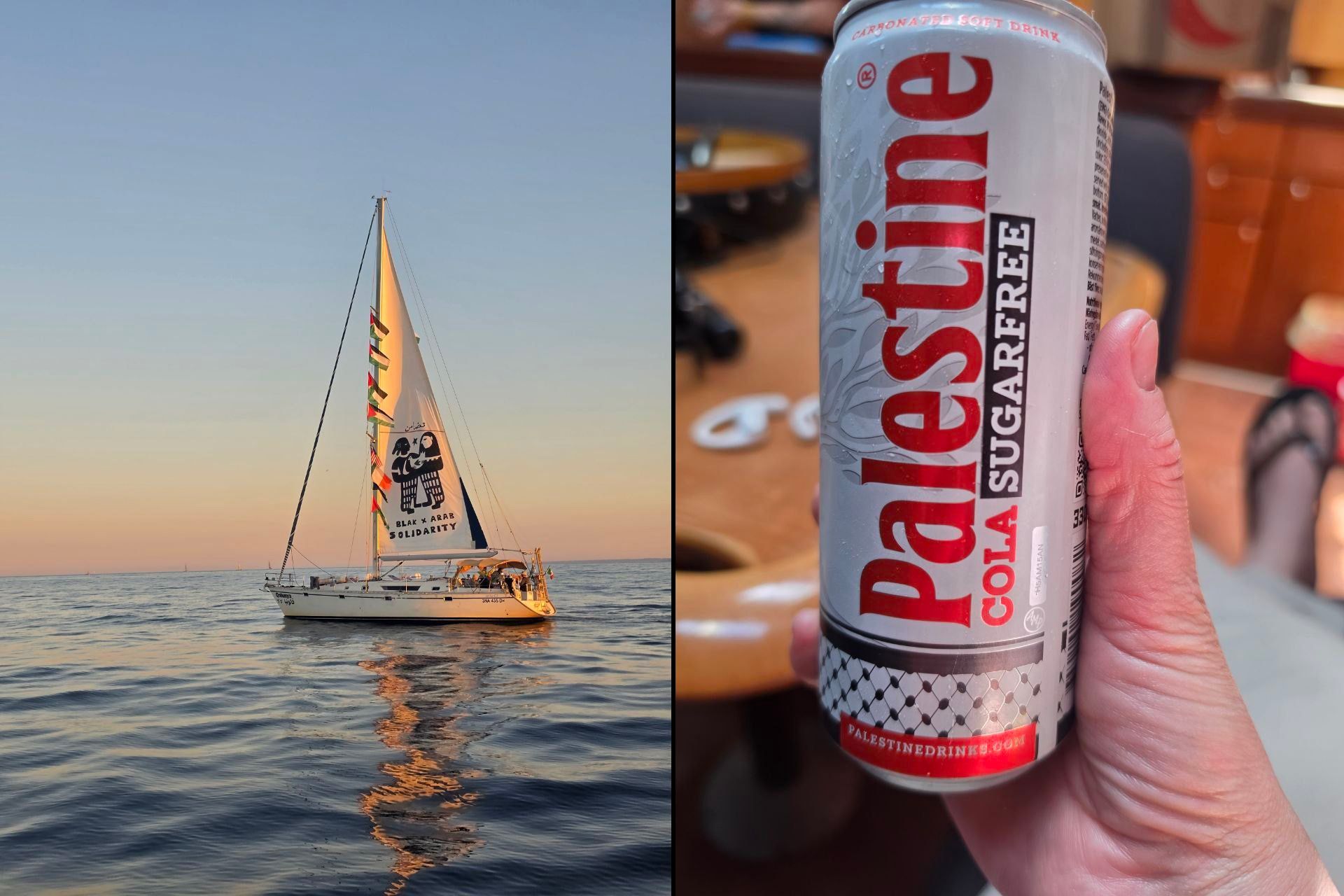
Photos provided by Nina Potarska
There is a lot of care here, including for physical comfort. We have a list of allergies, and we try to put together a menu so that it is safe and comfortable for everyone to travel. And honestly, I haven’t felt this relaxed in a very long time, because here people take care of you: they make sure you go to bed on time, that there is no unnecessary noise, that you are given suitable food. For example, I have many food allergies. Any mistake becomes a risk for the whole team. And I really like when there is an understanding in a group that caring for the vulnerable and caring for your neighbor is the key to the success of the whole group, its growth, and moving forward. And I think it is very important to have in life the experience of trusting the society in which you live.
And it is very sad that in the real world the logic is arranged differently. We are always running. The military context especially leaves its mark. Sometimes I feel like I am in another episode of “The Hunger Games”: you always win by taking more resources, and someone else gets less. And you understand that in this game, not everyone can win. Simply because the logic of the game itself is arranged that way: there can only be a few winners, and the rest must lose. And I do not agree with that logic. Because our land is so rich and diverse, there are so many resources, and we could reduce suffering or at least not increase it.
- Do you think the parallels between Ukraine and Palestine help us understand these conflicts better?
- On the one hand, you cannot put an equal sign between them — these are different contexts. But the dynamics are similar in some ways.
I know people in Donetsk and Luhansk who, while living in the same city, changed citizenship several times in their lifetime: first the Soviet Union, then independent Ukraine, then LPR and DPR passports, and now Russian passports. The people are not to blame for this. But in political rhetoric, responsibility is very often shifted onto ordinary people: that they voted wrong, wanted the wrong thing, looked the wrong way. In fact, this is a very infantile position for a state to take and a way of shifting responsibility.
As a citizen of Ukraine, by law I should say “occupied territories”. For residents of Donetsk Oblast, these may be “liberated territories”. For Russian citizens — “new territories”. But the people themselves still remain in some gray zone: they were “not-quite-Ukrainians” and remained “not-quite-Russians”. Everyone argues about them, everyone “liberates” them, but in fact the territory is destroyed, and in the broad sense no one really cares about these people. They become refugees in Europe with no prospects of citizenship or stability, labor migrants all over the world. And this is a very difficult and politically slippery topic.
I am filled with anger toward everyone who brought us to this situation and forced ordinary people to kill one another. And after that phrase, accusations usually follow that this is similar to Russian propaganda and to the idea of one fraternal people and civil war. But if you put propaganda aside and look only at the facts, about 16 million people in Russia have relatives in Ukraine.
My daughter’s biological brother lives in Moscow, and in the first year of the war she was horrified by the prospect that her brother would be drafted into the army on one side and her father on the other. That is a huge tragedy and injustice.
- Who do you think should bear responsibility for war crimes and crimes against humanity: the government, the military, soldiers, society?
- There is no simple answer to this question. First of all, I do not think collective responsibility is the right approach. For example, sanctions against all citizens. We see how Russian human rights defenders, our main allies, become victims of sanctions and repression themselves because they cannot easily move and settle elsewhere. And then the question arises: whom are we punishing? Those who are already struggling? Those who are weak before the system? Those whom the system has already been grinding down?
But on the other hand, it would be good if every person bore responsibility for the cruelty taking place. For the fact that the Geneva Convention is not being observed and international humanitarian law is being violated. But where do we find so many courts, and how can we issue so many rulings so that every person receives some kind of, let’s say, fair punishment? Because justice is also an attempt to give victims the chance to heal and not carry hatred and the desire for revenge forward.
When high-ranking officials ask me, “And what would you do?” — I only have a counter-question: “Did you really not know where you were going?” I want to return to my village and plant flowers. I was happy living in a village near Kyiv. I never wanted to bear responsibility for other people’s political decisions or take part in risky things. For ten years now I have been trying simply to return to life near my children — my son is already 24, my daughter is 16. Without seeing their mother, they themselves became activists. And I am very grateful to them for their support. We simply found ourselves in this situation and are trying to live in it as best we can.
- What would you like people in Israel to understand about your participation in the flotilla?
- I would like to say that I understand their fears. I understand what it means to live under shelling and feel a constant threat. I understand that there has been a lot of injustice. I understand that there is enormous fear of the future. There is often a feeling: either us or them. But for me the way out is to stand at a point where there is both us and them — without excluding anyone from this coordinate system. Because only in that way can balance and security be achieved. And I wish everyone to stand firmly on humanistic positions until the very end and not let hatred into their hearts, because it destroys us from within.
EDITOR’S NOTE: Three days after this conversation, on April 30, Israel intercepted 22 of the flotilla’s 58 vessels with 175 activists off the coast of Crete. Among them was the ship on which Nina was aboard.
On May 19, Israel intercepted the remaining flotilla ships — both those that had set out initially and those that joined near the coasts of Greece and Turkey. This involved nearly 430 participants from more than 40 countries. At that moment, the nearest ship to Israel was about 80 nautical miles from the coast of Gaza. This time, those detained were taken to Israel.
On May 20, Israel’s Minister of National Security Itamar Ben-Gvir posted a video online of the detention of pro-Palestinian activists from the “Sumud” flotilla, who were trying to break the naval blockadeof the Gaza Strip and deliver humanitarian aid there. In the video, they are kneeling in the port of Ashdod with their hands tied behind their backs and their heads lowered to the floor, while Ben-Gvir walks among them with an Israeli flag and shouts in Hebrew: “Welcome to Israel, we are the masters here”. The caption to the video in Ben-Gvir’s post says: “This is how we greet supporters of terrorism”. The EU and the US condemned Israel’s actions in connection with this situation. In Israel, the video was also met with a broad wave of condemnation.
Maria Bunina spoke with Nina Potarska in between these events — on May 10, when Nina was released.
- It seemed strange to me to publish an interview now where you are full of hope, after your ship was intercepted off the coast of Greece.
- I am still full of hope and filled with optimism. The flotilla continues to move. That’s one. More boats have joined. That’s two. It seems that initially there were about 60 boats. Twenty-two were detained. The fate of these boats is different: some were sunk, some were not. But in Greece, I think about 20 more boats joined, and in Turkey — another 30 or so. So from the point of view of representation, the situation has not changed much. On the contrary, it helped people become more united and understand that they must continue.
Despite the fact that we were detained, I think it had a very big resonance. Even bigger than if we had been detained near Israeli international waters, closer to Israeli territory. We were not planning to set foot on the land of Israel directly; rather, we planned to open a corridor so that boats with humanitarian aid could enter. We were supposed to become a kind of “human shield”.
If such force and unmotivated cruelty were used against us — doctors, teachers, human rights defenders, journalists — I can only imagine what is happening to Palestinians in prisons.
- And can you tell us what happened to you?
- We had training on how to behave during detention, what might happen, and what cases had occurred before. In addition, I work in international advocacy, and I often have to review and quote various provisions of international humanitarian law. But I did not even have such a scenario in my head when assessing the risks, that an Israeli ship would come in the middle of the Mediterranean, a thousand kilometers from its own shore, and carry out a detention.
The evening before, there was heightened drone activity. We began noticing objects in the sky; from a distance some looked like moving stars. But since I had already seen so much of this, I had no doubts. We started documenting the drones according to protocol: where they were flying from, whether it was a reconnaissance drone or whether it was carrying something. Other ships sent in the same reports.
The next day after sunset, there were again a lot of drones. Then we started receiving messages that a warship was nearby and that motorboats were approaching us. It was not immediately clear which country they belonged to. According to protocol, we had to put on life jackets and offer no resistance. We, in general, had nothing to hide.
Until the very end I thought it was most likely the Greek maritime police, but when I saw gunmen with Israeli patches I was very surprised. According to protocol, we had to go on deck, put on life jackets, sit in the prearranged order, raise our hands, and obey orders, not escalate. Realizing that Israeli military forces had approached us, I immediately threw my computer overboard first, then my phone, and continued sitting calmly.
- What do you mean by“threw it overboard”?
- It’s a fairly common wartime protocol: if there is a risk of losing access to devices, we destroy them. I’d rather throw my equipment into the sea than hand it over to the Israeli army. They don’t need to know how we communicate with one another or have access to all my contacts, friends, and personal information.
After that, we were moved to the stern, and for a while we sat there on our knees; we were not allowed to turn or move. They tore the sail, broke the Starlink, and apparently made a hole in the hull, because there was a long loud sound, as if something was being chopped. Then we were told to go downstairs one by one and gather personal belongings for four months. I even thought: what do they mean? Four months? On what basis? How exactly are they planning to fit this whole idea into legal terms? I took the pills and some personal items. They took all the backpacks and bags for an additional inspection and search. We were transferred to a military motorboat and then taken to a larger ship. Everything was happening rather slowly. I and someone else asked to use the bathroom. We were not allowed.
During the seizure of our boat they were shouting and giving instructions, but behaved quite civilly. But as soon as I took the first step onto the military ship, the situation changed drastically. They rather roughly explained how we should kneel, lie on the floor, press our heads to the floor, and look nowhere. I apparently had something happen to my leg, whether from the cold or from stress, and I could not bend down and lie down as they wanted — the muscle simply physically would not let me. They pushed me hard so that my head was closer to the floor.
Several times they lined us up in groups on the floor: on our knees, heads to the floor. They told us to remove our outer clothing, pulled us out one by one, and took us for inspection. We were checked with a metal detector, and our data was recorded.
They returned the passports, but took the Polish permanent residence card and the Ukrainian internal passport — I will have to replace them.
They took off my outer trousers, which protected me from water and wind. I was left only in very light clothing, and I was in a thin blouse against bare skin because I was going to sleep. It was about fifteen degrees outside. Someone came out with two jackets and shared one with me. That greatly improved my situation. And another crew member, Ben, a social journalist from Britain, was in shorts and a T-shirt: they took everything off him, and he was very cold. He kept moving to keep warm.
Then we were taken one by one into an area surrounded by cargo containers. On the sides there were plastic toilets, the kind usually found at events. When I went inside the container, other detainees, our colleagues and volunteers, were already there. The floor was covered with foam mats. It was already dark and cold, with condensation literally everywhere; it was very hard to find even one dry and warm place. The four of us sat huddled together just to get some warmth.
We all held assemblies together to organize daily life: we divided up the space, separated the toilets into shared and women’s ones, and tried to make shelters out of mats because not everyone could fit to sleep in the containers. There were elderly people among us, and one woman with a cane could not use the toilet. We also demanded pads.
I am lactose- and gluten-intolerant, and I had a minute of hesitation: what should I do about this? I did not want to be separated from the group and lose contact with everyone, and the food they gave us twice a day — hot dog buns and cheese sometimes — I cannot eat. In the end I simply joined the group that declared a hunger strike. There were about 30 of us: we asked to be shown the other people who had been taken, asked for pads, and demanded better detention conditions, which were very far from the minimum standards for prisoners.
I have back problems and circulation problems. When, for another count, we had to sit on the floor, put our hands behind our heads, and lower our heads, several times I felt that if I went a little further, I would lose consciousness. But I really did not want to lose consciousness, because then I would most likely be isolated from the group, and in the group I felt calmer. Those who had been isolated said they were kept in an air-conditioned room at fifteen degrees. There was no sense in it at all, just unmotivated cruelty.
We spent the evening, night, and the next day on the military ship. In the morning they brought us water and told us to form groups of ten to move to another ship, but they did not say where or why. We answered that we would not go anywhere and demanded that they show us the people they had taken, because we did not want to leave without them. So we just kept standing there, doing nothing and not reacting to the commands. From time to time we clapped and knocked on the walls of the container. It seemed safer to stay where we were all together than to allow ourselves to be separated and sent off again to who knows where.
I think they got scared when they realized we were not going to cooperate. Though that’s strange.
I have been to protests in both Russia and Belarus. In principle, the security forces have a million ways to lift an activist and put them in a transport van without beating them, without throwing them against a wall, and without hitting their head on the floor. But for some reason they decided to take a different path. So, despite the fact that we were not moving, all of this happened quite roughly.
When my turn came, they pointed a gun at me and said, “That’s it, go”. Before that, they had already used rubber bullets several times. There was, of course, little pleasant about that. But since we decided not to cooperate, I kept standing calmly, clapping my hands and demanding that our comrades be returned.
For some reason, what upset me very much was that these guys were about the same age as my son. The guy started shouting at me, pushing me, doing something, and I somehow became indignant — I don’t know, as a mother and as a teacher. I didn’t even expect that from myself. At first I told him, “Your mother must be proud of you”. And that, of course, caused another surge of aggression. He shoved me into yet another container, which was used as a corridor or filtration room. There they again tried to make me lie on the floor, it became painful, and I said I could not do that. Then I no longer held back and said that I was ashamed to share the same Jewish blood with him. After that he started kicking me in the legs. I have bruises. Then they threw me face down on the floor, and I ended up with my face in someone’s blood. I started shouting that they were criminals and would not hide it. They splashed water in front of me and wiped the blood off the floor with a towel.
After that container there was another roll call: they brought us to a table where we had to give our first and last names. One of them came up to me and asked: “Do you know this woman’s name?” I turned around and saw a woman lying face down and motionless. He said she had no documents. I answered that they were idiots and criminals, that they had done this and would have to explain it themselves. But I really could not identify her, because I did not know everyone in the group; we had little time to get acquainted and talk in the port.
And then there was a moment that seemed very important to me. I did not understand where we were being handed over, there was no information. But when I was being transferred to a small vessel, the feeling was completely different: after aggressive hands, other people suddenly received me very carefully and gently. At first I did not even see the patches, but I understood that these were different people. And then I noticed that it was the Greek police. They said: “Everything is fine, you are safe, we are taking you ashore”.
- And how are you now?
- I’m fine. I have a lot of work.
- One more question about the comparison between the experiences of Palestinians and Ukrainians. After this interception of the flotilla, has your sense of how similar or different these experiences are changed at all?
- I think it became very clear that, just as the Russian army and propaganda question the very fact of our existence [of Ukraine and Ukrainians — Most.Media] and our right to exist as an identity, a similar story is happening on the part of the Israeli state in relation to Palestine. Probably this was the most bodily experience I managed to feel. Because any violence can be justified if you believe that someone is “subhuman”, that they do not have the same rights, that they should not have existed at all. From a historical and political point of view, this is a very similar story for me. And if before I had already seen many similar dynamics — although the contexts are of course different — now I have finally become convinced: the logic of dehumanization works the same way.
When your very right to exist is called into question, it gives the person with the gun the feeling that they can do anything to you. Because in their picture of the world, you should not exist at all. And it is very sad that these were young guys, and they had already lost any sense of the value of human life and dignity.
If they could behave like that with teachers, doctors, people with passports from “civilized countries”, then I cannot even imagine what situation Palestinians are in. What worried us most was those who, by first and last name, even with another citizenship, could be identified as Palestinians, because they would most likely be treated even more harshly. And that is what happened: we were dropped off in Greece, and Saif and Tiago were taken further, to Israel. They were brought to Israel and tried*.
*According to Israel, Saif Abu Keshek, an activist of Palestinian-Spanish origin, was suspected of “ties to a terrorist organization”, and Brazilian Thiago Avila of “unlawful actions”. Both activists denied these accusations, were held under detention conditions that human rights defenders consider torturous, and were deported from Israel on May 10.
If you enjoyed this article, consider making a donation — one-time or, even better, monthly. Your support helps us motivate our authors and become better with every article.
Our organization is recognized by the Internal Revenue Service (IRS) as a 501(c)(3) tax-exempt, charitable organization, which means that all contributions made to us are tax-deductible to the fullest extent permitted by U.S. law. Individuals may generally deduct charitable contributions of up to 60% of their Adjusted Gross Income (AGI) for cash donations made to qualifying 501(c)(3) organizations. For donations of appreciated assets (such as stocks or other long-term capital assets), the deduction is typically limited to 30% of AGI, based on the fair market value of the asset. C-corporations may deduct charitable contributions of up to 10% of their taxable income for donations made to eligible charitable organizations.
By submitting a donation, you confirm that you have read and accept the following documents: Privacy Policy and User Agreement, and also give consent to the processing of your personal data.
If you would like to unsubscribe from a monthly donation, please email us at: [email protected]