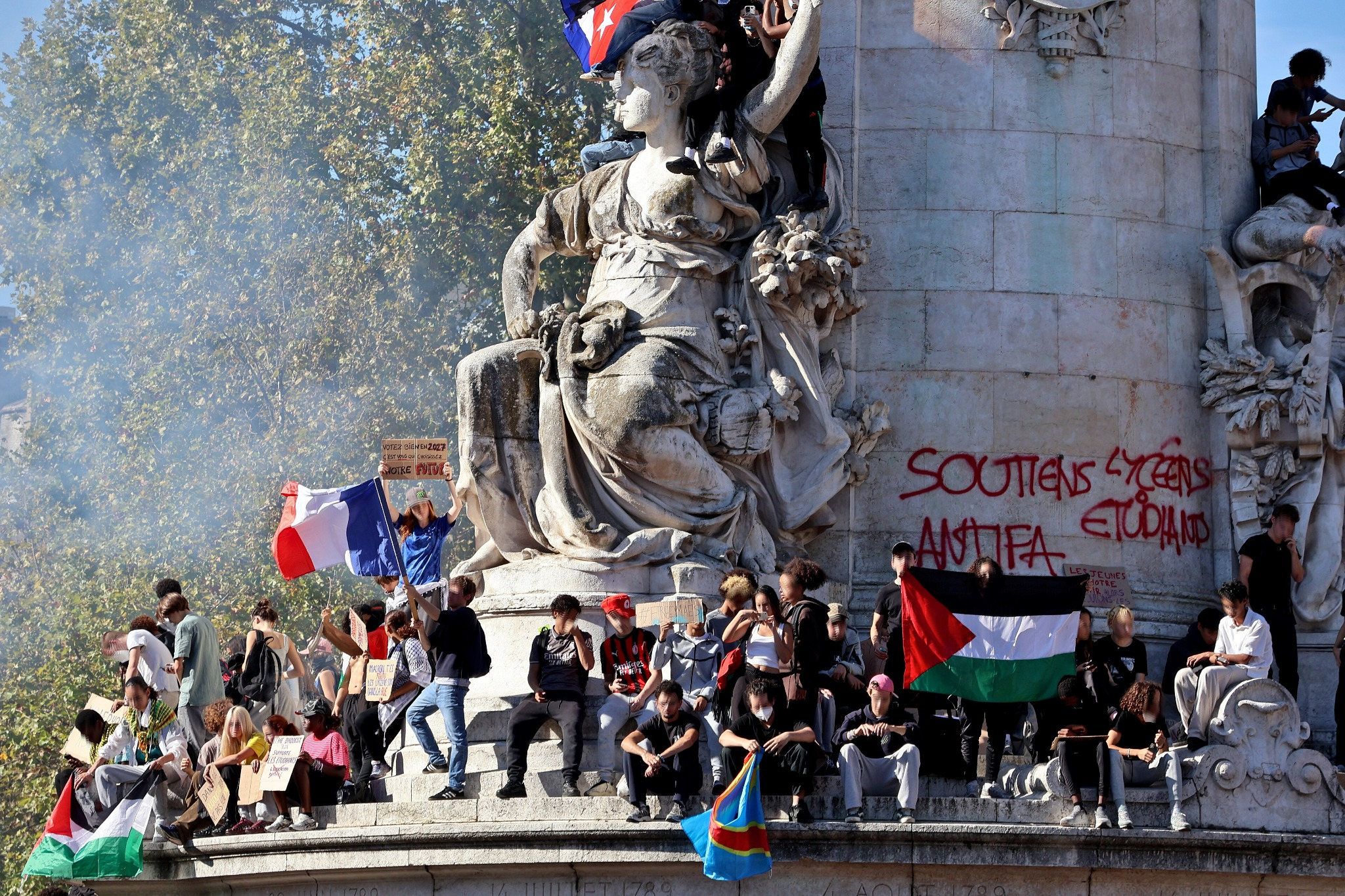
My daughter finished high school this year, having successfully passed her final exams, entered university, and formed her own opinion on the current protests, which, fortunately, she does not refuse to discuss with me. Thus, this text will be based not only on an analysis of the available information about the state of the French education system, budget problems, the election campaign, and possible political moves around the high school students’ protests, but also on personal experience, the limitations of which I fully recognize.
Demonstration of high school students in Paris on October 6, 2026. Photo: Wikipedia / FreCha / CC BY-SA 4.0
There is a well-known political formula that goes something like this: whoever had no left-wing convictions in youth has no heart, but if with age one’s views have not shifted to the right, that indicates a lack of mind. The authorship is sometimes attributed to Churchill, with left and right replaced by liberals and conservatives. In truth, Churchill most likely never said this, but something similar has been claimed by various politicians throughout the democratic history of the last two centuries in the West.
So it is no surprise that French youth mostly hold left-wing values, as do their European peers. This means, above all, that they are outraged by injustice. In particular, they see with their own eyes that there are high schools with good teachers and a quality curriculum — but there are also decayed ones, with overcrowded classrooms and a chronic shortage of teachers. Clearly, this second group of schools is located either in disadvantaged neighborhoods or in depressed provinces. Thanks to social media, high school students communicate a lot with one another, and this communication extends far beyond the local place of study. Footage of a rat running across the stairs or of students searching for missing chairs in a classroom is seen by tens of thousands of young French people. Solidarity, as is known, is also among the main left-wing virtues.
What do they want
Here is a description, according to my daughter, of the situation in one provincial high school where one of her friends studies. For several months there has been no French teacher, despite the fact that an exam of great importance for bacHere and below, the integral grading system upon completion of high school will be briefly called “ bac ”, as is customary among the French is coming in the summer. No substitute teacher is being provided either. But even during canceled classes, students cannot leave the high school grounds before the official end of the school day. How, one asks, are they supposed to prepare for exams under these conditions, and how does this correspond to the principle of equal rights, in the sense of equal access to the national education system?
I say that there are no ideal education systems anywhere in the world, just as there is no justice, but my daughter replies that even if that is so, high school students have the right to protest, and she supports their demands, which looked roughly like this.
First, they insisted on the need to have a full teaching staff in all high schools, as well as on compliance with basic conditions for learning: enough seats in classrooms, desks and chairs, school cafeterias and toilets, and a functioning medical office — and in general on ensuring the normal functioning of the educational process.
Second, they proposed drawing up a schedule in which high school students would not have to spend the entire day at school, from 8 a.m. to 6 p.m., despite multi-hour gaps between classes because some of them were canceled.
Third, they demanded the abolition or reform of Parcoursup, the electronic system for placing graduates in universities, which they found opaque. It does indeed have some oddities. For example, high school students must submit university applications in early April, that is, before the main bac exams, and it is not very clear by what criteria the selection process, which begins in early June, is carried out. In my daughter’s case, there were no complaints from our side, since she received enough offers and could choose a university. But among her friends there were other stories, all the more puzzling because they involved those who had studied well.
Fourth, political demands were also voiced, in particular a redistribution of budget expenditures.
It is important to emphasize that the high school students’ protests were not marginal from the very beginning. This is not only because they spread very quickly across France, but also because parents, teachers, and students (yesterday’s high school students) naturally joined them. The demands outlined above stem from a difficult situation familiar to many French people who agree with the high school students.
However, when I ask: how do you imagine the immediate correction of all shortcomings in the midst of a severe budget crisis — my daughter has no clear answer.
The spiral of violence
The idea behind the protests was initially to block the high schools. Even here I begin to have some doubts. Suppose there is a part of the students whose minds are boiling with outrage, and they are convinced that this cannot go on any longer. But there are also the others, who presumably would like to attend classes and have the right to do so, even if they share the anger of their more radical comrades. Why should they be prevented? My daughter replies that the protest must be sufficiently visible to attract the government’s attention. I do not really disagree, but I think one circumstance must be taken into account.
Perhaps it is necessary to think seriously precisely about the forms of protest. The experience of the last 15 years shows that practically all the most peaceful demonstrations, organized by the most respected trade unions, ended in riots and street battles with the police. No one could prevent this. Into the ranks of the demonstrators who came with the best intentions, young men in masks with athletic builds, ready to burn and fight, constantly infiltrated. These were extremist far-left groups, few in number but determined and well equipped. Or simply criminal elements.
It is no surprise that the high school students’ initiatives did not go unnoticed by these new revolutionaries. From the very first days of the protests, footage appeared of burning trash bins, overturned cars, and broken windows. Naturally, the police came to restore order. In the clashes, of course, there were casualties, and both sides accused each other of violence.
Very soon, not only trash bins began to burn, but also some high schools. My daughter tells me not to confuse peaceful demonstrators with rioters, and in theory she is right. In practice, the police arrive when something is already burning, and they have neither the time nor the ability to separate the sheep from the goats. As a result, the government circulates footage of violence by demonstrators, accompanying it with figures for those detained and injured, while high school students on TikTok and Instagram show scenes of police beating peaceful citizens. All of this together contributes to rising tension in society.
The protests naturally began to expand, and students quickly joined them. In universities, blockades of individual faculties or lecture halls also began. On the days of the largest actions, transport in the cities stopped running. My daughter, who is in her first year, had problems getting to classes and returning home on time, which she does not like very much, despite the fact that sympathy for the demonstrators’ goals remains.
But on October 17 the protests moved to a new level. The high school students went on holiday, and almost no one remembers them anymore, but the slogan “convergence des luttes” appeared, which can be translated as a call for the unification of different social movements in struggle. France has not seen such riots for a long time.
My daughter has the opportunity to see with her own eyes confirmation of the thesis that violence breeds even more violence.
The political backdrop
The mayor of the Paris suburb of Saint-Denis, Bally Bakayoko, recently triumphantly elected and representing the left populists from LFI, became famous for footage in which he stands between high school students and the police, preventing what seemed to be an inevitable clash. It was LFI leader Jean-Luc Mélenchon, a presidential candidate, who from the first days of the protests took the side of the high school students, accusing the police of violence. But after October 17, the situation became more complicated for him, for the government, and for the other political forces.
The mayor of Saint-Denis, Bally Bakayoko, stops the police at a school students’ demonstration
As in the case of the “yellow vests”, spontaneous protest movements of this kind develop unpredictably and uncontrollably, multiplying violence and damage but failing to find a rational way out of the crisis. Clearly, a plunge into chaos a few months before the presidential elections would be extremely undesirable. Mélenchon is often accused of a secret desire to provoke unrest in France in order to come to power on this wave by a semi-revolutionary path, since he is unable to win in the second round of the election (if he even gets there). But the problem is that he cannot control events either, just as he cannot openly justify violence. The historic building of the Limoges city hall was not set on fire by high school students, who until very recently were only beginning with modest blockades of their own high schools. Everyone understands this, including Mélenchon.
The other participants in the election race are also in a difficult position. It is not enough to speak of the legitimacy of the demonstrators’ just demands and, at the same time, firmly condemn violence. Claims to the presidency imply the existence of a project for solutions — meanwhile, the protests are taking such a turn that, on the one hand, the police must stop them, but on the other hand, ways of appeasement must be found. At the same time, no one trusts the government, and the state of the budget does not allow for extravagance. Nobody has good moves under these conditions.
How Paris recovered after the riots of October 17: a Most report
The first days of November will show whether the protests will subside after the holidays or, on the contrary, gain a second wind. In any case, the election campaign scenarios are being rewritten on the fly, and many unexpected twists still lie ahead. Of course, one would like fewer riots, but the situation is such that calm is still a long way off.
All that remains is to observe and discuss what is happening together with my daughter.
If you enjoyed this article, consider making a donation — one-time or, even better, monthly. Your support helps us motivate our authors and become better with every article.
Our organization is recognized by the Internal Revenue Service (IRS) as a 501(c)(3) tax-exempt, charitable organization, which means that all contributions made to us are tax-deductible to the fullest extent permitted by U.S. law. Individuals may generally deduct charitable contributions of up to 60% of their Adjusted Gross Income (AGI) for cash donations made to qualifying 501(c)(3) organizations. For donations of appreciated assets (such as stocks or other long-term capital assets), the deduction is typically limited to 30% of AGI, based on the fair market value of the asset. C-corporations may deduct charitable contributions of up to 10% of their taxable income for donations made to eligible charitable organizations.
By submitting a donation, you confirm that you have read and accept the following documents: Privacy Policy and User Agreement, and also give consent to the processing of your personal data.
If you would like to unsubscribe from a monthly donation, please email us at: [email protected]