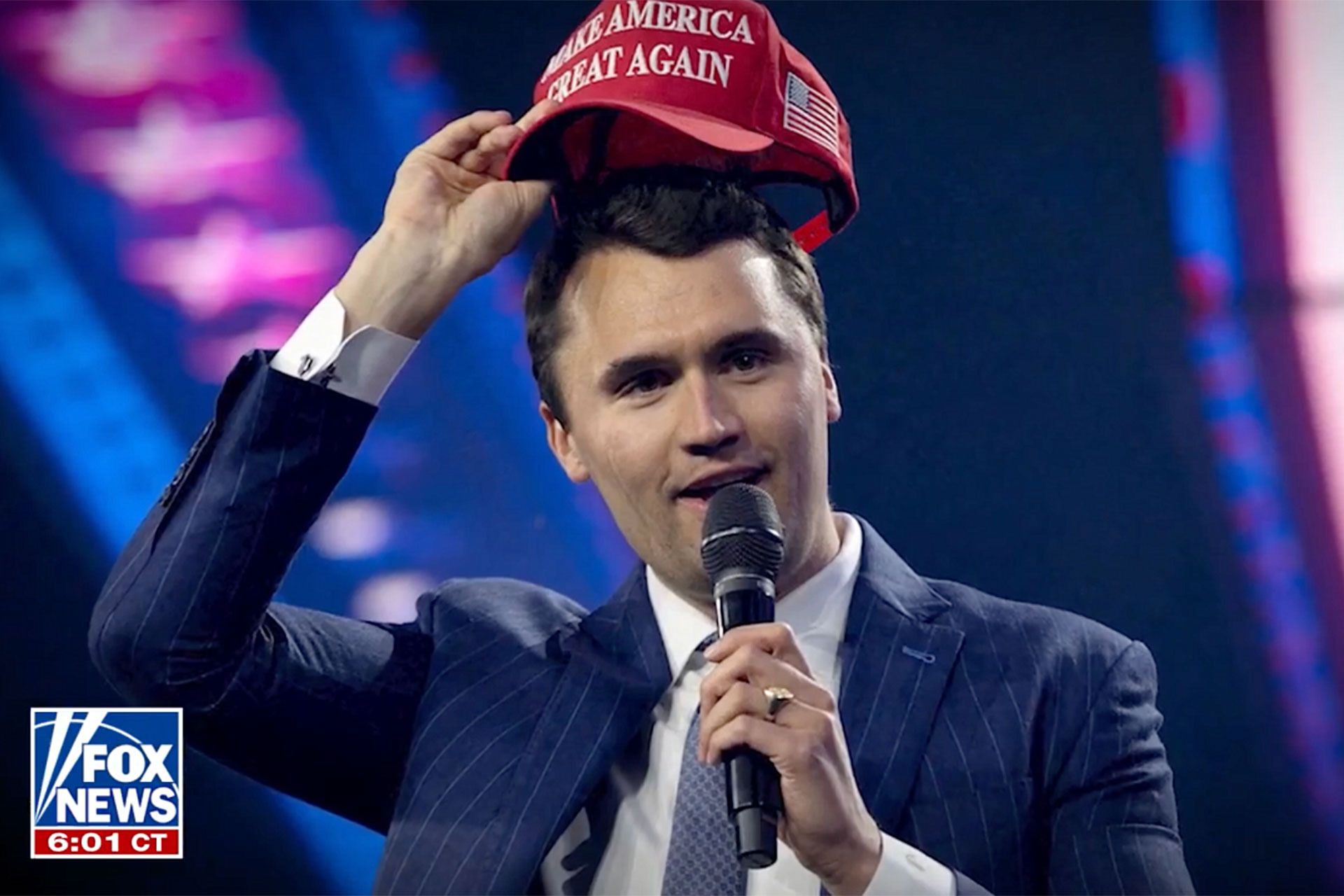
Although the First Amendment, guaranteeing freedom of speech and the press, is still in effect in the USA and protects hundreds of prestigious editorial offices and thousands of talented journalists working in them, for some reason millions of Americans prefer to entrust their information services to very strange people. People who are either directly affiliated with a certain political movement and don’t even try to hide it, or simply lack any expertise in the matters in which citizens with the right to vote listen to them.
Photo: foxnews.com
During a recent intra-European flight, my neighbor was a young man who spent the entire two-hour flight watching a video podcast on his laptop called The Brett Cooper Show. At that time, I had no idea what kind of show it was or what topics its host covered, and could only observe the silent picture, which struck me as extremely irritating.
It wasn’t about the editing style or Brett Cooper’s appearance—a quite friendly-looking young woman—but about her manner of storytelling. Every time I glanced at my neighbor’s laptop, Cooper would meet my gaze with wide eyes, very intrusive gestures, and a smug smile. As if everything the host said was so blatantly obvious and unambiguous that she herself was tired of having to say it. An expression familiar to any third grader whose teacher tries to drill in the principles of the multiplication table.
Only the sphere of interest of Cooper and her viewers turned out to be somewhat far from basic mathematics. The Brett Cooper Show is a conservative video podcast whose 23-year-old American host analyzes the news agenda in the USA from explicitly right-wing positions in each episode. “Explicitly right-wing” is not my subjective judgment but essentially Cooper’s raison d’être. Her career as a political commentator began in 2022 when Ben Shapiro’s publication The Daily Wire invited the UCLA student to participate in a new project called The Comments Section, aimed at Generation Z.
Typically, in this show Cooper first showed some awkward episode from the daily life of the “opposing camp” of Democrats—like Biden’s speech where he said “Iranians” instead of “Ukrainians”—then read comments resonating with The Daily Wire’s ideological line on Twitter and YouTube and joked. For example, that Nancy Pelosi looks like a raccoon or a gremlin, and “Iranians” is a nickname for Ukrainians after Chernobyl. This spectacle is rather boring not only because of the peculiar humor but also due to the absence of any analytical depth in the show featuring Cooper.
Now she releases videos on her personal channel about twice a week, which can last up to forty minutes, during which Brett explains something in her signature mentoring tone. That Taylor Swift’s wedding promotes the institution of marriage, that those insulting each other on Twitter “tradwives“ disgrace the right-wing movement, that socialists are mostly ”nepobabies“ looking down on ordinary Americans, and so on. It’s fairly harmless content without any ”cannibalistic“ judgments or calls, enjoying huge viewer success, and not long ago Brett even became a guest commentator on Fox News. Is there something to worry about here?
I described Brett Cooper in such detail because having an understanding of one modern right-wing conservative influencer makes it easy to get an idea of others. Isabel Brown, Alex Clark, Ben Shapiro, Charlie Kirk, and dozens of other media conservatives say roughly the same things, present them in a similar way, and target the same audience, collectively exerting enormous political influence. Not through conveying particular ideas and meanings, but through promoting a mindset and worldview in which the recent killing of Charlie Kirk is a natural consequence of circumstances.
As I said, it’s very difficult to accuse the mentioned speakers of “cannibalism.” They are not Anton Krasovsky or “Free Radio of the Thousand Hills”; they don’t speak the language of hatred. However, the essence of their media activity lies in maintaining strict “two-camp” American politics. After Kirk was shot, “right-wing” complimentary statements poured in about how he managed to build a career by providing the younger generation with a platform for dialogue, respect for alternative opinions, and willingness to discuss. Whatever your attitude toward the deceased, it must be admitted that this is completely untrue.
The reason Kirk became so famous, why the income of his nonprofit Turning Point USA more than doubled in four years, to$85 million a year, and his public debates in the Prove Me Wrong format on university campuses attracted such attention, is the overall provocativeness of his activities.
Kirk’s debate clips gathered millions of views not because of an impressive level of debate culture but due to the high degree of inadequacy of his opponents.
If you watch any compilation of highlights from debates featuring Charlie Kirk, you’ll notice that he argues either with people who are completely unable to defend their position—making their subsequent “destruction” by Kirk spectacular and interesting—or outright freaks who immediately insult and dismiss Kirk (also a perfectly spectacular format for TikTok or Instagram Reels).
Giving a platform to such people is less an act of respect for the First Amendment and freedom of speech, which Kirk mentioned at every opportunity, and more a clever marketing strategy to increase reach and damage the reputation of the left. Kirk was hardly ready to seriously listen to the left’s position: once during a debate, a young man told Charlie how much he hated and despised him, then immediately left, and Kirk criticized the offender as a “typical portrait of an American leftist.” Also noteworthy is Turning Point USA’s project called Professor Watchlist—a huge list of university professors who, according to the compilers, promote “anti-American values” and “left-wing propaganda.” For example, they acknowledge global warming and advocate for abandoning gas heating in homes.
In fact, since the late 2010s, Kirk has simply been serving Donald Trump’s agenda, whom he called “the bodyguard of Western civilization” and became very close to Trump’s family through Donald Trump Jr. and his girlfriend Kimberly Guilfoyle. I personally learned about Turning Point USA’s existence in 2020 because probably no media or influencer at that time could compete with Kirk’s organization in spreading fake news about presidential election fraud. It’s no surprise that Kirk’s murder so shook the White House. What’s surprising is something else.
Although the First Amendment, guaranteeing freedom of speech and the press, is still in effect in the USA and protects hundreds of prestigious editorial offices and thousands of talented journalists working in them, for some reason millions of Americans prefer to entrust their information services to very strange people. People who are either directly affiliated with a certain political movement and don’t even try to hide it, or simply lack any expertise in the matters in which citizens with the right to vote listen to them.
The surge in popularity of conservative influencers in recent years is linked to their earlier understanding of the needs of the young audience compared to their opponents.
They don’t care about classic journalism and boring newspaper columnists like Bret Stephens or David Brooks, who defended conservative positions in the media long before Kirk or Cooper were even born. Actually, conservative positions themselves don’t interest this audience either—their interest lies in finding support in an extremely complex informational world and feeling out the “side of the force” on which young people can find some semblance of identity. And enjoy it by booing “woke” students en masse in red caps at Kirk’s university debates, or laughing at the absurdity of the left while watching another episode of Isabel Brown’s podcast about gender-neutral bathrooms.
Because in this world of youth propaganda, almost any social problem boils down to ideological confrontation. Left and right, pro-life and pro-choice, woke and anti-woke, black and white, Muslim and Christian, and so on. This superficial binary opposition has reached such proportions that the personalities of commentators and analysts have become secondary at some point. At the beginning of this text, I called Brett Cooper’s deliberate “rightness” her raison d’être because this personality is simply inseparable from her media role. In 2022, The Daily Wire needed an outwardly attractive young woman to voice right-populist theses in front of an audience already familiar and inherently sympathetic to them, which turned into a huge success. Literally any of her peers with similar looks could have taken Cooper’s place and would probably have told banal things about the hypocrisy of mainstream media and modern feminists just as skillfully at Turning Point USA events. Where she would hardly have been given a word if she had dared to offer even mild criticism of the current American president—unlike dozens of boring “newspaper” conservatives that Kirk’s, Cooper’s, and Brown’s audience will never know about.
One of them, the already mentioned David Brooks, in a recent essay for The Atlantic recalled the start of his career as a conservative columnist in the 1980s. “Back then, there were two types of people in our movement: conservatives and reactionaries. We conservatives diligently read Milton Friedman, James Burnham, Whittaker Chambers, and Edmund Burke. Reactionaries just sought to shock the left. We conservatives devoted ourselves to writing articles for intellectual journals, while reactionaries were more attracted to television and radio. We were right-wing politically, but we had many liberal friends, while reactionaries despised everyone who wasn’t right-wing opponents of the establishment. They weren’t ‘pro-conservatives’—they were ‘anti-left.’ I came to understand that this was an important distinction.”
The importance of this distinction became especially clear when reactionaries defeated conservatives and appropriated the label. And by refraining from direct, articulated hatred toward opponents, they do everything to keep American society strictly politically polarized—and even more segmented by race, religion, and ideology on issues requiring a consensus approach.
Such an atmosphere does not greatly encourage healthy discussion but provokes a tendency toward violence among the least balanced segment of “politically engaged” young people—like 22-year-old Tyler Robinson, suspected of killing Charlie Kirk. Which could either trigger conservatives to finally return to reading Milton Friedman, intellectual journal columnists, and seeking liberal friends, or to an even greater isolation in a right-populist echo chamber of disinformation and self-absorbed podcasters. The latter is unlikely to lead to anything good.
If you enjoyed this article, consider making a donation — one-time or, even better, monthly. Your support helps us motivate our authors and become better with every article.
Our organization is recognized by the Internal Revenue Service (IRS) as a 501(c)(3) tax-exempt, charitable organization, which means that all contributions made to us are tax-deductible to the fullest extent permitted by U.S. law. Individuals may generally deduct charitable contributions of up to 60% of their Adjusted Gross Income (AGI) for cash donations made to qualifying 501(c)(3) organizations. For donations of appreciated assets (such as stocks or other long-term capital assets), the deduction is typically limited to 30% of AGI, based on the fair market value of the asset. C-corporations may deduct charitable contributions of up to 10% of their taxable income for donations made to eligible charitable organizations.
By submitting a donation, you confirm that you have read and accept the following documents: Privacy Policy and User Agreement, and also give consent to the processing of your personal data.
If you would like to unsubscribe from a monthly donation, please email us at: [email protected]